





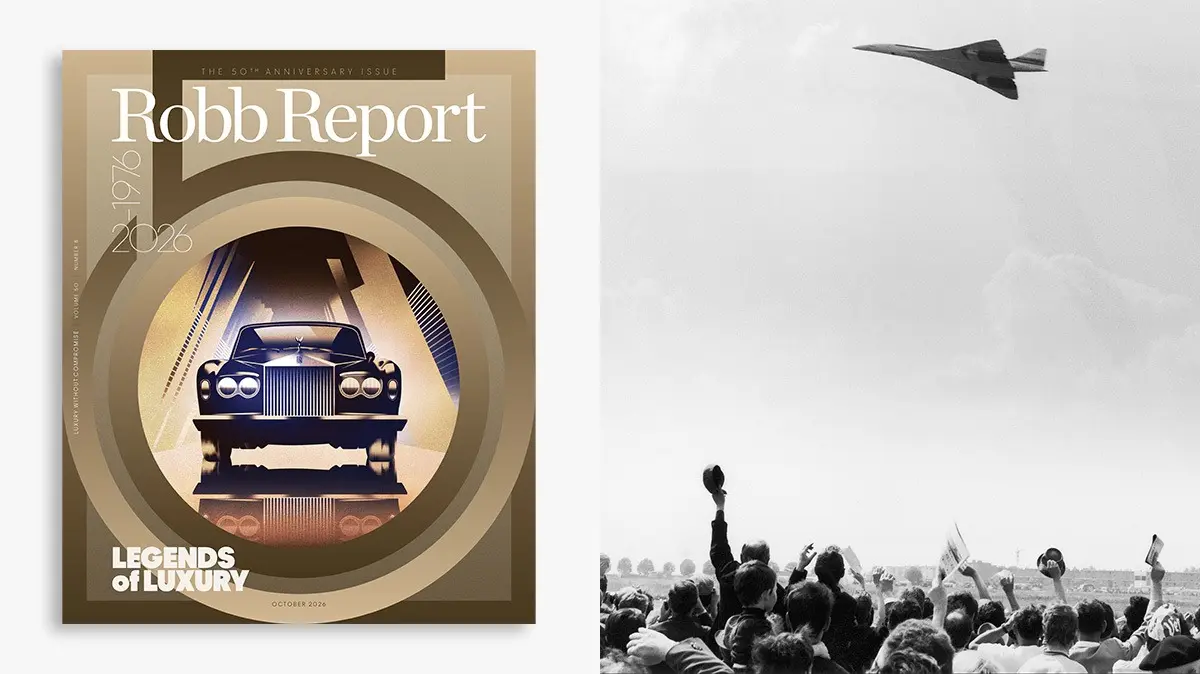
On January 21, 1976—the very year Robb Report was founded—the Concorde officially entered commercial service, beginning a new era of passenger flight that spanned the Atlantic at twice the speed of sound. While it is tempting to view this timing through the lens of grand, cosmic significance, it stands as a remarkably fitting coincidence. Just as the supersonic jet was shrinking the globe and redefining the limits of modern travel, a new publication emerged to chronicle such feats of engineering, daring, and human ingenuity.
Now, half a century later, Robb Report is celebrating its 50th-anniversary issue. Any publication that remains vital and influential after five decades has more than earned the right to indulge in a bit of nostalgia. When the editorial team began assembling "Legends of Luxury," the expansive feature at the heart of this milestone edition, the goal was initially simple: to put together a sprawling retrospective, a moment of reminiscing about the past. However, sifting through five decades of history revealed something far more compelling than mere memories.
Many of the 74 objects, people, places, and experiences selected for the retrospective did not merely represent their respective eras; they acted as harbingers of the future. They offered early glimpses of a transformed world that would fundamentally alter how humanity communicates, dresses, travels, dines, and chases thrills.
Consider, for instance, the Motorola DynaTAC 8000X. When this pioneering commercial handheld cellular phone hit the market in 1984, it carried an astronomical price tag of just under $4,000—equivalent to roughly $12,000 today—and weighed nearly two pounds. Owning one was an unambiguous statement of elite privilege. If an individual could afford what quickly became known as "the Brick," they invariably made certain that people saw them using it in public, an image immortalized by figures like Gordon Gekko on the silver screen. Today, the direct descendants of that bulky device, modern smartphones, are arguably more ubiquitous than televisions. What began as an exclusive luxury for the ultra-wealthy has evolved into an absolute modern necessity.

Yet, innovation does not always rely on silicon chips, microprocessors, or digital connectivity. In the late 1970s, legendary Italian designer Giorgio Armani upended the rigid conventions of menswear by stripping the internal structure entirely out of the traditional suit. He softened its shoulders and loosened its trousers, creating a silhouette that was simultaneously louche and sophisticated. Hollywood quickly recognized its potential, adopting the look for characters who required an effortless, high-end allure. At the time, this relaxed tailoring looked radical—almost rebellious against the stiff corporate uniforms of the era. Today, that relaxed elegance is simply foundational to the modern man’s wardrobe.
Some visionary ideas flamed out spectacularly, but not before permanently upending their respective fields. At the avant-garde restaurant El Bulli, Spanish chef Ferran Adrià used food science to systematically scramble diners’ expectations of what a meal could physically and sensorially be. While subsequent bad imitations eventually reduced molecular gastronomy to a cheap punch line defined by artificial foams, theatrical fogs, and controversial ingredients like meat glue, the best elements of Adrià’s culinary revolution endured. They fundamentally inspired and influenced a whole new generation of chefs who continue to push the boundaries of gastronomy.
A similar paradigm shift occurred on the water with the launch of Octopus, a staggering 414-foot vessel commissioned by the late billionaire Paul Allen. When this Lurssen-built superyacht was delivered in 2003, it successfully bridged two previously distinct worlds: the extreme luxury of a traditional superyacht and the rugged, functional capabilities of a serious scientific expedition ship. It was engineered to go virtually anywhere on the planet, transforming exploration itself into the primary purpose of yachting, while still leaving plenty of room for sunbathing at anchor. Today, explorer yachts of varying scales have become a standard fixture in the lineup of nearly every major luxury shipyard in the world.
Looking back across these milestones, it would be comforting to claim that the trajectory of these innovations was obvious from the start. But the reality is that none of it looked quite so certain at the time. Predicting the future, as generations of prognosticators have learned, is remarkably easy only in hindsight.

The publication knows this truth firsthand. Over the decades, media and industry observers have occasionally misread the tea leaves—such as the time publications boldly declared the internal-combustion engine entirely dead, only to watch it persist with surprising resilience. Conversely, other supposedly inevitable "next big things" have vanished into obscurity almost as quickly as they arrived, leaving cultural artifacts like Bored Ape Yacht Club NFTs as curiosities of a fleeting digital gold rush. The future, it seems, unfailingly humbles everyone who tries to map it too precisely.
Looking forward over the next twenty years, it is certain that one of the extravagances currently featured in the anniversary issue will eventually become as commonplace as the smartphone is today. Another will likely vanish from the commercial landscape entirely, leaving behind only an inspiring idea that outlives its physical creation. The magazine makes no claims to prophetic certainty about which will endure.
However, after fifty years of chronicling the pinnacle of human achievement and taste, one fundamental truth remains clear: every so often, the future arrives first disguised as an extravagant luxury. And as the publication enters its next half-century, the curiosity to see what that future brings next remains as strong as ever.