




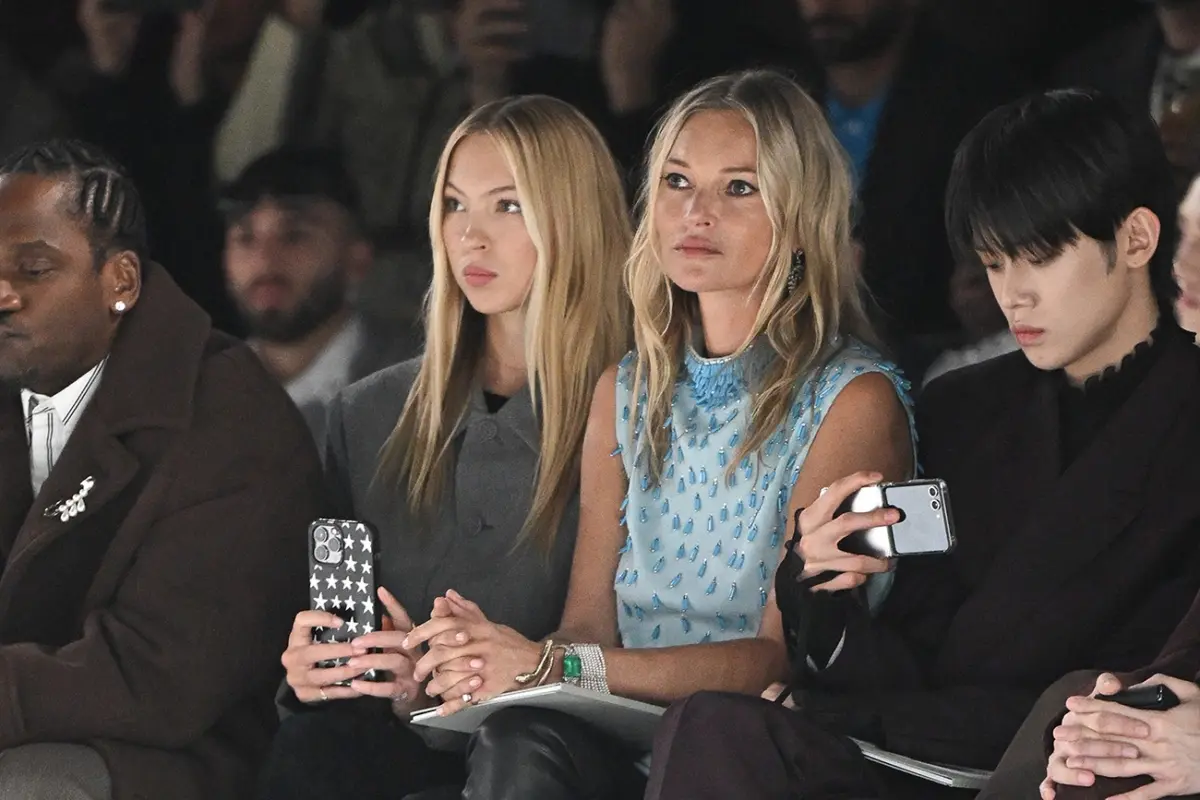
Mothers and coolness have historically been framed as a clashing combination, a binary where the responsibilities of domesticity and maternal care supposedly dilute personal edge and youthfulness. Yet, style-wise, they are coalescing like never before. In contemporary culture, the ever-fashion-conscious Rihanna, Gigi Hadid, and Hailey Bieber certainly qualify as icons who seamlessly blend high fashion with motherhood. However, author and fashion writer Terry Newman’s new book, “Cool Mothers: An Appreciation of Style,” looks beyond the current generation of celebrity offspring and paparazzi snapshots to focus on a broader pantheon of historic and enduring fashion arbiters.
Newman’s illustrated page-turner examines the profound, individualistic style choices of cultural figures such as Jane Birkin, Vivienne Westwood, Kate Moss, Charlotte Gainsbourg, Taylor Swift’s mother Andrea, and Rosita Missoni alongside her daughter Angela and granddaughter Margherita Missoni. While younger generations like Lila Moss speak casually of dipping into their supermodel mothers’ drawers to steal old rock T-shirts—noting a favorite Rolling Stones top—Newman’s book is fundamentally a celebration of mothers’ style rather than a how-to tutorial. In a recent interview, Newman explained that the featured mothers’ personal style choices convey individualism, assuredness, and a deep-seated confidence in their kin.
The exploration of maternal style taps into a rich, if sometimes unusual, history. While the peculiar fashion trend of wearing a false pregnancy bump called "The Pad" took hold in 1793, and Jeanne Lanvin introduced the pioneering mommy-and-me look in 1897, Newman’s examination of maternal coolness is definitively more contemporary and analytical. Adroit at delving into what wardrobes reveal about a person’s character, Newman has previously published acclaimed books exploring the style and cultural impact of figures such as Harry Styles, BTS, and Marilyn Monroe.

All of these projects ultimately come down to writing mini-biographies of people through their clothes, she notes, suggesting that everyday readers might examine their own closets as a different means for self-reflection.
Indubitably, mothers are having a significant cultural and political moment. The "Tradwife" movement continues to gain substantial traction across social media platforms, propelled by prominent influencers like Ballerina Farm’s Hannah Neeleman, who commands a staggering 10.3 million followers on Instagram alone. But Newman’s primary interest in stylish mothers lies in peering into the authentic character of women through the multifaceted lens of their roles as mothers. It is not necessarily a matter of thinking that cool mums are young, perpetually fashionable, and effortlessly glamorous, she emphasizes.
The inclusion of Hole frontwoman Courtney Love was an absolute must for Newman, who felt the musician had been given an unfair reputation as a young mother during the height of her fame. Recalling her early reporting days for style outlets like i-D and Self Service, Newman noted that Love was virtually the only woman she could find on the red carpet “accessorized with a baby”—her daughter Frances Bean Cobain—with both mother and child famously dressed in carefully curated vintage finds.
The initial impetus for writing “Cool Mothers” stemmed from personal loss, specifically following Newman’s passing of her own mother a few years ago. After discovering old diaries and a photo album containing “amazing” snapshots of her late mother at the age of 16, the author experienced a profound realization of how different her mother’s youth and inner life were from the domestic figure she had always known.

Looking ahead to the 30th anniversary of Princess Diana’s tragic death, Newman reflected on how the former royal served as a de facto mother figure for millions in the United Kingdom and across the globe. Noting how the late princess was heavily controlled, told what to do, what to wear, and how to behave, and forced to maintain a subservient role to a husband who was reportedly engaged in an affair even before their wedding, Newman observed that these pressures effectively pigeonholed Diana into a traditional-wife world.
However, as Diana matured, flourished, and began to assert her own autonomy and identity, she evolved from a wallflower wearing frilled blouses reminiscent of her own mother’s wardrobe into a global icon confidently dancing into the night wearing John Galliano. Another undeniable sign of her modern maternal coolness was how Princess Diana chose to dress her own children—most notably the future heir to the British throne, Prince William—in casual denim, a radical break from protocol that had never been seen before within the strict confines of the royal family.
Other prominent fashion figures featured in the project have similarly opened up about their matriarchal lineages. Cora Corré spoke candidly about her punk-leaning grandmother, Vivienne Westwood, a sentiment echoed by her mother, Serena Rees, the founder of Agent Provocateur. Meanwhile, a vintage photograph of Elizabeth Taylor and her daughter wearing matching Dior couture at a fair led Newman to track down one of Taylor’s granddaughters. Recalling the conversation, Newman shared that the granddaughter remarked, "Granny loved diamonds and everything. But if you gave her a ring from a Christmas cracker, she’d wear it just as proudly alongside all her diamonds."
While some daughters look through photo archives to pick up direct fashion cues from their mothers, Taylor’s similarly shaped granddaughter did so by watching the Oscar-winning actress’s classic films. Newman also highlighted an observation made by Judy Garland’s daughter, Lorna Luft, regarding the surreal nature of maternal legacy—noting how most women could never fathom attending a convention where thousands of people might be dressed as their deceased mother in identical, iconic clothing. Ultimately, these dynamics prove that cool mothers offer profound, multifaceted insights into identity.

In a way, Newman suggests, perhaps the coolest mothers were simply the ones who allowed their children to be whoever they wanted to be. They were not necessarily striving for an impossible standard of maternal perfection. In fact, Newman came to the conclusion that perfection is the exact opposite of cool. Instead, coolness is more about women who possess a strong sense of self, allowing their children to witness them as complicated human beings who pursue careers, make mistakes, and accumulate rich life experiences.
Through their various roles as creative directors, founders, designers, tastemakers, and prominent cultural figures, mothers are out in the public sphere very much on their own terms, Newman explains. "Cool" is often treated as a throwaway word in modern lexicon, but it begs the question of what it actually means within the context of motherhood. Some of the coolest women have managed to live extraordinary lives without ever losing their innate curiosity, personal style, or sense of self.
Noting how traditional literature, including feminist works, frequently highlights how individuals can lose their individuality upon entering motherhood, Newman emphasized that all of the mothers featured in her book successfully retained their core identity. From the late Vivienne Westwood proudly wearing a punk T-shirt to Courtney Love favoring vintage grunge, they all maintained their fierce ambition and individuality. The same holds true for the late singer and dancer Josephine Baker, who was in her late 40s when she adopted the first of her 12 children. Even unexpected archival moments, such as a snapshot of designer Lulu Guinness as a chubby, topless toddler playing on the beach with her mother in 1960, underscore the natural, unvarnished reality of these relationships.
Addressing figures who defy conventional maternal archetypes, Newman pointed to Condé Nast’s global chief content officer Anna Wintour. While Wintour is frequently perceived as an uncompromising, formidable career woman, Newman insisted on her inclusion precisely because she is also a mother. Women are too easily pigeonholed the moment they achieve significant influence or professional power, Newman argued, adding that society must move away from the idea of a single, perfect maternal formula.