




The recent exhibition Netzwerke/Networks by Jürgen Eickhoff at Galerie V&V has barely faded from memory, yet now only his remarkable body of work and our collective recollections remain. The exhibition’s subtitle, Boundaries: top and bottom, inside and outside, now tragically resonates as a profound exploration of the possible, as Jürgen has since crossed an irreversible boundary.
Throughout a prolific career that spanned decades, Eickhoff left an indelible mark on the international contemporary art jewelry community. His passing closes a significant chapter for those who knew him not only as a visionary creator, but also as a dedicated gallerist, educator, and cherished friend. His collegiality knew no bounds, and his energy seemed truly inexhaustible. For the 44 years that he was known to many of his peers as an artist, fellow gallerist, and steadfast friend, the concept of boundaries never really played a restrictive role in his life or his creative output.
The Architecture of Chaos and Order
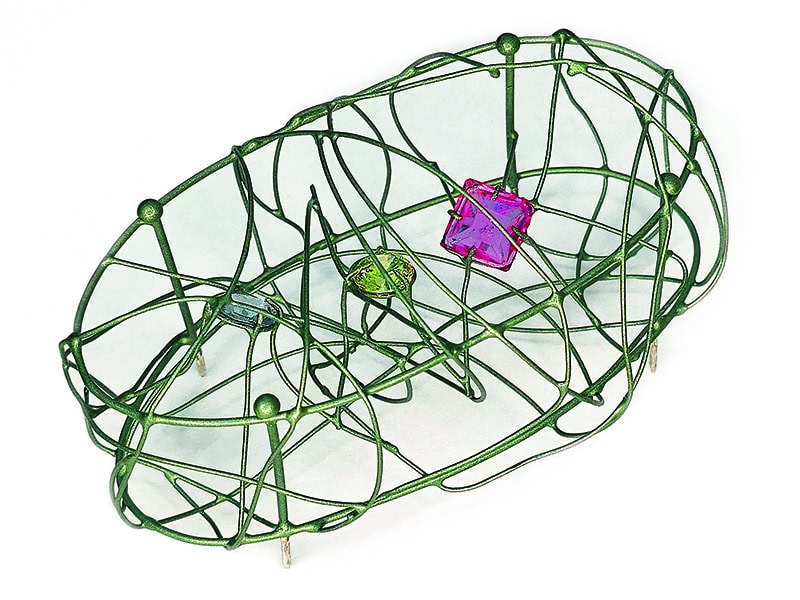
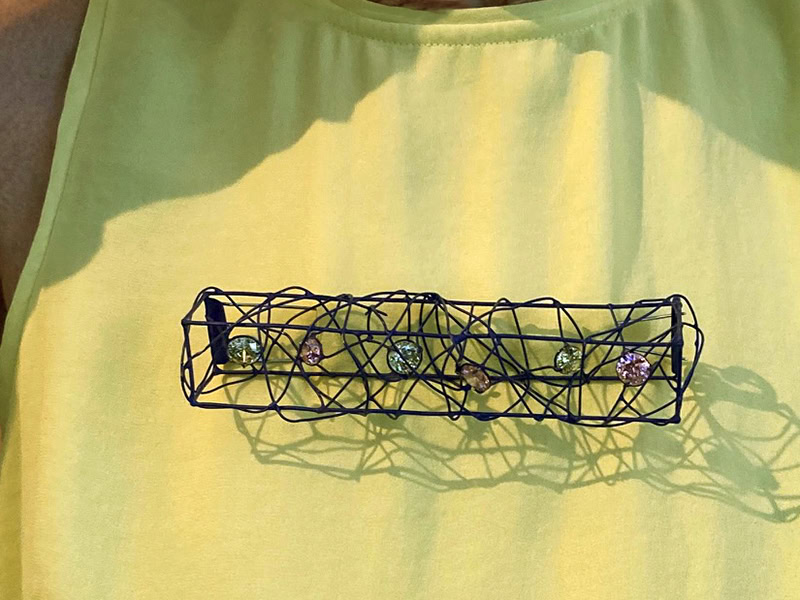
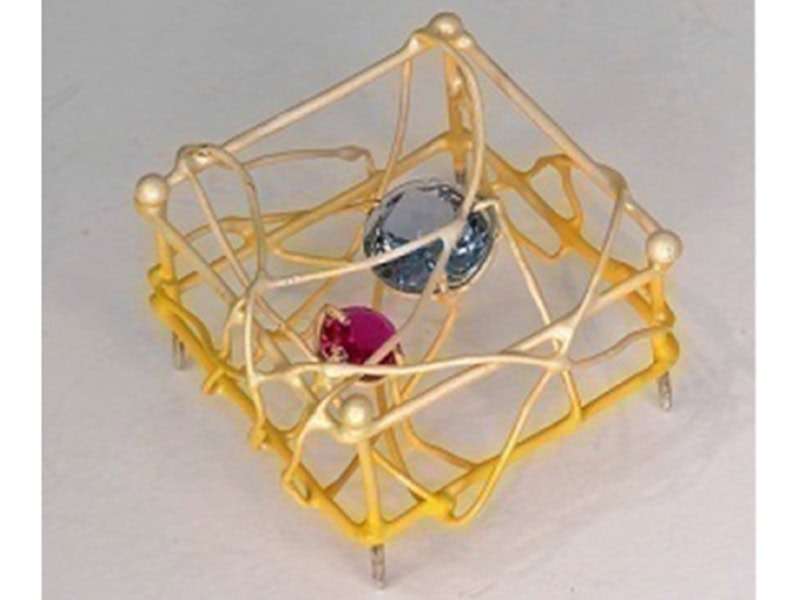
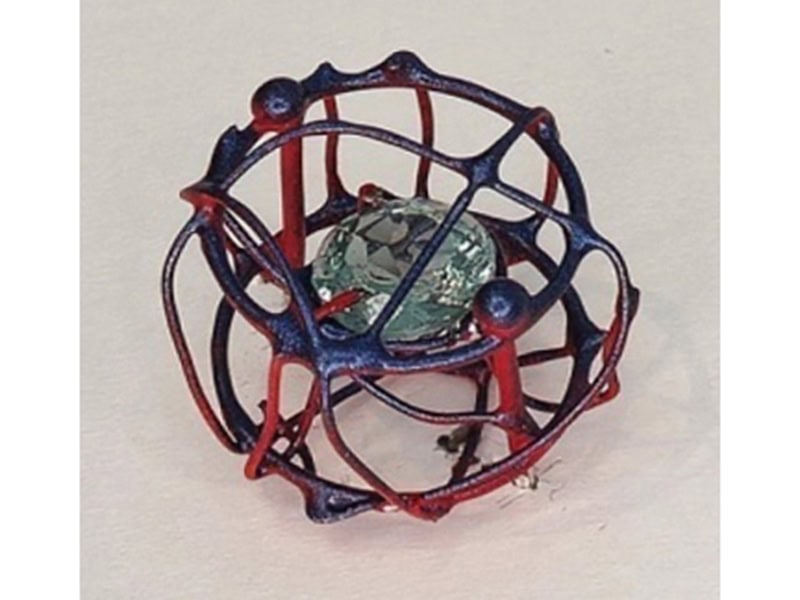
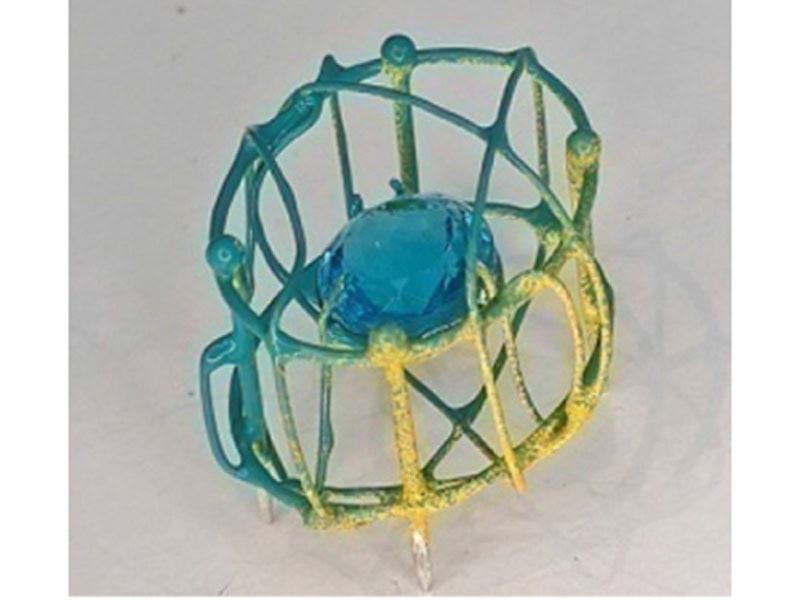
Eickhoff’s approach to jewelry design was deeply conceptual, drawing inspiration from architectural principles and the structural systems of the world around him. Describing his artistic vision, Eickhoff once explained that his jewelry was characterized by a system of apparent chaos and fragile order. Free forms with a defined exterior evolved from concrete, architecture-inspired shapes. Inside these boundaries, wires intertwined, connecting and crossing one another like biological synapses. Various found objects—such as wire fragments, nails, reflector parts, and similar industrial detritus—were integrated and found a completely new home within the metal pieces.
As his practice evolved, Eickhoff began to supplement or replace these industrial found objects with synthetic stones. These materials possessed highly defined colors, opening up a wide and vibrant spectrum of expressive possibilities for him. At times, he would lacquer the silver wires, creating a striking contrast and visual interplay between the brilliant stone and the metallic body. This deliberate choice stripped the precious metal—silver—of its traditional mystical significance, redirecting the viewer’s attention more strongly toward the work’s actual conceptual message.
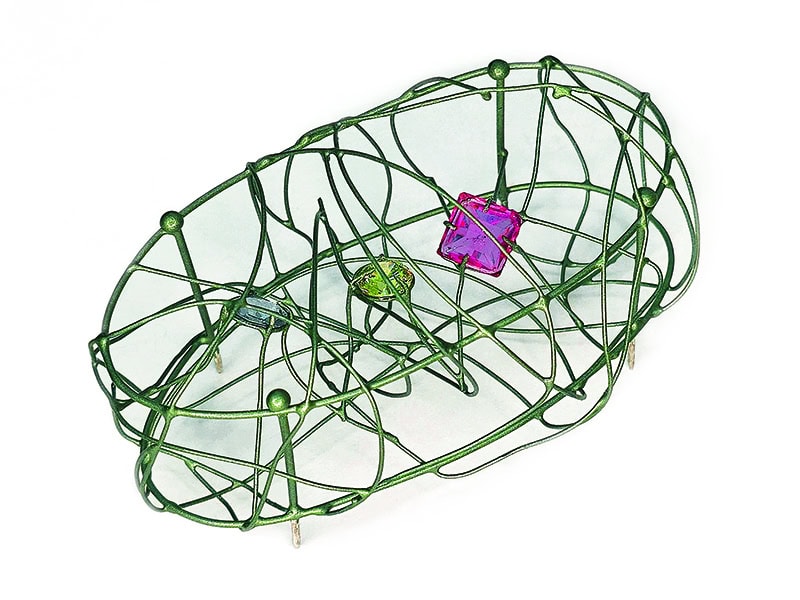
His pieces often hovered on the precarious boundary between wearable art and free-standing sculpture. In series produced during periods spent working from a house with a studio overlooking Lake Garda in northern Italy, Eickhoff utilized thin 935 silver wire to construct forms that evoked fish traps and the underwater structures used to anchor them. The meticulous manipulation of the wire gave these works the appearance of sketched, hatched drawings, beautifully reminiscent of travel sketches from the Venetian Lagoon.
A Shared Path in Art Jewelry and Gallery Management
Jürgen Eickhoff’s entry into the world of art jewelry began in 1981, ignited by Marianne Schliwinski, who awakened in him not just a romantic love, but a true and abiding passion for the field. Prior to pursuing jewelry studies at the Gerrit Rietveld Academie in Amsterdam, Eickhoff had studied geology. This scientific background perhaps informed his fascination with earth structures, topography, and the hidden systems running beneath our feet. Concurrently with his studies in the Netherlands, he launched his career as a gallerist alongside Marianne.
The experience of studying in Amsterdam forged deep professional and personal bonds within the international jewelry community. For practitioners educated in the Netherlands, it quickly became evident that creating the work was only one side of the coin; the art also had to be actively shown and contextualized for the public. Consequently, Eickhoff dedicated a significant portion of his professional life to running a gallery.
Serving as the creative, technical, and administrative heart of Galerie Spektrum, Eickhoff worked hand in hand with Schliwinski to manage artist representation and sales. Over the years, the gallery occupied five different locations across Munich and Karlsruhe. In every single iteration, Eickhoff took charge of the interior design, handling not just the conceptual layouts but the actual physical craftsmanship as well. He tirelessly produced small, thoughtful catalogs for almost every exhibition while simultaneously fabricating new pieces of jewelry at a remarkably rapid pace. Colleagues often marveled at his speed; while others were still deliberating over a concept or sketching an idea, Eickhoff had already finished the physical work.
His generosity and warmth as a colleague were legendary. Friends and fellow artists remember moments of profound hospitality, such as when Eickhoff shared adjacent booths with peers at Eunique, the International Fair for Applied Arts and Design in Karlsruhe in 2012. Alongside professional support, he offered a large jar of delicious honey produced by his late father, who had been a hobbyist beekeeper.
Uncovering the Hidden Systems of Civilization
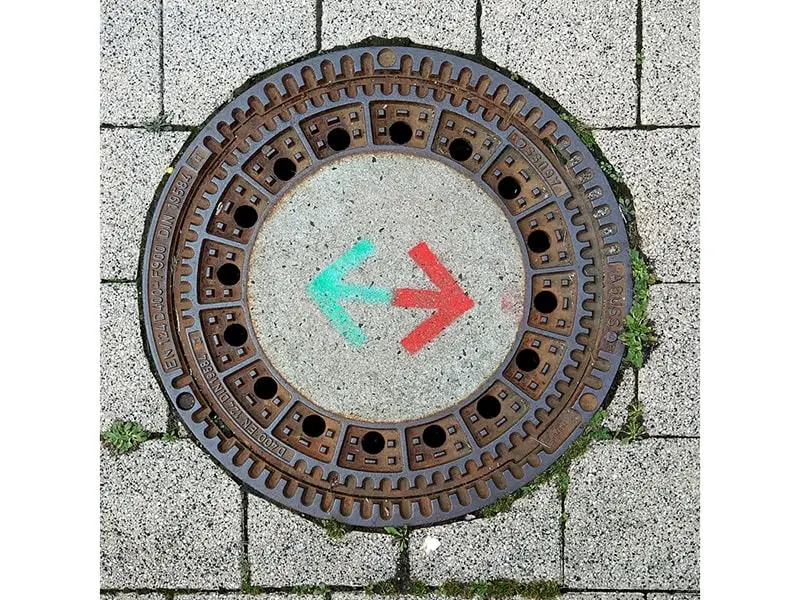
Eickhoff’s keen eye for structural systems extended far beyond the workbench and the gallery wall. His extensive photographic series of manhole covers offers a fascinating window into his observational philosophy. For years, he quietly documented the utility covers that everyday pedestrians simply walked past without a second glance. Beneath these lids, covers, and manhole covers lay the literal nervous system of human civilization.
Accumulating nearly 900 images over the course of his travels, Eickhoff eventually selected around 44 of them to be printed on small 20 x 20-centimeter canvases. Amidst the apparent monotony of urban infrastructure, his camera revealed a surprising variety, intricate geometry, and rich chromatic depth. He noted that many of these utility covers served as subtle elements of the corporate identity of cities and municipalities, resulting in remarkably sophisticated and impressive designs.
These photographic works underscored Eickhoff’s substantial international footprint. His documentation of manhole covers happened organically alongside his travels for lectures, guest professorships, and exhibitions. Throughout his distinguished academic and lecturing career, Eickhoff shared his expertise at institutions such as HAWK in Hildesheim, Germany; the Rhode Island School of Design in Providence; Pforzheim University in Germany; the Academy of Fine Arts Munich; Grey Area in Mexico City; the Bezalel Academy of Arts and Design in Jerusalem; and Shenkar College in Tel Aviv.
A Lasting Global Legacy
Eickhoff’s dynamic year of international engagement included curating and organizing the Chronos exhibition in Padua, alongside prominent exhibition appearances in Sweden, Vienna, and Cagnes-sur-Mer, France, where his work remains on view at the Espace Solidor. His artistic output has been widely collected and integrated into prestigious public and private institutions globally.
His pieces reside in the permanent collections of the Stadtmuseum in Munich; the Kunstgewerbemuseum in Berlin; the Dallas Museum of Art; the Badisches Landesmuseum in Karlsruhe; the Württembergisches Landesmuseum in Stuttgart; the Pinakothek der Moderne/Die Neue Sammlung in Munich; the Schmuckmuseum in Pforzheim; CODA in Apeldoorn, Netherlands; the Bröhan Design Collection in Berlin; the Bollmann Collection in Vienna; and the V&V Collection in Vienna.
As the international art jewelry community reflects on his profound contributions, Eickhoff’s legacy remains anchored by the beauty he brought to the world and the substance he so effortlessly gave to the everyday.