





Any time independent master watchmaker Roger Smith releases a new model, it marks a significant moment for the global horological community. It felt entirely appropriate that, on the momentous occasion of his brand’s 25th anniversary, Smith gathered some of his closest friends, supporters, elite collectors, and admirers of his legendary mentor, George Daniels, to unveil a creation that ties his entire career together. At an exclusive private dinner held in London, collectors were given their very first look at the Roger Smith Series 7, a magnificent annual calendar wristwatch featuring an integrated tourbillon and George Daniels’ revolutionary co-axial escapement.
While the Series 7 represents a series of technical firsts for Smith, the timepiece simultaneously feels deeply familiar. It references his past and the foundational history of British independent watchmaking while aggressively pushing modern watch mechanics forward. The announcement also arrives on the heels of another monumental milestone for the Isle of Man-based workshop: the delivery of the brand’s 200th watch, a Series 6 featuring a special custom engraving to mark the historic achievement.

What We Know
The Series 7 is not Roger Smith’s very first calendar mechanism, nor is it his first calendar wristwatch. However, it proudly stands as his first "smart" annual calendar. The mechanical intelligence of the watch allows it to automatically adjust to the varying lengths of all months except for February, which requires a manual correction via discrete adjusters recessed flush into the side of the case. Furthermore, the Series 7 marks the first time that Smith has ever utilized a central seconds display in one of his wristwatches.
This layout serves as a direct, poignant homage to the historic George Daniels Millennium series. Smith originally constructed the prototype under George Daniels’ meticulous direct instruction, utilizing a heavily modified ETA 2892 base movement outfitted with an early co-axial escapement. On the Series 7, the primary dial display is distinctively off-center, featuring a lower subsidiary dial dedicated to the date, while the current month is displayed clearly through an aperture positioned at the 12 o’clock marker.

The watch is housed in a relatively compact and wearable case measuring 40mm in diameter by 14.6mm in thickness. It will be made available in all four precious metals—rose gold, yellow gold, white gold, and platinum—and, true to the bespoke nature of his other creations, can be heavily customized across various aesthetic parameters to suit individual client requests. The standard hands are crafted as three-dimensional shaped spades, while the long, elegant central seconds hand features a round counterpoise, distinguishing it from the curved "T"-shaped counterpoise seen on the original Millennium.
Looking closely at the movement side of the watch reveals Roger Smith’s quintessential modern English frosted and grained finish. The architecture showcases sharp 90-degree angles on the stacked bridge plate edges. This design choice pays respectful homage to Smith’s historic second watch—often referred to as No. 2—while recalling the tiered construction techniques historically found in marine chronometers by master makers like Henri Motel. Additional artisanal touches include delicate frosting and hand-engraving adorning the dual mainspring barrels.

The tourbillon is positioned symmetrically between these twin barrels, technically situated at the 9 o’clock position, and indirectly powers the central seconds mechanism. Naturally, the movement beats with a co-axial escapement, though the workshop has not publicly specified which exact iteration is employed. Smith has largely transitioned to the MK2 version of his single-wheel co-axial escapement in recent years, though spatial constraints within a tourbillon architecture suggest unique engineering adaptations.
The under-dial components are equally impressive, serving as a masterclass in high-end finishing and reserved structural design. Rather than utilizing a cluttered mass of superfluous bridges and levers, Smith opts to display the bare architectural minimum. He artfully juxtaposes mirrored black polishing against traditional grainage, alongside vertical and circular brushing. The movement operates at a traditional frequency of 3Hz and offers a healthy power reserve of 48 hours.

The Series 7 is not designated as a limited edition and is technically available to order directly through the watchmaker upon request. However, due to the extreme complexity of the movement and the rigorous hand-craftsmanship required, production capacity is severely limited. Smith’s workshop is expected to produce only about two examples
of the Series 7 per year. The first two official prototypes have been cast in platinum (Number 1) and rose gold (Number 2). Official retail pricing has not been publicly disclosed.

What We Think
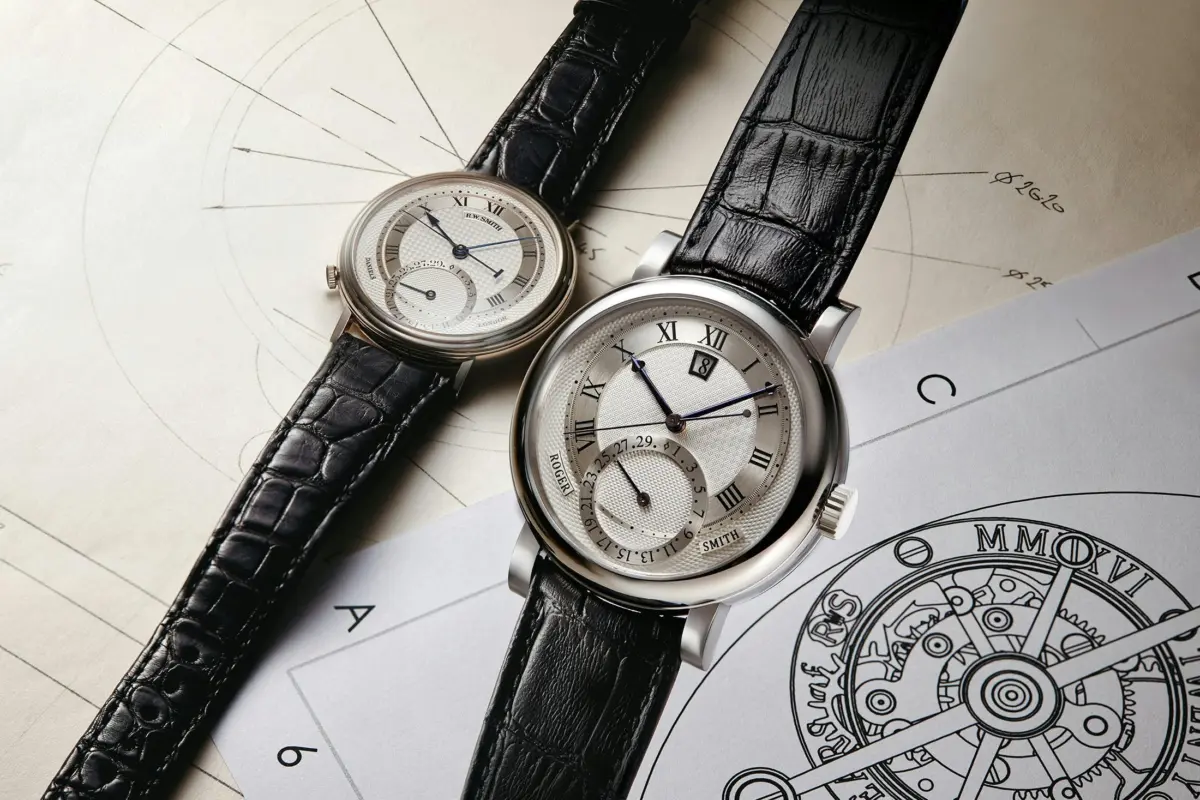
The new Roger Smith Series 7 is, as expected, visually stunning and technically formidable. It is a fitting tribute to mark 25 years of independent brand operations. Full of historical callbacks, the watch offers enough subtle details to satisfy any passionate scholar of the shared legacies of Roger Smith and George Daniels. The dial side, especially when rendered in a platinum case, serves as an unmistakable homage to Roger Smith’s personal Millennium wristwatch. That specific timepiece was notably the very last watch made in the Millennium series and stands as the only one double-signed by both Smith and Daniels. The visual lineage is so direct that the brand even provided composite imagery overlaying one watch directly atop the other. That original personal piece commanded over $2.4 million when it crossed the auction block at Sotheby’s in 2023.
The off-center dial architecture is a design language Smith has explored before with extraordinary results. His historic second watch—the very masterpiece that secured him his legendary apprenticeship under George Daniels—was a perpetual calendar tourbillon featuring a similarly top-weighted, asymmetrical layout. Smith famously sold that foundational watch to fund the opening of his own independent workshop. It most recently achieved a staggering $4.9 million at a Phillips New York auction in 2023. The movement architecture of that historic piece shares numerous philosophical and visual similarities with the newly minted Series 7.

The Smith No. 2, however, was originally built using a spring detent escapement. This further connects it to George Daniels’ early independent research before he dedicated his career to perfecting the low-lubrication, self-starting co-axial escapement. Alongside watches crafted by Daniels in the late 1960s and early 1970s, such as the famous "Sarah Jane" and "Hornby" timepieces, the No. 2 sits firmly within an elite horological lineage. One could compellingly argue that Smith’s modern output represents the ultimate contemporary reinterpretation of the "modern French" approach championed by Abraham-Louis Breguet, translated instead through a distinctively restrained English design vocabulary.
Discussing tourbillon wristwatches naturally leads to the co-axial escapements found in the two rectangular tourbillon watches—known as "The Blue" and "The White"—which Roger Smith built for George Daniels. Unlike historical accounts that occasionally misattributed their construction, these watches were fabricated by Smith for Daniels using raw ébauches, following the foundational methods established during the creation of the Millennium series.

To casual observers or collectors unfamiliar with British watchmaking, the unique English approach can sometimes be misunderstood. Because Smith stands as virtually the sole practitioner of this distinct school of finishing, its subtleties require a trained eye. The traditional Vallée de Joux heritage of wide Geneva stripes and deep, polished inward angles catches the casual light—and appears in the market—far more frequently than the English style of frosted graining and architectural minimalism. Yet no one should mistake this stylistic restraint for simplicity. The construction and finishing are profoundly difficult, requiring absolute mastery, and in the case of the Series 7, execution is nothing short of immaculate.
The level of precision demanded by this aesthetic leaves zero room for error. Every flat surface and every sharp edge is deliberately considered, meaning there is simply nowhere to hide a single microscopic flaw. While the watch has not yet been widely toured, the horological community is already speculating on what variants might follow. Given the modular capability of the underlying movement architecture, collectors can reasonably hope for simplified tourbillon-only or tourbillon-and-date configurations in potential future iterations like a Series 8 or Series 9. On a pure technical level, examining the miniaturized escapement closer will undoubtedly provide horologists with plenty of analytical material for years to come.

The Basics
Brand: Roger W. Smith
Model: Series 7
Diameter: 40mm
Thickness: 14.6mm
Case Material: Rose gold, yellow gold, white gold, or platinum
Dial Color: Various options available on request
Indexes: Engraved and filled
Water Resistance: Not shared
Strap/Bracelet: Alligator leather strap

The Movement
Functions: Hours, minutes, central seconds, subsidiary date dial, month aperture, and tourbillon
Power Reserve: 48 hours
Winding: Manual
Frequency: 3Hz (21,600 vph)
Chronometer Certified: No
Pricing & Availability
Price: Available on request
Availability: By order through the watchmaker
Limited Edition: No