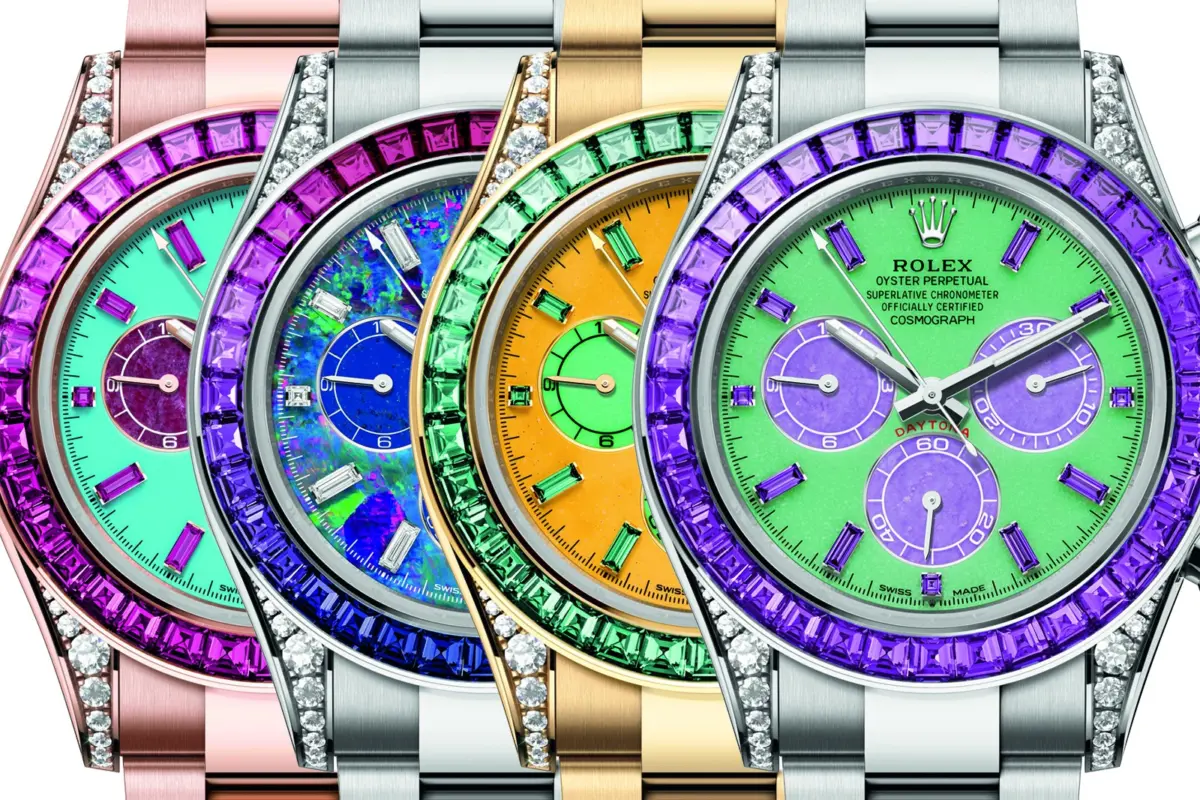





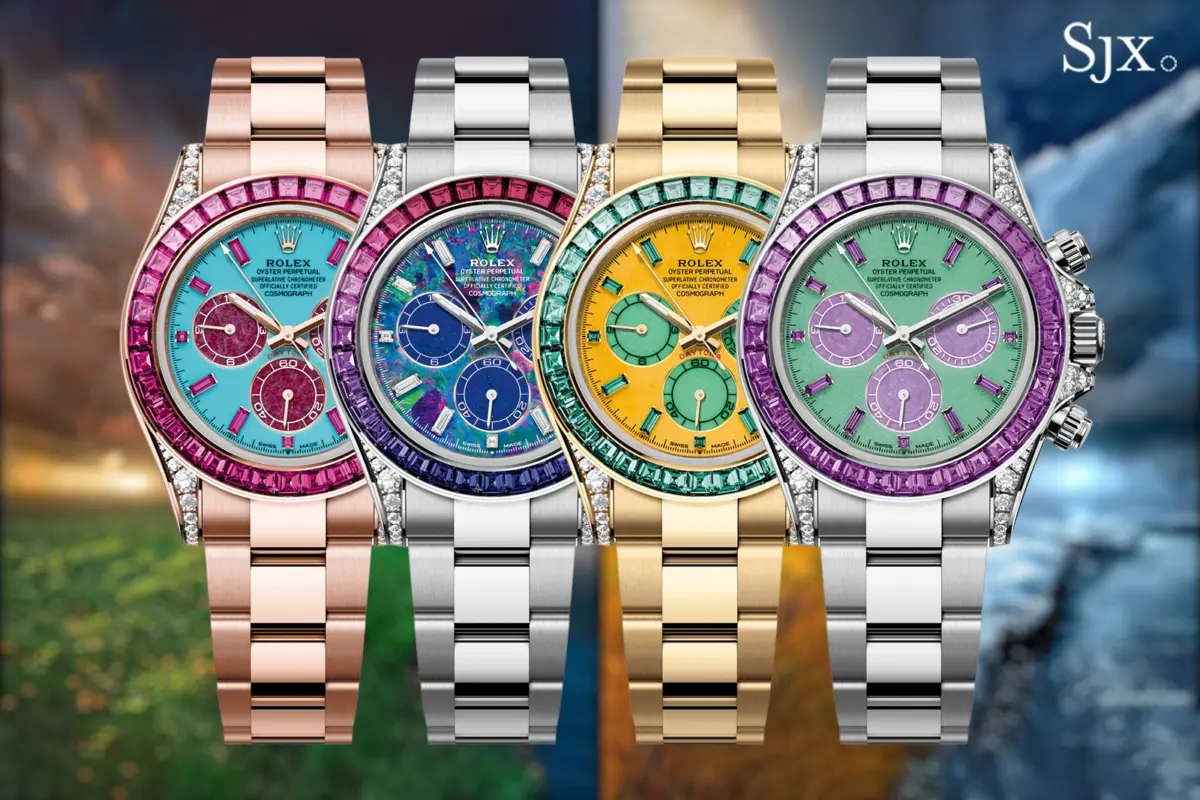
In just a matter of weeks, Rolex and Phillips achieved what many in the luxury watch industry would have previously considered nearly impossible: a historic, record-shattering charity auction where a unique set of four Rolex Daytonas known as the “Four Seasons” realized a staggering £37.3 million, equivalent to US$49.5 million. The astronomical sum establishes a new benchmark as the largest tally ever recorded for a charity watch auction of any kind. Furthermore, the total comfortably surpasses the US$31 million achieved by the legendary Patek Philippe Grandmaster Chime reference 6300A in 2019—though that notable sale comprised a single timepiece, whereas this new triumph belongs to a synchronized quartet.
All of the substantial proceeds generated from the sale of the “Four Seasons” collection are designated for charitable foundations established by tennis legend Roger Federer and Hollywood actor Leonardo DiCaprio. Both global celebrities serve as official Rolex “Testimonees” and lent considerable star power to the high-profile evening. The auction took place on September 28, conveniently scheduled for the day immediately following the conclusion of the Laver Cup, an event attended by Mr. Federer.
The venue chosen for this landmark evening was Raffles London at the OWO, widely regarded as the latest and most magnificent grand hotel in the British capital, a city that historically boasts no shortage of luxurious accommodations. Reputedly the most expensive hotel development project in London’s storied history, with development costs reaching an estimated £1.5 billion, the majestic colonial building once served as the historic headquarters of the British Ministry of Defence. Fittingly, for this exclusive preview, the four unique Daytonas were displayed securely inside a room that bore the distinct architectural characteristics of a basement bunker.
The lavishly restored and rebuilt interiors of the former Old War Office provided an appropriately dramatic backdrop for a record-breaking evening. The room was populated by an eclectic guest list featuring a mix of global icons, including rock legends Mick Jagger and Jon Bon Jovi, alongside numerous anonymous yet exceptionally affluent watch collectors who maintain long-standing client relationships with Phillips. Indeed, many of the world’s most significant and influential watch collectors were gathered in the room to witness the unfolding history.
Despite the remarkably short timeline allocated for organizing such a massive global event, the evening was executed with a meticulous attention to detail that arguably no other watch brand could possibly muster. Authentic Rolex wall clocks were hung strategically throughout the venue, while the carefully curated menu remained sustainable and vegan-adjacent. Even the spine of the commemorative auction catalogue was thoughtfully bound with signature green thread. It was a sophisticated, high-stakes production that only Rolex, working in tandem with auction house Phillips, could have successfully orchestrated within a span of just a few weeks.
Lotting and Momentum
The four exceptional watches were lotted in the precise order in which they appeared on the official event invitations: the sequence commenced with Winter, followed sequentially by Spring, Summer, and finally Autumn. As is frequently the case in high-stakes auction environments, the established lotting order would prove to have a profound psychological and financial influence on the momentum of the evening.
Market expectations prior to the commencement of the auction were almost unanimous in predicting that Winter would command the highest hammer price of the quartet. This anticipation was driven by the fact that the timepiece is crafted from platinum and fitted with a mesmerizing gradient sapphire bezel. Unsurprisingly, the bidding kicked off in a whirlwind frenzy, characterized by a flurry of raised hands and enthusiastic shouts echoing across the room. However, the initial breathless pace eventually began to steady once the bidding climbed past the £5 million threshold.

At that juncture, the competition narrowed down to two active telephone lines and a single besuited gentleman physically present in the room, who battled tenaciously nearly to the end. The dynamic shifted dramatically when the price reached the £9 million mark, at which point another gentleman in the room, casually dressed in a white shirt, suddenly entered the fray with a solitary bid—marking his first and only appearance in the bidding war of the evening.
Ultimately, the prized timepiece was secured by the besuited gentleman in the room, who appeared to be executing telephone bids on behalf of an unseen principal. The final hammer price settled at a clean, round £10 million, which was immediately greeted by a wave of enthusiastic applause from the assembled guests.
Interestingly, during a brief, incidental conversation with a fellow bidder following the lot, the besuited man revealed that his employer specifically desired Winter—with no substitutions—suggesting that the final price could have climbed even higher had an aggressive underbidder continued to push. Notably, the victorious besuited gentleman did not participate in the bidding for any of the subsequent lots.
Following the dramatic conclusion of the Winter lot, Spring was brought onto the auction block. The bidding atmosphere for the second lot felt somewhat more muted, as though the room was collectively recovering from the intense excitement generated by the opening watch. Once again, bidding proceeded briskly up to the approximately £5 million mark, after which the competition consolidated among a handful of telephone bidders and a young gentleman in the room who is already a familiar face on the global auction circuit, particularly at charity events like Only Watch. Notably, Leonardo DiCaprio actively participated in this round, putting in a series of targeted bids.
While the familiar young gentleman ultimately emerged as the underbidder, the winning bid was successfully secured by a telephone bidder who had also been one of the final contenders during the battle for Winter, demonstrating that perseverance in the auction room pays off. In relative terms, the ultimate winner—who utilized a James Bond-themed paddle ending in the digits "007"—managed to secure something of a bargain. Spring finished the evening as the most affordable Daytona of the quartet, commanding a final price of £6.8 million.
The realization that Spring represented a relative bargain quickly sank into the consciousness of the room, instantly revitalizing the atmosphere and injecting palpable energy into the crowd as lot three was introduced. Bidding commenced with even greater fervor than before, as collectors in the room appeared determined not to let another perceived deal slip through their fingers. Consequently, the bidding quickly escalated in a chaotic rush toward the £5 million mark, with Mr. DiCaprio once again raising his paddle on multiple occasions.
Eventually, the contest narrowed to a direct duel between two dedicated telephone bidders. However, the dynamic shifted yet again when a female bidder present in the room stepped forward with several decisive bids, driving the valuation past £7 million, then £8 million, and ultimately pressing onward toward £10 million.

Master auctioneer Aurel Bacs cleverly attempted to nudge the proceedings further by publicly asking Mr. Federer if he would be willing to sweeten the pot with a personal bonus. Mr. Federer graciously complied, offering the winner a private, one-hour tennis lesson. However, the female bidder in the room playfully retorted that she did not care for tennis, a witty quip that elicited hearty laughter throughout the hall. That lighthearted exchange may well have propelled the bidding to even greater heights, and a telephone bidder ultimately triumphed, securing Summer for £10.3 million and crowning it as the top lot of the entire evening.
The final lot of the evening was Autumn. Alongside Winter, this watch stood out as a personal favorite of many in attendance. Unlike Winter, however, Autumn possesses a visual duality: while it appears strikingly vivid when viewed in person, its nuances can occasionally translate as flatter in traditional photographs. This compelling visual appeal in the metal, combined with the lingering psychological reluctance of bidders to miss out on the final opportunity of the night, sustained the fierce momentum right through the end of the sale.
In fact, Autumn achieved elite financial figures much more rapidly than its predecessors. Bidding opened with a confident £4 million offer originating directly from the room, which was instantly eclipsed by a surge of aggressive telephone bids. Among these was a £10 million bid placed on behalf of a telephone client represented by Marcello de Marco of Phillips. The watch was ultimately awarded to a different telephone bidder who finalized the purchase at £10.2 million, reaching the eight-figure milestone with noticeably greater ease than the earlier lots.
Rolex Wears the Crown
The extraordinary success of the evening served to definitively underscore the status of Rolex as the undisputed titan of the global luxury watch industry. Measured by virtually every financial and quantitative metric, Rolex remains the industry leader, and the record-breaking prices achieved during this charity auction have successfully restored its crown in the high-end secondary and collector market as well.
Given the current broader economic and collecting climate—where even a moderately collectible timepiece from independent artisan F.P. Journe easily commands a seven-figure sum—such astronomical results felt almost inevitable. A more intriguing question raised by industry observers is the potential ripple effect these record prices will have on the broader market for contemporary and collectible modern Rolex watches. While the manufacturing quality of Rolex timepieces is undeniably high, it remains a remarkably large-scale brand in terms of absolute production volume, meaning the company produces a substantial quantity of watches each year compared to low-volume independent makers.
Phone Power
The unparalleled global appeal of the Rolex brand was vividly illustrated by the sheer volume of participation at the telephone banks, where more than 40 distinct telephone bidders were officially registered. This figure represents a multiple of the typical telephone participation seen for even the most elite individual auction lots, such as a historic Patek Philippe reference 2499. Some of these telephone bidders were dialing in from immense distances, reaching across continents as far away as Australia. Interestingly, despite a physical audience of more than 250 prominent guests gathered in the room, all four of the coveted Daytonas were ultimately claimed by bidders connected via the telephone lines.
Thus, while the prominent celebrities and cultural icons physically present in the room injected undeniable glitz and star power into the atmosphere, the actual purchasing muscle was concentrated over the telecommunication lines, presumably driven by deeply established watch and art collectors who maintain long-term client relationships with Phillips.

At the same time, participating via telephone does not automatically equate to being absent or located in a distant time zone. Much like the record-setting Patek Philippe reference 6300A “Only Watch,” which was famously secured by a phone bidder who happened to be physically closer than conventional wisdom suggested, it became apparent that at least one of the four triumphant winners during the evening auction was actually present within the room while executing their winning bid through an agent.
Stuff and Money
Recent macroeconomic trends, such as the massive capital mobilization by artificial intelligence infrastructure developers, have convincingly demonstrated that the global economy currently possesses a profound surplus of available capital. Conversely, the intense bidding wars for these four Daytonas proved that the world appears to suffer from a distinct shortage of truly exceptional physical assets. A similar dynamic can arguably be observed across other categories of luxury watches and collectibles more broadly, all of which have experienced rapid capital appreciation over recent years.
As long as global liquidity remains abundant and capital continues to flow freely, the underlying consumer demand for scarce physical goods will undoubtedly continue its upward trajectory, given that the world’s wealthiest individuals clearly possess significantly more liquid capital than there are rare, trophy-grade objects available to acquire.
The Power of Stories
Ultimately, the unprecedented success of the evening demonstrates that high-end luxury collecting is about far more than just acquiring tangible objects. One need only imagine the cultural capital and conversational value inherent in the narrative possessed by an individual fortunate enough to purchase a £10 million Rolex Daytona.
In much the same way that material goods function as status symbols, the ultra-wealthy and globally influential require compelling narratives to distinguish themselves within their elite circles. In an era where traditional millionaires have become commonplace and billionaires proliferate rapidly, privileged access and unique provenance constitute a distinct class of luxury in their own right. At an exclusive dinner table where nearly every guest might own a private Gulfstream G650 jet and an F.P. Journe timepiece, the individual who can casually recount this specific evening instantly commands the room with an unmatched story:
“I paid a world record price for this Daytona, and I successfully outbid Leonardo DiCaprio, who was seated directly opposite Roger Federer, who in turn was positioned right in front of Mick Jagger and Jon Bon Jovi.”