




In 1984, a 19-year-old Maurice Malone found himself facing a remarkably specific bureaucratic hurdle: he wanted to recreate a hat he had spotted in a music video, but it was nowhere to be found in retail stores. The obstacle wasn’t a lack of creative vision, but rather a wholesale restriction. To purchase the necessary leather and suede from a local Detroit supplier, Malone needed an official business license. That single requirement inadvertently sparked the creation of his first enterprise, setting in motion a trailblazing career that would permanently bridge the worlds of streetwear, denim, and the burgeoning culture of hip-hop.
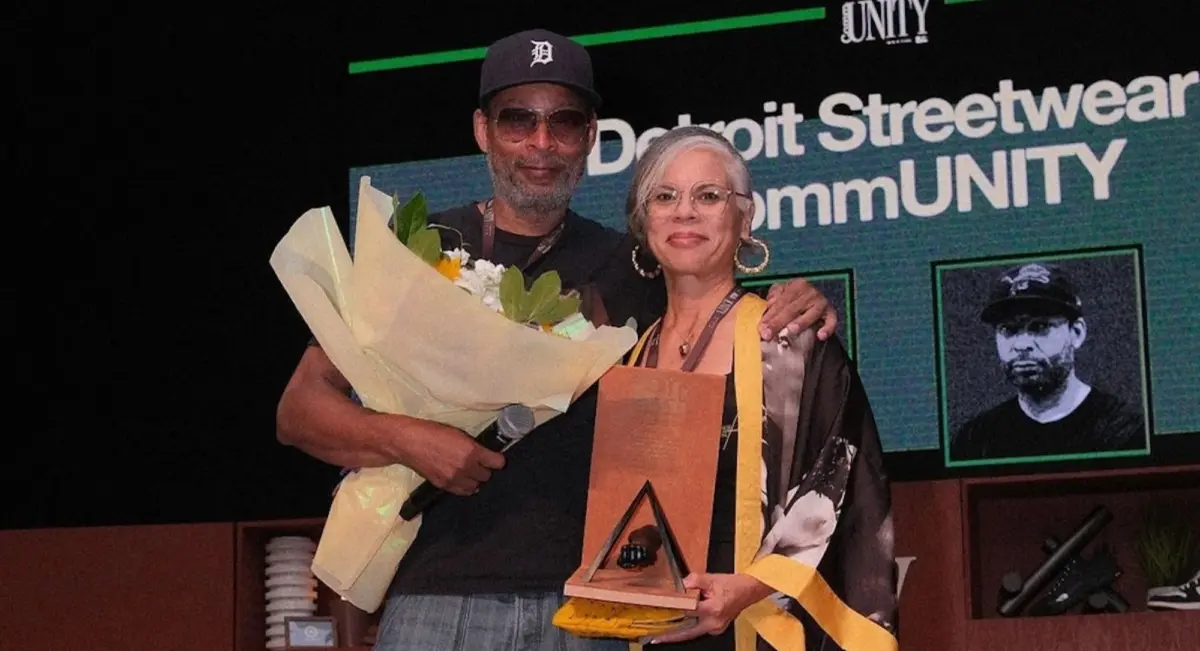
Decades later, Malone’s legacy and enduring impact on fashion were celebrated on stage at the Black Footwear Forum in Detroit. Joined in conversation by fellow streetwear pioneer April Walker—whose iconic Walker Wear pieces were famously embraced by hip-hop royalty like Biggie Smalls and Tupac Shakur—Malone reflected on an era when fashion and music were inextricably linked. While Walker outfitted the biggest rap stars on the East and West Coasts, Malone was busy shaping the cultural landscape of the Midwest, founding the legendary fashion-meets-music establishment known as The Hip-Hop Shop, an incubator that nurtured the raw talents of Detroit rappers, including a young Eminem.
Malone’s entry into the fashion industry was entirely organic, born out of a teenager’s desire to craft the exact style of jeans he wanted to wear. Lacking formal training, Malone turned to his local library in Oak Park, Michigan, to study sewing techniques, eventually utilizing his mother’s sewing machines to bring his designs to life. Ironically, his early limitations as a self-taught creator became his greatest asset, forcing him to innovate and develop a distinct aesthetic that stood apart from mainstream manufacturing.
Reflecting on those formative years during his panel discussion at the conference, Malone explained how technical constraints shaped his signature look. Because he was learning on the fly, he initially did not know how to construct a traditional zipper fly. To solve this, he engineered alternative solutions, creating pull-up pants featuring comfortable elastic waistbands and denim accented with bold leather stripes. His garments looked unique simply because he did not yet know how to make them the traditional way.

This lack of zipper expertise also led to Malone becoming renowned for his pioneering overall designs. His double-sided, reversible paisley-print overalls quickly became defining collector’s items of his early career. During their on-stage dialogue, Walker reminisced about the lasting impact of those garments, telling Malone that she would still love to own a pair of his overall jeans today because they were simply everything at the time.
Before establishing himself as a heavyweight in the fashion world, Malone was heavily involved in the local nightlife and party promotion scene, starting as early as high school. This entrepreneurial hustle naturally merged with his passion for clothing design. He eventually opened a venue called the U.N. in Detroit, which operated as a creative design studio by day and a vibrant nightclub by night. These parties served as a dual-purpose platform, functioning simultaneously as live runway shows and retail pop-ups where he could sell his latest apparel. However, frequent visits and shutdowns by local law enforcement ultimately prompted Malone to expand his horizons, leading him to New York City, where he immersed himself directly in the city’s pulsing hip-hop culture.
In 1990, Malone returned to Detroit with a clear mission: to channel the raw hip-hop energy he had experienced in New York and infuse it back into his hometown. He planned to finance his fashion ambitions through large-scale hip-hop parties, leveraging relationships with rappers he had met along the way to draw crowds while selling his custom T-shirts and jeans. Teaming up with a friend, he launched a recurring event called Rhythm Kitchen inside a Chinese restaurant named Stanley’s. The parties grew exponentially in popularity. Impressed by the momentum, a retail partner, Strictly Sportswear, provided financial backing, challenging Malone to prove he could pre-sell 1,000 pairs of jeans. Malone met the goal before production even officially commenced.
The climax of Malone’s cultural influence in Detroit was materialized through The Hip-Hop Shop, a retail and community space where future rap icon Eminem cut his teeth. Malone detailed the dual identity of the venue, explaining how the retail floor was physically transformed every Saturday afternoon to host legendary rap battles for local youth. During the week, the brand maintained its nightlife connection by hosting hip-hop nights at The Shelter every Monday.

These dual cultural touchstones—the Monday night parties at The Shelter and the Saturday afternoon battles at The Hip-Hop Shop—ultimately served as the direct inspiration for the critically acclaimed, Detroit-based film 8 Mile, which loosely chronicled elements of Eminem’s early life. Malone played an integral role behind the scenes, working directly with the film’s director as a consultant. Because Malone had proactively recorded the original rap battles and archived footage from his parties, the production crew was able to utilize authentic visual references to meticulously recreate those historic battle scenes on screen.
As his enterprise scaled, Malone returned to New York, entering a highly successful partnership that lasted from 1995 to 2001. During this prolific period, the designer expanded his portfolio across multiple distinct fashion categories, successfully navigating high-end runway collections, contemporary denim, and sportswear.
A crowning professional achievement arrived in 1997, when Malone was nominated by the Council of Fashion Designers of America (CFDA) for the prestigious Perry Ellis Award for menswear, sharing the category with fellow designers Sandy Dalal and Marc Jacobs. During their public conversation, Walker highlighted the immense historic significance of the nomination, noting that Malone was remarkably the first designer from their specific cultural background and movement to receive such high-level industry recognition.
Despite these milestones, breaking down institutional barriers was an uphill battle. As a Black designer operating within a mainstream denim and streetwear landscape heavily controlled by traditional gatekeepers, Malone recalled a systemic lack of representation for urban brands within major department stores. Urban brands were deliberately kept off the primary retail floors for an extended period.

Recalling a pivotal confrontation at a DNR retailers’ conference in Palm Beach, Malone described attending a panel where the president of Macy’s was the featured keynote speaker. Confronted by a room that lacked meaningful diversity, Malone raised his hand during the Q&A session to publicly challenge the executive regarding retail representation. He pointedly asked why major department stores aggressively stocked mainstream heritage brands like Tommy Hilfiger and Ralph Lauren—knowing they derived massive sales from the urban demographic—while completely locking out authentic urban brands that had already proven their commercial viability.
While the executive offered a polite dismissal, promising to look into the matter, Malone believes his outspokenness ultimately resulted in him being blackballed by the corporate retail establishment. He watched as department stores eventually began opening their doors to other urban labels like Fubu, Enyce, and Karl Kani, often capturing massive market share while Malone’s established brand was deliberately sidelined, despite leading sales metrics across cities nationwide. Similar systemic hurdles were present in the publishing world, where securing editorial placement in major fashion magazines required constant persistence.
Reflecting on the arduous road paved by early pioneers, Malone emphasized that every inch of progress had to be fought for. In the era when he was building his brand, staging high-end runway shows as a hip-hop designer invited skepticism from traditionalists who subscribed to the old-guard philosophy that fashion strictly trickled down from luxury houses rather than bubbling up from the streets. Now, as modern luxury fashion heavily embraces hip-hop culture, Malone’s early runway experiments stand as prophetic precursors to the current industry paradigm.
Disenchanted by the shifting corporate landscape, the rise of celebrity-backed vanity labels, and the commercial saturation of the streetwear market, Malone dissolved his major partnership in the early 2000s to refocus entirely on independent runway collections. By 2012, he returned to his true passion by launching Williamsburg Garment Co., a dedicated denim enterprise that continues to operate today. For the first five years, Malone ran the business entirely as a solo operation, maintaining absolute creative and manufacturing control.

Today, through Williamsburg Garment Co., Malone has pivoted toward mentorship and education, dedicating a significant portion of his time to training the next generation of denim designers and advocating for the revitalization of American-made garment manufacturing. He established the Denim Workshop, an intensive nine-week curriculum that guides students through the complete, end-to-end process of jean construction. Additionally, he hosts Denim Talk, a free online educational conversation series featuring industry guest speakers designed to make textile knowledge accessible to anyone interested in the trade.
As their on-stage conversation at the Black Footwear Forum drew to a close, Walker reflected on the supportive institutional spaces currently available to emerging creators, noting how beneficial it would have been to have a platform like the Black Footwear Forum when they were first starting out in the 1980s. The inspiring dialogue concluded with Malone receiving a heartfelt tribute from his longtime peer, complete with a bouquet of flowers and Walker formally passing her Trailblazer Award to him in recognition of his enduring contributions to fashion and culture.