


MILAN — Thirty years after the landmark Florence Biennale exhibition "Il Tempo e la Moda" traced a century of affinities between fashion and art, the relationship between these two creative disciplines continues to be reexamined through ambitious new curatorial lenses. Beginning September 24, Milan’s historic Palazzo Reale will open its doors to "Dalí and Fashion," a major exhibition exploring the Surrealist genius through the prism of his style. Media-partnered by Vogue Italia, the exhibition brings together rare art pieces and historical garments to offer a fresh perspective on a prolific career that constantly dissolved the boundaries between canvas and couture.
Co-curated by Judith Clark and Laura Bartolomé, under the scientific direction of Montse Aguer of the Fundació Gala-Salvador Dalí in Figueres, Catalonia, the exhibition ideally concludes a recent international wave of museum shows dedicated to the intersections of fashion, art, and psychoanalysis. From the Fashion Institute of Technology (FIT) in New York to the Victoria and Albert Museum (V&A) in London and the Metropolitan Museum of Art, institutions around the globe have increasingly turned their attention to the carnal, material, and psychological dimensions of clothing.
Singularities_Salvador%20Dali%CC%81_%C2%A9%20Salvador%20Dali%CC%81,%20Fundacio%CC%81%20Gala-Salvador%20Dali%CC%81,%20Figueres,%202026.jpeg%20.jpg)
"When fashion is placed in relation to artistic movements—rather than being evaluated based on presumed criteria of artistic merit—it becomes easier to identify affinities and points of convergence," notes Clark. This year’s global exhibition circuit began with "Dress, Dreams, and Desire: Fashion and Psychoanalysis," curated by Valerie Steele at the FIT Museum, which sought to reconstruct the cultural history linking clothing to the subconscious. In the accompanying volume for that exhibition, Steele emphasized the critical framework established by Jacques Lacan, writing that his work moved the relationship between fashion, Surrealism, and psychoanalysis beyond standard Freudian interpretations of dreamwork and sexual symbolism, paving the way for reflections on self-alienation, body image, fragmentation, and aggression.
That exhibition was followed by "Art X Fashion" at the FIT Museum, curated by Elizabeth Way; the V&A’s "Schiaparelli: Fashion Becomes Art," curated by Sonnet Stanfill and Rosalind McKever; and the Metropolitan Museum’s "Costume Art," where curator Andrew Bolton observed the importance of centering fashion’s materiality. "Rather than privileging the visual dimension of fashion, often to the detriment of its corporeal component, Costume Art centers its materiality and the inseparable connection between the body and the clothes we wear," Bolton observed. Spanning 5,000 years of artifacts, these exhibitions place the human body—material, carnal, vulnerable, seductive, devotional, and fragmented—at the very center of the museum.
Three%2520young%2520surrealist%2520women%2520holding%2520in%2520their%2520arms%2520the%2520skins%2520of%2520an%2520orchestra_Salvador%2520Dali%25CC%2581%25C2%25A9%2520Salvador%2520Dali%25CC%2581%2C%2520Fundacio%25CC%2581%2520Gala-Salvador%2520Dali%25CC%2581%2C%2520Figueres%2C%25202026.jpeg)
Dalí and His "Infinite Work"
Timed to coincide with Milan Fashion Week, the Palazzo Reale exhibition unfolds along a strict chronological thread. By tracing the chronological boundaries of Dalí’s career, the exhibition reveals how many of the themes highlighted by Bolton and the V&A naturally resurface. Internal research conducted for the project paints a broad picture of the artist’s relationship with the history of fashion, demonstrating that while Surrealism remains the aspect most immediately associated with his name, it represents only one facet of his extensive involvement in the fashion universe.
The exhibition opens with Dalí’s own reflections, drawn from his autobiography The Secret Life of Salvador Dalí, tracking the gradual process through which the artist constructed his public image. Initially modeled on his fluctuating moods, this persona ultimately crystallized into the iconic look recognized worldwide: the upturned mustache, the cowboy shirt, the cape, and the cane. From there, the exhibition explores Dalí’s deep engagement with the complex mechanisms of fashion creation and promotion. Visitors will encounter everything from textile designs and advertising campaigns to imaginative shop window displays, historic Vogue cover shoots, and examples of the artist acting as a dynamic model and guest editor.
Figure.%2520Barcelona%2520Mannequin_Salvador%2520Dali%25CC%2581_%25C2%25A9%2520Salvador%2520Dali%25CC%2581%2C%2520Fundacio%25CC%2581%2520Gala-Salvador%2520Dali%25CC%2581%2C%2520Figueres%2C%25202026.jpeg)
Crucially, the exhibition maps Dalí’s relationships with four emblematic figures of twentieth-century style. It traces his close creative partnership with Gabrielle Chanel, highlighting their collaboration on the costumes for the ballet Bacchanale and Dalí’s stays at La Pausa, the designer’s villa on the French Riviera. It also documents his partnership with Christian Dior for the famous Beistegui Ball in Venice in 1951, his friendship with Paco Rabanne, and, most famously, his extensive collaborations with Elsa Schiaparelli, which yielded some of the most radical and enduring garments and accessories in fashion history, such as the iconic Shoe Hat and the Lips Jacket.
What the Exhibition Reveals
For the first time in Italy, the Palazzo Reale exhibition features the personal wardrobes of Salvador and Gala Dalí. Preserved in Púbol within the medieval castle that the artist transformed into a secluded home for his wife and muse, these garments offer tangible proof of the couple’s extraordinary stylistic coherence over time. They also provide direct material reference points for the clothing depicted in several of the paintings featured in the show.
The%2520Eye%2520of%2520Time_Salvador%2520Dali%25CC%2581_%25C2%25A9%2520Salvador%2520Dali%25CC%2581%2C%2520Fundacio%25CC%2581%2520Gala-Salvador%2520Dali%25CC%2581%2C%2520Figueres%2C%25202026.jpeg)
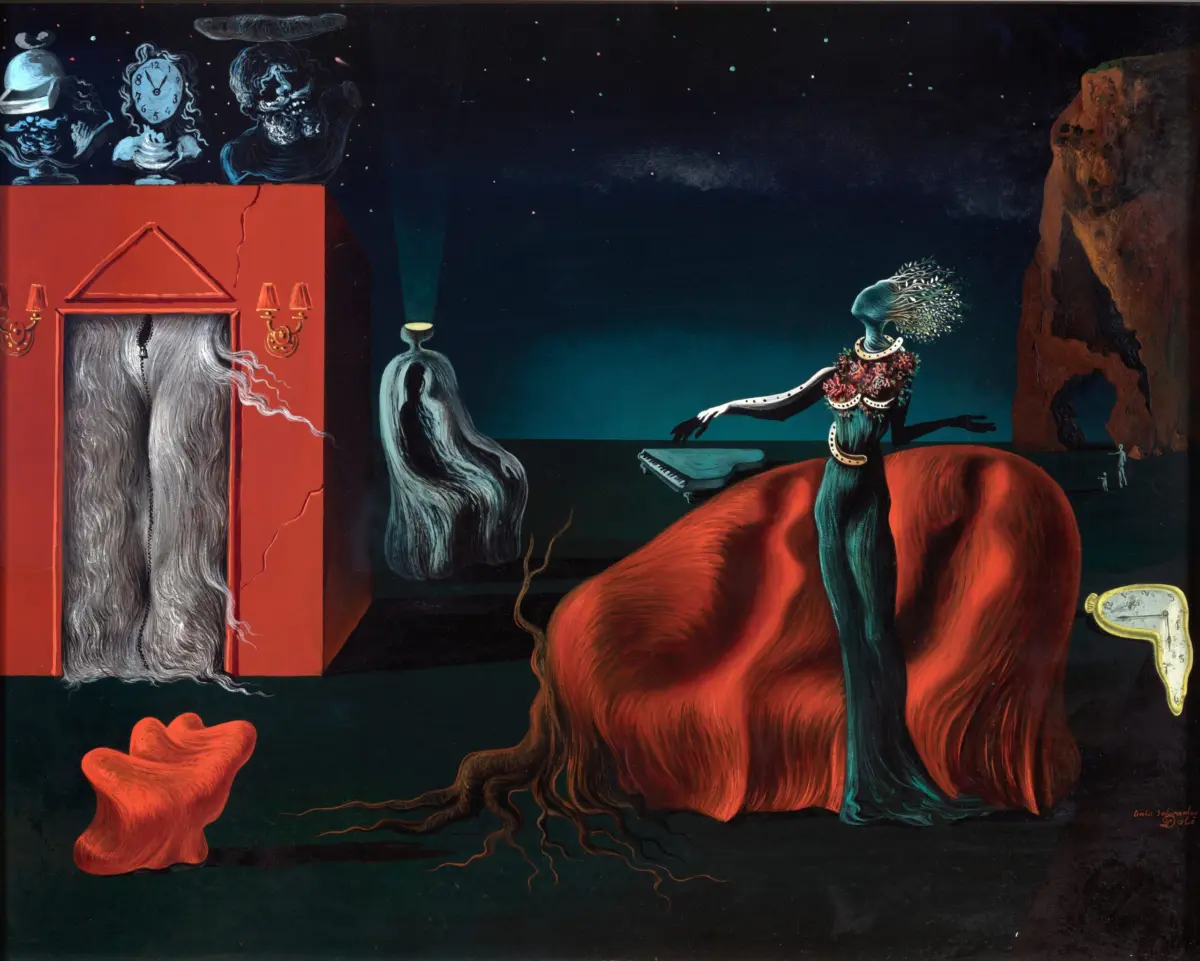
The paintings on view depict bodies in a state of constant transformation: double portraits, contorted and tormented figures, and physical forms translated into precious collections of jewelry. Among these are the Ruby Lips brooch, the hybrid pieces Leaf Veined Hands I & II, the watch-brooch The Eye of Time, and the Corset Ring. Functioning like fragments severed from the body, these jewels are designed to be worn—much like the surreal shoe-hat created with Schiaparelli—on the unexpected "wrong side" of the body, marking an unmistakable entry into the territory of the uncanny.
The exhibition design itself adopts a deliberately restrained approach. Eschewing any attempt to mimic the overwhelming theatricality of Dalí’s wider universe, the staging allows the artworks to provide color against monochromatic backdrops: eggshell cream, Mediterranean white, and museum gray. The decorative scheme utilizes a "sampling" technique developed in Clark’s studio, where designers intervene on only minor fragments of surfaces to evoke a broader decorative effect. By leaving parts of the base unfinished, the exhibition embraces a proactive modern museology that values thoughtful design over heavy-handed scenographic construction.
Gala%2520wearing%2520Elsa%2520Schiaparelli%25E2%2580%2599s%2520shoe-hat%2520inspired%2520by%2520a%2520Salvador%2520Dali%25CC%2581%2520design_Andre%25CC%2581%2520Caillet%2520_%25C2%25A9%2520Salvador%2520Dali%25CC%2581%2C%2520Fundacio%25CC%2581%2520Gala-Salvador%2520Dali%25CC%2581%2C%2520Figueres%2C%25202026%2520.jpeg)
The substitute body of the mannequin continues to serve as a vital area of collaboration for fashion exhibition curators. At Palazzo Reale, this dialogue is renewed through a partnership with Bonaveri, complemented by extraordinary hair creations by Angelo Seminara. The mannequins are draped in raw canvas coverings that intentionally avoid simulating human skin, instead celebrating the principles of conservation that form the foundation of museum practice.
While history may not yield a definitive, singular verdict on the relationship between Salvador Dalí and fashion, the recent proliferation of exhibitions dedicated to the subject invites a broader reconsideration. It asks observers to reevaluate how fashion is judged and whether it can exist purely as a conceptual act, independent of traditional manufacturing methods. Dalí deeply loved those production processes—he embraced them, imitated them, exploited them, and ultimately transformed them into art.