





veiling the Art of À Jour: How Open-Worked Settings Transform Fine Jewelry and Gemstone Brilliance**
When examining fine antique and vintage jewelry, connoisseurs and collectors often look not just at the sparkling face of a precious gemstone, but also at its reverse. Beneath the polished surface lies a masterclass in metalwork known to the trade as à jour. Derived from the French phrase meaning "to the day," this sophisticated technique involves creating open-worked backgrounds behind gemstones through meticulous sawing, piercing, and refining. By removing the metal backing traditionally used to secure a stone, artisans allow natural light to flood through the pavilion, fundamentally altering the visual dynamic of the gem.
The primary purpose of an à jour setting is to maximize the passage of light, which in turn dramatically enhances the stone’s scintillation, brilliance, and overall color saturation. Without an opaque metal backing or reflective foil to artificially boost color—a practice common in earlier centuries—a gemstone set à jour relies entirely on unobstructed illumination. This influx of light revitalizes the stone, making it appear remarkably more vibrant, lively, and luminous to the observer.
Historically, the widespread adoption of à jour settings in fine jewelry manufacturing gained significant momentum around the year 1800. Prior to this period, the prevailing convention in jewelry design relied heavily on closed-back settings. In these older mounts, gemstones were completely enclosed within a solid metal cup, often backed with colored foils or reflective substances to mask imperfections or artificially intensify pale hues. While these closed settings protected the lower portions of stones from accumulated dirt and bodily oils, they severely restricted light transmission, resulting in a heavier, more subdued appearance compared to modern standards of brilliance.
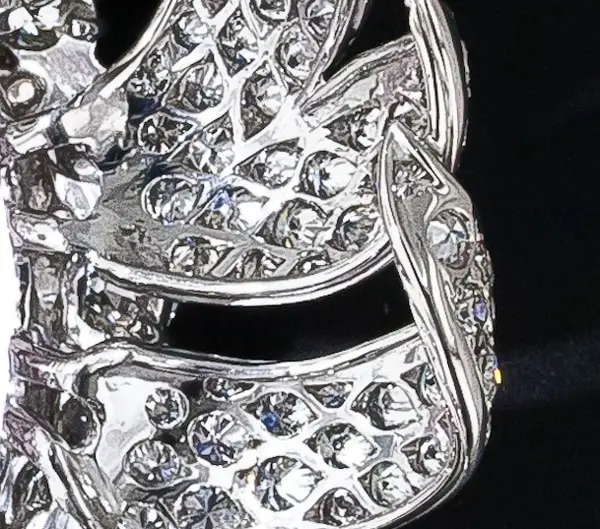
Achieving a high-quality open-backed setting requires exceptional skill and precision from the metalsmith. Fine à jour work is typically executed with the aid of a graver—a specialized cutting tool used by jewelers to carve, shape, and refine metal. Artisans use the graver to clean out excess material from the reverse of the jewelry piece, ensuring that the resulting openings are well-formed, symmetrical, and structurally sound while retaining enough metal integrity to securely hold the gemstone in place. This delicate balance between structural security and maximal openness is a hallmark of master craftsmanship.
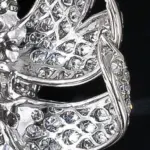
The evolution of this technique reached new artistic heights during the Art Deco period of the early 20th century. Art Deco jewelry customarily features intricate à jour work that elevates the reverse of a piece to a level of artistry nearly matching the front. Masters of the Art Deco movement viewed jewelry as a cohesive architectural sculpture, where every square millimeter deserved meticulous attention. Consequently, the intricate geometric piercing and open-worked metal patterns on the back of an Art Deco brooch, ring, or pendant were finished with the same rigorous standards as the visible gemstone settings on the front, transforming functional elements into hidden masterpieces.
Beyond traditional gemstone mounting, the philosophy of open-worked design finds a remarkable parallel in the specialized discipline of enameling. In this related field, artisans employ a specialized variation known as plique à jour. This complex technique uses an open metal framework—created without a solid backing—which is subsequently filled with transparent enamel paste and fired. When the finished piece is held up to the light, the absence of a backing allows illumination to pass directly through the translucent colored glass, creating a stained-glass effect that yields a dazzling myriad of shifting colors.
From its origins in the early 19th century to its refined execution during the height of the Art Deco era, the à jour technique remains a defining indicator of superior fine jewelry craftsmanship. By prioritizing the natural interaction of light over heavy, concealing metalwork, open-backed settings continue to unlock the deepest brilliance and truest colors of precious gemstones, proving that the true beauty of fine jewelry often extends far beneath the surface.