



As the dust settles on the international runways of the spring 2027 ready-to-wear season, the fashion world finds itself in the customary six-month lag before these much-anticipated garments finally arrive in stores. To bridge the gap, critics and enthusiasts alike are looking past the seams and silhouettes to explore the broader cultural currents that inspired designers this season. From French philosophy and Bloomsbury literature to 1990s counterculture and cult-classic cinema, the spring collections reveal a deeply intellectual and cross-disciplinary approach to contemporary design.

Recurring touchstones across the global fashion capitals include the French philosopher Michel Foucault, Bloomsbury writer Virginia Woolf, and photographer Bettina Rheims. Baz Luhrmann’s enduring cinematic classic Romeo + Juliet remains a perennial runway favorite, while experimental audio—ranging from a 1972 Italian gibberish track at Fendi to Merchant Ivory’s 1985 romantic idyll A Room With a View—provided the rhythmic heartbeat for the season.

Read: Nonfiction
For Alessandro Michele at Valentino, the starting point was literary and conceptual. Staged inside the astounding Bibliothèque Sainte-Geneviève, Michele’s presentation featured a bibliography of imagined books complete with descriptions, made-up authors, and phony ISBNs, such as A Garden of Small Errors, Elsewhere Is a Precise Place, and The Social Life of Velvet. In his show notes, Michele drew on Lebanese-American scholar Nassim Nicholas Taleb’s concept of the "anti-library"—a collection of unread books—comparing the potential of an unread library to a closet full of unworn clothes.

"Even the garments that we will never wear, no differently than those books sitting unopened on our shelves, still speak to us of the lives we could have lived. Not as regrets, but as promises," Michele wrote, as observed by Nicole Phelps.

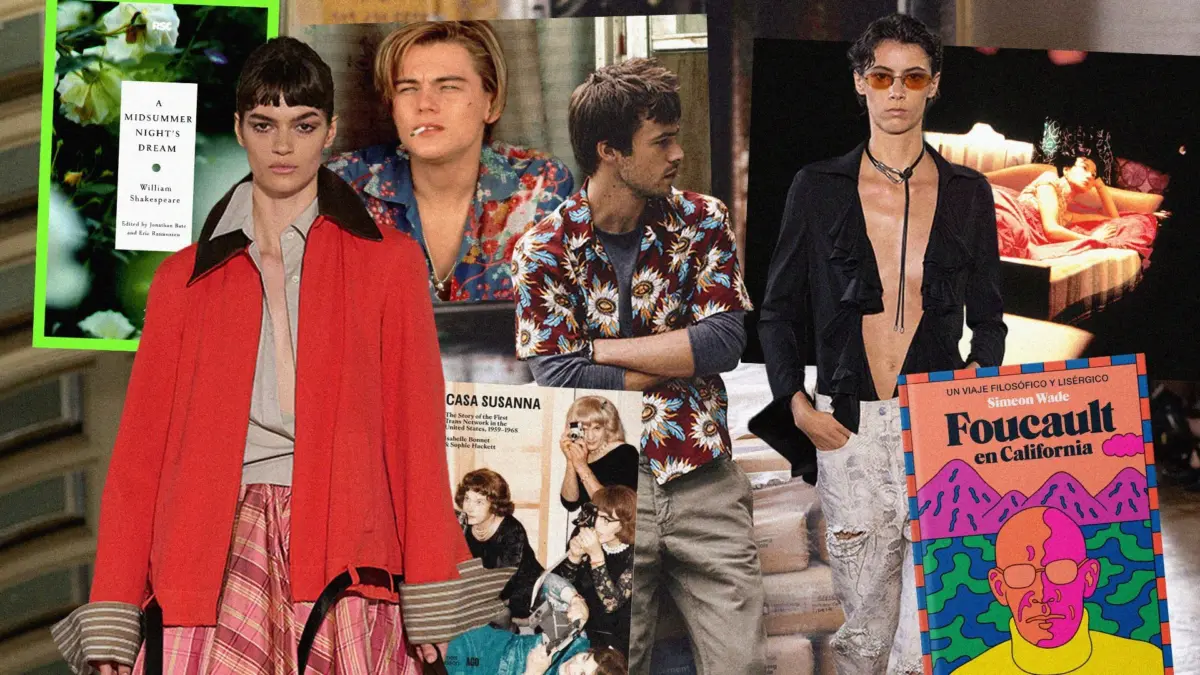
Philosophy and intellectual history heavily influenced Balmain and Natasha Zinko as well. Antonin Tron of Balmain turned to Simeon Wade’s 2019 book Foucault in California, which chronicles the philosopher’s LSD experiments in Death Valley. Tron sought to capture a collision between the strictures of French intellectual thought and the psychic expansiveness of the American West, weaving in references to Jim Morrison, Joan Didion, and Walter De Maria. Meanwhile, Natasha Zinko looked to Foucault’s 1975 seminal work Discipline and Punish for her collection "Pay Per View," exploring Jeremy Bentham’s panopticon prison structure and how modern live-streaming and social media force individuals to constantly regulate their own behavior as if under surveillance.

At Ambush, Yoon Ahn drew inspiration from Clarissa Pinkola Estés’s 1992 bestseller Women Who Run With the Wolves, examining the psychological tension between societal expectations and instinctual nature within the urban landscape of Tokyo. In Berlin, Laura Gerte deconstructed the moral ideals of femininity through Dadaism and Mina Loy’s 1914 Feminist Manifesto, framing female virtue as a historical tool of patriarchal control. Theory’s Dushane Noble explored the sociology of taste through W. David Marx’s Status and Culture, noting how status-seeking acts as the quiet engine behind fashion and identity.

Historical and archival research anchored several other houses. Stine Goya structured her collection around Florian Illies’s 1913: The Year Before the Storm, finding striking parallels between pre-war European artists living without a tomorrow and the creative urgency of the present day. At Gmbh, Serhat Isik and Benjamin Alexander Huseby celebrated their tenth-anniversary collection by drawing on Dr. Gesa Kessemeier’s Modestadt Berlin, shedding light on pre-war Berlin’s flourishing fashion scene and long-forgotten designers. Daniella Kallmeyer found meditative inspiration in Hideyuki Oka’s 1965 book on traditional Japanese packaging, How to Wrap Five Eggs, translating the structural discipline of its cover art into clever sartorial details.

Literature from the early 20th century also made significant impressions. Marke’s Mario Keine delivered a time-traveling 400-year odyssey inspired by Virginia Woolf’s Orlando, juxtaposing 18th-century Enlightenment ideals with modern digital saturation. Marco Rambaldi turned to Woolf’s A Room of One’s Own to construct clothes that function as personal shelters for free expression. Meanwhile, IM Men looked to a 10th-century poem by Su Shi and the cultural importance of bamboo, Yusho Kobayashi reinterpreted the darker, more sorrowful themes of Hans Christian Andersen’s The Little Mermaid, and Pillings’s Ryota Murakami utilized Kimiko Aman’s children’s story Shiroi Boshi (The White Hat) to blur the boundaries between memory, fantasy, and reality.

Rounding out the literary influences, Kunihiko Morinaga of Anrealage centered his "Skin" collection around Osamu Tezuka’s sprawling manga epic Phoenix, exploring themes of constant rebirth and shedding outer surfaces. Pauline Dujancourt constructed a "tears library" of crochet and lace inspired by Rainer Werner Fassbinder’s play The Bitter Tears of Petra von Kant, while Susan Fang focused on the imaginative worlds people create around love while preparing costumes for an upcoming opera adaptation of David Henry Hwang’s M. Butterfly. Finally, Antonio Marras hid a layered reference to Shakespeare’s A Midsummer Night’s Dream within the narrative of a midday Sardinian wedding.

Turn the Pages: Photobooks
Photography books provided rich visual narratives for designers seeking a deeper emotional resonance. Joseph Altuzarra looked to Isabelle Bonnet and Sophie Hackett’s Casa Susanna, a chronicle of midcentury individuals who gathered at a Catskill Mountains retreat to express their gender identities. The joy and freedom captured in the photography served as the emotional unlock for Altuzarra’s vibrant spring collection.

At Isabel Marant, creative director Kim Bekker traveled mentally to 1960s Los Angeles after discovering Sam Haskins’s photographic series Cowboy Kate & Other Stories, utilizing the translucent, hazy lighting of the images to inform her palette. Tod’s menswear designer Matteo Tamburini looked closer to home with Luigi Ghirri’s seminal 1984 photographic project Viaggio in Italia, seeking an authentic, unpretentious relationship with everyday Italian objects.

Bettina Rheims’s influential portraiture inspired multiple labels. Arashi Yanagawa of John Lawrence Sullivan referenced Modern Lovers (1990) to disrupt traditional tailoring with delicate lace, mesh, and patent finishes that played with the plurality of gender identities. Similarly, Charlotte Knowles and Alexandre Arsenault celebrated the tenth anniversary of KNWLS by returning to Rheims’s Chambre Close, translating the vulnerability of women in anonymous hotel rooms into deconstructed, layered garments with a vibrant color palette.

Watch: Movies
Cinema remained one of the most potent catalysts for the season’s aesthetics. Hillary Taymour of Collina Strada blended 18th-century romance with medieval chain-mail-inspired textures after rewatching A Knight’s Tale on a flight. Lu’u Dan’s Hung La channeled the somber tone of Takashi Miike’s Ichi the Killer alongside musical touchstones like Miles Davis and Tupac Shakur. Patrick McDowell translated the rich reds and greens of Wong Kar-wai’s In the Mood for Love into a standout green-striped silk material, while Emily Dawn Long and Dsquared2’s Dean and Dan Caten both nodded to the iconic visual style and religious symbolism of Baz Luhrmann’s Romeo + Juliet.

Asian folklore and international art house cinema also shaped collections across the globe. Samuel Yang and Erik Litzén of Samuel Guì Yang retold the ancient legend of the white snake through Tsui Hark’s 1993 film Green Snake. Simone Rocha presented a menswear collection that cast its wearer as the protagonist of Merchant Ivory’s A Room With a View, while Ernest W. Baker drew on Susan Seidelman’s 1982 cult classic Smithereens to infuse sharp tailoring with a punk edge.

Exploring the darker undercurrents of American cities, Mike Amiri looked to Paul Schrader’s American Gigolo for a seductive, shadowy vision of Los Angeles nightlife, and Stefano Gallici of Ann Demeulemeester watched Billy Wilder’s Sunset Boulevard to frame LA as a haunting, worn-out ghost of a city. August Barron drew from a similar cinematic canon including Cabaret and Boogie Nights to study the decay of fame, whereas Yuka Kimura of Mukcyen channelled Michelangelo Antonioni’s Red Desert to express the psychological exhaustion of modern digital noise.

Dark romance and surrealism permeated collections by Enfants Riches Déprimés, who referenced Pier Paolo Pasolini’s Teorema, and Leandro Cano, who filtered Andalusian religious and flamenco traditions through the surrealist lens of Luis Buñuel’s Un Chien Andalou. Francesco Murano looked to Fritz Lang’s Metropolis to explore the dichotomy between virtue and seduction, and Mel Usine’s Stephen Biga found inspiration in Carl Theodor Dreyer’s 1928 masterpiece The Passion of Joan of Arc.

Concluding the cinematic references, Thom Browne melded the worlds of A Bug’s Life and The Frog Prince, while Abra’s Abraham Ortuño Perez pulled from Studio Ghibli’s The Secret World of Arrietty and Alice in Wonderland to turn everyday perspectives upside down.

Watch: Television
Television classics also left their mark on the runway. Louis-Gabriel Nouchi transported his menswear collection to the Pacific Northwest of David Lynch’s Twin Peaks, blending Boy Scout gear with dystopian undertones inspired by Francis Bacon’s palette and Blade Runner. Meanwhile, Josef Lazo and Andreas Schmidl of Lazoschmidl found retrospective alignment between their designs and the comforting, bathrobe-clad aesthetic of The Golden Girls.

Listen
Music and audio-visual performance served as vital narrative layers for several presentations. Fendi’s show was underscored by Adriano Celentano’s 1972 experimental track "Prisencolinensinainciusol"—a song written entirely in gibberish to sound like English—mixed alongside Raffaella Carrà’s Italo-disco anthem "Rumore." Nicklas Skovgaard invented a fictional 1960s girl group called the Skovgaardettes, soundtracked by a cover of "Cherry-Coloured Funk." Junya Watanabe divided his collection into two distinct phases using Chaka Khan’s "Like Sugar" and Michael Jackson’s "I Just Can’t Stop Loving You." Finally, guests at Anthony Vaccarello’s final collection for Saint Laurent entered to the atmospheric sounds of Miles Davis’s soundtrack for Louis Malle’s Elevator to the Gallows.

Try This at Home
Connecting the dots between archival inspiration and contemporary reality, designers invited audiences to engage directly with their source material. Attersee’s Isabel Wilkinson Schor based her collection on Trevor Hughes’s 1990s photographs of Toronto bike messengers, capturing an innate, functional sense of style. Similarly, Julie Kegels looked to a YouTube video of science educator Dan Burns explaining Einstein’s theory of general relativity, suspending stretch fabric just above the ground on her runway to visualize the physical weight of every step.