





The history of the diamond is a vast narrative spanning millennia, defined by shifting trade routes, evolving religious beliefs, and remarkable technological breakthroughs. Long before diamonds became synonymous with engagement rings and modern luxury, their story was shrouded in mystery, linguistic confusion, and rare treasures accessible only to the highest echelons of ancient societies.
Pre-Roman Diamonds
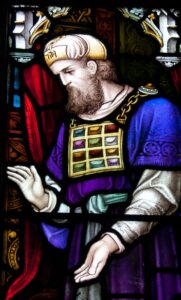
References to diamonds in antiquity are frequently complicated by translation errors in ancient texts. For centuries, readers encountering passages such as the description of the high priest’s breastplate in Exodus 18—which lists stones including a diamond—assumed the gem was well-known during biblical times. However, gemological historians note that these references stem from the mistranslation of the Hebrew word yahalom, derived from halam, meaning "to beat," and the Greek adamas, meaning "indomitable" or "invincible."
While these terms clearly described an extremely hard substance, assuming they referred specifically to the modern diamond is a retrospective projection. In Greek literature, philosophers like Plato used adamas, yet there is no concrete proof that actual diamonds were known to the classical Greeks. The term likely described gold, non-noble metals, or corundum.
Where diamonds first entered human commerce, however, is undisputed: India. An ancient Sanskrit work titled the Arthasastra, dating back to the fourth century BC, provides the earliest definitive evidence of diamonds being mined, traded, and taxed. The text mentions diamond experts and a formal classification system, implying that these stones had already been integrated into South Asian culture and commerce for a considerable period.
Roman Diamonds
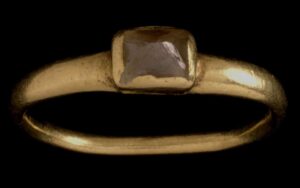
By the Roman era, genuine diamonds were known, prized, and worn as ring stones, with several surviving uncut specimens currently housed in the British Museum. The Roman scholar Pliny the Elder wrote extensively about diamonds in his Naturalis Historia, declaring them the most valuable of all human possessions. He detailed their astonishing hardness, noting how they resisted blows on an anvil and could be used by engravers to cut the hardest known substances.
Yet, Pliny also recorded properties that suggest he occasionally confused diamonds with other minerals. Historians note that Indian suppliers likely reserved the finest crystals for their domestic markets, meaning Romans primarily received lesser specimens. Furthermore, ancient beliefs held that the divine crystal possessed protective powers that would vanish if the stone was altered from its natural state. Consequently, cutting or shaping diamonds was viewed as both taboo and technically prohibitive, leaving ancient artisans to rely on raw, uncut crystals.
The Introduction of Diamond Cutting
Following the decline of the Roman Empire, diamonds largely vanished from European jewelry. The rise of Christianity subdued the popularity of the gemstone due to its association with pagan superstitions, while the disruption of trade routes severed Western access to Indian markets. Conversely, the gem retained its high status throughout the Islamic world and India.
Texts from these regions offer crucial historical insights into early gem manipulation. The sixth-century Indian text Ratnapariska by Buddha Bhatta notes that flawed diamonds, unsuitable as gems, could be pulverized to create diamond powder for polishing other stones. Later, tenth-century Islamic scholar Al-Biruni documented similar practices, confirming that lapidaries ground down lower-quality diamonds to create abrasive dust.
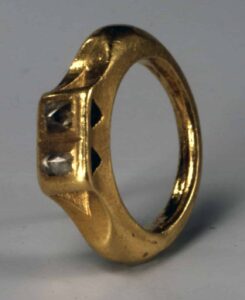
It was not until the thirteenth century that the earliest cut diamonds began to appear. Notable jewelry historian Jack Ogden identified simple table-cut diamonds in medieval Islamic jewelry dating to this period, aligning with contemporaneous Indian texts like the Agastimata, which explicitly stated that a diamond could only be polished using another diamond.
Europe
European diamond cutting likely originated in Venice shortly after 1330, facilitated by Venetian merchants reopening trade routes to the East. As luxury goods trickled back into Europe, craftsmen began developing rudimentary shaping techniques. The lack of supply for perfectly formed natural crystals in the West—as Indian and Islamic traders kept the superior stones—likely spurred European artisans to begin fashioning their own rough stones.

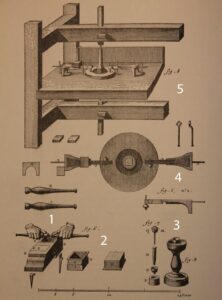
The introduction of continuous rotary motion tools in the fifteenth century revolutionized the craft, enabling cutters to grind facets into diamonds with greater ease. This technological leap fostered broader creativity and a wider variety of stone shapes.
Transition
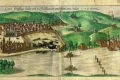
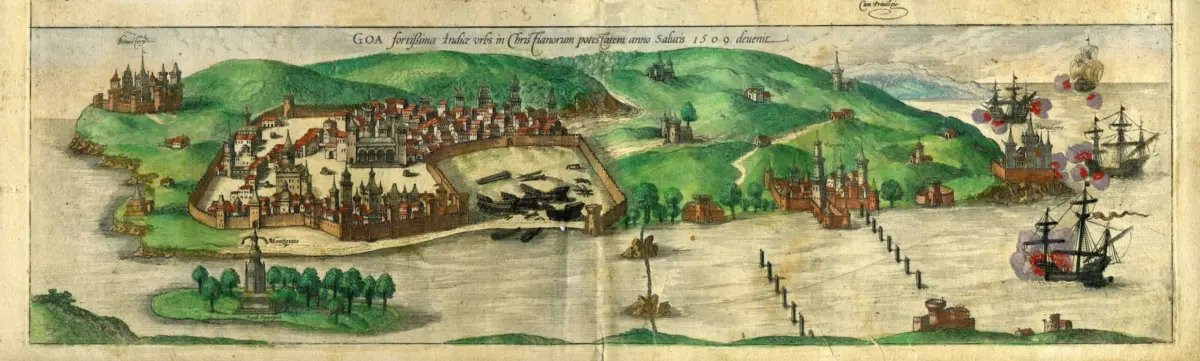
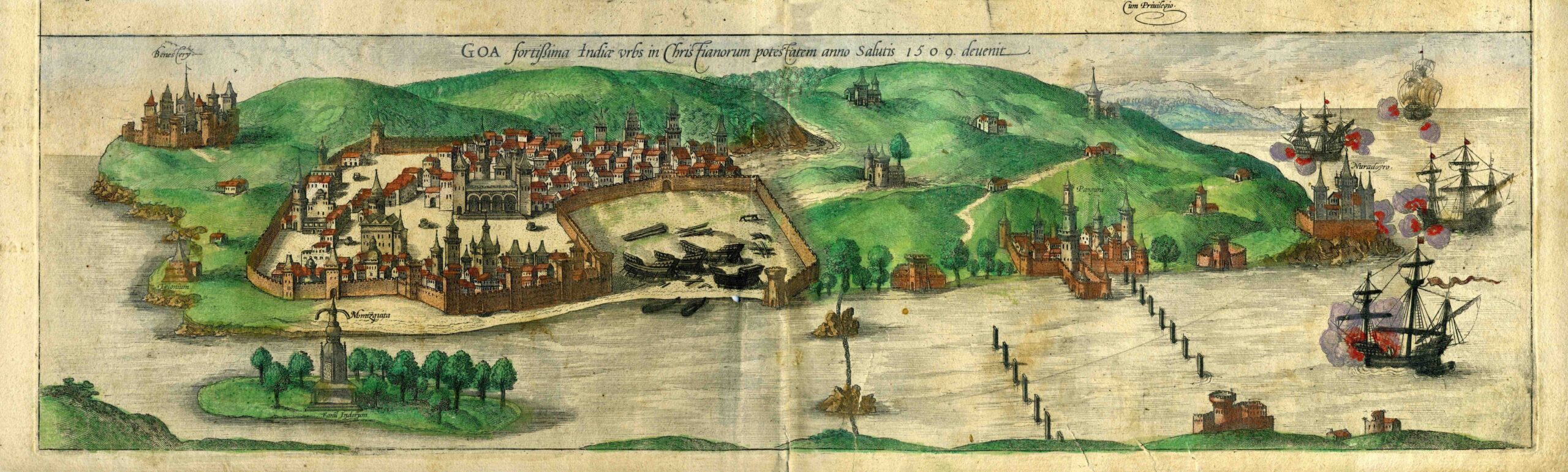
The late fifteenth and sixteenth centuries brought sweeping changes to the global trade and the diamond industry. Following Portuguese explorations that established direct sea routes to India—such as the conquest of Goa in 1510—Europe experienced a steadier, more substantial influx of rough diamonds.
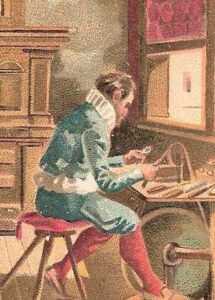
As the economic center of gravity in Europe shifted northward, cities like Paris, Bruges, and Antwerp emerged as the primary polishing centers. Because these cutting communities stood outside the traditional guild system, Jewish refugees fleeing the Spanish and Portuguese Inquisitions were able to enter the trade, fostering rapid advancements in cutting and trading techniques.
Court documents from the era illustrate a dramatic shift: the natural crystal shape was no longer treated as sacred. Cutters began heavily modifying rough stones, as evidenced by a sixteenth-century Augsburg record noting a stone that weighed 11.5 carat before polishing and only five carats afterward. True faceting had arrived. The sixteenth century saw the rise of the Rose cut, enhanced table cuts, and elongated rectangular stones known as "hogbacks," which served as precursors to the modern baguette cut. Detailed descriptions by Renaissance goldsmith Benvenuto Cellini in 1568 documented the sophisticated processes of bruting, dopping, and polishing using diamond powder mixed with oil on tempered steel wheels.
Grinding and Cleaving
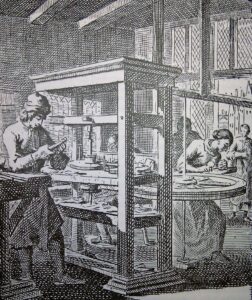
Understanding historical cuts requires examining the unique physical properties of diamond. Beyond being the hardest substance on earth, diamonds possess directional hardness, meaning they resist scratching more effectively in certain crystallographic directions than in others. Octahedral faces, for instance, lie in planes of high relative hardness and are virtually impossible to polish directly, forcing historical cutters to orient facets slightly askew from these natural planes.
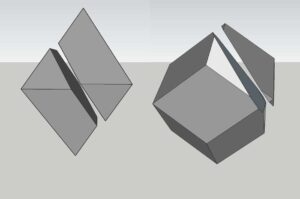
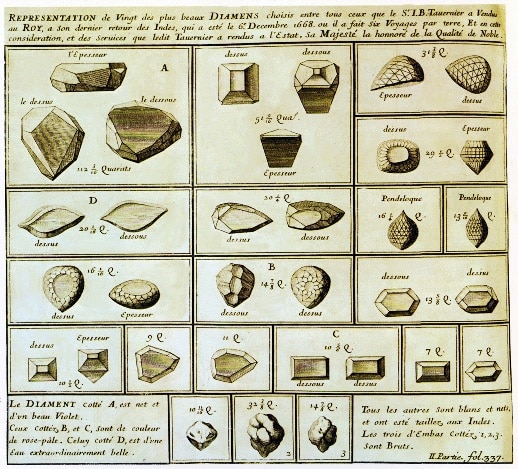
Furthermore, diamond possesses perfect cleavage, allowing smooth fractures when force is applied in specific directions. While ancient peoples used small diamond fragments for engraving, and medieval texts noted cleavage planes, the systematic use of cleaving to shape rough stones for gem-cutting blossomed in the post-medieval period. Seventeenth-century traveler J.B. Tavernier observed that Indian miners were exceptionally skilled at cleaving stones with internal flaws. This technique allowed cutters to transform flat, naturally faceted slivers into early Rose cuts and shield-shaped stones.
Sawing
The final foundational technique added to the lapidary repertoire was diamond sawing, documented by de Laet in 1647. This labor-intensive method involved drawing a thin wire dressed with diamond powder and oil across the stone to sever it. Though tedious, sawing allowed cutters to bypass the limitations of cleaving and shaped stones in directions previously deemed impossible, a practice that persisted well into the nineteenth century.
Indian Diamond Cutting
Jean-Baptiste Tavernier’s seventeenth-century travel accounts provide a vivid window into Indian diamond workshops of the period. Tavernier described mills operated by teams of workers, utilizing traditional wheels continuously anointed with oil and diamond powder by young assistants. While Indian cutters were exceptionally skilled at handling difficult stones with internal knots that European cutters refused to touch, Tavernier noted that their steel wheels required frequent resurfacing with emery, preventing the ultra-smooth finishes achieved in European workshops. Stones cut in this traditional manner across the sixteenth, seventeenth, and eighteenth centuries are collectively known today as Mughal-cut diamonds.
Baroque Roses and Brilliants
During the late sixteenth century, the Rose cut was standardized into a flat-bottomed gem featuring a dome covered in triangular facets, gaining immense popularity throughout the seventeenth century. Concurrently, the candle-lit social gatherings of the Baroque era demanded stones with greater brilliance and sparkle.
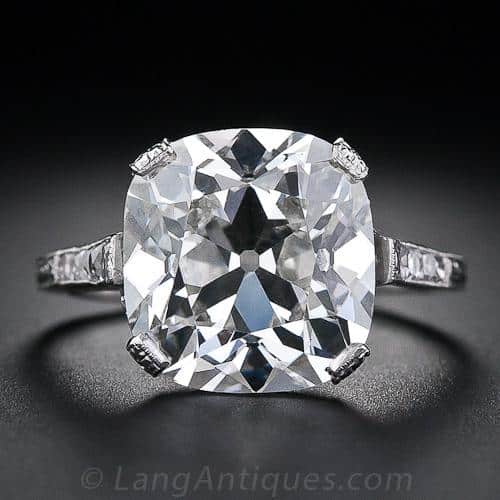
This environment birthed early brilliant-cut diamonds. Unlike modern round brilliants, these early brilliants were highly asymmetrical and dictated entirely by the shape of the original rough stone—dodecahedral rough yielded rounder outlines, while octahedral rough produced square or cushion-shaped stones. These cuts shared a pavilion-based design with the modern brilliant, distributing weight toward the lower portion of the stone with triangular and diamond-shaped facets across both crown and pavilion. Historical examples include famous stones like the Wittelsbach and the Grand Sancy.
Enter Brazil
By the early eighteenth century, India’s historic diamond mines began to face exhaustion. Salvation arrived in 1725 with the discovery of diamonds in the alluvial deposits of Minas Gerais, Brazil, centered around the town of Diamantina. Independent miners flooded the region, triggering a massive surge in global diamond availability.
The influx of Brazilian rough caused diamond prices to plummet to thirty percent of their previous values, transforming diamonds from exclusive treasures reserved strictly for European nobility into luxuries accessible to a broader prosperous class. This democratization of diamonds fueled the growth of the cutting industry, allowing the brilliant cut to steadily eclipse older styles. The eighteenth and nineteenth centuries became the defining era for Old Mine Cut stones.
Eureka
The nineteenth century brought continued industrial expansion and a rising middle class across Europe and the United States, driving up demand for diamond jewelry. When Brazilian production began to wane in the 1860s, European cutting houses in London, Antwerp, and Amsterdam faced severe shortages.
The crisis was averted by the discovery of the Eureka diamond in South Africa in 1867. This monumental find not only changed the life of the teenager who discovered it but also rescued the Belgian and Dutch diamond-cutting industries by securing a vast, steady supply of rough material.

Modernization
The turn of the twentieth century modernized diamond cutting into a mechanized global industry. In the 1870s, Henry D. Morse and Charles M. Field patented steam-driven bruting machines, paving the way for the first electric bruting machines in 1891. Shortly thereafter, in 1900, a Belgian immigrant in the United States invented the motorized diamond saw, allowing cutters to precisely shape rough stones along any desired plane.
These technological advances, paired with the massive influx of South African rough, transformed ancient craftsmanship into modern industrial manufacturing. The round brilliant evolved into the idealized mathematical standard, while specialized cuts like the Asscher cut in 1902, the reintroduction of the baguette cut in 1912, and the 1960s Princess cut provided consumers with diverse stylistic choices.

Tragically, the devastation of the Holocaust during World War II decimated the predominantly Jewish-operated cutting industries in Antwerp and Amsterdam, shifting global manufacturing hubs toward emerging centers in Israel and, later, India. In contemporary times, traditional craftsmanship continues to integrate advanced technologies, utilizing virtual three-dimensional modeling to optimize yield from rough stones alongside high-precision laser sawing to maximize efficiency and profitability.