






Conventional wisdom holds that stopping a tourbillon for precise time setting—known as "hacking" in watchmaking parlance—is a remarkably difficult endeavor given the constant, uninterrupted rotation of the carriage. For modern watch enthusiasts, the arrival of the hacking tourbillon wristwatch is often associated with the 2008 introduction of the A. Lange & Söhne Cabaret Tourbillon. In fact, hacking mechanisms of any sort remained a rarity in mechanical watchmaking until the last few decades. This is somewhat ironic, given that the primary functional role of the seconds hand has arguably evolved over time from a practical tool to assess accuracy into a simple visual indicator confirming that a watch is actively running.
While some contemporary brands are still in the process of adding stop-seconds features to their basic calibres, hacking remains exceptionally scarce in wristwatch tourbillons, appearing with regularity only within the last two decades. However, when building for the waistcoat pocket rather than the wrist, historical master watchmakers were already figuring out ways to stop tourbillons for almost as long as they had been building them. Along the way, these historic artisans developed a diverse array of clever solutions to the problem, each halting either the tourbillon assembly itself or merely the seconds display through entirely unique mechanical means.
Breguet: Stopping the Seconds Without Stopping the Watch
Nearly 225 years ago, the French Ministry of the Interior granted Abraham-Louis Breguet a formal patent for his most famous creation: the tourbillon, designed as an ingenious mechanical method to improve a watch’s performance during rigorous accuracy testing. For a traditional mechanical watch to keep consistent time across all vertical positions, the "balance complete"—comprising the balance wheel, staff, roller, collet, and balance spring—must be meticulously "poised" or balanced, a task that remains challenging even with the benefit of modern manufacturing technology.

Breguet’s invention rotated all the components most relevant to timekeeping along the same axis as the balance wheel over a short, continuous period. Theoretically, this meant that any arbitrary vertical position averaged out to be identical to any other when measured over a duration of a few minutes or more. This architecture was a natural fit for chronometry trials using the Plantamour rating system, which emphasized consistency across multiple positions and quickly became the definitive standard by which fine timepieces were assessed during the late 19th century.
Although hacking seconds would not become a mainstream feature for more than a century, A.-L. Breguet demonstrated at least a passing interest in stopping his watches. Many of his historical timepieces feature small nibs integrated into the case band that can halt the balance wheel directly—all the way up to his exceptionally complex watch, No. 160. Furthermore, his resonance watches were thoughtfully equipped with two distinct nibs, capable of stopping each balance wheel individually.
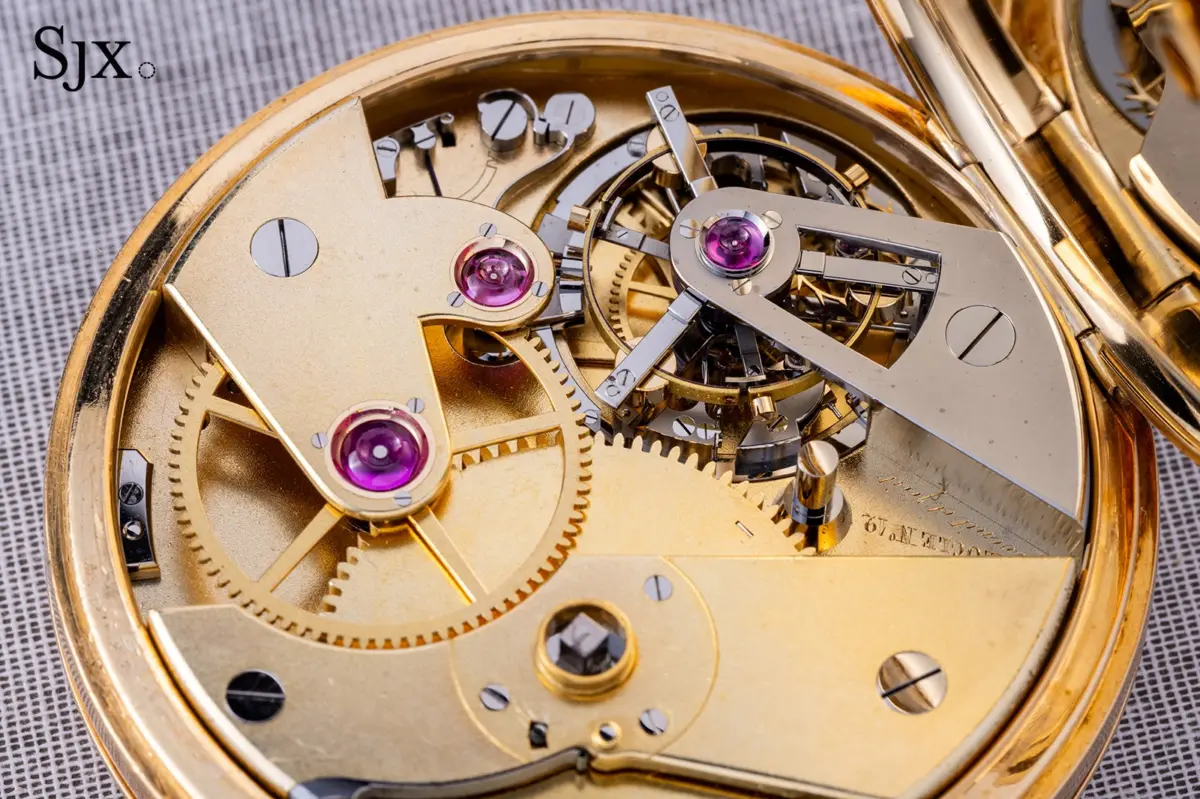
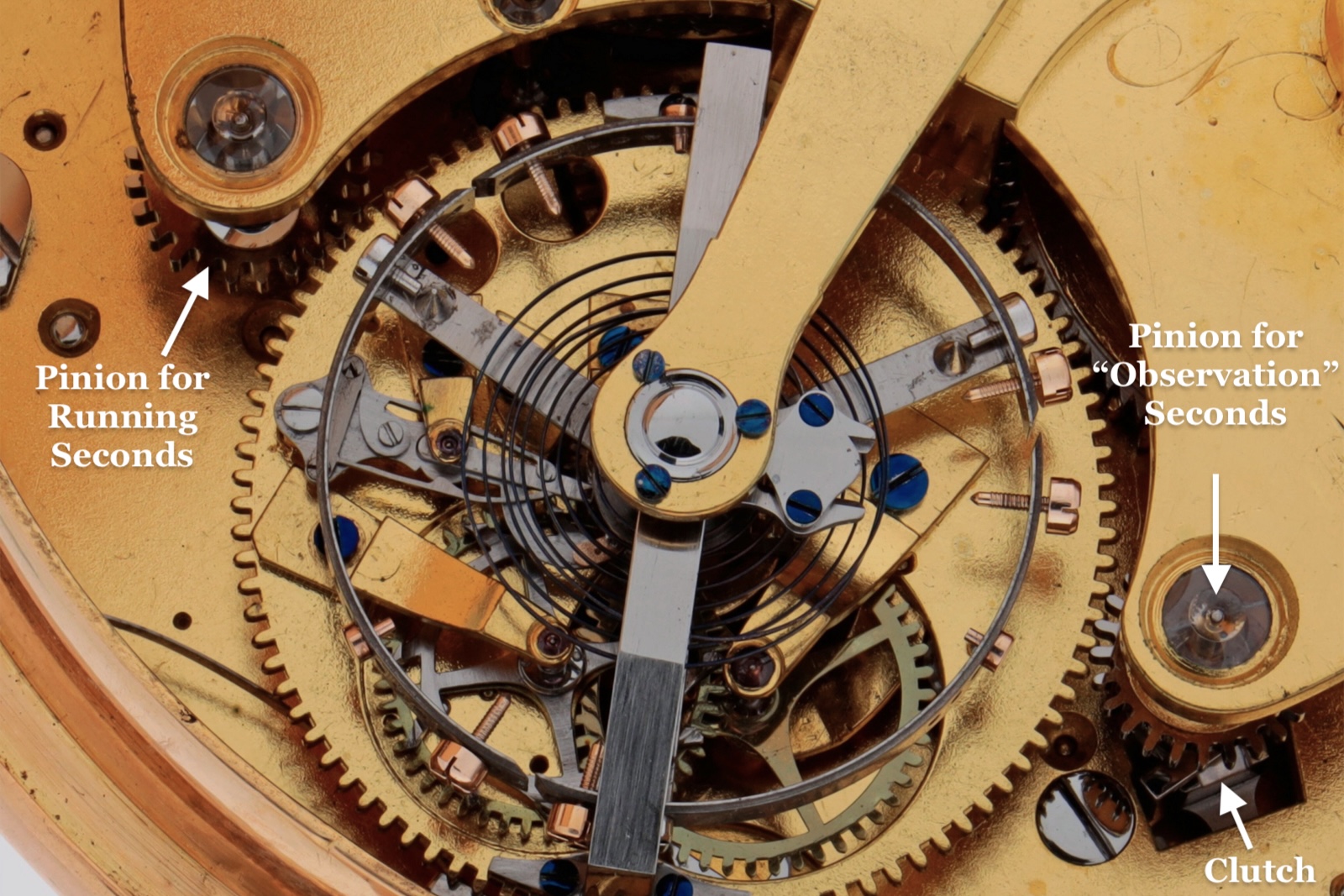
Fittingly, Breguet also equipped his finest timekeepers—a rare series of eight pocket chronometers featuring four-minute tourbillons—with stoppable seconds, though crucially without interrupting the motion of the balance itself. Rather than hacking the seconds hand by stopping the tourbillon carriage, Breguet added a secondary "observation seconds" hand. The four-minute tourbillon drives two separate pinions, each turning once per minute. One pinion directly carries the running seconds hand, while a rudimentary vertical clutch sits delicately between the second pinion and the secondary observation seconds hand.

What visually appears to be a repeater plunger integrated into the pendant actually serves to disconnect this internal clutch and halt the observation seconds hand entirely, allowing time to be read frozen until the user chooses to release it. In the modern era, the Breguet Classique 7225 brought this exact historical functionality over to the wrist. A select few other early tourbillons, including Breguet designs such as No. 2329, similarly stopped a secondary seconds hand, which also effectively bypassed the technical issues involved in restarting non-self-starting escapement varieties like the delicate spring detent.
Houriet: Arresting the Third Wheel
Jacques-Frédéric Houriet was a master watchmaker and movement constructor born just outside of La Chaux-de-Fonds. Contemporaries such as Ferdinand Berthoud and A.-L. Breguet hailed from the same general region, and Houriet would go on to collaborate with both luminaries, as well as Julien and Pierre Le Roy. According to J.C. Sabrier’s comprehensive volume, Jacques-Frédéric Houriet, The Father of Swiss Chronometry, Houriet designed at least 110 distinct movements, which surviving historical notes and brass templates reveal represented 77 entirely unique structural designs. His workshop even built nine six-minute tourbillon movements for Breguet.
As the foremost manufacturer of pocket chronometers in Switzerland during his era, Houriet applied his deep experience working with bimetallic compensation balances to construct some of the first bimetallic thermometers found in continental Europe. These were housed in standalone pocket-watch-style cases or integrated directly onto the dials of his timepieces, making the bimetallic thermometer a signature calling card for Houriet, alongside his preferred spherical balance spring.
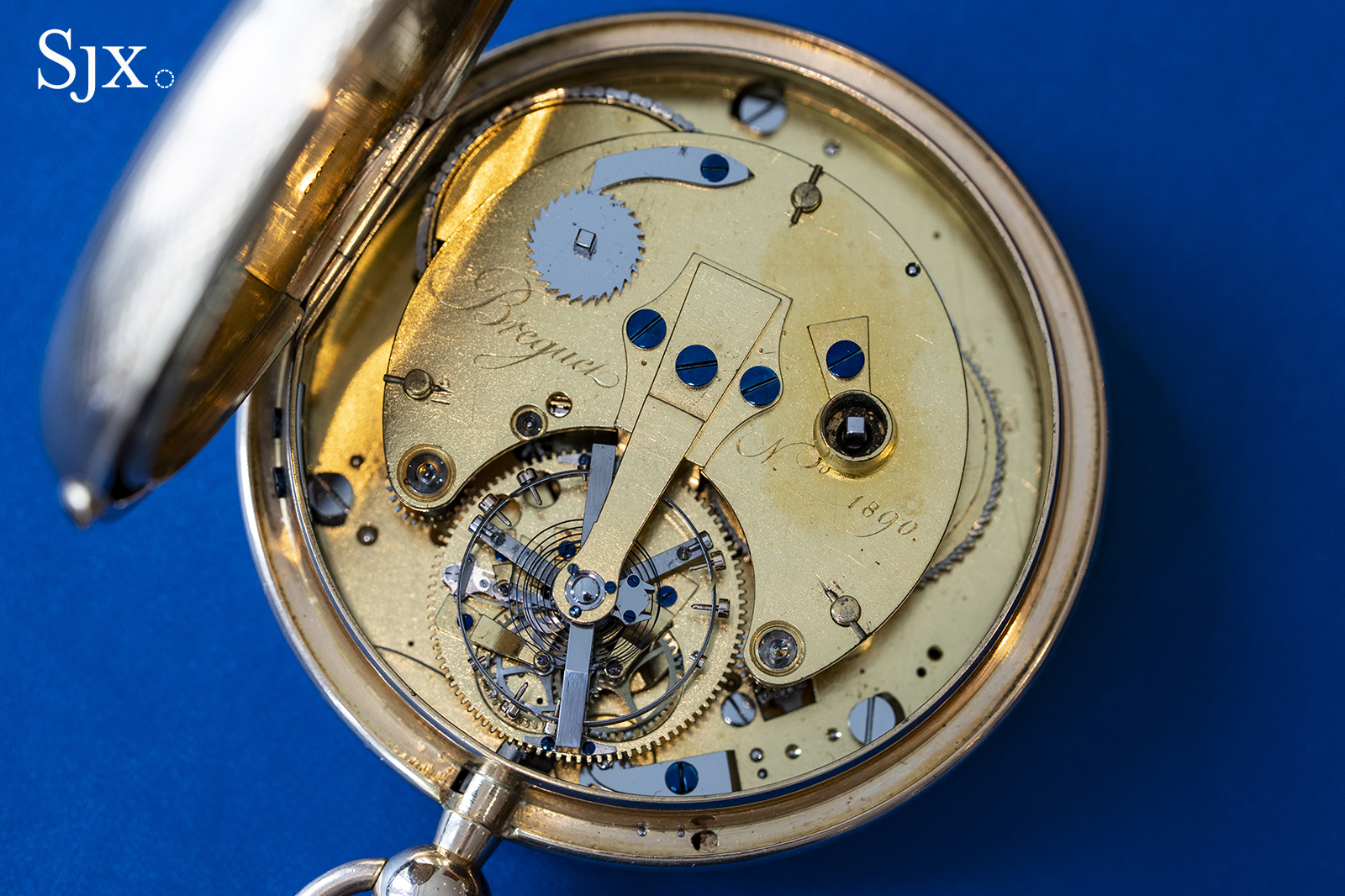
Houriet also designed and constructed a series of one-minute tourbillon pocket chronometer movements for private clients, which are widely recognized as the first to feature a true stop-tourbillon mechanism. These movements adhered closely to traditional chronometer conventions, featuring plate-and-pillar architecture, chain and fusee constant-force mechanisms, massive free-sprung compensation balances, and spring detent chronometer escapements—though utilizing Houriet’s signature spherical balance spring rather than the helical form typically found in marine chronometers—along with his signature dial-side bimetallic thermometer.
Opening the bezel of these watches, a step necessary to access the time-setting square, reveals a small sliding tab integrated into the case band. Moving this tab lifts a delicate spring away from, or drops it onto, the third wheel of the gear train, bringing the entire transmission to an immediate halt. This mechanism can be clearly observed on a Hunt & Roskell-signed watch housed within the British Museum’s collection, dating from before 1836, as well as on an Urban Jürgensen watch from around 1930 featured in Reinhard Meis’s definitive text, Das Tourbillon.
Watch No. 88, produced around 1830 by Philippe Du Bois of Le Locle and also featured in Das Tourbillon, showcases a fascinating mechanical variation where the sliding tab directly locks the third wheel. Intriguingly, Meis makes no explicit mention of this integrated feature, nor does the British Museum in its documentation, though historic auction house catalogues have successfully identified a "stop feature" on alternative Dubois pieces and on a Berthoud Frères watch equipped with a stop-slide hidden beneath the bezel.
Stopping the third wheel is inherently less direct and responsive than stopping the balance wheel directly, or even arresting the fourth wheel and tourbillon cage. Consequently, it remains slightly unclear whether this specific intervention was intended for precise daily time setting or for another technical purpose, such as allowing the watchmaker to safely remove the tourbillon assembly for adjustment. Furthermore, because the delicate detent escapement is not self-starting, a gentle lateral shake of the watch is required to set the mechanism back into motion once released.
Louis Richard: Stopping the Cage and the Third Wheel
Swiss chronometer maker Louis Richard is a figure of immense renown among a very select group of connoisseurs—not least the two dedicated collectors who engaged in a fierce bidding war for his absolute magnum opus at Phillips. Watch No. 12 combines an elaborate, experimental constant-force escapement with a one-minute tourbillon. While conceptually similar, Richard’s constant-force escapements varied significantly between individual examples, underscoring just how experimental these historical pieces truly were, which largely explains their immense modern appeal among serious collectors.
The intricate escapement comprises three distinct detents: two traditional spring detents and one pivoted detent. Rather than directly delivering impulse to the balance wheel as seen in a typical chronometer escapement, the otherwise conventional escape wheel continuously charges the pivoted detent, which remains securely locked by the second spring detent. When the balance wheel swings through and unlocks the second detent, the fully charged pivoted detent fires forward to impulse the balance.

While the raw driving force delivered by the escape wheel naturally fluctuates as the mainspring gradually winds down, the fully charged pivoted detent consistently delivers a uniform pulse of energy to the balance wheel. However, this complex method is inherently less efficient than a traditional chain and fusee system, as it intentionally sacrifices a substantial portion of the mainspring’s total energy reserve in the pursuit of absolute force constancy. It was also vastly more difficult to manufacture than the already complex chain and fusee, which easily explains why it never achieved broader commercial adoption despite its sound theoretical foundations.
Much like Houriet’s tourbillons, Watch No. 12 can be arrested at the level of the third wheel. By turning a fork-tailed screw from the letter M—representing marche, meaning "go"—to the letter A, representing arret, meaning "stop," a spring-loaded pin is allowed to drop directly between the teeth of the third wheel located on the dial side, locking the gear train securely in place.
Additionally, sliding a dedicated tab integrated into the case band allows the owner to stop the tourbillon cage directly by pivoting an internal mechanical lever connected to an S-shaped hacking lever positioned on the rear of the movement. This structural redundancy can likely be explained by the third wheel lock being intended primarily for the professional watchmaker’s benefit rather than the everyday owner’s convenience, as it is not easily accessible during normal operation. Locking the third wheel allows a watchmaker to remove the delicate tourbillon cage for adjustments without needing to fully let down the mainspring.

The active hacking lever used here—a design found in contemporary Chopard tourbillons, Grand Seiko’s Kodo, and numerous other modern wristwatches—stops the tourbillon cage instantly, even though the balance wheel continues to oscillate under its own inertia for a brief period afterward. Hacking the fourth wheel, which a one-minute tourbillon cage essentially functions as, is uncommon but not entirely unprecedented in standard non-tourbillon watches, with Daini Seikosha’s Calibre 44 of King Seiko fame serving as perhaps the best-known historical example.
Nicole Nielsen: Stopping the Balance Directly
The earliest known tourbillon movement to successfully stop the balance wheel directly is a silver sweep-seconds tourbillon crafted by Nicole Nielsen for Thomas Russell and Son of Liverpool around 1906, though historical horology leaves open the possibility of earlier precursors. Founded in Le Solliat in the Vallée de Joux in 1837 as Nicole & Capt, the firm subsequently expanded its operations to London, eventually becoming Nicole, Nielsen & Co. after Danish-born watchmaker Sophus Emil Nielsen joined the partnership in 1870.
As the preeminent English tourbillon manufacturer at the turn of the 20th century, Nicole Nielsen produced a remarkable variety of tourbillon timepieces, including what is widely regarded as the most complicated historical tourbillon ever made, alongside some of the earliest flying tourbillons.

Operating the system involves pressing a dedicated pin integrated into the case band, which pushes a physical wire hack directly into the path of the balance wheel. While the rotating cage’s three structural pillars will intermittently block the hacking wire during its rotation, this presents a minor mechanical hurdle when zeroing the seconds hand. Because the tourbillon cage and the seconds hand both complete a full rotation in exactly sixty seconds, a watchmaker positioning the seconds hand when the balance is exposed ensures the balance will always be safely exposed whenever the hand nears the zero position.
Master horologist George Daniels once described a Nicole Nielsen tourbillon as being "as fine a watch as has ever been made, and one whose performance can hardly be bettered" in his 1965 publication Watches. It is hardly surprising, therefore, that Daniels chose to utilize wire hacking mechanisms in a few of his own handcrafted tourbillon watches, including the famed unfinished movement he left behind, albeit for a distinctly unusual operational purpose.
As the mainspring neared total exhaustion, an internal mechanism linked to the power reserve would release the wire hack, bringing the watch to a complete stop until it was rewound by the user. Daniels firmly believed that it was structurally preferable to halt the watch entirely and alert the owner rather than allow it to run under sub-optimal power conditions. Here again, the rotating cage pillars posed no permanent obstacle; even if a pillar temporarily blocked the wire, the continuous rotation of the tourbillon would quickly move the pillar out of the way, and the precise stopping point of the cage was ultimately immaterial.

However, those same rotating pillars presented a major engineering problem for Helmut Geyer, a master watchmaker and movement constructor at Lange Uhren. Geyer’s innovative approach to hacking the tourbillon relied on an ingenious M-shaped spring, based on the logical premise that one functional end of the spring would always make contact with the balance wheel, even if the opposite end happened to be temporarily obstructed by a cage pillar.
Patented in 2001, Geyer’s invention did not officially debut until 2008 with the arrival of the Cabaret Tourbillon, arriving just after his retirement from active watchmaking. While the Cabaret Tourbillon was not technically the very first hacking tourbillon ever produced—as it is frequently characterized—it was undisputedly the first produced in commercially significant numbers, and Lange’s dual-pronged technical approach to hacking proved both novel and exceptionally reliable.
Lange’s sister brand, IWC, subsequently adopted a very similar mechanical approach for its own tourbillons shortly thereafter. Jens Schneider, another prominent member of the team behind Lange’s Sax-0-Mat project, also deserves special recognition for his experimental brush-hack mechanism, which utilized ultra-fine bristles fashioned from human hair to gently stop the balance wheel. Not to be overlooked is the pillar-less Exotourbillon design, which elegantly avoids the entire issue of cage obstruction altogether.

Geyer, alongside the aforementioned tourbillon expert Reinhard Meis, also engineered A. Lange & Söhne’s 1997 Sax-0-Mat calibre, which utilized a traditional heart cam and operating hammer—a brilliant mechanism originally invented by Nicole Nielsen—to instantly snap the running seconds hand back to zero whenever the winding crown was pulled out. In 2014, Lange successfully combined both of Geyer’s historic inventions to create a sophisticated hacking tourbillon featuring a zero-reset seconds function within the 1815 Tourbillon.
Gene Clark: Stopping at Zero
Gunsmith-turned-horologer Gene Clark built a total of just seven watches during his lifetime in his remote workshop nestled in the Rocky Mountains of Pagosa Springs, four of which were complex tourbillons. Clark was an exceptionally skilled artisan capable of fabricating nearly every single metal component that went into his timepieces, ranging from delicate detent and passing springs to rolling his own custom steel mainsprings before eventually transitioning to Swiss imports. According to a profile published in a 1988 issue of the Horological Times, he even alloyed his own gold, creating a durable 19-karat gold alloy for his watch cases alongside 16-karat and 22-karat variations specifically tailored for internal escapement components.
Reportedly, only two tasks remained beyond his independent capabilities: free-hand dial engraving and gear-tooth counting. Clark utilized a traditional wire hack in his first tourbillon, designated Watch No. 7, to stop the balance wheel housed inside the two-minute tourbillon cage. His second tourbillon omitted any stop feature whatsoever, choosing instead to focus entirely on an integrated constant-force mechanism. However, his third and fourth tourbillons featured sophisticated hacking mechanisms engineered to halt the watch precisely when the seconds hand reached the zero mark.

On Watch No. 5, pressing a small button integrated into the case band rotates an internal column wheel, which in turn shifts a mechanical lever either toward or away from the fourth wheel driving the tourbillon. A dedicated stop pin mounted on the fourth wheel collides directly with the extended lever, arresting the watch precisely so that the seconds hand stops in the exact same position every time—ideally zero, provided the hand was properly fitted during assembly.
Watch No. 32 completely eliminated the column wheel, instead utilizing one dedicated button to extend the stop lever into position, and a separate button to retract it and restart the watch—a solution that feels remarkably harmonious with the 18th- and early 19th-century pocket chronometers that originally inspired Clark’s work. Simple, elegant, and highly practical, this direct mechanical approach exemplifies the ingenious problem-solving spirit that historic watchmakers applied to conquering the persistent challenge of the hacking tourbillon.