





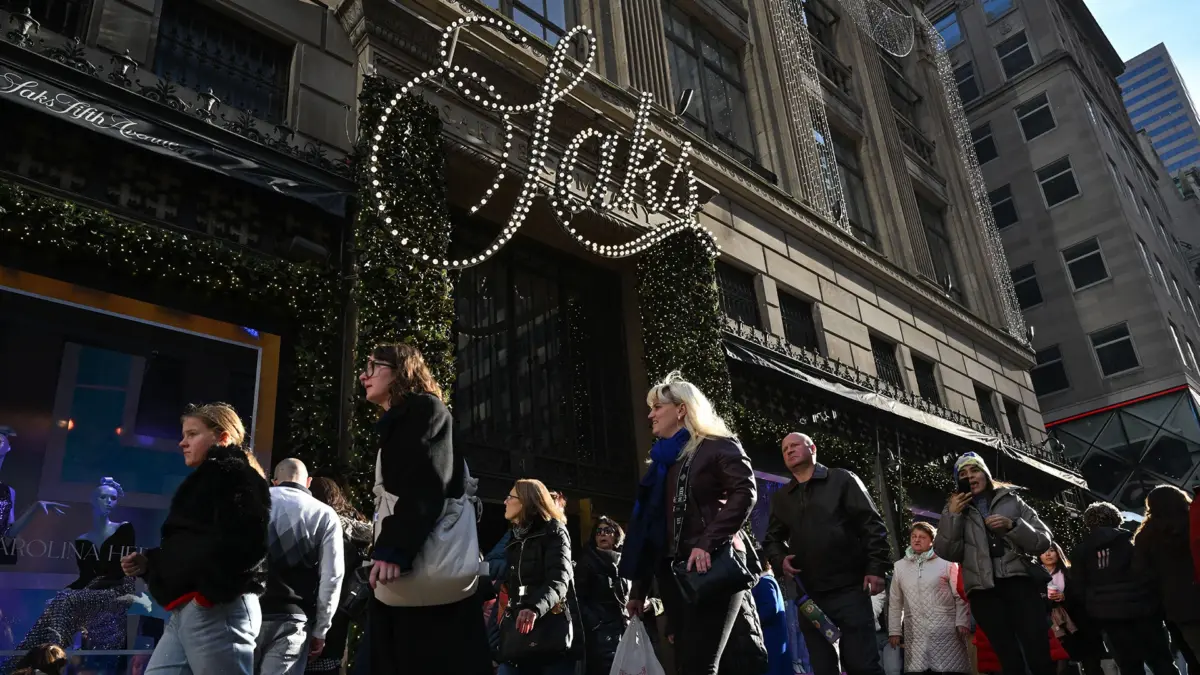
Long before modern algorithms dictated our digital shopping carts and curated our social media feeds, luxury retail had a definitive north star: Saks Fifth Avenue. For generations of discerning buyers, the name was synonymous with uncompromising elegance, high glamour, and impeccably curated taste. Inside its legendary Midtown Manhattan flagship, designer Donatella Versace once declared, “Saks is New York,” capturing a sentiment that resonated far beyond the borders of Manhattan. Across the United States, its sumptuous department stores stood as towering architectural and cultural destinations in their own right, where shopping was elevated from a mere errand to an immersive, theatrical experience.
From Armani to Zegna, the retailer’s polished floors once carried rack upon rack of the world’s most enticing indulgences. Shoppers could browse Oscar de la Renta evening gowns, snakeskin Gucci loafers, precise Montblanc fountain pens, Dior eaux de toilettes, meticulously tailored Ralph Lauren suits, and matching Burberry trench coats for both adults and children. There were classic Chanel 2.55 handbags, practical yet sophisticated Louis Vuitton briefcases, and—under its own prestigious house label—meticulously crafted pearl necklaces, buttery calfskin gloves, and cashmeres so soft they defined understated luxury.
“Saks was the reliable destination where you knew you could find whatever you wanted,” reflects Julia Stedman, a New York-based brand-strategy consultant specializing in fashion and technology who patronized the stores for decades. “Every luxury brand was there.”
Footwear proved to be a particularly formidable cornerstone of the department store’s enduring appeal, anchored by covetable labels like Manolo Blahnik, Roger Vivier, Jimmy Choo, and Christian Louboutin. Within the imposing Manhattan flagship—a magnet for both stylish locals and international tourists since its doors opened in 1924—the massive eighth-floor designer shoe department attained a unique distinction that no other commercial enterprise in the United States could claim. In 2007, the United States Postal Service formally granted the floor its own dedicated zip code: 10022-SHOE.
“It was a great shoe department to begin with,” Stedman recalls. “And then they expanded it. Literally, you could find anything and everything you could ever imagine and ever want. And it was always packed and bustling.” In the 2008 film The Women, Annette Bening’s character offered a simpler, widely accepted verdict: “Nobody. Hates. Saks.” At the time, few could argue.

A Stained Prestige and Financial Turmoil
Over the past few years, however, the storied company’s immense prestige took a severe beating. A cascading series of financial and managerial complications, largely tied to the ambitious 2024 acquisition of Neiman Marcus, ultimately culminated in Saks Global filing for Chapter 11 bankruptcy protection in January with a staggering $3.4 billion in debt. Following a complex restructuring process, the firm announced in June that it had successfully emerged from bankruptcy. Operating with a significantly trimmed footprint of stores, the parent entity has since been rebranded as the Exemplar Luxury Group. Whether Saks can fully recover its historic stature—and win back the enduring affection of luxury shoppers—remains an open question across the retail landscape.
Even before the formal restructuring, the everyday shopping experience had perceptibly deteriorated. Customers increasingly walked into their once-beloved department stores only to find sporadic, sparse assortments across their favorite categories.
“People just felt that it wasn’t the same Saks that they used to shop at,” notes Anita Berger, a former senior salesperson at the Saks Fifth Avenue location in St. Louis, Missouri, which had maintained a fiercely loyal client base for more than half a century.
To be fair, traditional department stores have faced immense existential pressure for years. Consumers have increasingly shifted their spending habits online, purchasing directly from brand e-commerce sites, major digital platforms, and secondary resale markets like TheRealReal. Instead of spending leisurely afternoons browsing physical racks and seeking advice from trusted, long-term sales associates, modern shoppers frequently find their inspiration scrolling through social media feeds. Furthermore, formal suits and men’s neckwear no longer anchor everyday professional wardrobes the way they once did, a cultural shift accelerated by the COVID-19 pandemic. The classic grand-department-store model—featuring floor after cavernous floor packed densely with inventory—may well have run its course.
“What you have is literally this transition and shift in the paradigm,” observes Marshal Cohen, chief retail adviser at Circana, a consumer-buying pattern tracking firm. “The model needs to adjust.”

As Bain & Company noted in a comprehensive 2024 report examining the state of American department stores, many domestic shoppers have grown indifferent or outright averse to the traditional format.
Cracks Beneath the Surface
Even before Saks Fifth Avenue finalized its purchase of Neiman Marcus in December 2024, industry insiders sensed deep trouble as familiar buyers and experienced sales staff began turning over at an unsettling rate.
“You could kind of smell that something was going on, just because everything was getting a little difficult,” says Daniel Wingate, founder and creative director of Wingate, a collection of sophisticated designer women’s apparel previously sold at trunk shows across Saks locations. “The people in the stores were in and out and changing, unhappy. Then, the rumor started that they were trying to buy Neimans.”
That rumor proved accurate, but the acquisition saddled Saks Global with a crushing debt load that soon crippled its ability to pay routine bills. Eventually, many luxury brands felt they had no operational choice but to halt shipments entirely.
“Every one of my clients was saying, ‘God, the stores look so bad—there’s no inventory,’” explains Gary Wassner, CEO of Hilldun, a financing firm that guarantees payments for roughly 180 fashion and beauty brands carried across Saks Global stores, including Rick Owens, Golden Goose, Ulla Johnson, Isabel Marant, and Victoria Beckham. “The consumer was well aware walking into any Saks Fifth Avenue that the inventory was depleted. It was quite noticeable, particularly as the days wore on.”

“My floor looked so bad,” echoes Berger, the former St. Louis salesperson. “Customers would come in and say, ‘Are you closing? This looks like Saks Off 5th.’ There was nothing new and exciting because they couldn’t get anything—they owed money to everybody.”
Babatunde Fakuade, who worked for nearly a year as a salesperson at Neiman Marcus Lenox Square in Atlanta, shares a similar recollection. “We never had a full size run of dresses. We would get size 2, 12, 8. It’s like, ‘Where are the other sizes?’ We didn’t get a delivery of full size runs of dresses for months at a time.”
The St. Louis store where Berger spent nearly a decade ultimately closed its doors in May, though she had already departed the previous September. “How they were treating us, how they were not paying, how the store looked—I just started to feel like, ‘I need to get out,’” she says. Fakuade similarly chose to leave Neiman Marcus to pursue a career as a retail business consultant.
Legacy Debt and Real Estate Focus
The cash-flow complications predated the Neiman Marcus acquisition. Saks Global had combined Saks Fifth Avenue, Neiman Marcus, Bergdorf Goodman, Horchow, and discount divisions Saks Off 5th and Last Call. However, Saks entered the merger already carrying substantial debt, much of it linked to its 2013 purchase by the Hudson’s Bay Company, the historic Canadian retailer with roots stretching back to 1670.
Early strategic moves frequently raised industry eyebrows. The Fifth Avenue flagship building was mortgaged in 2014 for approximately $1.2 billion, necessitating heavy monthly debt service payments. In 2016, the company acquired off-price retailer Gilt Groupe for $250 million to bolster Saks Off 5th, only to sell it a couple of years later for an undisclosed sum widely rumored to be far lower. Additional investments piled further recurring financial obligations onto a cash-strapped balance sheet.

“There were a lot of prior Hudson’s Bay issues—leases and bonds—that Saks, through succession, became obligated on,” explains Lorenzo Marinuzzi, a partner at the law firm Morrison Foerster, which represents Saks Global’s unsecured creditors, including fashion giants Chanel and LVMH.
The financial baggage of Hudson’s Bay did little to soothe vendors awaiting timely payments. As Marinuzzi puts it, “When you’re telling your vendors that you don’t have money to pay them for goods they’ve sold or shipped or consigned or delivered to your stores, yet you’re paying off this Hudson’s Bay debt, it rubs people the wrong way.” Hudson’s Bay Company ultimately filed for bankruptcy and closed all its remaining stores.
As Saks Global unraveled, many observers pointed a finger at Richard Baker, who served as Hudson’s Bay Company’s governor, executive chairman, and CEO, and subsequently assumed the role of executive chairman at Saks Global. Baker’s professional background is rooted heavily in real estate, leading critics to argue that his approach to managing retail department stores prioritized property acquisition and dealmaking over the delicate craftsmanship of a designer gown. Baker previously purchased Lord & Taylor in 2006, sold its flagship building to WeWork in 2017, and transferred its retail operations to Le Tote in 2019 before the brick-and-mortar locations permanently closed in 2020.
This strategic pivot was explicitly reflected in corporate communications. A July 2024 press release announcing the Neiman Marcus purchase described the merged entity as “a combination of world-class luxury retail and real-estate assets.” Upon finalizing the transaction, Baker stated the goal was to “redefine the luxury shopping experience” through, among other assets, “a portfolio of prime real estate.”
“There’s a lot of head-scratching about the way Richard Baker handled himself and ran the company, his background—maybe it wasn’t the right background for this kind of retailer,” Marinuzzi says. “When people thought about the decisions that were being made and how the company was being operated, they didn’t really trust management, and they didn’t trust Richard Baker.”

Baker departed Saks Global in January. Today, his public focus appears to have returned to real estate development, highlighted by social media profiles describing him as being “Behind $Billions in Real Estate.” When approached for comment regarding this story, Baker stated, “No comment on Saks at this time.” Exemplar Luxury Group similarly declined repeated requests to make current executives available for interviews.
The Cost to Vendors
When Saks Global formally filed for Chapter 11 bankruptcy protection, court documents revealed staggering sums owed to the world’s most prominent luxury brands. Filings from January 2026 showed liabilities exceeding $136 million owed to Chanel; roughly $60 million to Kering, the parent company of Gucci, Saint Laurent, and Bottega Veneta; approximately $30 million to Richemont, owner of Cartier, Montblanc, and Chloé; and nearly $16 million to the Estée Lauder Companies, whose portfolio includes La Mer, Jo Malone London, Le Labo, and Tom Ford.
While global luxury conglomerates possess financial cushions via independent boutiques and expansive international reach, smaller independent brands faced much more crippling vulnerabilities.
“As a small business, you have limited bandwidth,” says a senior executive at a critically acclaimed beauty brand formerly carried by Neiman Marcus. “Finances are not just endless.”
The brand has still not recovered the six-figure sum it is owed for orders fulfilled prior to the bankruptcy, forcing its management team to cut external contractors and let go of key personnel. Similar sacrifices echoed across the independent sector. Executives at various other beauty and fashion labels reported canceling advertising campaigns, marketing programs, product launches, and runway shows. One prominent designer brand laid off 20 percent of its staff to survive what executives termed a devastating “cash vacuum,” estimating that the financial fallout will stall the business’s growth trajectory by five years.

Communications with the retailer reportedly broke down entirely for months. Furthermore, vendor inquiries regarding unpaid invoices were frequently routed to administrative representatives in Bengaluru, India, where Saks Global had centralized functions including finance, human resources, merchandising, analytics, and marketing.
“It felt like people who really were not connected to who we were,” one fashion executive notes. “You’re trying to explain to India how you work. In the end, it felt like that was a stunt to just delay your payments.”
While independent labels struggled, a source familiar with the retailer’s vendor disbursements indicated that many world-renowned design houses received at least half of their outstanding balances, with some major brands recovering nearly their entire owed amounts under strict confidentiality agreements. Hilldun successfully recovered virtually all approved debt for its client base, shielding its designers from the worst of the fallout.
Rebuilding Trust and Looking Ahead
In the wake of its bankruptcy filing, Saks Global executed a sweeping restructuring, closing 21 stores—including 18 Saks Fifth Avenue locations and three Neiman Marcus stores—in cities such as Chicago, Costa Mesa, Las Vegas, St. Louis, San Antonio, and McLean, Virginia. More than 60 Saks Off 5th and Last Call discount outlets were also shuttered. Viral videos on TikTok captured barren, markdown-heavy floors that further damaged consumer perception.
However, an initial infusion of $1.75 billion in new capital allowed suppliers to be paid and inventory to begin flowing once more. By March, Exemplar Luxury Group announced that nearly 600 brands had formally resumed shipping products. According to corporate figures, associates across Bergdorf Goodman, Neiman Marcus, and Saks Fifth Avenue are currently recording higher overall sales compared to the same period in the previous year.

Despite these operational steps forward, rebuilding foundational trust with both discerning consumers and skeptical fashion houses remains a formidable hurdle.
“It’s hard to come out of that with both your brand partners and with your consumers,” notes Aaron Cheris, a partner at Bain & Company and head of its global retail practice. For shoppers especially, negative experiences with depleted inventory and lackluster service create a psychological doom loop that requires immense effort to reverse.
The core challenge, Cheris emphasizes, is simple: “Can you convince both suppliers and customers that there’s a new day one?”
For independent designers weighing their options, Exemplar’s recent struggles may ultimately benefit competitors. As one industry insider observes, “Now more than ever, every brand I know wants to be in Bloomingdale’s. It’s almost like Bloomingdale’s and Nordstrom will become what Barneys was in the ’80s.”
Meanwhile, longtime patrons remain cautious. “It’s going to take a while to rebuild my trust,” Stedman says, reflecting on the months of empty shelves and continuous clearance events. “During that time, what made Saks special was not there anymore. I’m going to take a wait-and-see approach and see what happens with them.”