




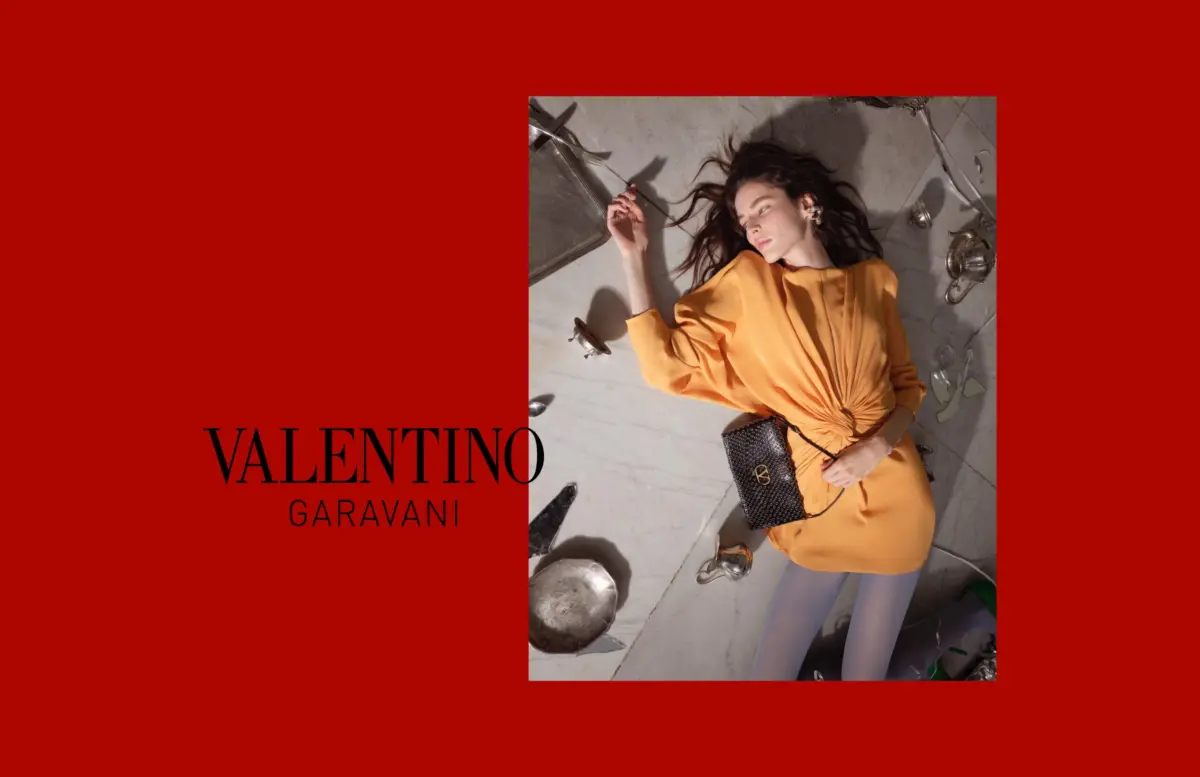
Holidays, galas, and lavish celebrations have historically gone hand in hand with the fashion industry, serving as the ultimate backdrop for resort and cruise collections. For Valentino’s upcoming Cruise Holiday 2027 campaign, creative director Alessandro Michele has leaned directly into this festive association, but with a characteristically melancholic and philosophical twist. Rather than capturing models reveling in the height of euphoria during an active party, Michele’s vision—lensed by photographer Liv Liberg back in July—transports the viewer to the morning after. The setting is an antique palazzo once the festivities have officially concluded, leaving behind the unmistakable physical evidence of a remarkably wild night.
In the striking campaign imagery, the opulent floor of the historic venue is strewn with the chaotic remnants of celebration: shattered crystal glasses, discarded silver plates, overturned chairs, and fallen chandeliers. Amidst this architectural and decorative wreckage, models George Anderson, Joe Bottomer, Khadim, Libby Taverner, and Dario Tonin are captured lounging and resting. Instead of dynamic action shots, the campaign focuses on a state of quiet recovery and stillness.
In an accompanying letter detailing the creative direction of the project, Michele elaborates on the mood of the imagery. He describes it as “that suspended moment when the euphoria has faded and the space still holds the traces of something that has already happened.” He notes that the models appear “immersed in an atmosphere in which beauty seems to have survived the tumult of the night,” characterizing the scenes as “an awakening of sorts” where “what remains offers itself as material for a story yet to be imagined.”
However, for a designer known for his deeply pensive and intellectual approach to fashion, these photographs operate on a much deeper, more metaphorical level than a mere morning-after aesthetic. Shot months prior, the imagery ultimately serves as a poignant reflection on fashion’s evolving values, broader societal shifts, and the resilient nature of beauty amidst profound transformation.
“From the very beginning, this representation contained a larger question: What remains of magnificence when its rituals come to an end? What happens when a universe built around the promise of desire encounters its own vulnerability?” Michele contends in his statement. For the designer, the aftermath of the party acts as a powerful metaphor for the sweeping changes currently underway across the global fashion system—an industry that has long relied on exceptionality, exclusivity, and spectacularization as its defining codes, but is now forced to confront a significant redefinition of its languages, values, and its shifting relationship with society at large.
The conceptual weight of the campaign took on an unexpected and sobering resonance in the wake of real-world events. As Michele observed the landscape around him, particularly pointing to recent protests concerning the soaring costs of living and the intense riots that have swept through various parts of Europe—leaving behind damaged storefronts and broken glass—he recognized an uncanny, unsettling parallel.

The imagery of damaged shop windows and urban disruption, he noted, suddenly began to mirror the visual universe he had constructed inside the studio months earlier. What had initially been conceived as the private, controlled landscape of a fictional party’s aftermath suddenly collided with the harsh realities of public disruption and civil rupture.
“What had been conceived as the private landscape of a party’s aftermath encountered the images of a rupture that had unfolded in public space,” Michele writes. He explains that this unforeseen convergence fundamentally altered the way the photographs could be viewed, opening them up to layers of meaning that could not possibly have been anticipated or calculated at the time the shutter was clicked back in July.
The realization brought moments of intense creative doubt. Michele admits that the striking overlap caused him to question whether it remained appropriate to release the campaign at all, noting that at one juncture he seriously considered abandoning the project entirely. Ultimately, however, he decided that hiding the images would bypass an important dialogue. He concluded that openly recounting the genesis of the photographs—the original intentions that gave birth to them and the questions that shaped them—might provide a valuable opportunity to reflect upon an unforeseen convergence between art and reality.
Furthermore, Michele saw it as a broader chance to examine the complex relationship between fashion imagery and the historical climate in which it is produced and consumed. He emphasizes that the meaning of any creative work is never fully exhausted at the exact moment of its creation; rather, subsequent historical and social events inevitably raise fresh questions, altering and deepening the way those visuals are interpreted by the public.
In discussing this phenomenon, Michele invokes the theoretical reflections of philosopher Walter Benjamin regarding the “dialectical image”—that fleeting, critical instant when what has been in the past encounters the present moment, giving rise to entirely new relationships and meanings that were previously difficult to discern.
By confronting these uncomfortable associations head-on rather than sweeping them under the rug, Michele states his desire to begin anew, anchoring the creative narrative in the enduring beauty that continues to inhabit human bodies and accepting the profound responsibility of engaging with the complex contradictions that run through contemporary society.