





Shortwave radios have long offered a vital way to connect one location on Earth to practically anywhere else with minimal infrastructure. Operating across vast distances by bouncing signals off the Earth’s upper atmosphere, these traditional radio setups bypass the need for costly cellular towers, fiber-optic cables, or complex terrestrial grids. But these classic radios have historically come with significant drawbacks. Unlike modern satellite communications, their transmission rates for digital data are typically frustratingly slow, measured in just hundreds of bits per second.
Despite these data limitations, innovators continue to find ways to squeeze unprecedented utility out of the high-frequency spectrum. Among them is Peter Bloom, the founder of Rhizomatica.
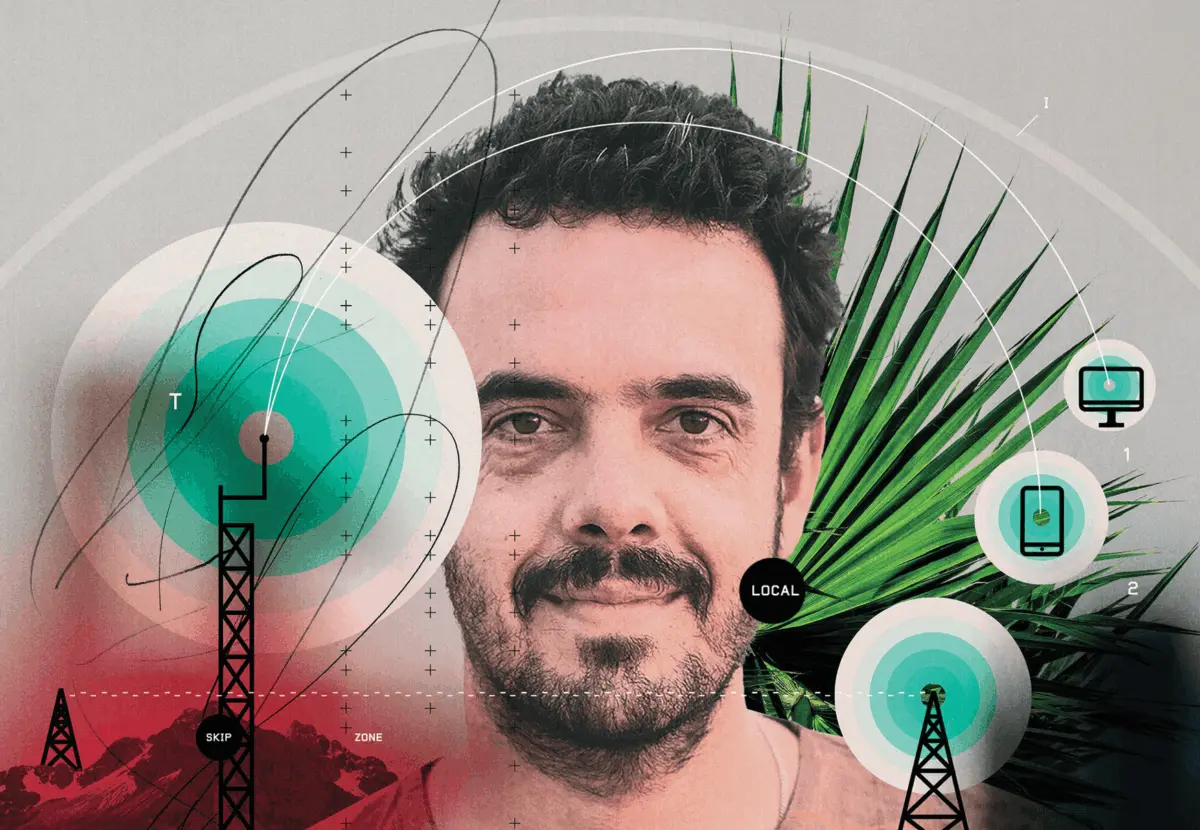
Peter Bloom
Peter Bloom is the founder of Rhizomatica, a Philadelphia-based nonprofit that works with remote, indigenous, and off-grid communities around the world to build shortwave and cellular-communication infrastructure. Rhizomatica has open-sourced an innovative digital shortwave-radio set called the High-frequency Emergency and Rural Multimedia Exchange System, or HERMES.
The HERMES set operates in the high-frequency, or HF, band spanning from 3 to 30 megahertz. Accompanying the radio hardware is Mercury, its specialized digital modem. Traveling extensively for his work, Rhizomatica staff journey to remote locations in developing and isolated regions across countries like Bangladesh, Brazil, and Ecuador. Wherever they go, they deploy HERMES to help bridge the digital divide, connecting localized populations directly to the broader global community.
Bloom recently spoke with IEEE Spectrum about how the HERMES project breathes new life into shortwave technology, bringing vastly improved data rates and modern encryption capabilities to an old-school medium.
How Does HERMES Connect Remote Locations?
Explaining the mechanics behind the technology, Bloom notes that the system turns Earth’s natural atmospheric layers into a global asset.
"We use the ionosphere as our satellite—or mirror—which helps us move information, voice, and data over really long distances," Bloom says. "We’re using small radios that put out about 20 watts of power, and we can pretty reliably do 400- to 600-kilometer links between two radios. We’re talking about places that are not easy to reach, where it’s not simple to put terrestrial infrastructure."
Because these regions often lack reliable electricity grids, paved roads, or internet service providers, relying on the ionosphere provides an elegant, self-contained method for maintaining lines of communication where everything else fails.
What Can HERMES Send That a Basic Voice Radio Can’t?
Traditional emergency and rural radio setups are strictly analog, limited to voice transmissions that can be prone to static, misinterpretation, or language barriers. HERMES, however, fundamentally changes what can travel across the airwaves.
"HERMES is a software stack—it’s a set of different programs that all work together in order to be able to send data over HF," Bloom explains. "HERMES allows you to send pretty much any file. Depending on what the file is, whether it’s a photo or an email or a voice memo, it just sends it as a file. It’s like a data pipeline over HF."
This capability transforms the shortwave radio from a simple walkie-talkie style communicator into a versatile digital utility capable of transmitting complex information packages across thousands of miles without requiring internet connectivity or expensive satellite subscription plans.
Why Does Sending Files and Data Matter More Than Just Voice?
In crisis scenarios, precision and clarity can mean the difference between life and death. Voice communication over noisy shortwave bands can easily lead to misunderstood numbers, misspelled names, or garbled coordinates.
"In emergency situations, people send their latitude and longitude over HF to say, ‘Hey, I’m here at this place,’" Bloom points out. "People need to be able to send data over HF if there’s a manifest, a parts list, telemedicine—here’s what we have, here’s what we need. Instead of trying to read that out over the air, it’s much easier to just send the file."
The utility extends far beyond emergency medical needs into environmental monitoring and community defense. According to Bloom, visual documentation is equally critical for remote populations facing external pressures.
"Same with a photo—if we need evidence that an area was logged illegally, we can just have someone send that over HF, rather than spending days getting down the river to get the photo where it needs to go," Bloom says.
Why Did You Build in Encryption That Amateur-Radio Regulations in Many Countries Don’t Allow?
Privacy and security are major concerns for indigenous groups, activists, and remote communities operating in politically sensitive or legally contested areas. However, adding encryption to shortwave transmissions crosses paths with strict regulatory frameworks governing amateur and hobbyist radio operators worldwide.
"Encryption [regulations] for ham radio operators are different in each country. So it’s all optional—you turn it on, you turn it off," Bloom clarifies. "The reason we built the encryption is that some of the partners we work with are in very sensitive areas and don’t want to be sending out information that can be easily captured and used against them."
By making encryption a modular, user-controlled toggle rather than a permanent default, Rhizomatica allows operators to balance local legal compliance with the physical security needs of vulnerable communities.
How Has HERMES Made an Impact?
The real-world value of open-source digital shortwave communication is already being demonstrated in the field. Rhizomatica’s ongoing pilot project with artisanal fishers in Bangladesh offers a clear glimpse of the technology’s potential to save lives at sea.
"We’ve been working with artisanal fishers in Bangladesh on a pilot project. There’s 10 or 11 boats that have HERMES systems on them," Bloom says. "Pretty soon after we installed those, one of the boats had a mechanical issue in the Bay of Bengal, 100 or 200 kilometers offshore. They were able to send their GPS position and an SOS that they were having trouble. They were able to coordinate the rescue of the crew and the boat. So that was a really cool moment of HERMES in action that we’re super happy about."