






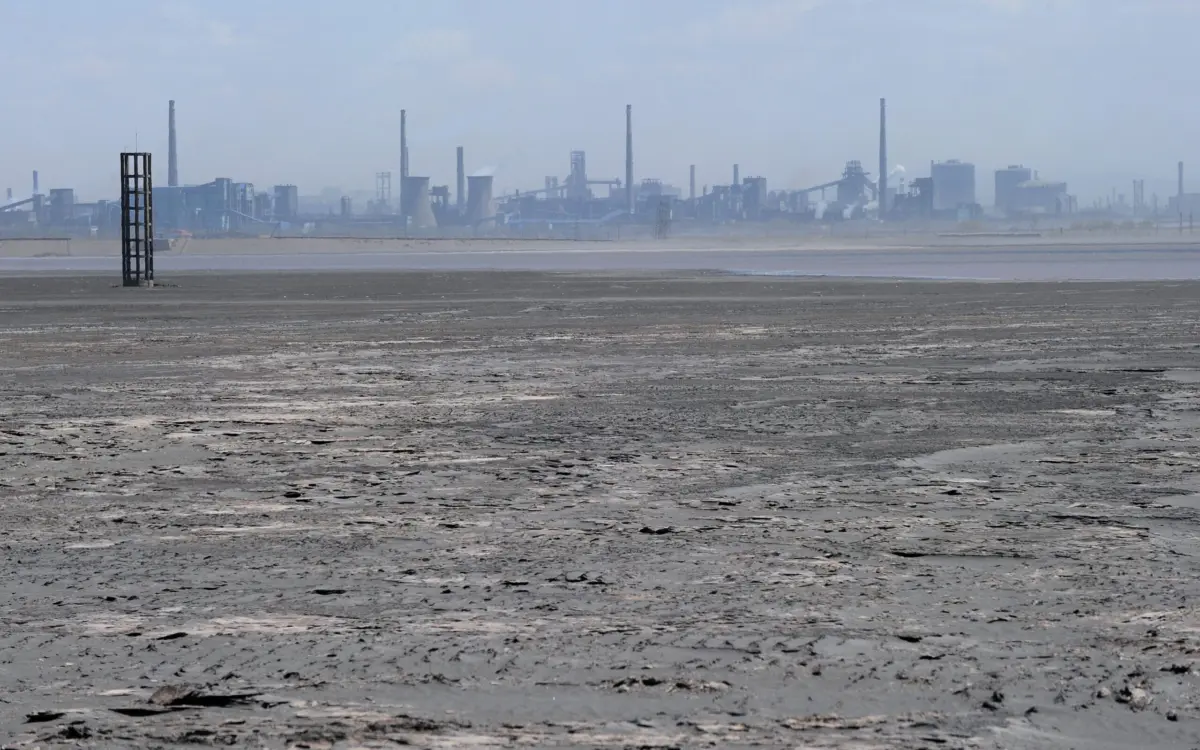
One of the singular features of Baotou, an industrial city of two million people nestled in China’s Inner Mongolia autonomous region, is a sprawling 10-square-kilometer (4-square-mile) artificial lake that stands among the most polluted bodies of water on earth. Commonly referred to by the name of the dam associated with it, the Weikuang Dam—also known as the Baogang Tailings Dam—has for decades served as the final resting place for a relentless tide of industrial effluent. This toxic slurry is the byproduct of minerals processing for China’s globally dominant iron, steel, and rare-earths industries.
Built in the late 1950s, the lake contains a highly toxic stew of industrial chemicals infused with substantial amounts of radioactive thorium. This radioactive element finds its way into the tailings primarily as a result of processing monazite ores for rare-earth elements. In the decades since the dam’s construction, China has drastically tightened its environmental regulations and imposed sweeping restrictions on mining and minerals processing. A prime example of this regulatory shift is rooted directly in the environmental catastrophe that is the Weikuang Dam: the country no longer permits the development or operation of stand-alone monazite mines. Under current Chinese law, a facility where nothing is mined except monazite ore is strictly forbidden.
Now, as industrialized nations across North America, Asia, and Europe spend billions of dollars to shore up their domestic rare-earths supply chains—and increasingly count on monazite to help them achieve that independence—China’s complex history and hard-earned experiences with the radioactive ore offer vital lessons for the global market.
The Role of Monazite in China’s Rare-Earth Dominance
Monazite ore remains a critical pillar of China’s formidable rare-earths industry because it serves as a prime source of several less common but extremely important rare-earth elements. Most notably, monazite is rich in dysprosium, terbium, yttrium, and erbium, elements that are indispensable for high-tech applications, defense systems, and green energy technologies. To maintain its manufacturing edge, China mines and processes vast quantities of domestic monazite ore, while simultaneously importing massive amounts of the ore from international sources to feed its relentless processing machine.
The vast majority of the monazite ore mined domestically in China comes from a single, gargantuan source: the mammoth Bayan Obo complex, located roughly 150 kilometers north of Baotou in Inner Mongolia. Bayan Obo is primarily an iron-ore mine, but geological fortune has made it home to the largest known rare-earth deposit on the face of the planet. It functions as the source for nearly half of all the rare-earth ore mined globally in a typical year.
Crucially, the vast majority of the rare-earth ore mined at Bayan Obo is a different mineral type called bastnaesite. It is the large-scale commercial mining of that bastnaesite that legally permits the concurrent mining of monazite ore at Bayan Obo. Without the primary bastnaesite operations providing the legal and operational umbrella, the strict regulations governing monazite extraction would make such high-volume recovery much more difficult under domestic Chinese law.
All told, ore extracted from the Bayan Obo complex was used to produce an astonishing 170,000 tonnes of rare-earth metal last year, according to David Merriman, research director at the minerals intelligence firm Project Blue. Industry estimates indicate that roughly 30 to 40 percent of the rare-earth ore mined at Bayan Obo is monazite. That domestic volume alone would be more than enough to position China as the world’s largest processor of monazite for rare earths, but Beijing’s ambitions extend far beyond its own borders.
China’s 2025 Monazite Imports Topped 70,000 Tonnes
A much more detailed and revealing picture of China’s enduring strategic interest in monazite emerges when observers examine the country’s aggressive importation of the ore. Last year alone, China’s imports of monazite amounted to more than 70,000 tonnes, according to Thomas Kruemmer, a Singapore-based consultant specializing in minerals and metals.
That import figure becomes even more impressive when one considers the unique and formidable logistical challenges of shipping monazite by sea. Because of its inherent radioactivity, concentrated monazite ore is classified as Class 7 dangerous cargo under the rigorous International Maritime Dangerous Goods Code. Because of this strict classification, Kruemmer notes, the radioactive ore can be legally imported through only four designated ports across the entirety of China.
Furthermore, the official importation of certain kinds of monazite into China is theoretically supposed to be funneled through a specific joint venture consisting of the China National Nuclear Corp. and Shenghe Resources, both of which maintain varying degrees of state ownership. However, a significant volume of imported monazite manages to bypass those specific state-backed organizations entirely, as Merriman points out.
The loophole lies in the handling of heavy mineral sands. These sands, which may contain roughly 2 to 3 percent monazite by weight, are not subjected to the exact same stringent import controls and regulatory hurdles as concentrated monazite ore. Consequently, commercial enterprises import the heavy mineral sands under broader commodity classifications, separate out various profitable industrial concentrates—including the valuable monazite mineral concentrate—and then process that recovered monazite to extract critical rare-earth elements.
Global Supply Chains and Strategic Maneuvering
In recent months and years, China has visibly stepped up its efforts to secure rare-earth ore and mineral assets around the world. One primary driver of this international push, Kruemmer explains, is simply to make up for recently lost supply channels as Western nations wake up to their strategic vulnerabilities.
The shifting geopolitical landscape was underscored when the U.S. government invested $400 million in MP Materials, the company that operates the vital Mountain Pass mine and processing facility located in California. That major financial intervention effectively put an end to longstanding commercial contracts under which MP Materials had previously been selling tens of thousands of tonnes of rare-earth concentrate annually to a trading affiliate of Shenghe Resources, cutting a key supply line to China.
Beyond merely replacing lost pounds, many Western analysts and industry insiders speculate that China possesses broader strategic motivations for stepping up its acquisition of heavy mineral sands and other rare-earth assets abroad. By locking down exclusive offtake rights, equity stakes, or direct ownership of deposits and processing projects globally, Chinese organizations are effectively making those resources unavailable to non-Chinese developers and rival industrial powers, according to this line of reasoning.
At the same time, Western nations are playing a similar game with high financial stakes. Merriman points out that an observer’s view of these global resource acquisitions largely depends on where they sit geographically and politically. The U.S. government recently made a conditional loan commitment of up to $725 million to Energy Fuels, a U.S.-based monazite processor that has been aggressively securing substantial monazite supplies across Australia, Brazil, and Madagascar.
To a Chinese policy observer or domestic industry analyst, those aggressive Western maneuvers to lock up global monazite supply chains likely look every bit as strategic and deliberate as Beijing’s own overseas investments.
China, meanwhile, continues to operate according to a long-established playbook that has secured its dominance over the modern technology metals market for decades. As Merriman succinctly puts it, China is simply playing its game.