




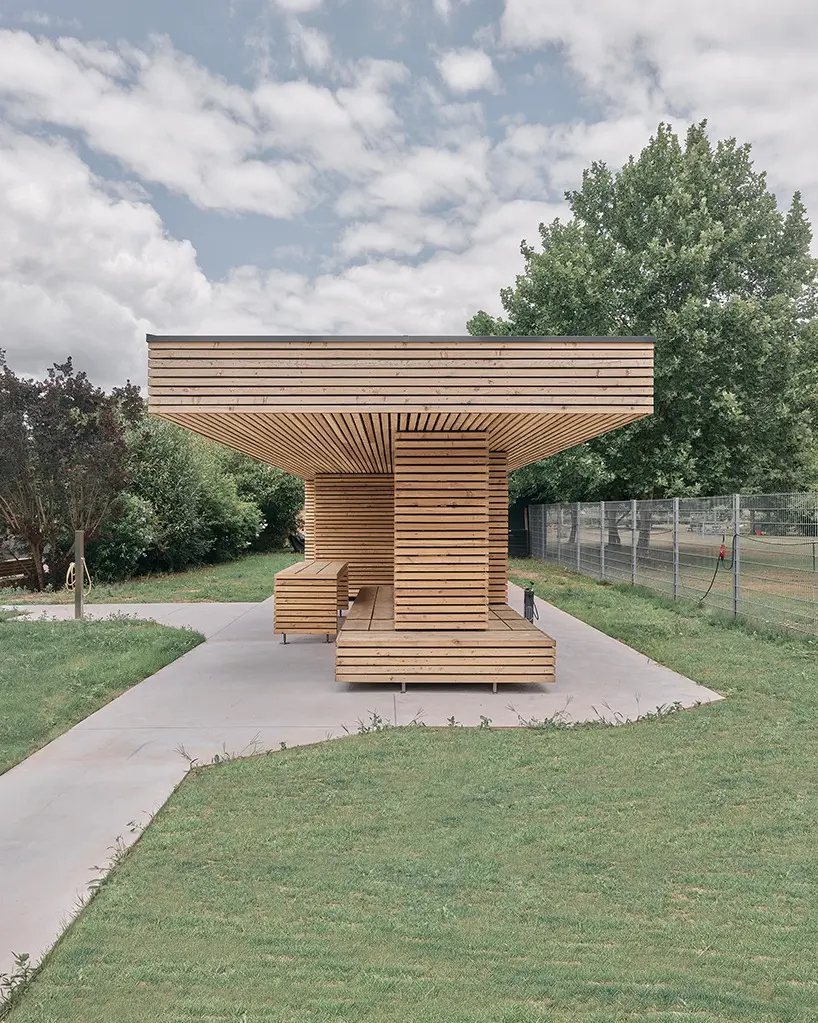
BURGSINN, GERMANY — Architectural practice ToB.Studio has completed a striking new public service hub along the D9 cycle route in Germany, blending regional forestry heritage with contemporary sustainable design. Positioned delicately at the transition zone between the built environment of the town and the surrounding natural landscape, the Burgsinn Cycling Rest Station offers a comprehensive suite of modern amenities for cyclists, local residents, and visitors to the area.
The project, captured in photographs by Benjamin Brückner, draws its primary visual and conceptual cues from the local history of forestry. Rather than imposing a standard, sterile utility building onto the landscape, the designers chose to reinterpret the familiar regional sight of stacked timber logs. This log-pile geometry shapes a compact, solid-looking volume that feels entirely at home within its wooded surroundings.
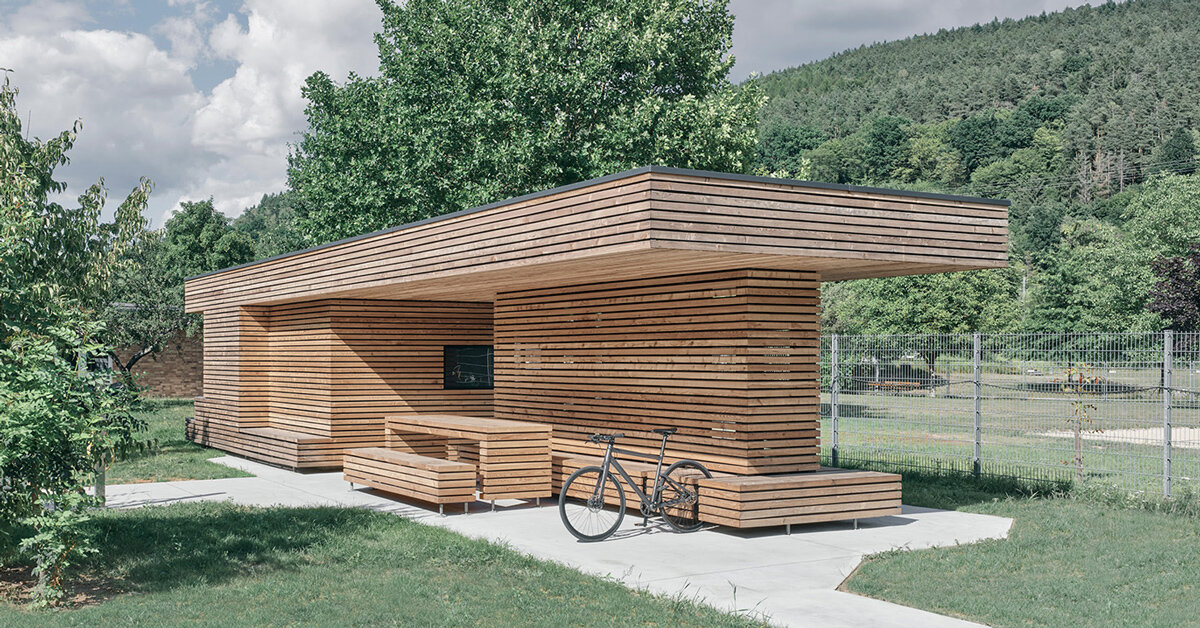
Log-Pile Geometry Shapes Timber Cycling Hub
The architectural concept centers on a robust, monolithic form that is carefully carved away rather than built up through added ornamentation. ToB.Studio conceived the entrances, sheltered seating areas, and essential service points as precise cuts into the compact timber figure. These carved-out niches open up the building in all four directions, creating inviting, sheltered spaces for travelers to arrive, rest, and meet one another before continuing their journey along the D9 route.
Crowning the structure is a broad, overhanging green roof that visually anchors the building into the topography while providing natural thermal insulation and ecological continuity. Beneath this protective canopy, the station serves a dual purpose as both a functional transit node and a community gathering point. It bridges the gap between active recreation and civic infrastructure, catering not only to long-distance cyclists navigating the German cycling network but also to local pool visitors and everyday pedestrians.
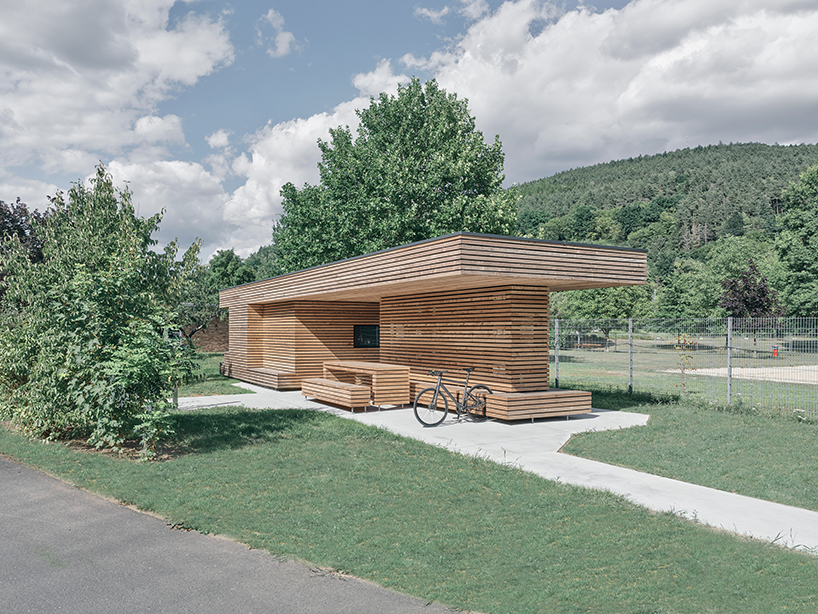
Rough-Sawn Larch Cladding Wraps Bike Station’s Exterior
At the heart of the Burgsinn cycling station is a robust array of modern public amenities designed to support sustainable mobility. The facility integrates high-capacity e-bike charging stations, a dedicated repair and wash area for bicycles, and digital information displays that keep travelers informed about local routes, weather conditions, and community notices. Additionally, the building houses accessible public restrooms and a shower facility, addressing a critical need for long-distance cyclists and outdoor enthusiasts seeking comfort on the road.
The material palette and construction methodology reflect a rigorous commitment to environmental sustainability and circular architecture. The entire station is built using a prefabricated timber frame, engineered strictly in accordance with Design for Disassembly principles. By utilizing reversible mechanical connections instead of permanent adhesives or complex composites, the architects have ensured that the building can be easily maintained, repaired, and eventually disassembled for material-specific recycling at the end of its lifecycle.
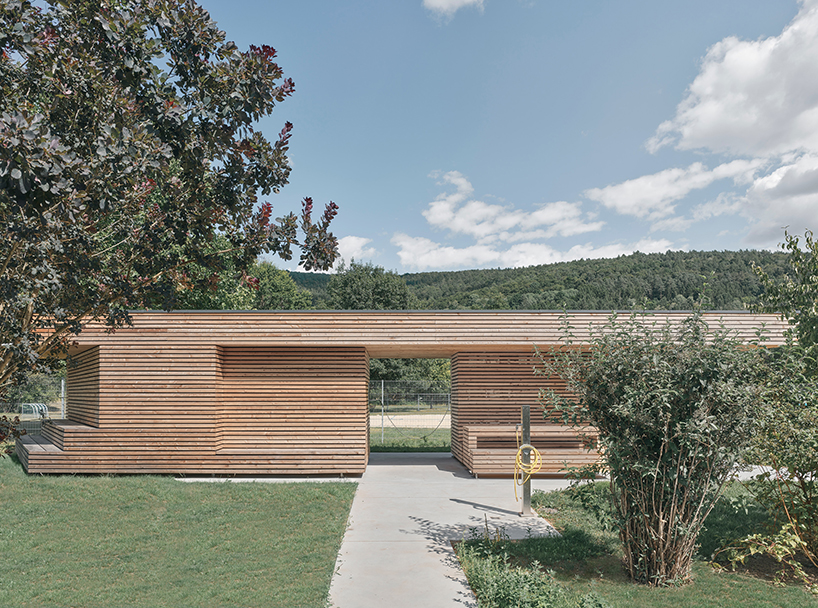
The exterior of the station is wrapped in rough-sawn, locally sourced untreated larch cladding, a material chosen for its exceptional durability and natural weathering characteristics. Over time, the larch will develop a silvery-grey patina, further harmonizing the building’s aesthetic with the surrounding landscape. Beneath the cladding, the wall assembly avoids synthetic membranes entirely, relying instead on high-performance wood-fiber insulation to create a breathable, environmentally benign envelope.
The entire structure rests upon a single reinforced-concrete slab. This foundational element performs multiple architectural roles simultaneously, serving as the structural base, an integrated flood barrier to protect against seasonal weather events, and the finished interior floor surface. Through this thoughtful integration of local materials, ecological construction techniques, and community-focused programming, ToB.Studio’s Burgsinn Cycling Rest Station establishes a forward-thinking benchmark for rural infrastructure along Europe’s expanding cycling networks.