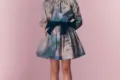





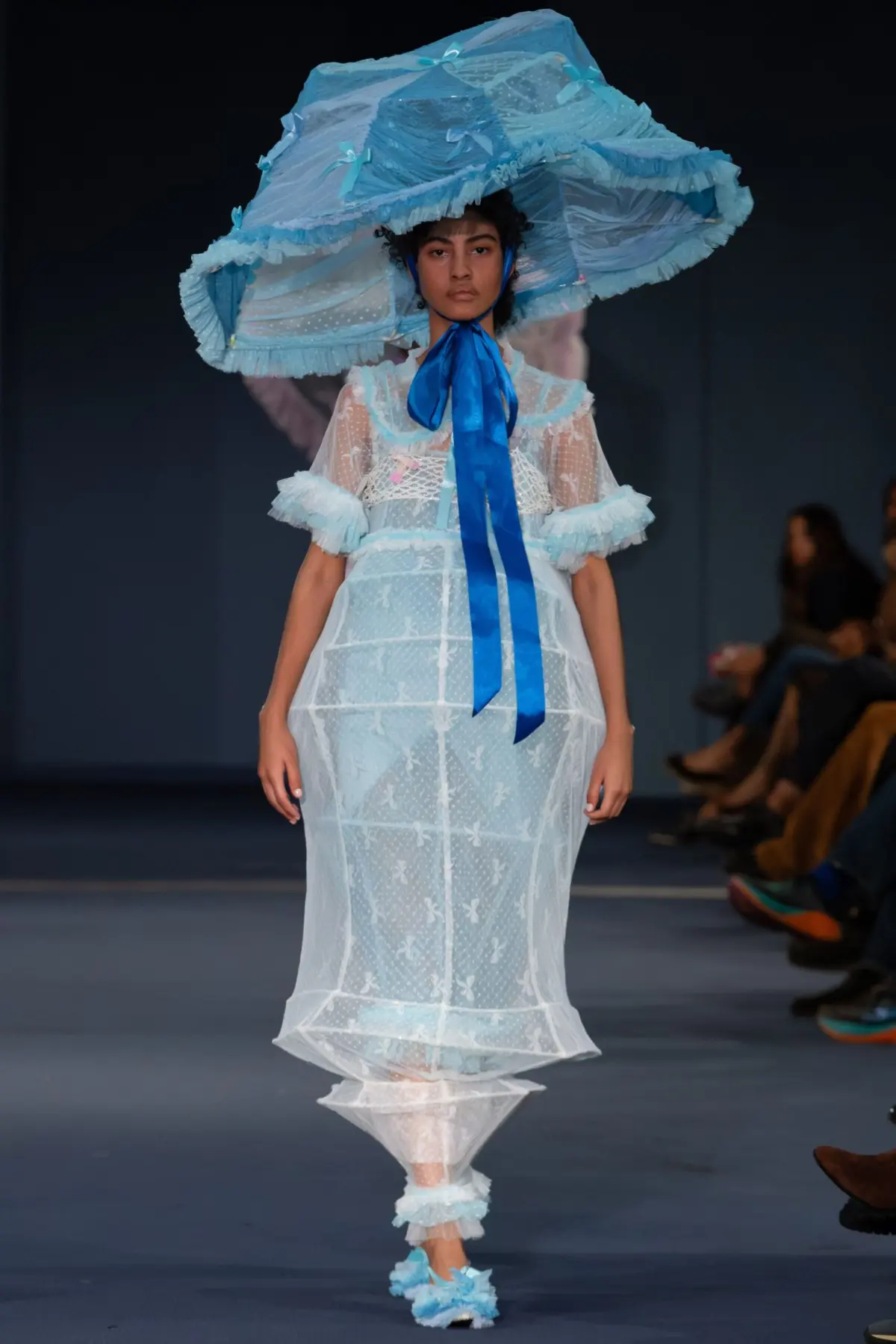
This afternoon, the 41st International Festival of Fashion, Photography, and Accessories in Hyères, France, officially announced its winners, marking a watershed moment for the legendary cultural institution nestled within the modernist walls of the Villa Noailles. Taking home the prestigious Grand Prize was Shanghai-based designer Yui Chen for “Food Cover,” a womenswear-leaning, unisex lineup that the creator described as a deeply personal way of preserving childhood memories. Developed in collaboration with the renowned embroidery house Montex, Chen’s silhouettes ingeniously combined everyday pieces—such as a vibrant yellow lingerie dress—with collapsible overlayers, including tent-like structures in transparent lace or intricate cages formed from leather bows.
During her showroom presentation, Chen elaborated on her meticulous design process, revealing that she models every single piece in miniature at least once before bringing the actual garments to life. Among her standout creations was an eight-paneled sheath dress fashioned from recycled leather that folds completely flat, much like an accordion, into eight distinct panels. Speaking to Vogue about her overarching creative vision, Chen noted that fashion remains the most vivid form of theater, expressing her ultimate dream to construct an entire universe and language akin to the pioneering work of Issey Miyake.

Chen’s victory is accompanied by extensive industry backing. As the Grand Prize winner, she will receive critical support from Chanel, the festival’s long-term Grand Partner, alongside new Grand Partner le19M and its prestigious roster of ten maisons d’art. Additional grants and resources will be provided by key sponsors, including the Atelier des Matières, Supima, and newcomer Watteau, a prominent visual content hub. Further support will be extended by Les Teintures de France, the Alliance for European Flax-Linen & Hemp, and Richemont’s AZ Academy, among others. In addition, all fashion laureates recognized at this year’s festival will have their collections showcased by Première Classe during Paris Fashion Week in both March and October 2027.
Beyond the main category, the festival celebrated a diverse array of international talent across multiple disciplines. London-based artist and designer Dieter Vlasich Obermann, representing Mexico and Germany, scooped the le19M Métiers d’Art Prize for a striking collection inspired by tiliches—the traditional Mexican concept of "junk"—and the hidden handicrafts they can conceal. Meanwhile, Paris-based Dutch designer Rachel Luurssen was awarded the Atelier des Matières Prize for a womenswear collection that drew on a complex mix of Hollywood glamour, coquettish aesthetics, fading beauty, and body dysmorphia.
In the menswear arena, Paris-based Chinese designer Xiao Xu won the Supima Prize for "Uncanny," a collection rooted in latex, 1970s fetish culture, intricate embroidery, and advanced knitwear. The dual honors of a special mention and the Public Prize went to Spanish designer Brais Albor Rodriguez, whose imaginative and witty collection improbably fused the concept of squirrels—crafted using shearling sourced on Vinted—with cojones. Additional Grand Prizes were awarded to Sassa Ann van Wyk for Accessories and Motoki Nakatani for Photography, rounding out a comprehensive podium of emerging visionaries.

Renewal and transformation permeated the atmosphere across the historic hilltop estate of the Villa Noailles, reflecting a broader sense of rejuvenation seen in creative studios worldwide. The festival’s chosen motif—a racing flag featuring a star set against a pink-and-green checkered ground—served as a visual signal that the event is firmly back on track. Organizers designated this 41st edition as "a year of firsts," not least because Yui Chen’s Grand Prize victory marks the first time a Chinese designer has claimed the festival’s top honor.
Further signaling this fresh chapter, Hugo Luccino, the festival’s managing director, historicized the event by placing women at the helm of every single jury panel. Chloé creative director Chemena Kamali led the fashion jury, photographer Camille Vivier oversaw the photography jury, and Danish fashion designer Cecilie Bahnsen directed the accessories panel.
The powerful presence of women in leadership roles extended far beyond the juries. During her official welcome speech, Josée Massi—the mayor of Toulon, who earlier this spring also assumed office as the first woman president of the Métropole Toulon Provence Méditerranée—offered encouraging words to the 30 finalists, telling them that they already possess their rightful place in the industry and reminding them that true talent transcends any single prize. Shortly after, Hyères’s newly elected mayor, Véronique Bernardini, who holds the distinction of being the first woman to lead the municipality since its creation in 1677, opened the festivities with a modern riff on a famous Gabrielle Chanel aphorism: "Trends pass, but style remains… and in Hyères, audacity is never out of style."

At the subsequent reception, Mayor Massi praised the strategic decision to bring the central fashion show directly to the Forum du Casino in the heart of Hyères, framing the move as an essential cultural renaissance. Emphasizing that culture should never be elitist, she noted the fundamental importance of reaching people as closely as possible, particularly the younger generation. Massi envisions Hyères and Toulon functioning as twin regional hubs for fashion and design respectively, pointing to Toulon’s existing satellite campus of the École Camondo interior architecture and design school and hinting that the Design Parade could relocate to the city’s Porte d’Italie district as early as next year.
Valérie Duport, who stepped into her role as president of the Villa Noailles in July, also celebrated a personal first, remarking that she was simply the one who raised her hand to take on the leadership challenge. Duport paid respectful tribute to France’s premier fashion festival, emphasizing that institutional longevity is rare and vital in an industry defined by volatility. Addressing the institution’s future head-on, Duport addressed the financial realities candidly, outlining a concrete plan already in place to resolve approximately €1.3 million of debt over the next two years to clear the path for a fresh beginning.
The festival grounds also welcomed back a vibrant community of alumni and past winners, showcasing the enduring legacy of the Villa Noailles incubator. Lucas Emilio Brunner, who captured last year’s Grand Prize with a collection centered on inflatables, returned with "Standards," a sharply executed lineup inspired by sports flags and 1960s Ivy League style, developed in collaboration with the Ateliers de Verneuil. Standout pieces included draped striped poplin shirts, polos featuring contrasting trims, and a meticulously crafted coat in leather marquetry.

Emma Bruschi, the 2020 le19M Métiers d’Art Prize winner, headlined a collaborative straw-weaving workshop hosted alongside Galerie 19M. Amaury Darras, the 2025 Accessories Grand Prize laureate, presented "Keratina Medusa," a striking Art Nouveau-inspired corset created in partnership with Goossens that seamlessly bridges cabinetry and fine jewelry-making. Adrien Michel, who won the 2025 le19M Métiers d’Art Prize, debuted a capsule inspired by Marcel Breuer’s iconic Cesca B34 chair, anchored by a clever shirt engineered to fold out of a custom leather case produced with Studio MTX. Finally, Sébastien Meunier—who launched his eponymous label after clinching the Grand Prize at Hyères in 1998—returned with "Re-Authored," a reflective re-examination of his own creative trajectory.
Looking ahead, managing director Hugo Luccino confirmed that as part of this renewed era, the doors of the Villa Noailles will remain open to the public for longer periods throughout the year. Expanded programming will significantly build upon the traditional foundations of the annual fashion and design festivals by incorporating museum-style exhibitions, alongside the revival of a comprehensive roster of artistic residencies.
Describing the core ethos of the institution, Luccino emphasized that the festival remains an uncompromising celebration of creativity and a sanctuary where young talents are encouraged to express themselves through any medium they choose. They are the ones asking the necessary questions and, above all, imagining and inhabiting the world of tomorrow, he noted. While acknowledging that creative inquiries do not always yield simple answers—and that often there are more questions than solutions—Luccino maintained that these foundational artistic intuitions invariably find their first public expression in Hyères.

The exhibitions and programming for the 41st International Festival of Fashion, Photography, and Accessories in Hyères will remain open to the public through February 28, 2027. The venue is open Wednesday through Sunday from 1:00 PM to 6:00 PM.