






In the intricate lexicon of design, historical ornamentation, and gemology, certain terms bridge the gap between ancient heraldry and fine jewelry. Among the most visually striking and historically rich of these concepts is the term "addorsed." Derived from the French word adosse, which translates to leaning or back-to-back, addorsed is a specialized descriptive term applied to motifs where identical or complementary animals, objects, or symbols are positioned facing away from one another while sharing a central axis. While frequently observed in medieval coats of arms and heraldic achievements, the addorsed configuration has left an indelible mark on the history of fine jewelry, serving as a signature device for some of the most celebrated master artisans of the nineteenth century.
To understand the full scope of the addorsed motif, one must look to its traditional roots in heraldry, where visual symmetry and symbolic representation were paramount. In heraldic design, animals such as lions, eagles, lambs, and griffins were frequently rendered in an addorsed position to create a powerful sense of balance and dynamic tension. When two lions or other heraldic beasts are placed back-to-back, the composition creates an immediate focal point, projecting an image of strength, vigilance, and regal authority. This deliberate placement was not merely aesthetic; it conveyed lineage, allegiance, and heritage, transforming static metal and stone into a narrative of power. Over centuries, these symbolic postures migrated from illuminated manuscripts, carved stone facades, and royal crests into the intimate sphere of decorative arts and personal adornment.
As the decorative arts evolved, master jewelers adopted heraldic principles to elevate their creations, infusing wearable pieces with historical gravitas and sophisticated composition. The application of the addorsed concept expanded beyond whole animal figures to encompass stylized objects, motifs, and eventually, the very letters used to brand and authenticate masterpieces. This evolution is particularly evident in the realm of maker’s marks and signatures, where jewelers sought distinctive ways to authenticate their work while maintaining the artistic integrity of the piece.
One of the most prominent historical examples of the addorsed motif utilized in fine jewelry is found in the signature marks of the legendary Italian firm Castellani. Operating primarily in Rome during the nineteenth century, the House of Castellani, founded by Fortunato Pio Castellani, revolutionized the jewelry world through their meticulous revival of ancient Etruscan, Greek, and Roman goldsmithing techniques. Known for pioneering archaeological revival jewelry, the Castellani family infused every element of their production with historical reverence, extending this philosophy even to their maker’s marks.
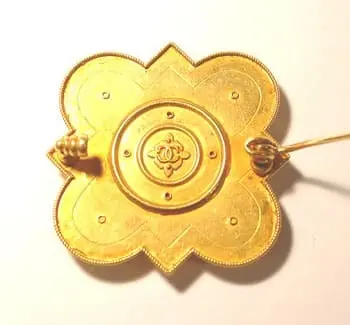
Among the various hallmarks and ciphers utilized by the firm, the Castellani mark featuring addorsed C’s—dating back to approximately 1880—stands out as a testament to their refined aesthetic sensibility. In this iconic trademark, two uppercase letter C’s are positioned back-to-back, echoing the classic heraldic arrangement of addorsed figures. This subtle yet powerful configuration allowed the firm to stamp their precious creations—ranging from intricate gold bullae and mosaic brooches to archaeological-style earrings—with a monogram that was simultaneously modern and deeply rooted in classical design principles.
The choice of the addorsed C’s was not arbitrary. By arranging the letters back-to-back, Castellani created a symmetrical monogram that naturally complemented the circular and balanced nature of many jewelry components. Furthermore, the use of a sophisticated hallmark served as an early form of brand protection and artistic validation in an era marked by a surge in antique revivals and imitations. Today, encountering the addorsed C’s mark on a piece of antique jewelry acts as an immediate indicator of authenticity, guiding historians, curators, and collectors to attribute the work to one of the most influential workshops of the Victorian era.
The legacy of the addorsed motif extends far beyond the specific marks of nineteenth-century Roman jewelers, influencing how contemporary experts analyze and appreciate antique craftsmanship. Institutions such as Wartski, the renowned London-based firm specializing in fine antique jewelry, Renaissance works of art, and Fabergé, frequently handle and document these rare pieces, preserving the historical context of marks like the Castellani addorsed C’s for future generations. Through careful examination of these small yet significant details, jewelry historians can trace the lineage of design ideas from ancient heraldic shields down to the intimate scale of a lapel pin or signet ring.
Ultimately, the enduring appeal of the addorsed design lies in its ability to marry symmetry with narrative depth. Whether manifested as majestic heraldic beasts guarding a family crest on a heavy gold signet or as delicate, interlocking letters stamped by a master goldsmith in a nineteenth-century Roman studio, the concept of placing elements back-to-back remains a cornerstone of decorative composition. As antique jewelry continues to be studied and celebrated for its intricate artistry, understanding the nomenclature and heritage behind terms like addorsed provides a deeper appreciation for the thought, history, and technical precision woven into every historic masterpiece.