





Right now, everyone could use a treat, and there is perhaps no better way to indulge while simultaneously celebrating and supporting the vibrant community of independent artists and specialized galleries than by acquiring a terrific piece of art jewelry. Art Jewelry Forum’s international gallery supporters are dedicated to exhibiting, promoting, and advancing the field of contemporary art jewelry, championing creators who push the boundaries of materials, form, and meaning. Through AJF’s bi-monthly On Offer series, this extensive network of international galleries is given a dedicated platform to showcase extraordinary pieces personally selected to tempt, challenge, and inspire collectors and enthusiasts alike.
As viewers browse through the curated selections, they are bound to find a fantastic piece that commands attention and sparks an undeniable connection. From delicate, miniature wearable sculptures to bold statements exploring gender, history, and the natural world, the current selection reflects the remarkable breadth and diversity of the contemporary jewelry landscape. For those interested in acquiring any of the highlighted works, inquiries and purchases can be made by contacting the respective galleries directly.
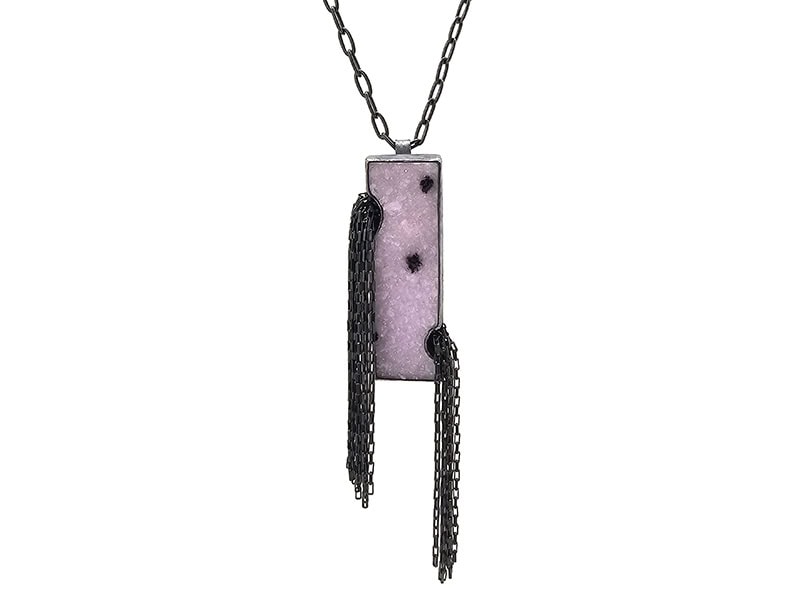
Opening the October selection is a striking piece from Pistachios Contemporary Art Jewelry in Chicago, Illinois, featuring a brooch and necklace combination by artist Heather Guidero, available for US$1,695. Representing the gallery, Meg Nash highlights a design anchored by a stunning lilac-colored druzy that sparkles with rare intensity. Framed by handmade oxidized sterling silver tassels, this one-of-a-kind brooch possesses a remarkable sense of movement and fluidity. Additionally, because the design includes an integrated bail, this versatile creation transitions effortlessly, allowing it to be worn as a pendant as well.
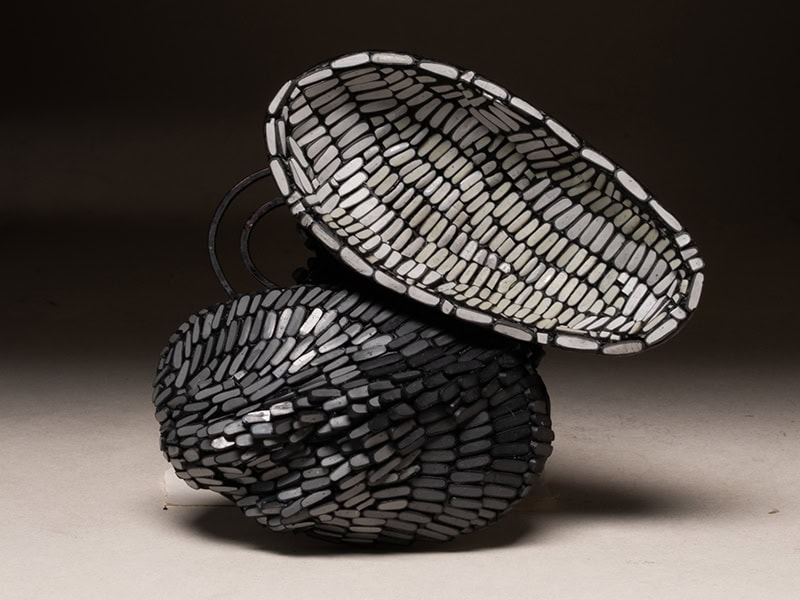
Moving from the American Midwest to the West Coast, the Wearable Art Museum presents a fascinating conceptual piece titled Perch, created in 2026 by the artistic duo 2Roses and retailed at US$750. According to gallery director Lisa M. Berman, 2Roses specializes in crafting small, one-of-a-kind sculptures specifically engineered to be worn on any part of the human body. Perch consists of two hollow forms covered entirely in polymer clay tesserae. Each individual piece is meticulously cut, textured, and finished before being set, creating a shimmering surface that catches and reflects light as the wearer moves through space. One form is dark and closed, while the other is pale and open, tipped delicately against the first in a state of permanent tension and balance. In this innovative work, the wearer actively completes the composition by deciding where the piece is placed and at what precise angle it rests, ensuring that every placement fundamentally recomposes the artwork by design.
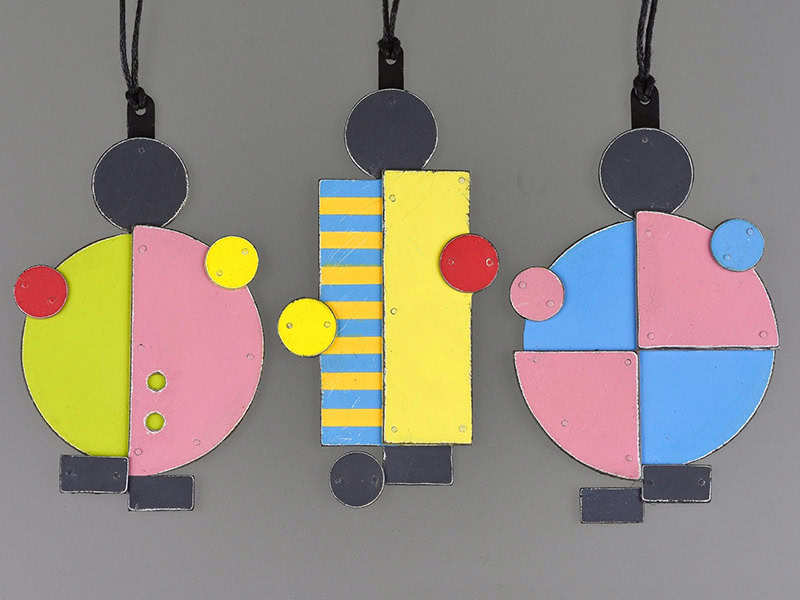
Across the globe in Auckland, New Zealand, Fingers Gallery presents a series of pendants titled Play Time, crafted in 2024 by artist Becky Bliss, with each piece priced at NZ$750. Lisa Higgins, representing the gallery, notes that Bliss initially trained as a graphic designer before transitioning into a celebrated career as a contemporary art jeweler. Her distinguished work is held in numerous prestigious collections, and she was selected to exhibit in the esteemed Schmuck special exhibition in Munich in both 2015 and 2020. Play Time draws inspiration from the foundational building blocks of child development, which were originally formalized by Friedrich Froebel, the founder of the kindergarten system, during the early 1800s through a series of educational toys known as "gifts." Bliss adopts the geometric shapes from gift number two—specifically circles, squares, and triangles—and anthropomorphizes them. The resulting family of pendants plays playfully with color, form, and gender conventions, subverting traditional expectations through endless combinations to demonstrate the fluidity of youth and the boundaryless expression inherent in pure play.
In the Netherlands, Nijmegen-based Galerie Door presents an untitled 2026 brooch by Daniel Kruger, offered at 2,000 euros. Doreen Timmers, representing the gallery, points to the fascinating questions raised by Kruger’s practice: What do a seashell, a precious gemstone, a piece of plastic, an ancient relic, and a cultural fetish truly have in common? In the hands of Kruger, these disparate elements are seamlessly combined into a single, cohesive piece of jewelry. His work is known for being surprising, exuberant, sometimes mischievous, and profoundly seductive, inviting the observer to linger and examine the intricate details up close. Kruger seamlessly merges every conceivable material and technique, bridging gemstones with everyday found objects, and traditional textile work with refined metalwork. Through his vision, the sublime meets the mundane, the precious meets the cheap, and classical aesthetics meet kitsch, ultimately rendering the finished piece far more compelling. Kruger’s jewelry directs the eye deliberately toward the neck, chest, hand, or ear, functioning simultaneously as an ornament, a talisman, a personal statement, or simply an irresistible object designed to bring joy.
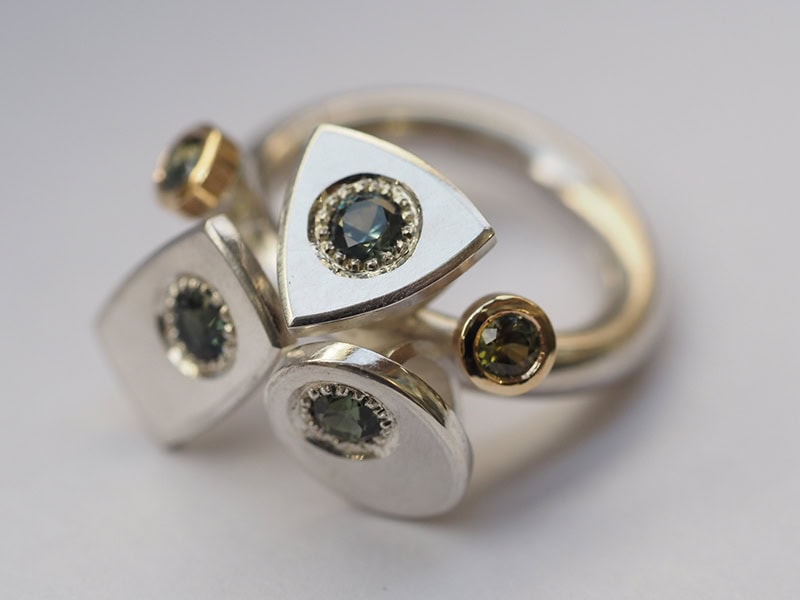
Traveling to Adelaide, Australia, Zu design features a remarkable ring titled Parti Sapphire, created in 2026 by Angela Giuliani and priced at AUS$8,615. Jane Bowden, representing the gallery, explains that this piece is part of a broader exhibition titled stateMEANT, for which Zu design invited participating artists to write thoughtfully about their practice, processes, and personal philosophies. The exhibition focuses on bold, meaningful jewelry that has something vital to say, whether addressing social, political, or environmental issues, or quietly reflecting on materials, sustainability, craft, and the realities of daily life. In her artist statement, Giuliani reflects on her creative ethos, noting that her work explores structure, form, and geometry through the considered application of precious metals and gemstones. Drawn to clean lines, simple shapes, and the inherent balance of geometric design, Giuliani regards the making process as every bit as important as the finished object. Working primarily with sterling silver alongside yellow and rose gold, she selects gemstones not merely for decoration, but to introduce color and interest that integrates seamlessly into the architecture of the piece, creating timeless jewelry designed to foster a lasting connection with the wearer.
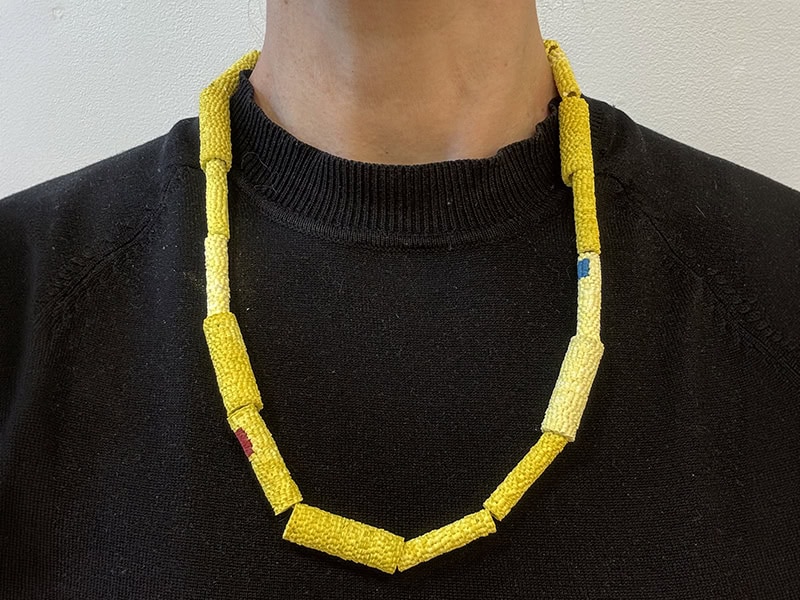
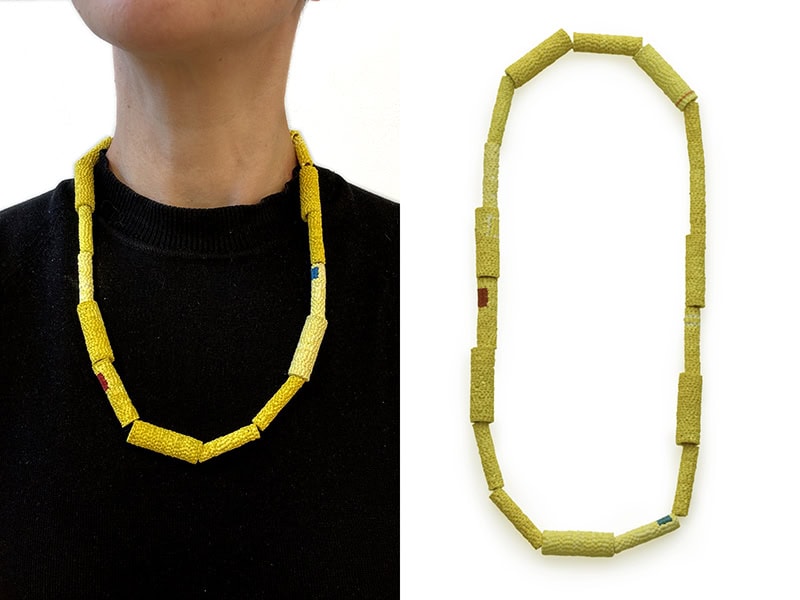
In Sweden, Four Gallery in Umeå presents Necklace 539, a 2026 work by Karin Seufert constructed from PVC and thread, measuring 280 by 125 by 12 mm, with a retail price of 1,700 euros excluding VAT. Karin Roy Andersson, representing the gallery, notes that Seufert’s latest creations tackle the abstract and elusive concept of time, which, much like emptiness, is notoriously difficult to depict. Because time is complex, ever-changing, and fundamentally immaterial, humanity has historically relied on the sky for orientation. The sun marks the passing of days, the moon governs longer lunar phases, and the stars allow for spatial navigation. Seufert’s newest pieces translate these celestial bodies into physical form, portraying the sun as a flickering yellow circle, the moon in its various shifting phases, and the stars through multifaceted geometric structures.
In the United States, Gravers Lane Gallery in Philadelphia, Pennsylvania, presents an 18-karat yellow gold and sterling silver necklace crafted in 2025 by Naomi Kurita, available for US$4,752. Gallery contact Mia Chen shares that Kurita has spent three decades guided by three core tenets: natural, simple, and wearable. Born in Japan, Kurita began her formal jewelry education at a college in Denver before specializing in jewelry and metalwork at the Rhode Island School of Design. She subsequently honed her hand alongside master craftsmen and designers in New York, navigating both traditional techniques and modern idioms. The synthesis of these diverse experiences manifests as a striking restraint in her design. This timeless necklace pairs 18-karat yellow gold against sterling silver, contrasting two metals of differing warmth at a 15-inch length designed to rest closely at the base of the neck. Kurita’s work has been widely exhibited in museums, galleries, and high-end boutiques across both the United States and Japan.
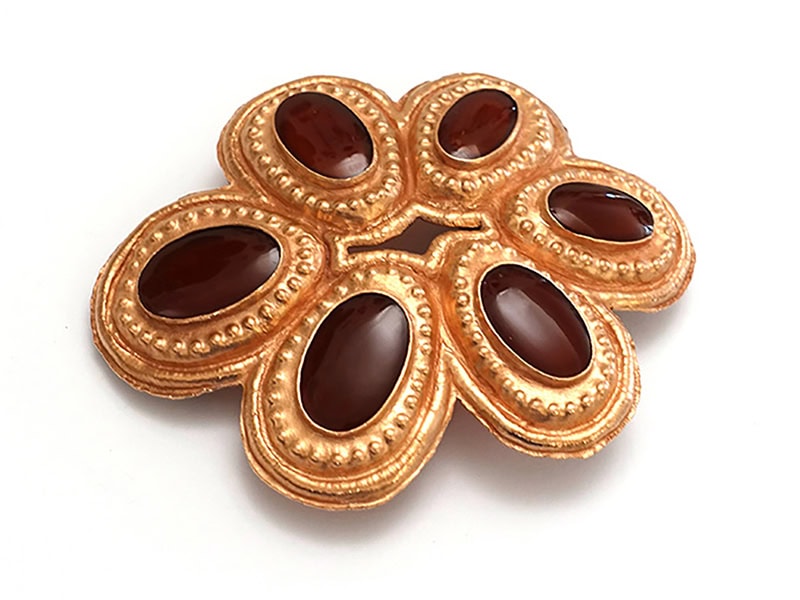
At the Baltimore Jewelry Center in Baltimore, Maryland, artist Liz Clark is featured with her 2023 Petite Wreath Studs, crafted from sterling silver and measuring one by one by one-half inch each, available at a retail price of US$175. Gallery contact J Diamond notes that Clark earned her Bachelor of Fine Arts in crafts and material studies from Virginia Commonwealth University in 2006. Based in Providence, Rhode Island, Clark maintains a dedicated metal studio where she creates art and jewelry on a part-time basis while continuing to exhibit her work through galleries nationwide.
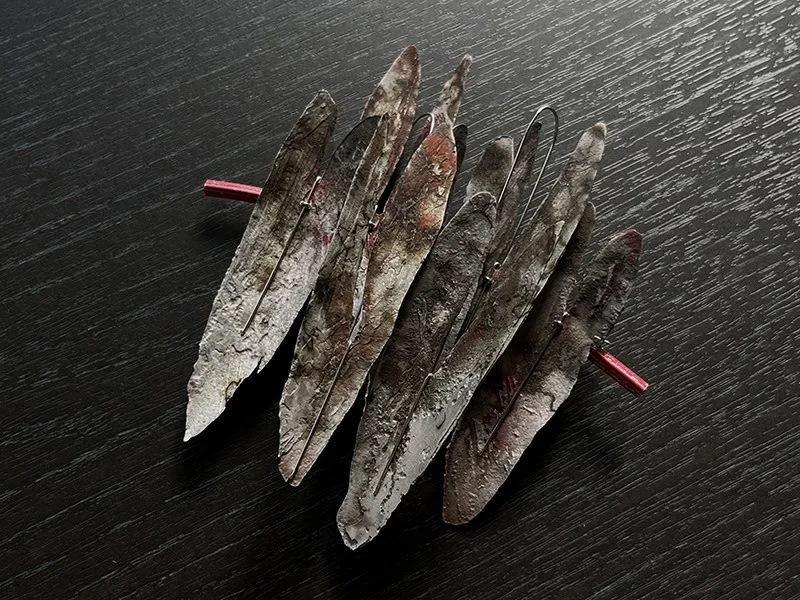
In London, United Kingdom, Objects Beautiful presents The Other Shore #2, a 2022 brooch created by Mei Fang Chiang in anodized aluminum and stainless steel wire, measuring 100 by 95 by 25 mm, priced at £760 before tax. Gallerist Yael Reisner highlights that Chiang, based in Tainan, Taiwan, is an exceptional art jeweler renowned for her specialized expertise in working with anodized aluminum. Utilizing proprietary techniques developed within her own studio, Chiang achieves a uniquely vibrant and sophisticated palette of colors. Her artistic practice engages deeply with narratives concerning the coexistence of nature and the man-made. An award-winning creator, Chiang has her work housed in prominent public collections, including the Gold Museum in Taiwan, where her pieces are celebrated for being original, visually striking, and remarkably lightweight and comfortable for daily wear.
In Brooklyn, New York, In the Gallery at Brooklyn Metal Works features a 2026 brooch by Kerianne Quick titled Well, It’s Not Up to Us, fabricated from vegetable-tanned leather, Plexiglas, and a nickel alloy pin, measuring three and a half by eight and a half by one and a quarter inches, priced at US$650. Gallery director Brian Weissman explains that Quick’s academic and artistic research is deeply rooted in craft practice as a cultural expression, with a particular focus on material specificity—a concept Quick defined in their master’s thesis to recognize physical materials as active participants in the generation of meaning. Through this creative methodology, Quick seeks to uncover overlooked and hidden narratives by leveraging the embedded histories of materials to create profound cultural impact. The black-shrouded mirrors from Quick’s Nevermind series, constructed from leather and Plexiglas, directly reference traditional mourning customs wherein mirrors were covered following a death. Rather than serving to protect the spirit of the deceased from its own reflection, these obscured mirrors intentionally turn the gaze back toward the living, materializing complex emotions of shame, culpability, despair, and helplessness.
In Lisbon, Portugal, Galeria Tereza Seabra presents Sugar Rush, a 2026 necklace created by Catarina Silva using painted tin, leather, glass seed beads, glass flowers, embroidery, zinc, silver, and pearls, measuring 300 by 100 by 10 mm, available for 1,500 euros plus shipping. Gallerist Tereza Seabra notes that this necklace represents Silva’s newest body of work for her solo exhibition Jardin d’agrément, which forms part of the official program for the third Lisbon Jewellery Biennial. The exhibition envisions a lush, utopian garden inspired by the paradisiacal and divine gardens found across various world cultures. Within this realm, humans, animals, and plants coexist harmoniously beyond hierarchy, participating in a shared ecology marked by reciprocity and wonder. Jewelry functions here as a living constellation of symbolic motifs, including apples, unicorns, flowers, birds, and Marian imagery, collectively evoking knowledge, care, fertility, and transformation. At the conceptual heart of the exhibition, the snake appears not as a tempter, but as a protective guardian symbolizing wisdom, regeneration, and the eternal cycle of life. Rather than mourning a lost Eden, Jardin d’agrément offers a poetic fiction that invites viewers to imagine alternative ways of inhabiting the world, where mutual coexistence operates as a living practice rather than a distant ideal.
At the Heidi Lowe Gallery in Lewes, Delaware, artist Emily Cobb is featured with Floppy Flower, a 2026 sculptural work measuring 30 by 8 by 1.5 inches, constructed from gold-plated brass ear nuts, surgical steel ear nuts, assorted deadstock stud earrings, brass jump rings, and silver-filled jump rings, available at a retail price of US$1,480. Gallery contact Kassadi Williams explains that Cobb fabricated this intricate piece specifically for the 2026 ReJewelry exhibition, hosted by Heidi Lowe Gallery as part of the Radical Jewelry Makeover initiative.
Concluding the current On Offer selection, Galeria Reverso in Lisbon, Portugal, presents an untitled 2026 necklace by Manuel Vilhena, crafted from juniper, ebony, fine silver, cotton, coral, and steel, measuring 200 by 200 by 30 mm, with a retail price of 2,220 euros. Gallery director Paula Crespo shares a statement from the artist reflecting on the philosophical underpinnings of the piece: of all the dichotomies with which humanity must coexist, perhaps the most evident is the precarious and fragile dance between life and death. Vilhena addresses this eternal theme through the adventurous exploits of a notorious band of outlaws who casually defy mortality and treat death as a daily companion: the pirates.