






For nearly a century, the promise of tomorrow has been intimately tied to the domestic sphere. The narrative has long been a familiar one: dirty dishes would effortlessly wash themselves, screens would instantly bridge gaps across miles, and eventually, a desktop computer would sit humming in the corner, quietly orchestrating the ecosystem of the household.
Now, the Los Angeles County Museum of Art (LACMA) is taking a comprehensive look back at these ambitions. Titled Home of the Future, 1925–1985: Designing Domestic Utopias, a major new exhibition curated by Wendy Kaplan, department head and curator of Decorative Arts and Design, has officially opened at the museum’s Resnick Pavilion. Bringing together more than 260 objects, models, and images, the exhibition charts six decades of American imagination, capturing how generations envisioned the way they would soon live. While some of these futuristic concepts vanished almost as quickly as they were conceived, others simply required a longer runway to become reality.
The exhibition is open to the public through March 14, 2027, offering visitors a fascinating lens through which to view the intersection of technology, architecture, and daily life.
The House as a Machine
The chronological journey begins in 1925, an era when architects and industrial designers increasingly began to treat the home as a finely tuned machine whose inherent inefficiencies could be engineered out of existence. Rather than viewing housework as an inevitable burden, innovators of the period sought to mechanize domestic labor.
A prime example featured in the exhibition is Kohler’s 1926 Electric Sink. By cleverly folding a dishwasher directly into the basin, the appliance promised users a radical kind of freedom—an escape from the endless cycle of washing dishes by hand. Around the same time, psychologist Lillian Moller Gilbreth applied scientific management principles to the home. By meticulously studying the physical movements involved in household chores, Gilbreth redesigned kitchens around shorter transit routes and fewer wasted gestures. In this early vision of the future, domestic liberation was something that could be structurally built into a floor plan or purchased outright as a gleaming new appliance.
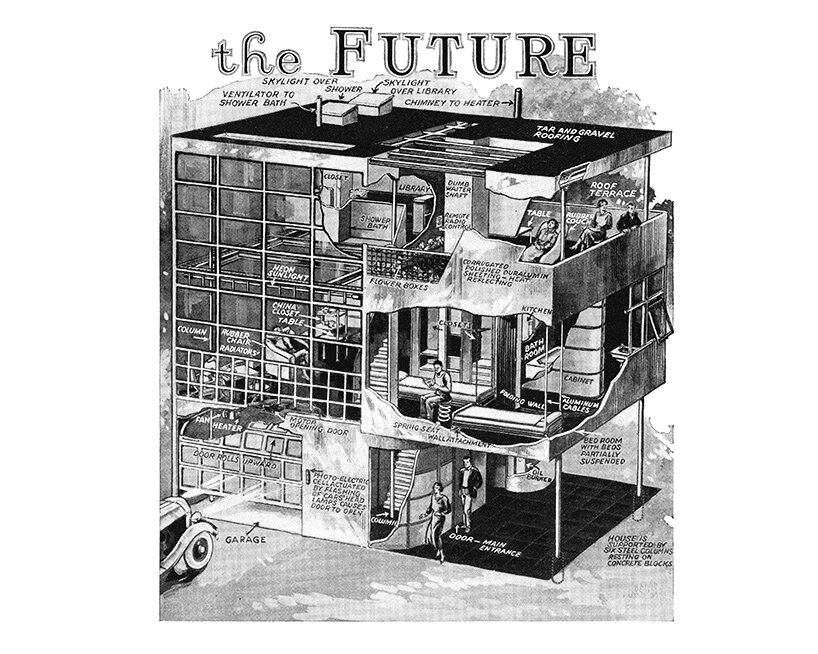
This mechanical mindset extended to structural design as well. Architects A. Lawrence Kocher and Albert Frey, alongside illustrator Logan U. Reavis, conceptualized futuristic living spaces like the Aluminaire House, famously featured in a 1931 issue of Popular Mechanics. These designs championed prefabrication and lightweight metals, signaling a shift away from traditional masonry and toward industrial efficiency.
Tomorrow Becomes a Consumer Product
Following the conclusion of World War II, domestic futurism gained an entirely new material language. Plastics, which had undergone rapid development through wartime military research, found their way into everything from individual chairs to entire experimental housing structures. Prefabrication was heralded as the magic bullet that would make modern architecture universally accessible and easy to distribute.
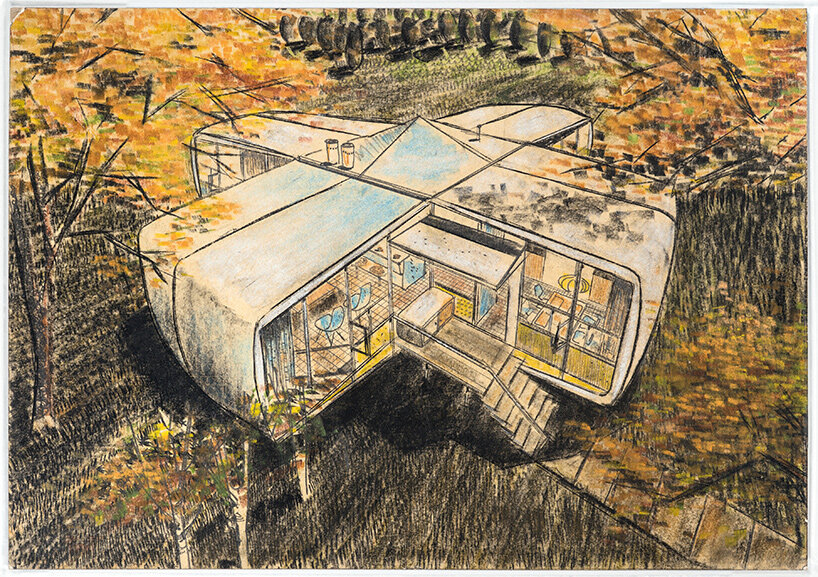
Perhaps the most famous manifestation of this post-war optimism was the Monsanto House of the Future, erected at Disneyland in 1957. Designed by Hamilton & Goody Architects, the house cantilevered four molded plastic wings out over the landscape, filling its seamless interior with push-button appliances and a kitchen crafted entirely from synthetic surfaces. It was a massive cultural phenomenon, drawing approximately 20 million visitors before it was unceremoniously demolished in 1967.
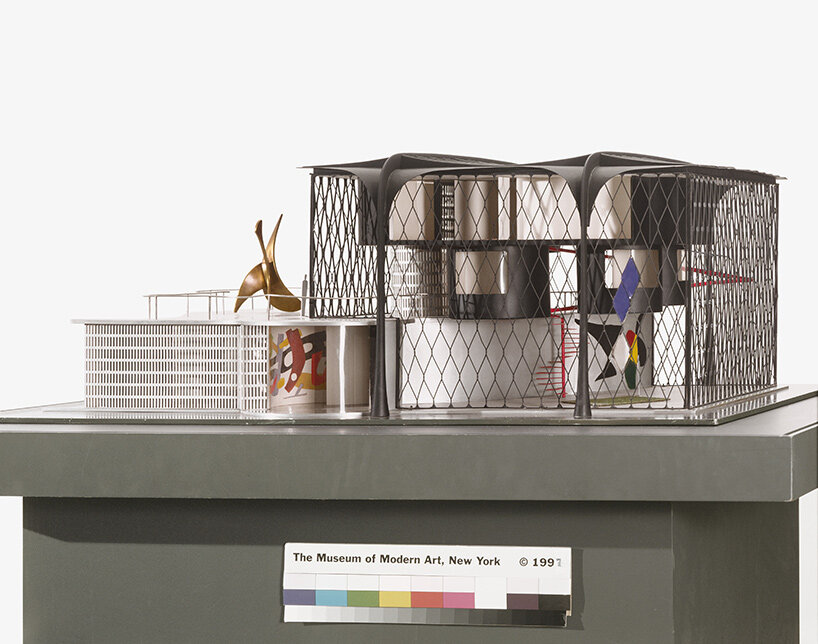
Nearby in LACMA’s timeline, visitors encounter Charles and Ray Eames’s Case Study House #8, assembled in Los Angeles in 1949. Utilizing off-the-shelf industrial components, the Eames house presented a different flavor of modernity. Its exposed steel frame and factory-made parts provided a disciplined structural backdrop that was soon softened and enlivened by the books, textiles, and everyday objects accumulated over years of actual living.
The exhibition also cleverly weaves cultural artifacts into the architectural narrative, including Barbie’s first Dream House, released around 1962. Notably devoid of a kitchen, the iconic toy imagined a young woman’s domestic life centered entirely around leisure and independence—a striking contrast to a real-world era when access to mortgages and independent credit remained heavily restricted for women. Throughout the galleries, the exhibition continuously underscores the gap between the gleaming demographics featured in promotional imagery of the future and the populations who could actually attain them.
The Living Room as a Command Center
As the atomic age took hold through the 1950s and 1960s, domestic futurism took a distinctly stranger, more anxious turn. The looming threat of nuclear conflict inspired underground living spaces and cocoon-like furniture designs, while the parallel ambitions of the Space Race pushed designers to look toward orbit.
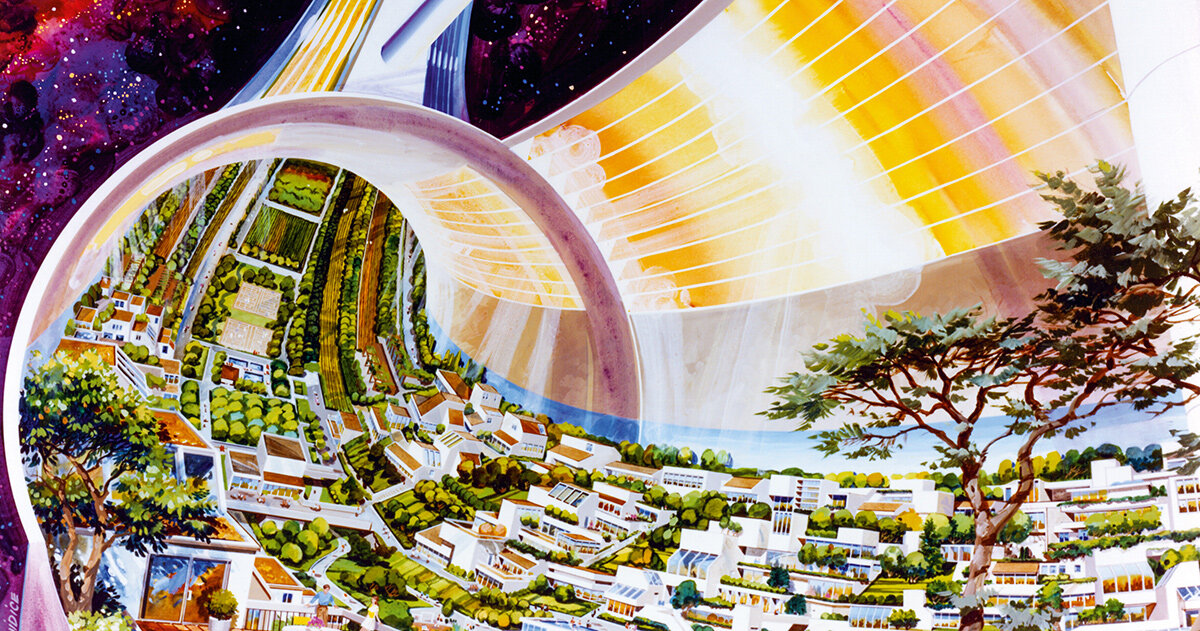
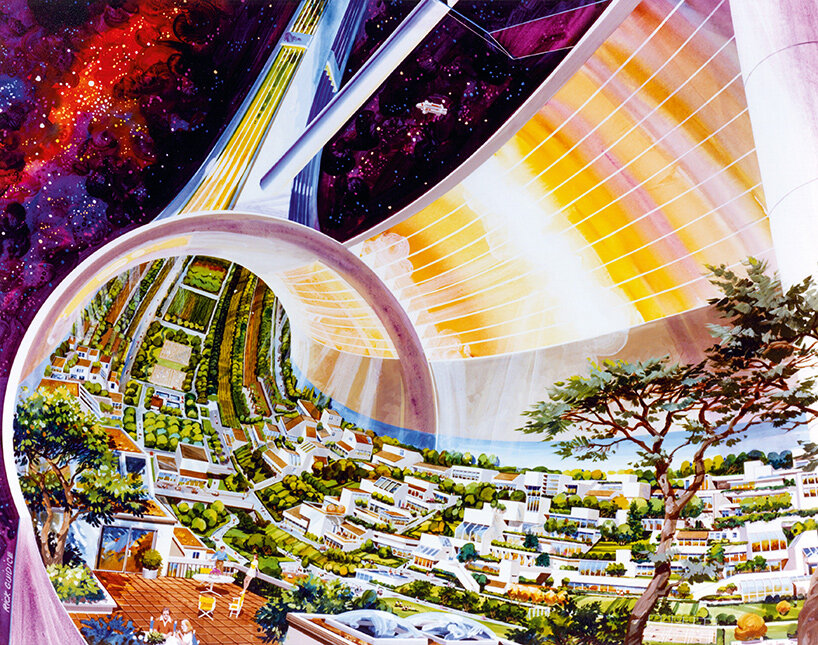
Paul László’s 1950 Atomville, U.S.A., for instance, proposed a sleek, California-style modern home safely buried underground to protect inhabitants from atomic fallout. Decades later, illustrator Rick Guidice’s visionary paintings for NASA imagined colossal permanent settlements circling the Earth. These conceptual torus wheel habitats featured integrated houses and agricultural plots inside enormous rotating structures designed to artificially simulate gravity.
At the same time, technology was flowing inward, bridging the gap between the private home and the wider world. The television successfully transformed the living room into an ambient information center, while telecommunication pioneers began pushing boundaries that would feel familiar to modern remote workers. At the 1964 New York World’s Fair, AT&T introduced the Picturephone, offering visitors a firsthand preview of video calling decades before Zoom or FaceTime became household staples. The experimental device even featured a voice-only privacy switch, though using it was reportedly viewed as a social awkwardness at the time. Ultimately, the hardware proved too expensive and invasive for widespread commercial adoption in the 1960s, yet its core premise has since woven itself into the fabric of daily life.
Counterculture Ends Up at the Computer
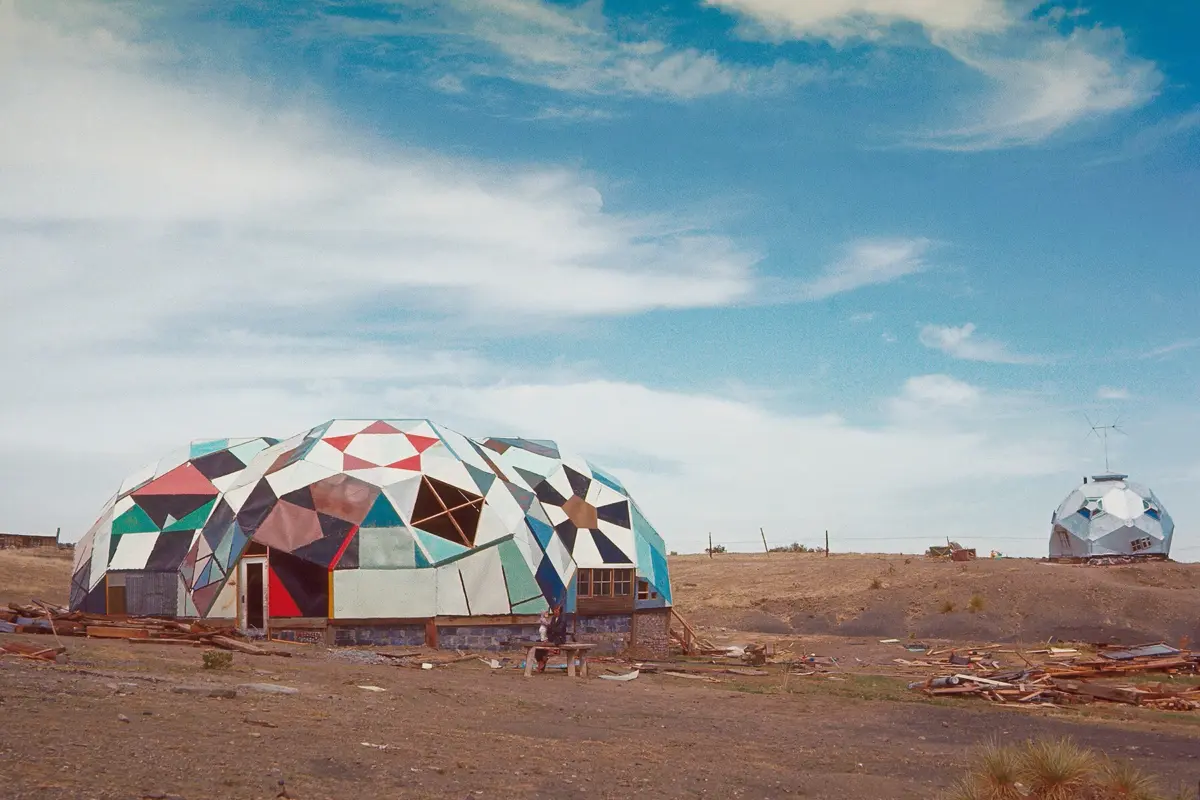
The final thematic chapter of the exhibition begins around 1965, a tipping point when unbridled confidence in plastic abundance began to falter under the weight of growing environmental awareness and countercultural experiments in self-sufficiency. Designers began pivoting toward salvaged materials, modular construction, and flexible, movable interiors—such as Ken Isaacs’s DIY living structures. Concurrently, visionaries like civil rights activist Floyd McKissick proposed ambitious projects like Soul City, a planned multiracial town in North Carolina designed to foster equal economic opportunity through innovative community planning.
By the late 1970s and early 1980s, the personal computer made its inevitable entry into the domestic sphere. Experimental futuristic environments like the Ahwatukee house and Xanadu—the famous foam house built in Florida—attempted to translate early concepts of automated systems and decentralized computing into actual living spaces.
Viewed from the vantage point of 2026, this closing chapter of the exhibition carries a striking sense of proximity. While the terminology has naturally shifted from the mid-century "home of tomorrow" to the contemporary "smart home," the fundamental pitch remains remarkably consistent: technology is continually promised to remove friction, eliminate manual labor, and make the physical house adapt more intuitively to the needs of its occupants.
Ultimately, Home of the Future, 1925–1985: Designing Domestic Utopias succeeds precisely because it anchors these grand architectural ideologies to tangible everyday objects. Whether examining a transparent telephone, a molded plastic pavilion, or an early Macintosh computer, visitors are left with a vivid record of what past eras earnestly hoped would soon become ordinary.