




"If you build it, they will come." It is the age-old quote about watchmaking, wrapped somewhat curiously in a sentimental movie about baseball, but the sentiment rings profoundly true today. A. Lange & Söhne is finally having its overdue, thoroughly deserved moment among elite collectors for doing what it has always done best: manufacturing stunning, mechanically complex timepieces with a traditional, high-touch, artisanal approach. Sticking with the baseball analogy, it is the Milwaukee Brewers playing old-school small ball and somehow fighting their way into the World Series. Nostalgia hits hard, and the one constant through all the years has unmistakably been master-level watchmaking.
And yet, when you step back to look at the broader catalog, a distinct void has lingered within the modern A. Lange & Söhne lineup—a glaring gap that true deep-cut collectors have mourned ever since a certain aesthetic disappeared from official production in the late 2000s. For years, connoisseurs yearned for the return of factory-fitted metal bracelets, with the legendary name "Wellendorff" hanging heavily in the air long after the German Saxon manufactory concluded its historic partnership with the renowned Pforzheim jewelry maker. When the watch-loving team first laid eyes on the newly announced Datograph Perpetual on a solid metal bracelet, gleaming in all its heavy, architectural glory, it felt like an impressive and emotional culmination of the brand’s past and present. It is a release that reminds enthusiasts of all that once was great in independent-leaning high horology, and what can magnificently be again.

“Wellendorff” Bracelets and the Secondary Market
This renewed obsession with braceleted masterpieces brings back personal memories of encountering an A. Lange & Söhne for the very first time on a Wellendorff bracelet. Attending a local RedBar collector meet-up years ago, a prominent aficionado of the brand walked in wearing a platinum Datograph Perpetual mounted on an imposing, intricately linked metal bracelet. Admitting to the room that a braceleted Lange had never been witnessed in the flesh, the collector—a complete stranger at the time—simply unclasped the watch from his wrist, handed it over, and walked away. The gesture floored attendees on multiple levels, leaving an indelible imprint on anyone who witnessed the sheer presence of the watch.
The market for vintage and modern A. Lange & Söhne has intensified so dramatically that quoting specific secondary market prices is a volatile endeavor; values fluctuate so rapidly that figures cited today could easily climb substantially by tomorrow. Rather than writing a sweeping treatise on the often-insane state of the secondary watch market, it suffices to say that collectors have finally woken up to the immense rarity and aesthetic appeal of braceleted Lange models. Unfortunately, the market subsequently went on an absolute bender, driving prices up to levels that many consider genuinely staggering and frankly untenable.

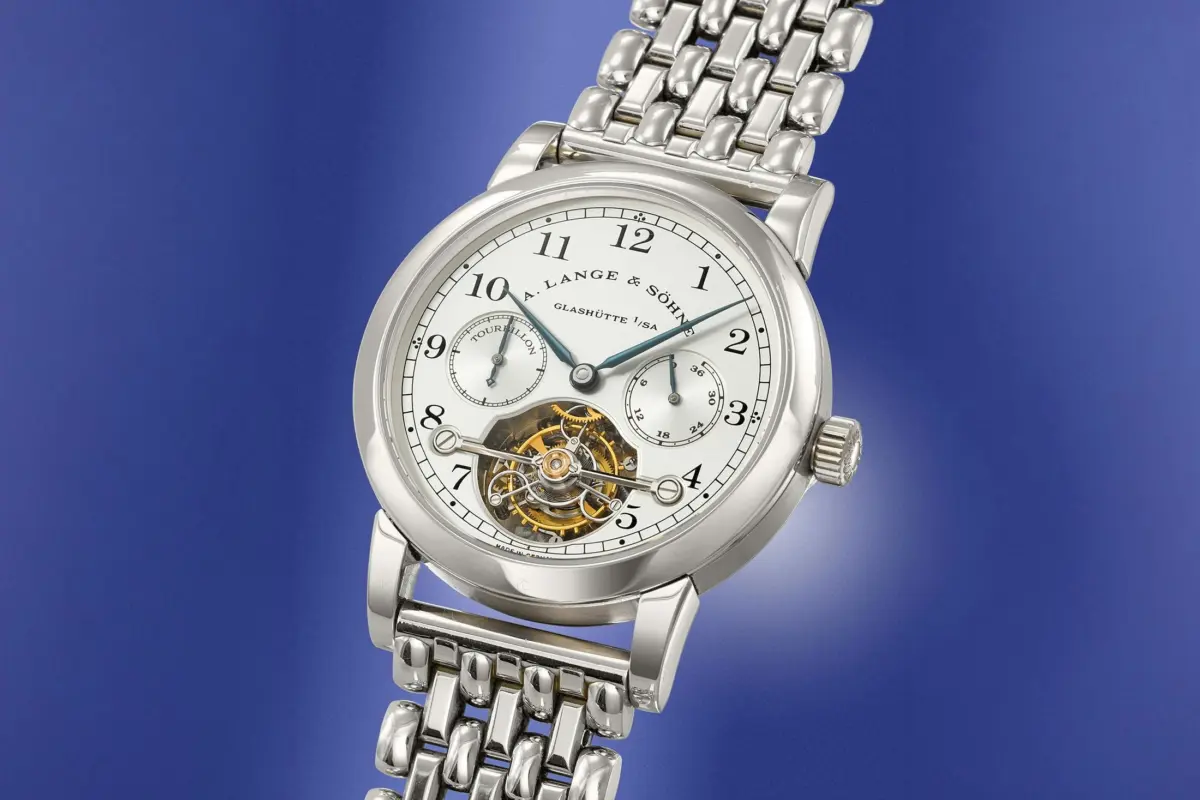
Lange bracelets have long been synonymous with the Pforzheim-based jewelry institution Wellendorff, which historically produced metal bracelets for Lange with such frequency that they became universally known simply as "Wellendorff bracelets." These intricate bracelets came in a variety of styles, and it is crucial to note that not every metal bracelet found on a secondary-market Lange is historically correct for that specific reference—let alone born with that watch from the factory. This exact nuance is why the brand’s latest release matters so profoundly: it is a definitive piece of official fan service, leaving zero doubt regarding its historical veracity and factory authenticity.
The true production numbers and overall rarity of vintage Wellendorff bracelets remain shrouded in mystery; any quoted figures originating from outside the walls of the Glashütte manufactory should be taken with a grain of salt. However, they are unquestionably rare and strikingly attractive. Navigating this space requires deep expertise because buyers must know precisely what they are acquiring.

While official, direct confirmation from A. Lange & Söhne on historical bracelet production remains difficult to secure, extensive research across multiple collector circles points to three primary, correct styles of bracelets historically fitted to the iconic Datograph. The first is what enthusiasts describe as a straight-link style, featuring a Gay Frères-inspired beads-of-rice-style straight bar end-link. The second is commonly referred to by collectors as a "square-link" design. The third features a distinct flare to the links, widely known as the "dog-bone" bracelet. Each of these traditional designs incorporates a seven-link construction; the first two styles feature four rounded links interspersed with three squared links, while the third utilizes an entirely different geometric pattern.
Collectors must also remain vigilant regarding "wave-pattern" bracelets occasionally seen on secondary market listings. According to comprehensive research and insights from seasoned collectors, any wavy bracelet encountered on a Datograph should be heavily scrutinized as a later aftermarket addition. These wave bracelets were originally designed and fitted to the Langematics. However, because the case dimensions and profiles made it relatively easy to swap components, less-profitable models were sometimes stripped of their bracelets to transform standard chronographs into more desirable, high-value braceleted pieces. As one thoughtful collector noted of his modified piece, his watch was "plus Wellendorff" rather than "with Wellendorff," openly acknowledging the aftermarket nature of the pairing—even when added to an exceptionally rare Datograph.

Only specific historical configurations are considered entirely correct from the factory. First-generation Datographs originally born on a metal bracelet carry unique reference numbers. The earliest platinum models, for instance, feature references beginning with 453 instead of the standard 403. For an early first-generation, "Meter"-dial platinum Datograph, the straight-link style represents the earliest bracelet offered, which was fully removable from the case. Finding these pieces in their correct, factory-original configuration is exceptionally rare—far rarer than alternative styles—and any authentic piece should proudly carry the reference number 453.135.
The square-link version was similarly found on platinum models, utilizing a bracelet permanently soldered directly into the watch lugs, cataloged under reference 453.035. A close examination reveals shorter links where the bracelet meets the case. Furthermore, distinguishing between white gold and platinum variants comes down to the three squared-off intermediate links: platinum models feature brushed mid-links, whereas white gold bracelets are fully polished.

The final historical iteration is the dog-bone-style bracelet, introduced in 2006 to coincide with the launch of the groundbreaking Datograph Perpetual. This design consists of a seven-link architecture featuring a distinct outward flare at the edge of each individual link, departing from the alternating bead-and-block pattern of earlier generations. Removable variants of these later bracelets can be easily differentiated from soldered versions by observing how the end links sit slightly farther away from the case.
These later bracelets were un-soldered, allowing the reference numbers of compatible watches to accommodate the metal bracelet as an official factory option across multiple first-generation Datographs, including the platinum reference 403.435 and the rose gold reference 403.432. Ultimately, these classic bracelet styles appeared across all four traditional precious metals—white gold, rose gold, yellow gold, and platinum—with yellow gold standing out as the absolute rarest, appearing exclusively on the legendary "Yellowjacket" variant.

The complexity of these historical configurations is notoriously confusing, a reality compounded by the astronomical prices commanded by braceleted models on the secondary market. What was already an expensive and nearly impossible-to-find proposition just a few years ago—perhaps fetching $80,000 to $90,000 for a platinum Wellendorff-equipped piece—has more than doubled. Today, buyers routinely face price tags approaching $200,000. Indeed, a first-generation platinum Datograph paired with a bracelet was recently listed at $445,000, carrying reference 403.035, which technically denotes a leather-strap configuration. Industry experts estimated that had the piece featured the correct, factory-soldered square links, the price would easily soar closer to $550,000.
While discussing sums of this magnitude has little to do with traditional value propositions, comparing those secondary-market figures to A. Lange & Söhne’s latest official release places things into perspective. The newly introduced factory release is technologically superior, features an improved and modern bracelet engineering system, and makes a $300,000 luxury investment look almost like a relative bargain compared to the overheated vintage market.

Hands-On Impressions and Mechanical Evolution
Reflecting on the sheer volume of collector obsession directed toward vintage, third-party bracelets, one might assume that if market researchers had asked enthusiasts what they wanted next, the immediate response would have been for Lange simply to rerun the historical playbook. Instead, the Glashütte manufacture chose to elevate the concept entirely, injecting a healthy dose of modern technical innovation.
When discussing the historical lineage of these metal bracelets with one of the world’s most prominent Lange collectors, the insight offered shifted the perspective entirely: this new release has very little to do with copying Wellendorff, but everything to do with continuing the structural lineage of the modern Odysseus.

Comparing the new release to Lange’s previous braceleted chronograph efforts reveals immediate distinctions. While the Odysseus Chronograph established a distinct sporty identity, and the unique Hampton Court Concours d’Elegance piece showcased a seven-row bracelet with fully polished, dog-bone links, the new Limited Edition Datograph Perpetual takes a decidedly different route. It features a robust five-row bracelet design, where the outer and middle links showcase a sophisticated brushed finish on top with polished chamfered facets, while the alternating inner two rows are fully mirror-polished. This creates an aesthetic that essentially inverts the polishing scheme of historical Datograph bracelets, paired with a fully rectangular link geometry.
The most substantial engineering leap, however, is hidden beneath the surface. Flipping the bracelet over reveals that A. Lange & Söhne has adopted the Richemont-patented link removal system originally engineered by IWC Schaffhausen and subsequently adapted for the Odysseus. Utilizing a simple toothpick or the brand’s provided tool, an owner can press the discrete push-buttons integrated into the underside of the outer links to effortlessly detach individual segments. The connection pins remain completely hidden when viewing the bracelet from its outer profile, maintaining a seamless aesthetic.

While the design lacks the convenient push-button micro-adjust mechanism found on the clasp of the Odysseus, the two-button butterfly deployant clasp feels entirely appropriate for a grand complication of this caliber. Purists who adore the delicate, vintage seven-row aesthetic might view the bolder five-row structure as a slight visual departure, but from a purely technical standpoint, it represents an undeniable, modern engineering upgrade.
The aesthetic package is further elevated by the inclusion of baguette-cut diamond indices. Rather than relying on modern gimmicks, the brilliant-cut diamond markers integrate seamlessly across the deep black dial of the Datograph, bringing a timeless elegance that also extends to diamond-set bezel variants when produced by the brand. While the timepiece approaches visual perfection, minor design critiques among purists note that where the diamond markers intersect with the chronograph subdials and the signature outsize date window—specifically at the 1, 2, 10, and 11 o’clock positions—slightly longer baguettes might have achieved an even more balanced dial symmetry.

Mechanically, the watch remains a masterclass in traditional German watchmaking, adhering closely to the architectural standards established by previous generations. While the movement does not introduce an entirely new caliber, industry insiders note that this release serves as both an exclusive "reward" piece fiercely contested by brand VIPs and a triumphant celebration of the second-generation Datograph Perpetual platform, which originally debuted in 2015. Whether this acts as a final swan song for the current movement architecture before the brand eventually trickles down the instantaneous jumping calendar and expanded power reserve technologies seen in the ultra-exclusive Datograph Perpetual Tourbillon remains to be seen.
As it stands, the movement retains a relatively modest power reserve of 36 hours when fully wound—a common characteristic for manually wound high-complication chronographs of this scale. Unlike the Datograph Perpetual Tourbillon, this model omits the instantaneous jumping calendar function recently highlighted by competitors like Patek Philippe. Nevertheless, it proudly retains the instantaneous jumping minute counter that underpins the entire mechanical architecture of the Datograph family. The depth, layering, and meticulous hand-finishing of the movement components remain arguably the finest in high horology, cementing its reputation as the absolute gold standard for chronograph finishing.

While the 2024 Datograph Perpetual Tourbillon Lumen in Honeygold remains an unmatched technical pinnacle for the collection with its futuristic aesthetic, the new limited-edition Datograph Perpetual with diamonds brilliantly straddles the delicate line between historical reverence and contemporary luxury.
Weighing heavily on the wrist—thanks to a substantial platinum case measuring 41mm in diameter and 13.5mm in thickness—the watch makes its presence felt immediately. It is slightly thicker than traditional ultra-thin perpetual calendars, but it offers a wrist presence and mechanical finish that few competitors can rival. Collectors who have handled the piece note that it is impossible to forget you are wearing a heavyweight masterpiece of Saxon engineering.

The only real debate among collectors centers around the visual shift from a seven-row bracelet to a bolder five-row layout. Some enthusiasts praise the modern, muscular stance of the wider links, while others nostalgically yearn for the supreme elegance of vintage Pforzheim creations. Regardless of personal preference, it is safe to say that virtually no serious collector would turn down an allocation on that basis alone.
Priced around the $300,000 mark, the initial sticker shock is naturally formidable. Yet, among top-tier clients and dedicated connoisseurs in a position to acquire such a timepiece, the consensus is that the valuation aligns fairly with today’s elite market realities. It has been quite some time since a major mainstream brand release generated this level of intense, genuine excitement among hard-core independent watch collectors. The piece encapsulates everything connoisseurs love about A. Lange & Söhne, delivered in a configuration that has been missing for over a decade. Whether this overwhelming market demand convinces the manufacture to produce more braceleted chronographs in the future remains one of the most anticipated questions in modern horology. As the cinematic proverb reminds us: if you build it, they will come. And people are most certainly coming.