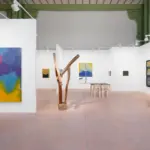




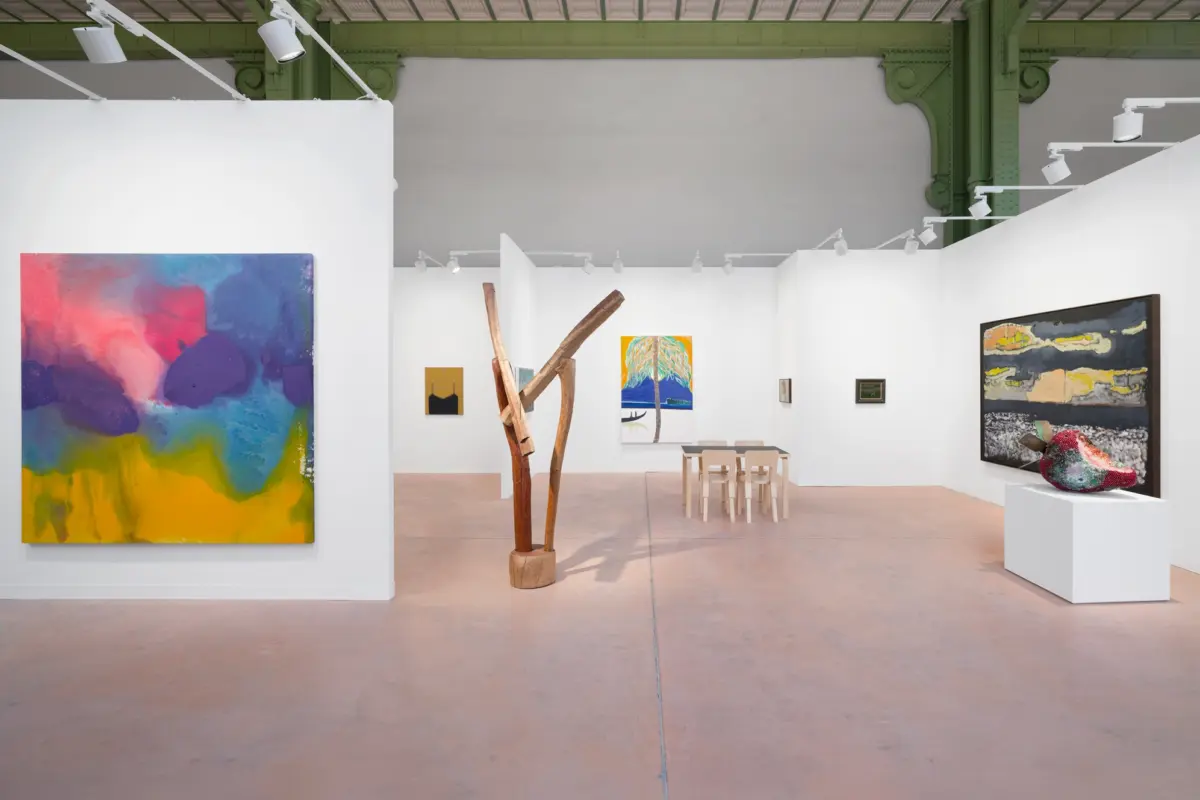
Under the grand glass-and-iron roof of the historic Grand Palais nave, a wave of vibrant color washed over the exhibition space—flashes of brilliant oranges, deep blues, striking yellows, and primary hues everywhere you looked. And that was merely the fashion of the massive, bustling crowd. This was not a seasonal runway presentation or a high-profile fashion week event; it was the return of Art Basel Paris, drawing international collectors, curators, and cultural figures to the French capital.
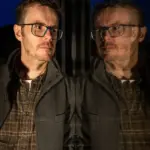
Smartphones were immediately pulled from pockets as influencers and VIP guests went live from the opening hours, capturing the electric atmosphere. Near a ground-floor installation, an older gentleman paused to admire his own reflection warped within a sweeping, highly polished Anish Kapoor mirror sculpture. "I feel like Dorian Gray," he remarked to a companion, gazing intently at the distorted metallic surface. "I need one, regardless of cost." While the price was officially listed upon request, auction records indicate the high market value of the British-Indian sculptor’s work, with Christie’s having sold a similar Kapoor piece for €538,000 back in 2020. It was, effectively, the most expensive selfie filter operating inside the building. Nearby, at the Pace Di Donna Schrader booth, hung the undisputed priciest masterwork of the entire fair: Amedeo Modigliani’s luminous 1917 painting, Nu étendu (Lolotte), carrying a valuation exceeding $100 million.
Then, the operational landscape of the capital shifted dramatically, forcing a sudden and unprecedented alteration to the fair’s carefully planned schedule. On Thursday, event organizers formally announced that Art Basel Paris would be forced to close its doors early at 7 p.m. on Friday and remain completely shut throughout the remainder of the weekend. The decision was made in response to planned public demonstrations across the city. Police authorities had already enforced a brief, unexpected lockdown of the Grand Palais during the final stages of booth installation earlier in the week, triggered by student-led protests addressing grievances over educational funding and public services.
For the massive blue-chip galleries commanding extensive capital and international prestige, the truncated public run was a manageable disruption that still allowed for substantial networking and high-level sales. However, for smaller galleries, securing a booth at an institution as prestigious as Art Basel serves primarily as a vital platform to gain critical exposure, connect with emerging collectors, and establish institutional relevance. The abruptly shortened run stripped away much of that anticipated momentum. Yet, despite the logistical hurdles, shortened hours, and citywide tensions, five distinct booths managed to stand out, capturing the critical imagination and leaving an indelible mark on the abbreviated edition: Mariposa, participating for the first time in the Emergence sector; Paris-based mainstays Sans titre and Sultana; London collaborative pairing Seventeen and Nicoletti; and New York’s powerhouse gallery Karma.
Mariposa
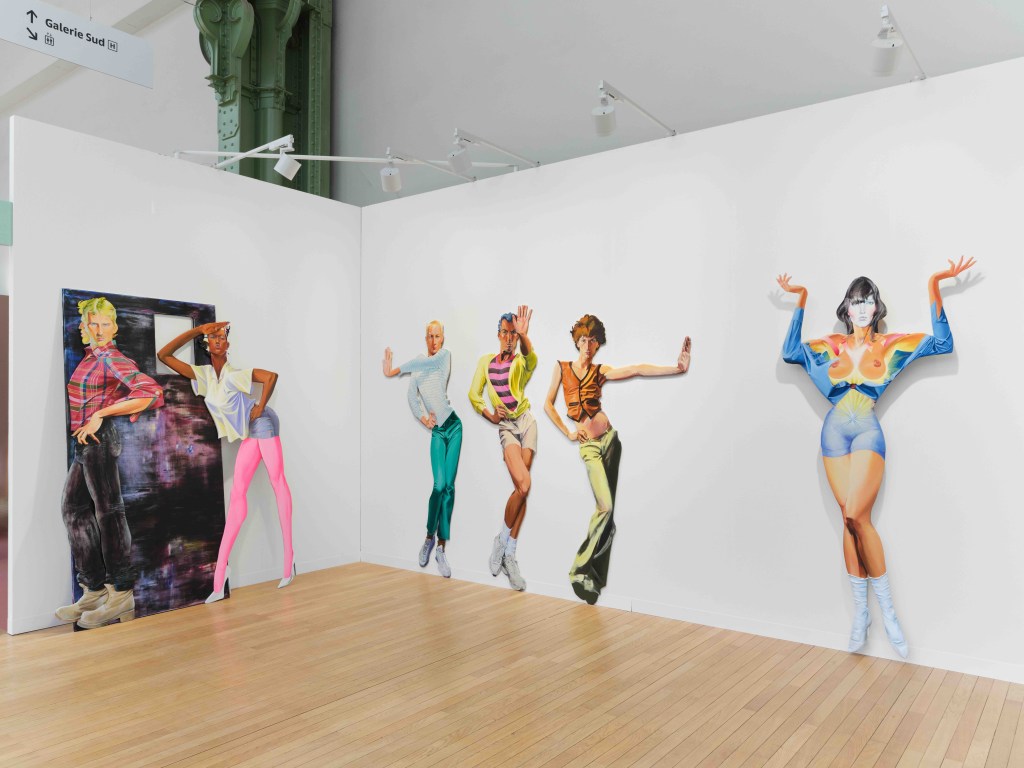
For its inaugural presentation within the fair’s Emergence sector, the gallery Mariposa chose to dedicate its entire stand to the singular vision of artist Drake Carr. Over the course of two years, Carr meticulously painted 10 life-size figures using acrylic on plywood sheets, carefully cutting out each silhouette with a jigsaw before presenting the works leaning casually against the gallery walls. For Art Basel Paris, the gallery rearranged these striking cutouts into what it termed a "modular fresco."
The figures possessed the long, elegant limbs, cocked hips, and poised, expressive fingers characteristic of Mannerist saints, yet they were dressed in thoroughly contemporary attire: plaid flannel shirts, casual track pants, chunky modern sneakers, and oversized bomber jackets. This fascinating aesthetic synthesis mirrors Carr’s own biographical journey—growing up deeply embedded in a church community in Flint, Michigan, before spending years tending bar at Happyfun Hideaway, a tiki-themed gay bar located in Bushwick, Brooklyn, where his early drawings were frequently stapled directly to the walls. In Carr’s perspective, both the traditional church sanctuary and the underground neighborhood bar shared a common trait: they were rooms filled with intense visual art that people rarely paused to truly look at and evaluate.
Sans titre
Sans titre, a Paris-based gallery that spent its formative early years staging exhibitions in unorthodox and provisional spaces such as residential apartments, empty parking lots, and an industrial shipyard, looked to the thematic framework of its 2024 exhibition dedicated to Ezio Gribaudo for its booth "Paysages, d’après la fin du monde," translating to "Landscapes, after the end of the world." The six diverse artists featured on the stand engaged directly with themes of remnants, reconstruction, and what is left behind in the wake of societal or structural collapse.
Gribaudo, who lived from 1929 to 2022, anchored the presentation with a striking 1970s work drawn from his celebrated Atlante series. Produced originally within industrial print shops by forcefully pressing heavy ink into paper until the surface resembled a scorched, ambiguous horizon, the piece set a contemplative tone. Nearby, Wei Libo presented a wooden vitrine meticulously modeled after the interior structural frame of his grandfather’s rural home—a building that has since been demolished—containing an incised ceramic form resting securely within.
Jessy Razafimandimby exhibited evocative paintings executed directly onto discarded bedsheets and secondhand household textiles. In Sequoia Scavullo’s haunting painting Car Crash, the human body and the mechanical wreckage of an automobile fused seamlessly into a single, terrifying mass. Mel Odom’s 1985 work Charleston, depicting a lone, enigmatic figure standing against a deep night sky, recalled the artist’s foundational place in 1980s downtown New York culture, appearing all the more poised and melancholic next to the surrounding imagery of ruin. At the very center of the stand, Liselor Perez contributed a child-sized sculptural figure holding a delicate doll underneath a lampshade that was subtly illuminated from within.
Sultana
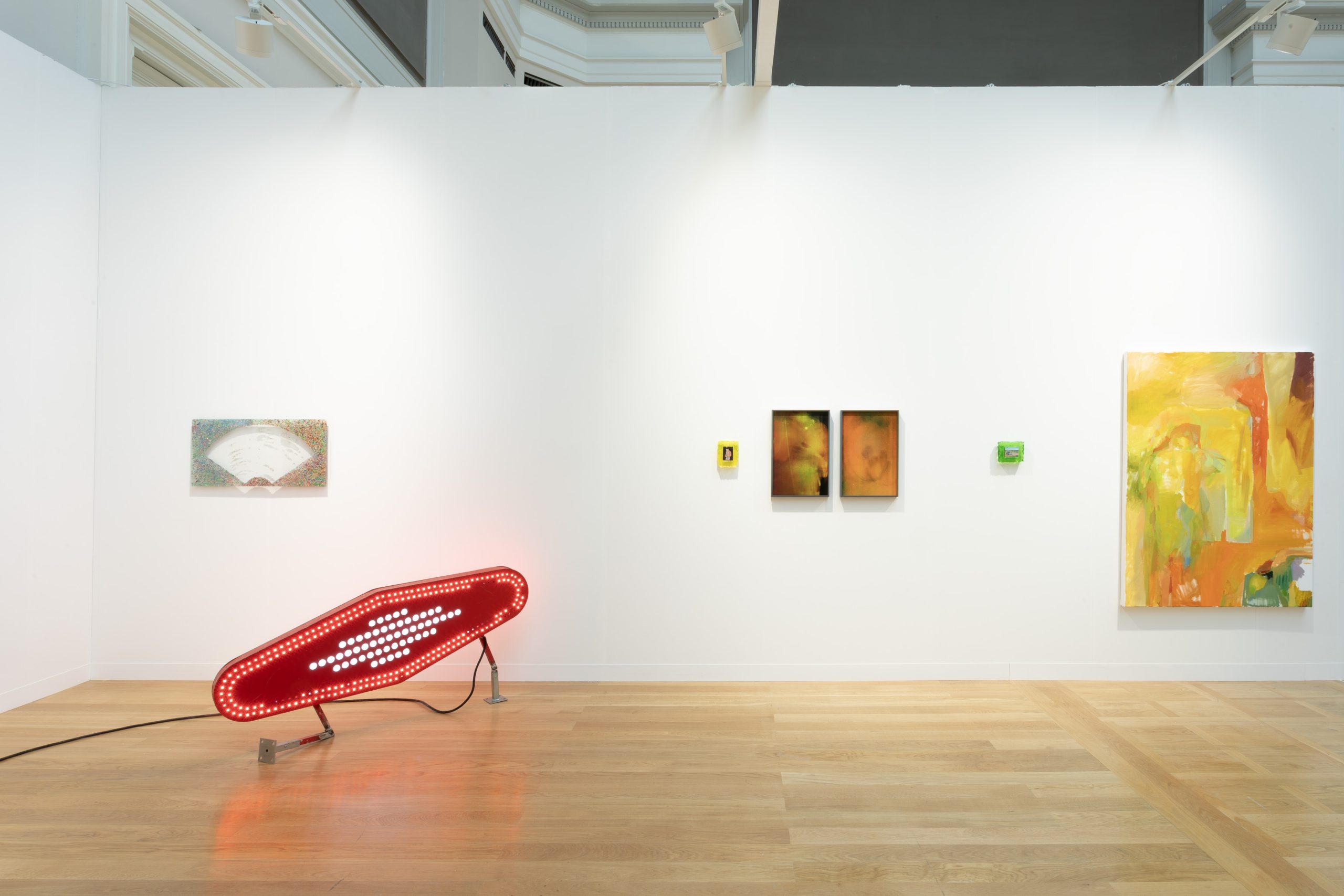
The presentation mounted by Paris-based Sultana was characterized by meticulous craft and intimate scale. Jean Claracq exhibited a series of exquisite miniatures painted in oil on wood, some measuring a mere 9 by 5 centimeters, housed carefully within antique glass-paste frames. Claracq sources his subjects through digital platforms like Instagram and Grindr, rendering their portraits with the exacting technical care and reverence of a 15th-century Flemish master. Alongside these miniatures, Bettina Samson presented her Spume Heads—a densely packed crowd of tiny sculptural heads fashioned from glazed porcelain and stoneware, the majority standing under 15 centimeters tall.
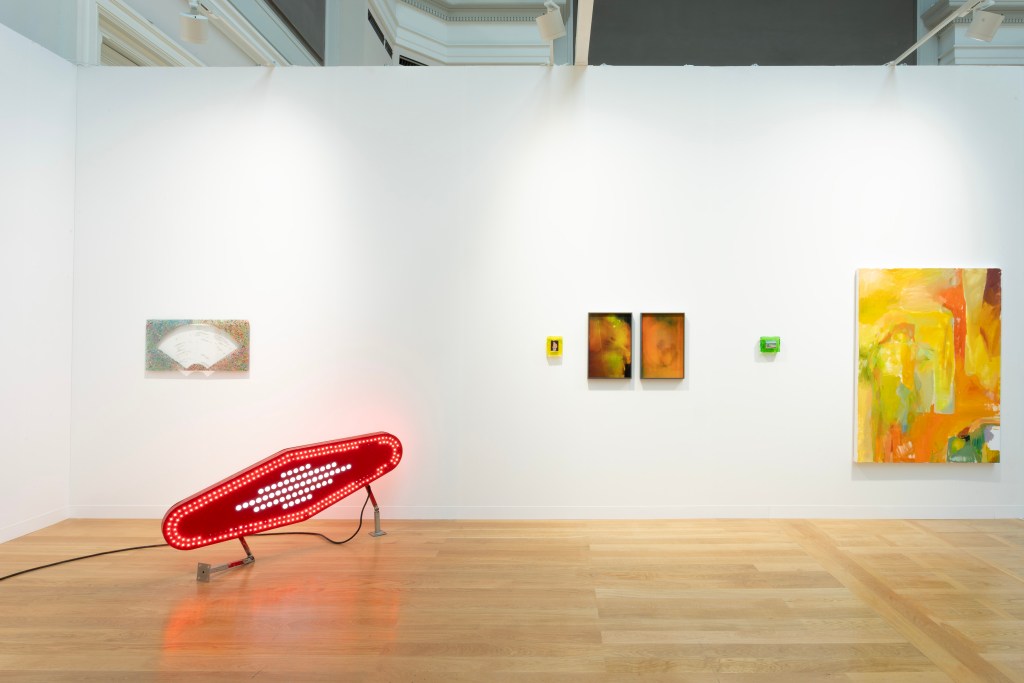
Jesse Darling, winner of the prestigious 2023 Turner Prize, contributed damaged, hand-manipulated illuminated shop signs drawn from their ongoing Blanks (les enseignes) series. These were displayed alongside Reliquary 2 (for and after Felix Gonzalez-Torres, in loving memory), a 2023 work comprising light boxes holding physical remnants and leftovers from Gonzalez-Torres installations, including discarded candy wrappers, spent light bulbs, and colorful beads.
Benoît Piéron, an artist who has spent significant portions of his life navigating institutional medical environments, piled decommissioned hospital sheets into soft, sculptural mounds topped with delicate porcelain elements for his Cairn series. This ongoing project serves as an offshoot of his large-scale installation presented earlier in the summer at Art Basel’s Unlimited sector. Rounding out the booth, Philipp Timischl’s 2026 work Louvre paired a traditional canvas painting with an active LED panel—a pointed and timely conceptual choice during a week when public protests had briefly forced the closure of the world-famous museum just across the city.
Seventeen and Nicoletti
For the second consecutive year, London-based galleries Seventeen and Nicoletti joined forces to share a single, unified stand, bringing together six distinct artists whose practices investigate how contemporary images are constructed, layered, digitally manipulated, and ultimately faked.
Josèfa Ntjam, a finalist for the prestigious Marcel Duchamp Prize who simultaneously maintained a major solo exhibition on view at the Musée d’Art Moderne de Paris, contributed complex photomontages executed on delicate Kozo paper, built up physically with layers of resin, raw tree bark, powdered mushrooms, and flower petals. Tarek Lakhrissi’s VELVET SERIES featured striking oil-pastel drawings depicting heavy boots pressing downward upon human bodies, positioned strategically behind industrial stainless-steel sidewalk grates that occasionally opened like functional hatches. Ana Viktoria Dzinic applied paint directly over printed photographic surfaces to mimic the slick visual aesthetic of digital social media filters, while her velvet-textured prints incorporated a twisted tangle of charging cables reminiscent of those featured in Balenciaga’s dystopian 2020 "Blue" runway show.
On the side of the booth curated by Seventeen, Justin Fitzpatrick presented Shoe Angel (The poet Milton in heaven geolocating William Blake’s foot), a 2026 work riffing directly on William Blake’s prophetic poem Milton, in which the deceased epic poet descends from the heavens to land upon Blake’s foot like a falling comet. Gabriele Beveridge paired organic, hand-blown glass elements with sleek industrial chromed steel, while Nina Davies presented Image Syncers, an installation of flat screens housed inside clear plastic garment bags and hung neatly from a clothing rail. The screens played a fictionalized podcast documenting the logistics of staging real-world events so thoroughly that they appear entirely AI-generated. Notably, Davies shot the footage entirely without post-production effects, ensuring that every visually synthetic-seeming moment actually occurred in reality.
Karma
New York gallery Karma structured its ambitious presentation around major institutional exhibitions opening concurrently across the international arts calendar this autumn. Mungo Thomson, whose monumental public project Monument opened at Lafayette Anticipations featuring a towering bronze column of stacked mailing tubes in the central courtyard, contributed Nageire Variation No. 4 Upright Style, a lenticular print named after a traditional, freestyle school of Japanese flower arrangement. Reggie Burrows Hodges, whose solo exhibition A Theater of Passions opened at the Getty Center featuring narrative paintings responding directly to the historical works of Orazio and Artemisia Gentileschi, brought the nearly eight-foot-wide canvas The Buoy: Sturdy Inclinations. Meanwhile, Peter Bradley, whose work was bound for MoMA PS1’s historical survey "Hard Art," exhibited Masqualero, a canvas sharing its title with a celebrated jazz composition by Wayne Shorter.
The remainder of Karma’s booth focused heavily on innovative materiality and historical resonance. Kathleen Ryan presented Bad Strawberry (Blossom), a visually striking, moldering fruit sculpture constructed from 16 different varieties of semi-precious and decorative stones, integrated ingeniously with a discarded John Deere tractor cooling fan. Jeremy Frey, a celebrated Passamaquoddy tribe basket maker from Maine, exhibited Vapor, an intricately woven vessel crafted from traditional ash and sweetgrass. On the painting side, Maja Ruznic’s sweeping seven-foot oil painting Renunciation of Infinite Illusion II and a characteristically luminous, tall canvas titled Dusk by the late Matthew Wong anchored the contemporary offerings, which were thoughtfully placed in dialogue with historical works by American modernists Milton Avery and Gertrude Abercrombie.