





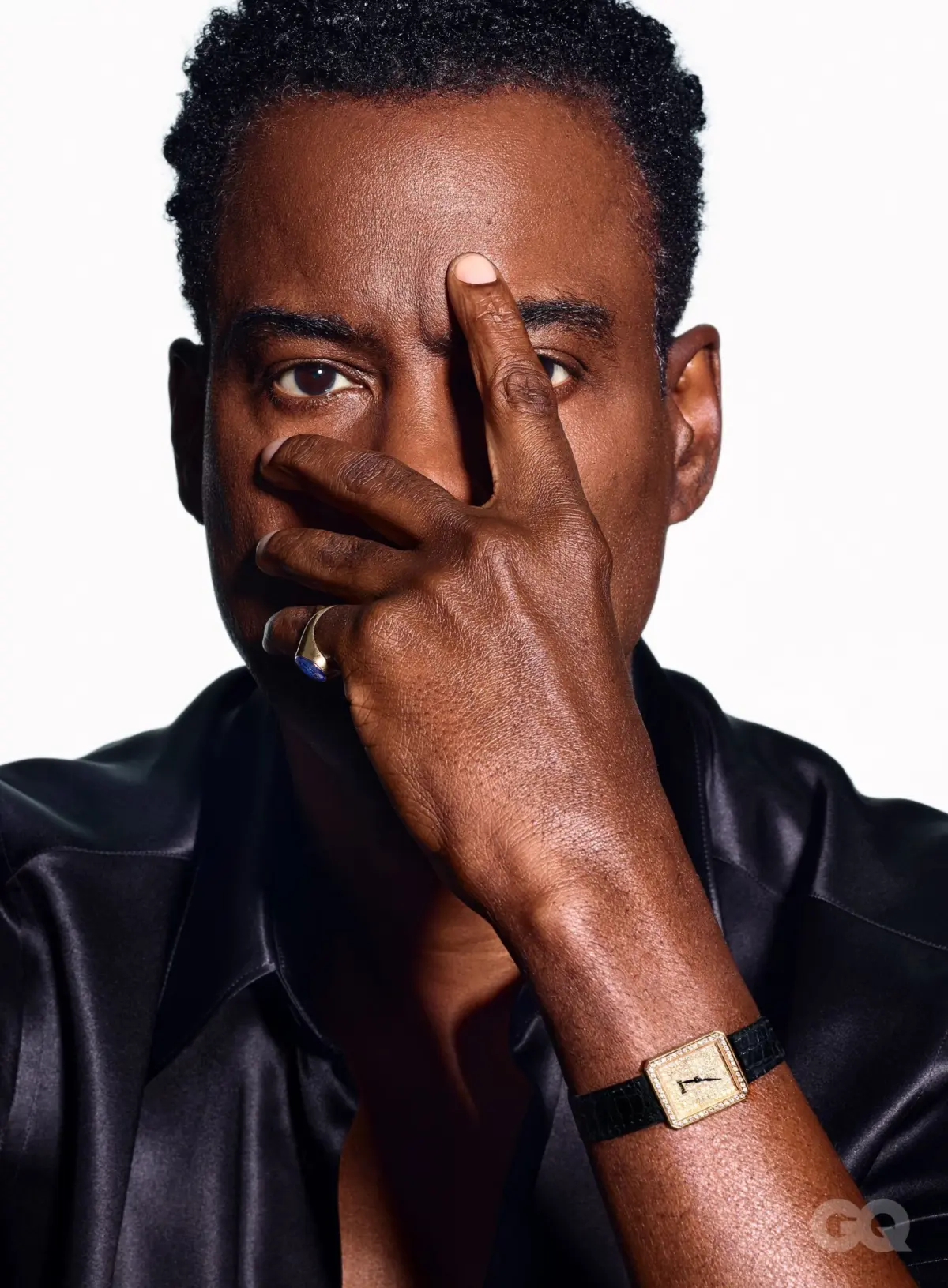
When Chris Rock steps into a room, he does so with a quiet, observant diffidence, carefully scanning his surroundings and making understated remarks about the world around him. On the 24th floor of the World Trade Center in New York, surrounded by an elaborate media setup featuring studio lights, cameras, and microphones for a GQ cover story, the 61-year-old comedian and filmmaker takes in the scene with characteristic dry humor. Having recently wrapped shooting on his latest independent feature, Rock quietly notes that his movie set felt considerably more sparse than the media apparatus arrayed before him, observing that he had just finished filming a project with barely three people on set at a fraction of the budget.

That movie is Misty Green, marking Rock’s fourth feature film as a director. The story follows an immensely gifted actress named Misty, played by Rosalind Eleazar, who has experienced real career success but consistently struggles to get out of her own way. While the character’s self-sabotaging tendencies present a stark portrait of creative struggle, Rock sees a reflection of himself across the entire ensemble. He notes that a part of his own personality lives in every character in the script, including Misty’s best friend, played by Anna Kendrick, who delivers sharp comedic relief while navigating her own unsatisfactory love life, and Misty’s ailing brother, played by Daniel Kaluuya. Rather than relying on Hollywood clichés, Misty Green offers a grounded, lived-in depiction of the entertainment industry, balancing sharp social commentary on modern hypocrisy with genuine empathy for its flawed protagonists.
For Rock, Misty Green represents the continuation of a deeply personal style of filmmaking that began with his 2014 effort Top Five. While many prominent directors aspire to helm massive, big-budget studio blockbusters or high-octane action thrillers, Rock has embraced a far more intimate, 1970s-style character-driven approach. He likens his filmmaking process to hand-crafting a bespoke suit—an art form built on precise detail, individual craftsmanship, and personal connection rather than industrial scale. Over his four-decade career, his observational eye for cultural absurdities remains as razor-sharp as ever, but his work behind the camera now carries a warmer, more reflective quality forged through decades of audience engagement and personal trial.

The thematic roots of Misty Green connect directly to Top Five, a film built around a renowned comedian attempting to promote a serious artistic project while facing line after line of intrusive media questioning. Reflecting on the parallel during his conversation with GQ, Rock offers a candid assessment of modern entertainment journalism and gossip culture. He contends that today’s media ecosystem is increasingly driven by sensationalism, clickbait, and artificial controversy. In Rock’s view, contemporary society has elevated gossip to a dominant cultural force, effectively discarding traditional norms against spreading false witness in favor of amplified drama and public polarization.
The twelve-year hiatus between Top Five and Misty Green was shaped by significant personal turbulence, including a difficult divorce that required substantial time, financial restructuring, and emotional recovery. As Rock explains, navigating a marriage breakdown inevitably takes a heavy toll, forcing him to return to extensive stand-up touring across the globe to rebuild his personal life and career. That decade also encompassed major global shifts, including the COVID-19 pandemic, alongside a period of intense self-examination that reshaped his artistic priorities.

Rock’s personal evolution is vividly documented across his body of stand-up work. Where his legendary early-career specials—such as 1996’s Bring the Pain, Bigger & Blacker, and Kill the Messenger—established him as one of the most commanding figures in comedy history, his subsequent releases marked a turn toward raw introspection. In his 2018 special Tamborine, Rock opened up about the breakdown of his marriage, acknowledging his own past infidelity, emotional distance, and a long-standing addiction to pornography that he successfully overcame half a decade ago.
Looking back at that era of his life, Rock compares his past behavior to a superhero origin story in a Marvel film, where a character abruptly acquires extraordinary power and acts recklessly before being brought back down to earth. He recalls testing his own metaphorical powers, acting with arrogance, and pushing boundaries until reality forced a profound reckoning. That period of severe humbling, though painful, served as a necessary catalyst for personal growth, steering him away from self-centered impulses and toward a deeper understanding of human vulnerability.

Around the time he was preparing Tamborine, Rock sought professional evaluation following a casual observation by a close friend, undergoing an exhaustive eight-hour cognitive assessment. The testing revealed that Rock has Nonverbal Learning Disorder (NVLD), a condition characterized by difficulty interpreting nonverbal social cues, a tendency toward black-and-white thinking, and a habit of catastrophizing. While NVLD created communication hurdles in his personal relationships—where he often struggled to decipher subtle social signals in real time—it unexpectedly served as an asset in his stand-up comedy. His analytical mindset, combined with an extraordinarily precise auditory memory and a relentless work ethic, fueled an intensive creative process that saw him test material on stage over 250 times for a single special.
Rock’s journey toward self-awareness also involved intensive therapy, an experience he refuses to romanticize or weaponize as a point of pride. Rejecting the modern trend of bragging about self-improvement, Rock frankly describes entering therapy not out of casual curiosity, but out of absolute necessity, arriving in a state of deep emotional distress seeking answers for his personal struggles. He views mental health maintenance as an ongoing commitment, akin to managing a chronic condition, relying on a dedicated support system that includes both traditional therapy and specialized assistance for his NVLD diagnosis.

Addressing his 2023 special Selective Outrage—which addressed the notorious incident at the 2022 Academy Awards involving Will Smith—Rock emphasizes a firm desire to move past the controversy. He clarifies that he has no intention of returning to the Oscars or similar award shows unless he is participating as a nominee, stressing that he wants his vast body of work to define his legacy rather than a single chaotic evening. With a rich pipeline of upcoming projects—including film scripts, television developments, and a forthcoming book—Rock remains focused on delivering new art rather than remaining tethered to past public dramas.
Rock’s perspective on the entertainment industry is informed by decades of navigating its systemic barriers and shifting dynamics. Reflecting on his monumental 1996 breakthrough Bring the Pain, he recalls carrying a physical VHS tape of the special to prospective talent agents after parting ways with his former management team. Despite his established résumé on Saturday Night Live, New Jack City, and CB4, one prominent agent rejected him outright, stating explicitly that his roster already contained "too many Black guys." When Bring the Pain subsequently became a massive cultural phenomenon—landing Rock on Oprah and 60 Minutes—the same agent called back offering reduced commission rates, an offer Rock steadfastly declined.

That early lesson in resilience reinforced Rock’s focus on artistic integrity over industry conformity. While early mentors like Lorne Michaels provided valuable perspective on navigating financial ups and downs, and legendary director Mike Nichols offered constructive critique on his stand-up pacing, Rock eventually recognized that his true calling as a filmmaker lay in small, meticulously crafted projects. Recognizing that traditional studio comedies have largely vanished from the theatrical landscape, he embraces his role as an independent storyteller focused on human nuance rather than chasing broad blockbuster stardom.
The emotional realism in Misty Green is further grounded in Rock’s personal experiences with grief and familial devotion. The dynamic between Misty and her struggling brother in the film draws subtle inspiration from Rock’s own relationship with his late brother, Charles, who died in 2006 following a long battle with alcoholism. Rock reflects on the unique perspective of a sibling who remembers a loved one long before their struggles began, holding onto hope and unconditional support despite societal judgment. Having also lost his father in 1988—an event that forced him to mature quickly right before joining SNL in 1990—Rock acknowledges the sobering reality of aging and losing loved ones, observing that reaching one’s fifties brings an inevitable encounter with mortality.

Now at 61, Rock approaches his career with the pragmatic wisdom of a seasoned veteran. Comparing his current stage in life to legendary actors like Morgan Freeman in The Shawshank Redemption or Danny Glover in Lethal Weapon, he acknowledges the challenge of shifting public perception in show business. Rather than chasing youth or demanding lead hero roles, he is content to contribute as a high-value collaborator, drawing parallels to a veteran basketball player coming off the bench to play solid defense and execute smart plays. With his children grown, Rock plans to devote more time to writing and directing, leaving open the question of how much stand-up remains in his future unless he can maintain the sharp competitive separation that has defined his career.