





The international denim industry put its collaborative spirit on full display at the latest edition of Kingpins Amsterdam, reinforcing the B2B trade show’s reputation as a vital nexus for global textile innovation. Once again, the gathering brought together a diverse ecosystem of denim mills, fiber producers, cutting-edge technology companies, and visionary designers. Together, they showcased capsule collections and exhibits designed to transform out-of-the-box creative concepts into commercially viable, market-ready products.
From upstream chemical advancements to downstream circular supply chains and avant-garde art installations, the event underscored how modern denim manufacturing relies on cross-industry partnerships to address pressing environmental challenges while meeting consumer demands for performance and style.
Forging Sustainable Pathways Through Strategic Partnerships
Among the major announcements made on the trade show floor, Swiss specialty chemical manufacturer Archroma and Chinese textile mill Prosperity Textile inked a strategic agreement aimed at shaping the future of denim innovation. The partnership will focus on jointly developing, evaluating, and implementing new chemical and finishing approaches designed to enhance denim aesthetics, durability, and overall performance.
Speaking on the operational framework behind the alliance, Prosperity Textile director Stafford Lau highlighted the strategic advantages of the company’s smart factory infrastructure in China and Vietnam. According to Lau, these advanced facilities enable the enterprise to develop and test new ideas quickly and smoothly transition the most promising innovations into full-scale production.

Echoing this sentiment, Jordi Calucho, Archroma’s super systems denim director, emphasized that true innovation requires commercial execution. An innovation only matters once it reaches the market, Calucho noted, and achieving that milestone requires a dedicated partner to help shape it, test it, and run it at scale. He added that Prosperity Textile provides that vital partnership, with both companies aiming to deliver the look and lasting performance that brands and consumers crave, produced through increasingly sustainable methods.
Scaling Recycled and Bio-Based Spandex Solutions
Elastane manufacturer Hyosung TNC served as the foundation for several high-profile collaborations featured at the trade show. In one notable project, Hyosung teamed up with Turkish denim mill Maritaş to combine cotton cultivated through regenerative agricultural practices in Turkey with Hyosung’s RCS-certified recycled spandex, produced locally at its Turkish facility. This collection resonated strongly with European apparel brands looking to shorten their supply chains and support regional manufacturing loops.
In another collaborative effort, Hyosung paired its 100 percent recycled regen elastane fiber with Tencel Lyocell – HV 100. Taiwanese denim mill Nien Hsing brought these materials to life, producing fabrics that demonstrate how brands can infuse denim with an authentic look and texture while maintaining the ease and comfort associated with recycled stretch.
Hyosung also joined forces with DNM Denim—both participating members of the circular economy initiative known as the Denim Deal—to develop innovative fabrics containing more than 20 percent post-consumer recycled cotton alongside Hyosung’s regen BIO Max Elastane, which is derived from sugarcane.
This specific collection provided an ideal platform to showcase Hyosung’s broader operational transition toward renewable resources. Commercial production for the company’s sugarcane-based regen BIO Spandex officially commenced in August, marking the industry’s first operating integrated bio-based spandex production system. The proprietary system connects the entire manufacturing chain, starting from sugarcane feedstock to Bio-BDO, Bio-PTMG, and finally finished spandex. The facility currently operates with an annual production capacity of up to 50,000 tonnes, with strategic plans already in place to scale capacity up to 200,000 tonnes in response to anticipated market growth.

Expanding Fiber Blending Possibilities with Lenzing and Kaihara
Lenzing continued its legacy of industry collaboration by partnering with world-renowned Japanese denim manufacturer Kaihara Corporation. Together, the two entities developed the REMOD collection, which features three of Lenzing’s signature lyocell fiber offerings tailored specifically for denim applications: standard Tencel, the linen-inspired Tencel dtex 2.2, and Tencel Lyocell – HV 100.
Spanning a diverse array of apparel categories—including men’s heavyweight jackets, midweight wide-leg jeans, and shirting—the REMOD collection reportedly unlocks a wide range of fiber-blending possibilities, including constructions crafted both with and without traditional cotton.
Dennis Hui, Lenzing’s global business development manager for denim, expressed enthusiasm about renewing the partnership with Kaihara Corporation, noting that Tencel fibers have been integrated into Kaihara’s collections since the 1990s, with each successive era posing new material challenges. Hui explained that each Tencel fiber variant brings an authentic denim character complemented by elevated comfort and hand feel, adding that the company eagerly anticipates seeing mills, brands, and designers draw fresh inspiration from the extensive application possibilities within the Tencel Lyocell fiber portfolio.
Artistic Installations and Historical Exhibitions Inspire the Industry
While material science and commercial partnerships drove much of the business activity, several exhibits at Kingpins Amsterdam were designed to purely inspire attendees through art, history, and cultural exploration.

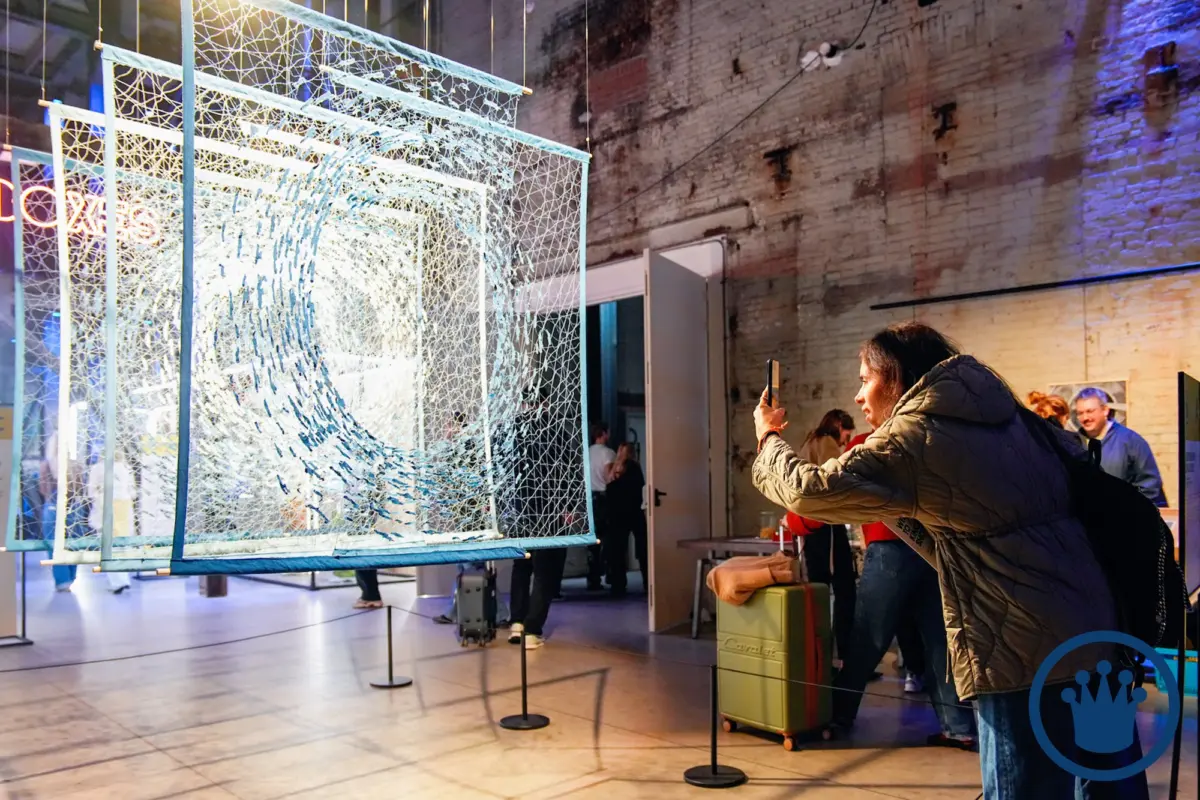
Munich-based artist Isha Pimpalkhare welcomed visitors at the entrance to the trade show with her textile installation, “Four Breaths of Blue.” Curated by the Indigo Art Museum and supported by Indian denim manufacturer Arvind, the artwork draws visual inspiration from the gradual deepening of color achieved through repeated indigo dips and continuous exposure to oxygen. Pimpalkhare developed the underlying technique—a modern reinterpretation of Devore—while studying textile design. The process utilizes acid to burn away select areas of indigo-dyed cotton, while a delicate polyester mesh structure holds the remaining fragments together.
In a separate artistic venture, Stella Blu partnered with artist Nouch to create a limited-edition collection of 100 art pieces titled “Material Intent.” The collaboration plays conceptually with the idea of social constructs, centering around denim bags designed to mimic disposable plastic shopping bags, each featuring unique animal illustrations.
Meanwhile, Cone Denim celebrated its milestone 135th anniversary by exhibiting a curated selection of never-before-seen vintage garments chosen specifically for how they reflect the lived experiences of their original wearers. Another popular exhibit, presented by The London Showroom, was titled “Blue-Collar Modernism.” This display offered a thoughtful exploration of style originating from Fleet Street, which served as the historical home of British print and national journalism for nearly five centuries. The showcased pieces reflected a cleaner, more refined workwear aesthetic compared to previous showroom presentations that heavily emphasized distress, repair techniques, and faded finishes.
Celebrating Chinese Craftsmanship and Innovation
Continuing its regional showcase tradition, Kingpins presented the third installment of its ongoing “Made in” series, this time turning its focus toward China. Exhibitors were invited to present their unique perspectives on the future trajectory of Chinese denim. Vivian Wang, CEO of Kingpins, noted that the participating companies successfully blended tradition with cutting-edge technology, combining meticulous handwork with next-generation thinking to paint a comprehensive and modern picture of China’s contemporary denim landscape. The “Made in China” exhibit was further enriched by the screening of the short film “Indigo Story: The Hands That Remember.”
Pushing the Boundaries of Finish and Form

Advanced finishing technologies and experimental design also claimed a major spotlight at the exhibition. Jeanologia joined forces with denim consultant and Denim Forum founder Sue Barrett to create “Common Ground,” a utility-wear collection deeply inspired by nature. Barrett explained that the collection bridges traditional workwear and military-inspired silhouettes with nature-derived patterns, laser-etched details, vintage finishes, and subtle references to archival garments, resulting in a timeless feel infused with a contemporary attitude.
Jeanologia’s proprietary laser and G2 Ozone technologies played a central role in the production process. The laser system was utilized to apply intricate patterns, contrast, and visual depth directly onto the garments, while the ozone technology worked to manipulate color and aging effects to achieve the final aesthetic. Carme Santacruz, Jeanologia’s creative director, noted that for many involved, the creative process proved just as meaningful as the resulting collection, encouraging reflection on the balance between blending into one’s surroundings and preserving individual identity.
In another striking presentation, Italian chemical manufacturer Officina39 debuted “Renegade Renaissance,” a two-piece collection that utilized unconventional materials under the creative direction of Marta and Glenda Goldschmied, founders of Gold Girl Co. The daughters of legendary denim pioneer Adriano Goldschmied and inventors of the Recycrom technology served as the technical engine and creative enablers for the project, translating their distinct vision into tangible garments through advanced chemistry, textile expertise, and material experimentation.
The two-piece lineup featured “Marble Dreams,” a draped white gown inspired by classical sculpture that Officina39 treated by dipping it in marble dust to achieve a structured yet smooth finish. The second piece, “Midnight Journey,” drew inspiration from scratch-off lottery cards, utilizing a specialized leather coating applied by Officina39 to secure the vintage effect envisioned by the designers.
Reflecting on the unconventional partnership, Andrea Venier, managing director of Officina39, praised the strong creative vision brought by Marta and Glenda Goldschmied. Explaining that the company’s primary role was to provide that vision with a material language, Venier noted that working with unconventional briefs involving marble dust, permanence, chance, and ambition is precisely what drives the chemical company’s ongoing exploration of material possibilities.