





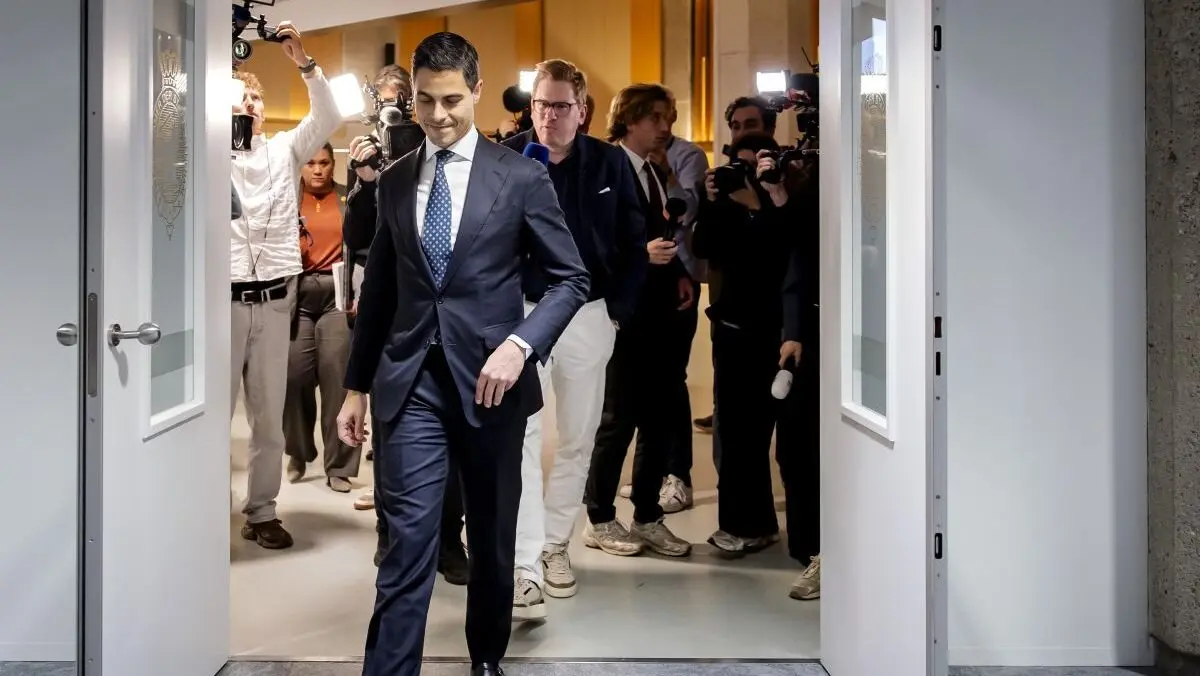
There is an old medical joke about a surgeon who declares, “The operation was a complete success, but the patient died.” For Dutch Prime Minister Rob Jetten, that punchline became a harsh political reality late Thursday night. After months of chaotic, grueling negotiations, Jetten successfully secured a parliamentary majority for his crucial tax bill, but the victory came at the devastating expense of his fragile governing coalition, leaving it in absolute tatters.
The right-wing liberal VVD (People’s Party for Freedom and Democracy) was so incensed by a last-minute deal struck by the other two coalition partners—Jetten’s D66 and the Christian Democratic Appeal (CDA)—with the left-wing opposition party Pro that they ultimately voted against the entire legislative package. The irony was thick: the bill had been extensively drafted, redrafted, and painstakingly polished by the VVD’s own finance minister, Eelco Heinen, only for his own party to reject it on the floor of parliament.
VVD leader Dilan Yeşilgöz swiftly denounced the resulting legislative compromise as “a bad deal for the Netherlands” and demanded a “fundamental reset” of the centre-right coalition. In colloquial terms, she essentially wanted the prime minister to switch his cabinet off and switch it on again, completely halting the momentum of the administration to reevaluate its foundational terms of agreement.
The Millionaires’ Tax Knife Twist
The friction centres on a specific fiscal measure that ignited a political firestorm. Strikingly, the amendment that D66, the CDA, and Pro agreed upon on Wednesday afternoon was actually a much milder version of a wealth tax tweak that the VVD had seemed tentatively willing to tolerate earlier in the week. Pro had originally pushed to raise an extra €1.5 billion in wealth taxes to fund an income tax cut for the lowest earners in Dutch society. Through negotiation, D66 and CDA managed to beat the amount down to a more modest €1 billion. Furthermore, they built in robust counterbalancing measures specifically designed to protect citizens with modest savings—which had been one of the VVD’s core concerns during earlier stages of the legislative process. Consequently, its direct impact, even on the private investors it targeted, was marginal.
However, the substance of the compromise mattered far less to the VVD than the political breach it represented. For the party, the cross-aisle deal crossed an absolute red line: raising taxes on successful, hard-working entrepreneurs. Compounding the insult, the agreement had been formulated completely behind their backs by their own coalition partners working in tandem with the left-wing opposition.
To make matters worse, Jesse Klaver, the leader of Pro, twisted the political knife by publicly describing the measure as a “millionaires’ tax.” The phrase went down like cold gravel in the throats of not just VVD members, but also CDA leader Henri Bontenbal, who found the partisan framing needlessly provocative and damaging to the fragile chemistry of the governing bloc.
The Unagreed Terms of an Open Marriage
The seeds of this multi-faceted political crisis were actually sown roughly ten days earlier, as detailed in a thorough reconstruction published by AD.nl. Sensing an impasse, the coalition parties agreed to enter what political commentators immediately dubbed an “open marriage.” After months of abortive attempts to strike a collective, unified deal with a deeply divided parliament that successfully balanced the competing interests of left and right, the three ruling parties decided to try a different tactical approach. They would attempt to form separate, ad-hoc majorities for their respective legislative priorities.
This arrangement theoretically allowed D66 and the CDA to pair up with left-leaning parties like Pro and Volt on progressive issues, while the VVD was given leeway to court the right-wing opposition block, including JA21, the farmers’ party BBB, and the orthodox Protestant SGP. As a desperate last resort, the coalition partners even gave themselves permission to vote on opposite sides when amendments were tabled in parliament, provided it meant the broader tax bill and the government itself survived.
The fundamental flaw in this unconventional arrangement, however, was that none of the coalition parties had ever agreed on the strict terms or boundaries of their open marriage. What the VVD completely failed to reckon with was that D66 and the CDA would go all the way with Pro, producing an amendment that felt calculated to humiliate and undercut their core constituency.
For their part, D66 and the CDA protested that they had kept their coalition partners adequately informed throughout the tortuous negotiations and had even repeatedly invited them to the table. But the VVD’s entire raison d’être for joining the coalition in the first place was to keep the left-wing Pro out of power and influence—a political reality that D66 and the CDA were acutely aware of.
For Yeşilgöz, the finalized amendment represented the exact political outcome she had entered the governing partnership to avoid in the first place. When Klaver subsequently held a triumphant press conference and posted celebratory Instagram reels celebrating the passage of the “millionaires’ tax,” it felt to the VVD like rubbing salt straight into a raw wound. To use another domestic analogy, it was akin to agreeing to an arranged marriage only to watch your partner immediately phone up an ex-partner—whom you were assured was no threat—and take her out for an expensive dinner.
Self-Inflicted Wounds and the Final Betrayal
None of this political drama, however, should obscure the extent to which the VVD actively engineered its own downfall. From day one, the minority cabinet was built on shaky foundations precisely because the VVD wanted to lock out the opposition party that naturally held the strongest hand in upcoming legislative negotiations. When the official coalition agreement was finally published, the VVD took out prominent billboards across the country to parade their policy achievements, such as successfully retaining the lucrative mortgage interest tax relief for homeowners.
From the outset, the VVD focused far more energy on fiercely defending their rigid red lines within the coalition than on doing the difficult, necessary work of finding pragmatic opposition votes to pass their broader legislative agenda. This strategic vacuum allowed Pro to skillfully exploit the resulting legislative deadlock to torpedo key VVD priorities, most notably a sweeping package of €6.5 billion in welfare cuts.
The budget amendment ultimately served as the final betrayal for the VVD, but it was also the predictable outcome of a process wherein the party persistently refused to build any kind of constructive, working relationship with Pro. Meanwhile, D66 and the CDA had shown far greater flexibility, at times even reaching out to unlikely partners on the far right, such as Gidi Markuszower’s faction. When the VVD finally decided to cut off its nose to spite its face by rejecting its own government’s budget deal, its abandoned partners delivered a final humiliation by salvaging the legislation anyway, relying on the support of two fringe parties on the left: Denk and the animal rights party PvdD.
An Uncertain Future
Where Dutch politics goes from here remains entirely unclear. The VVD, smarting from what they perceive as a profound breach of trust, are demanding that the coalition formally renew its vows. Prime Minister Jetten, choosing his words more cautiously, prefers to speak about a “restart”—the clinical terminology typically reserved for corporate entities that have been forced to call in bankruptcy receivers.
Yesşilgöz’s fierce rhetoric almost seemed to goad the other coalition parties to try their luck forming a new government combination entirely with Pro. Yet, such a reshuffled configuration would still leave any prospective cabinet nine seats short of a working majority in a hostile parliament dominated by a stern right-wing opposition. Furthermore, Jesse Klaver may well have overplayed his political hand with his public-facing social media tactics.
At the same time, calling for snap new elections presents an equally risky gamble for all three governing parties, whose standing in public opinion polls has only been further eroded by the messy, protracted tax plan saga. If the current coalition somehow manages to survive in its present form, it will undoubtedly do so as a marriage of pure political convenience. Once again, the turbulent intersection of politics and matrimony has proven to be a deeply toxic mix.