






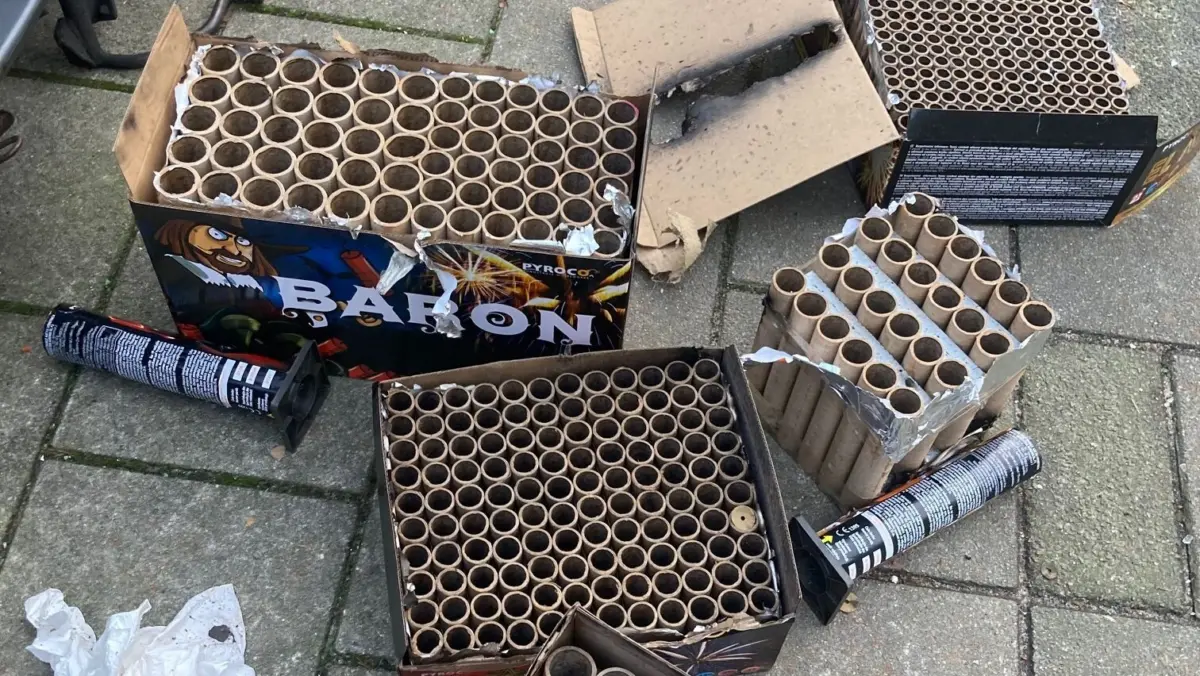
AMSTERDAM — Fireworks retailers across the Netherlands are expressing deep frustration over a newly announced government compensation scheme, which they argue falls woefully short of covering the financial losses they will suffer due to the upcoming nationwide ban on consumer fireworks.
Under the newly outlined financial arrangement, business owners are technically entitled to claim compensation for lost profits, provided they can prove they retailed consumer fireworks during the most recent New Year’s Eve celebrations as well as in at least one prior December season. However, the calculation of these payouts is tightly restricted, based strictly on the volume of stock business owners purchased during a designated previous year, rather than accounting for long-term investments, operational overhead, or future revenue potential.
The national fireworks industry foundation, Vuurwerkcheck, has sharply criticized the measure, branding the compensation scheme as restrictive as humanly possible. Industry representatives have reiterated their long-standing warning that prohibiting legal, regulated consumer fireworks will not eradicate the tradition, but will instead drive the market underground. They argue that the ban will inevitably fuel a booming trade in illegal black-market explosives, which are frequently far more powerful, unstable, and dangerous than the products previously sold by licensed domestic merchants.
Frans Köhler, chairman of Vuurwerkcheck, did not mince words when discussing the plight of seasonal retailers. Speaking to Dutch broadcaster NOS, Köhler warned that many merchants who rely heavily on winter holiday sales are now hurtling toward bankruptcy. He pointed out that some businesses are desperately attempting to pivot and adapt their commercial models to sell alternative merchandise, but noted that the government has given them a critically narrow window of just one single year to execute these sweeping structural changes. According to Köhler, the capital expenditures required to successfully overhaul a business model of this scale will drastically eclipse the limited financial compensation being offered by the state.
The friction between retailers and lawmakers follows a decisive legislative progression that culminated earlier this year. In April 2025, a solid majority in the Dutch parliament voted in favor of enacting a total, nationwide ban on consumer fireworks. This momentum carried through the legislative chambers when the Senate subsequently approved the measure in July 2025. The statutory framework officially took legal effect in August 2026, setting the stage for the upcoming holiday season to be the first under the comprehensive prohibition.
The legislative push to outlaw consumer fireworks has been driven for years by mounting public safety concerns regarding the carnage witnessed every December. High-powered pyrotechnics, frequently smuggled or obtained illegally from neighboring countries where regulations differ, cause catastrophic injuries, permanent disfigurements, and extensive property damage each year.
Data compiled by VeiligheidNL, the Dutch safety institute, highlights the persistent severity of the problem. During the most recent New Year’s Eve celebrations spanning into 2026, emergency departments and out-of-hours general practitioner posts treated a staggering 1,239 people for fireworks-related injuries. This figure represented a troubling 7% increase in casualties compared to the preceding year, reinforcing the arguments of lawmakers and safety advocates who insisted that drastic regulatory intervention was long overdue.
In addition to personal injuries, the uncontrolled use of heavy fireworks continues to pose profound threats to public infrastructure and historical architecture. During the turn of the year leading into 2026, investigators heavily suspected that rogue fireworks may have played a role in sparking a devastating blaze that gutted the historic 19th-century Vondelkerk in Amsterdam. Although police and forensic investigators ultimately concluded their probe without being able to uncover enough concrete, definitive physical evidence to definitively prove the pyrotechnic origin of the church fire, the incident served as a stark reminder of the volatile risks associated with holiday celebrations in densely populated urban centers.
As the first restricted New Year’s Eve approaches under the new legal framework, affected business owners and industry advocates maintain that the government’s financial safety net is fundamentally inadequate. With bankruptcy looming for specialized shops and concerns mounting over the rise of illicit cross-border smuggling, the debate surrounding the enforcement and socio-economic fallout of the Dutch fireworks ban remains fiercely contentious.