





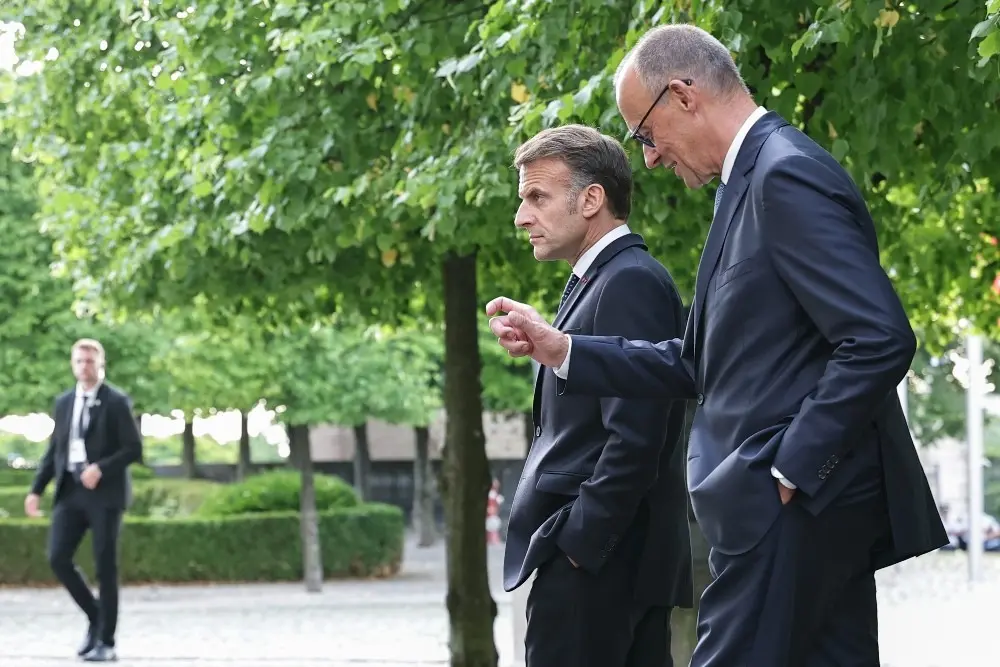
Just days before top European trade leadership is scheduled to meet with their Chinese counterparts in Beijing to hash out the complexities of a fast-growing and deeply unbalanced trade relationship, French President Emmanuel Macron and German Chancellor Friedrich Merz have made a bold and urgent diplomatic play. The two leaders are pushing for the European Union to deploy a powerful new legislative weapon designed to protect the bloc’s domestic manufacturing sectors from what they characterize as an overwhelming deluge of state-subsidized imports.
In a joint letter addressed to European Commission President Ursula von der Leyen, Merz and Macron escalated the pressure from Paris and Berlin, warning that the 27-member trade bloc’s domestic manufacturing industries and its broader economy face an existential threat. They pointed directly to systemic market-distortion practices originating outside Europe, arguing that the crisis requires immediate, decisive attention rather than slow-moving bureaucratic deliberation.
The Franco-German proposal cuts straight to the heart of how the European Union handles unfair trade. Without delaying the full implementation and enforcement of the EU’s existing set of defensive trade instruments, the two leaders wrote that Europe urgently needs a comprehensive framework to complement its current regulatory toolbox with fresh legal mechanisms. Crucially, they emphasized that these new tools must be designed in a lean, non-bureaucratic way to ensure swift action.
At the center of their proposal is a rapid-response mechanism explicitly modeled on the United States’ Section 301 trade duties. According to Macron and Merz, adopting a European equivalent would drastically speed up and streamline the European Commission’s operational processes for investigating and addressing unfair trade practices or severe market imbalances, allowing Brussels to act with the agility required in modern global trade conflicts.
The push from Paris and Berlin comes as European leaders grow increasingly vocal about the macroeconomic fallout of swelling import volumes. Macron, in particular, has spoken openly and frequently over the past year about the devastating impact that a growing flood of China-originating imports has had on European domestic producers. Furthermore, European officials have observed that ongoing United States efforts to rectify its own massive trade deficit with the global sourcing superpower have inadvertently led to a significant redirection of surplus products toward the more vulnerable European market.
Washington’s Section 301 tariffs—some of which were initially applied to Chinese goods during President Donald Trump’s first term in office and subsequently maintained and built upon by President Joe Biden—have successfully slowed the flow of targeted Chinese products into the U.S. market in several critical sectors. Just this summer, the U.S. applied even more sweeping duties to various trading partners, including China, following comprehensive investigations into trade practices tied to forced labor.
With Washington effectively tightening its borders against certain influxes of foreign goods, European leaders have grown anxious that Europe is serving as the primary alternative destination for excess global capacity. The proposal put forward by Macron and Merz heavily implies that the EU desperately needs its own razor-sharp trade cudgels to wield against swelling import volumes. The urgency of the matter is underscored by staggering economic figures: the European Union’s trade deficit with China has ballooned by a staggering 1 billion euros, or approximately $1.125 billion, every single day.
While the European Union already possesses a specialized legal instrument known formally as the Anti-Coercion Instrument—and colloquially referred to by trade policy insiders as the "trade bazooka"—critics argue it falls short of what is needed in fast-moving commercial disputes. The trade bazooka imbues the European Commission with substantial statutory authorities to constrain imports and retaliate in the face of economic coercion, but Merz and Macron pointed out that firing it off takes far too much time.
Under the current rules governing the Anti-Coercion Instrument, a cumbersome months-long investigation must take place before its deployment can even be officially approved. Additionally, the mechanism requires a majority of EU member state governments to vote affirmatively in favor of the plan before any measures can be enacted, creating potential political bottlenecks and vulnerabilities to member-state vetoes. The new proposal out of Paris and Berlin aims to erect safeguards against those potential vetoes, ensuring that the European Commission could act much faster and more decisively to protect European industrial interests.
Beyond immediate defensive tariffs and rapid-response mechanisms, the joint letter also proposed that the European Commission take concrete steps to ensure that Europe further diversifies its vital supply chains. The overarching goal of this diversification strategy is to systematically reduce the bloc’s deep-seated economic reliance on China, insulating European industries from future supply shocks and geopolitical leverage.
According to reports from Reuters, the European Commission has responded favorably to the initiative, characterizing the plan presented by the French and German leaders as valuable and potentially viable. Commission leadership noted that the proposal directly addresses critical structural issues such as industrial dumping and aggressive government subsidies—phenomena that President Von der Leyen herself has repeatedly highlighted as deeply detrimental to the long-term health and competitiveness of Europe’s economy.
The timing of the letter is critical. European Trade Commissioner Maroš Šefčovič is scheduled to travel to Beijing to carry out the final, high-stakes round of trade rebalancing talks with Chinese trade officials. These negotiations, which represent the culmination of four months of intense diplomatic and economic engagement, will determine whether a negotiated accommodation can be reached or if the bloc must pivot toward a more aggressive, unilateral defensive posture.
The results of Šefčovič’s discussions in Beijing are expected to be brought directly to the table at an upcoming summit of European leaders scheduled to take place in Brussels on October 15 and 16, where the fate of Europe’s future trade defense strategy will be heavily debated.