






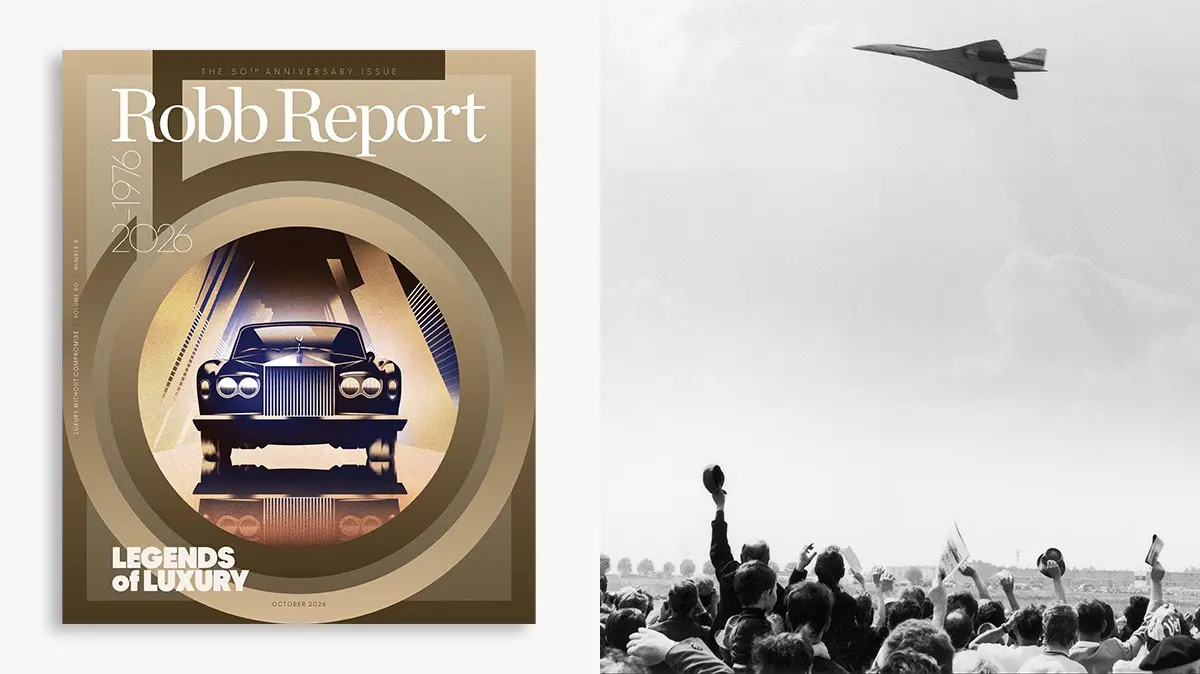
On January 21, 1976—the very year Robb Report was founded—the Concorde began flying commercial passengers across the Atlantic Ocean at twice the speed of sound. While it would be a stretch to claim some grand, cosmic synchronicity was at play, it stands as a remarkably fitting coincidence. Just as the supersonic jet was dramatically shrinking global distances, a new publication was launching to chronicle the daring feats, engineering marvels, and unprecedented innovations of the modern era.
Now, half a century later, Robb Report is celebrating its 50th-anniversary issue. Any publication that maintains its cultural footprint and editorial vigor after five decades has more than earned the right to indulge in a bit of retrospection. When the editorial team began assembling "Legends of Luxury," the expansive feature at the heart of this milestone issue, the initial goal was simple: orchestrate a sprawling retrospective, a moment to look back and reminisce.
However, sifting through five decades of archives revealed something far more compelling than mere nostalgia. Examining the 74 landmark objects, influential people, defining places, and unforgettable experiences chosen for the feature exposed a broader narrative. Many of these selections served as early blueprints for the modern world, hinting at seismic shifts in how society would eventually communicate, dress, travel, dine, and chase thrills.
Consider the technological leap represented by the Motorola DynaTAC 8000X. When the world’s first commercial handheld cellular phone debuted on the market in 1984, it came with a staggering price tag of just under $4,000—roughly equivalent to $12,000 today—and tipped the scales at nearly two pounds. Owning one was the ultimate expression of elite privilege. If you were among the select few who could afford what quickly became known as the "Brick," you made certain that people saw you using it out in the open, an image immortalized on screen by cinematic figures like Gordon Gekko. Today, the smartphone descendants of that bulky device are arguably more ubiquitous than televisions, transforming a once-unreachable luxury into an absolute daily necessity.

Yet, as history demonstrates, technological innovation does not always require a microchip or a silicon processor to rewrite the rules of modern life. In the late 1970s, legendary Italian designer Giorgio Armani executed a radical departure from traditional tailoring by stripping the structure entirely out of the classic men’s suit. He softened the shoulders, relaxed the lines, and loosened the trousers. The resulting aesthetic was simultaneously louche and sophisticated, capturing the attention of Hollywood and quickly becoming the definitive uniform for a generation of sharp-dressed figures. What felt daring, rebellious, and radically unconventional at the time has since settled comfortably into the bedrock of the modern man’s wardrobe.
In the realm of gastronomy, some revolutionary ideas flamed out brilliantly, but not before completely upending their respective fields. At the famed El Bulli restaurant, visionary chef Ferran Adrià deployed culinary science to fundamentally scramble diners’ expectations of what a meal could be, introducing textures and techniques that shocked the senses. While subsequent waves of poorly executed imitations eventually reduced molecular gastronomy to a tired punch line centered on ephemeral foams, artificial fogs, and controversial ingredients like meat glue, the best elements of Adrià’s philosophy endured. They permanently altered the global culinary landscape and inspired an entire generation of forward-thinking chefs.
The evolution of travel and leisure experienced a similar paradigm shift on the water. When the late Microsoft co-founder Paul Allen’s 414-foot mega-yacht, Octopus, was delivered by German shipbuilder Lurssen in 2003, it fundamentally redefined the concept of private seafaring. The vessel successfully paired traditional superyacht luxury with the rugged capabilities of a serious, ice-strengthened expedition ship. It was designed to go virtually anywhere on the globe, effectively making deep-sea exploration the primary purpose of the voyage, even if sunbathing at anchor remained firmly on the itinerary. Today, dedicated explorer yachts have transitioned from eccentric novelties to standard staples in the portfolios of nearly every major luxury shipyard in the world.
Looking back across these milestones, it would be tempting to claim that the trajectory of these innovations was obvious from the start. In truth, none of it looked quite so certain in real time. Predicting the future, as journalists and industry analysts alike know all too well, is a discipline much easier practiced in hindsight.

The publishing team knows this reality firsthand, having once confidently declared the definitive death of the internal-combustion engine—a piece of machinery that, as anyone paying attention to the automotive landscape today can readily observe, remains very much alive. Conversely, other supposedly inevitable "next big things" that captured the cultural imagination evaporated almost as quickly as they arrived. The sudden rise and fall of speculative digital assets and viral trends serves as a humbling reminder that the future rarely follows a straight line.
Looking ahead, it is entirely possible that one of the extravagant creations, high-end technologies, or avant-garde experiences highlighted in the pages of this anniversary issue will, in another twenty years, be as commonplace and unremarkable as the smartphone is today. Another may vanish entirely from the marketplace, yet leave behind a conceptual spark that outlives its physical creators.
While the exact destination remains unwritten, half a century of observation has taught the magazine one enduring truth: every so often, the future makes its first appearance disguised as a luxury. As Robb Report enters its next chapter, the curiosity that drove its founding in 1976 remains as sharp as ever, eager to witness what the horizon brings next.