






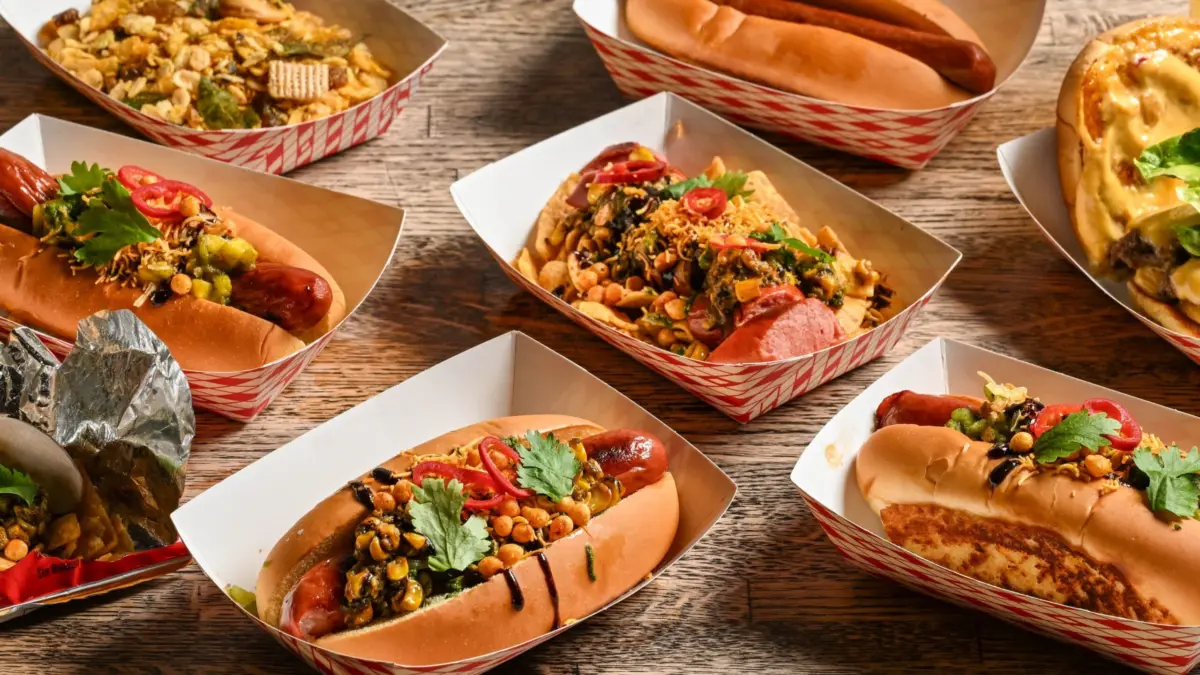
In the summer of 2017, journalist and chef Pervaiz Shallwani and his wife, Laena McCarthy, hosted a hot dog cook-off for a friend’s birthday. Their contribution to the backyard celebration was simple yet unexpected: a classic hot dog topped with bhel puri, a popular South Asian street food snack composed of crispy puffed rice, diced red onions, and tomatoes, all brought together with a vibrant mix of tangy and spicy chutneys. That combination—where a Chicago-style hot dog met the distinct street food flavors of Karachi—was a happy accident, but it served as the accidental starting point for something much larger than a backyard gathering.
Shallwani’s father migrated from Karachi to the United States in 1971, arriving as part of an expanding wave of Pakistani immigrants who began to settle in increasing numbers throughout the 1970s. This growing community established roots around major American urban centers, particularly New York City, Chicago, and Los Angeles, later expanding into Washington, D.C., and Houston. For decades, the small number of Pakistani restaurants that emerged in these immigrant hubs faced a commercial dilemma. They either hid behind the generalized labels of "Indo-Pak" or "Indian"—categories that had already secured mainstream acceptance through popular takeout staples like butter chicken and chana masala—or they catered exclusively to Pakistani communities concentrated tightly within specific immigrant enclaves, such as Hillcroft in Houston, Little Pakistan in Coney Island, and Devon Avenue in Chicago.
For a long time, the Pakistani culinary footprint lived quietly in the shadow of the far larger Indian-American community, which stands as the second-largest immigrant group in the United States. While exceptional establishments managed to break out of this mold—such as Aga’s in Houston, recently noted as the busiest single-location restaurant on Uber Eats, and the beloved James Beard Award-nominated Zareen’s Kitchen in Palo Alto—these successes were largely the exception rather than the rule. However, as the Pakistani diaspora in the U.S. has expanded dramatically from just 32,600 people in 1980 to nearly 680,000 today, Pakistani restaurants and food concepts are finally stepping into the spotlight on their own terms.

Much of this culinary shift has accelerated in the years following the pandemic. The new wave of Pakistani food concepts emerging across the country differs markedly from the fine-dining contemporary movements seen in recent years, such as the West African food movement or the thriving Filipino food scene of the 2010s. Instead, this new movement is scrappier and deeply accessible: a fast-casual approach that introduces bold Pakistani flavors through distinctly American formats. Imagine hot dogs crowned with spicy, tangy chaat; New York-style chopped cheese sandwiches made with spiced chapli kabab; and crispy, buttermilk-brined hot chicken seasoned with a complex medley of South Asian spices. Welcome to the rise of the modern Pakistani-American kitchen.
In Fort Worth, Texas, pitmaster Zain Shafi found his entry point through barbecue. Shafi had never eaten traditional Texas barbecue while growing up because it was exceptionally difficult to find certified halal options. But when he finally tasted it as an adult, it completely altered his perspective. While simultaneously helping to manage his family’s furniture business, Shafi dove deep into the world of barbecue, eventually securing a coveted spot learning the craft at the acclaimed Goldee’s. He then launched his own venture, a food truck called Sabar. From 2023 to 2025, Sabar served halal, Pakistani-inspired barbecue creations, including sausage seasoned with seekh kebab spices and smoked tandoori turkey, served alongside classic barbecue sides as well as raita, tangy yogurt, lentils, and fresh naan. Operating in Texas, Shafi discovered that food could serve a profound cultural purpose. In the midst of navigating Islamophobia in the region, he found that barbecue acted as an effective stepping stone to introduce Pakistani culture and flavors to a broader audience, effectively breaking the ice.
Remixing familiar American favorites has proven to be a central strategy for how Pakistani-American food is capturing mainstream attention. Usman Chaudhry, an accountant by trade, moved to the United States from Pakistan in the early 2000s alongside his parents and siblings. He had long considered opening a restaurant when a commercial space unexpectedly became available in Chatham, New Jersey, in the fall of 2020. Seizing the moment, he and his wife Amena partnered with his brother to launch Namkeen. Their goal was straightforward: bring high-quality halal hot chicken featuring bold, authentic flavors to the Tri-State area within a casual dining space. The tight, focused menu centered on creative variations of Nashville-style hot chicken. Offerings included their signature Clucking Waffle Sandwich, featuring hot fried chicken placed between jalapeño-and-cheddar Belgian waffles; the Tikkaville Sandwich, layering fried chicken with a rich tikka sauce, coleslaw, pickled onions, and mint chutney on a brioche bun; and Chicken Tikka Mac & Cheese, combining classic comfort food with savory tikka sauce.

Opening a restaurant during the height of the COVID-19 pandemic might have seemed like a high-risk venture, but Namkeen drew masked lines out the door almost immediately after its debut. While its takeout- and delivery-friendly model suited the demands of the moment, its streamlined and replicable menu also translated naturally into a scalable franchising model. Namkeen has since expanded to 10 locations across three states as well as Canada, and the Chaudhry brothers have even launched a second concept, Ori’s Cheesesteaks, also located in Chatham, specializing in premium halal ribeye cheesesteaks.
While Shafi utilized Texas barbecue and Chaudhry leaned into Nashville hot chicken, Zeeshan Bakhrani chose the iconic New York City bodega staple—the chopped cheese sandwich—as his canvas at Nishaan in the East Village. Founded in a tiny 600-square-foot counter space at 160 First Avenue, Nishaan quickly became one of the most talked-about new food spots in the city. The centerpiece of the menu is the Pakistani chopped cheese, which features heavily seasoned chapli kebab meat chopped on a flat top griddle with peppers and onions, then finished with a vibrant lime-cilantro sauce and tamarind chutney. The inventive menu also features bihari barbacoa tacos, Pakola soft-serve ice cream as a nostalgic nod to the iconic green soda beloved across Pakistan, and elote chaat—a clever hybrid inspired by the Mexican flavors Bakhrani was surrounded by during his childhood in Chicago.
Bakhrani’s path to opening Nishaan was anything but conventional. After being laid off from his job in IT product management in 2024, he began creating food content online and experimenting with unexpected culinary mashups like mango lassi pie and elote chaat. He secured a vendor booth at Smorgasburg before earning a coveted spot on Season 18 of the Food Network’s The Great Food Truck Race in 2025. Describing the television experience as an intense boot camp, Bakhrani notes that about half of the menu items he sells today were initially developed during the show. The Nishaan team ultimately won the $50,000 grand prize, making history as the show’s first all-halal food truck to take the title. That victory provided the vital proof of concept he needed to confidently sign a lease on his first permanent brick-and-mortar storefront.

Since then, Bakhrani has established himself as an energetic and highly visible champion of Pakistani cuisine in New York City, which has firmly cemented itself as the epicenter for a new generation of Pakistani restaurants redefining American dining. Bakhrani actively builds community through frequent culinary collaborations, Pakistan Day block parties, and a rotating menu of inventive, nostalgic takes on Pakistani flavors. When someone previously questioned whether prominently using the Pakistani label might hinder his success during the television competition, his response was clear and resolute: it wouldn’t hurt him at all.
Proudly owning the label "Pakistani" represents a complete 180-degree shift from the approach taken by previous generations. Saud Khan, the founder of Kaafi, a Pakistani chai café in Harlem, was raised entirely within the restaurant industry. Born in Peshawar, he moved to the United States at the age of five and spent his youth assisting in his father’s restaurant located in upstate New York. Though Khan initially had no intention of following in his family’s footsteps, a casual afternoon sitting in a café led him to wonder why there wasn’t a dedicated Pakistani space centered around high-quality chai and Pakistani-inspired snacks. That simple question motivated him to open two cafes in upstate New York before ultimately bringing the concept to New York City, where he felt the market was finally primed for it.
Kaafi welcomed its first guests to its Harlem location in 2024, and the reception was immediate. Khan reports that the café was an instant success story upon opening its doors. He believes there has never been a more opportune time for South Asian restaurateurs in New York City, noting that a rising wave of South Asians are actively contributing to the local restaurant landscape. Calling it a definitive moment for the community, Khan emphasizes the importance of seizing the opportunity.

Yet, before the arrival of modern spots like Kaafi, Nishaan, and Namkeen in New York, there was BK Jani, a name that translates roughly to Brooklyn Sweetheart. Founded by Sibte Hassan in 2015, the restaurant served as an early indicator that New York City was poised to become the beating heart of this culinary movement. Today, standing alongside this exciting new wave of eateries, BK Jani continues doing the work it pioneered over a decade ago.
Hassan came to the restaurant industry from a background in the creative arts, with no initial plans to enter hospitality. After moving from Lahore—widely recognized as one of Pakistan’s premier culinary capitals—he found himself deeply underwhelmed by the options available in New York. The existing Pakistani restaurants he encountered were constructed by necessity to feed local cab drivers quickly and cheaply for under $10, rather than focusing on sourcing and serving premium ingredients. Following a series of casual backyard grilling sessions where he cooked for friends, Hassan stumbled upon a former pizza parlor space in Bushwick. Teaching himself the trade on the fly, he faced operational hurdles—even admitting that he initially didn’t know what kind of grill to buy and faced amusement from local supply shop owners. Through trial and error, Hassan mastered restaurant operations and developed BK Jani’s distinct menu centered on premium halal burgers infused with authentic Lahori flavors.
The initial public response, however, was quiet. Two months after his formal launch, Hassan experienced days where he would open at noon and close at 10 p.m. without serving a single customer. He was on the verge of accepting a buyout offer when a review by Ligaya Mishan was published in The New York Times, praising Hassan as the "Midas of Meat." Business transformed overnight, and he has remained consistently busy ever since. Like his contemporaries at Namkeen and Nishaan, Hassan deliberately chose the fast-casual format for its operational simplicity, allowing the primary focus to remain precisely where it belonged: on the food and the quality of its premium halal ingredients.

As for Pervaiz Shallwani, the bhel puri hot dog he debuted at a friend’s backyard cook-off in 2017 continues to resonate deeply. That spontaneous experiment planted the seeds for Chaat Dog, the hot dog pop-up he officially launched in 2022, blending his suburban Chicago upbringing in the self-proclaimed hot dog capital of the country with his proud Pakistani heritage. While Shallwani initially harbored doubts about how South Asian audiences might respond to traditional chaat served on top of an American hot dog, the reaction revealed an overwhelming sense of validation. People felt genuinely seen. Chaat Dog has since expanded, opening its first permanent brick-and-mortar location inside Time Out Market in Brooklyn while continuing to host pop-up events across the city.
Reflecting on the broader cultural momentum, Shallwani views the current boom in Pakistani-American cuisine not merely as fusion, but as the continuation of a deeply rooted American tradition. People cook what they know, utilize the ingredients available around them, and adapt those elements over time. Every immigrant group that arrives in the United States ultimately shapes American food into their own reflection, and that continuous evolution is precisely what defines American cuisine as a whole. With this dynamic new wave of restaurants making their mark, Pakistan and its bold, vibrant flavors are now firmly part of that ongoing story.