






Independent watchmaker Armin Strom has expanded its high-complication portfolio with the introduction of the Minute Repeater Resonance 12:59 First Edition. Rather than simply chiming the current time on demand, this remarkable timepiece is specifically engineered to chime 12:59—widely considered the optimal time to showcase a Westminster Carillon of four hammers striking against four distinct gongs. By pairing this intricate chiming mechanism with the brand’s signature chronometric innovation—a pair of sprung balances linked by an elastic resonance clutch spring—Armin Strom has managed to squeeze a staggering amount of horological engineering into a water-resistant, 42 mm titanium case that is notably slimmer than most modern chronographs.
Initial Impressions and Ergonomic Improvements
The new release represents a monumental evolution for the brand, arguably earning the title of Armin Strom’s most improved product to date. Its predecessor in the masterclass chiming series was notably imposing, measuring a bulky 47.7 mm in diameter and standing 16.1 mm tall. In contrast, the Minute Repeater Resonance 12:59 achieves a far more wearable 42 mm diameter and a thickness of just 11.7 mm. To put that into perspective, it is actually slimmer than a standard Rolex Daytona, though a significant portion of its visual height is borne by the mid-case, which gives it a slightly more substantial presence on the wrist than the raw measurement suggests.

Despite its dramatic reduction in size, the watch has also improved in durability, offering a water resistance of up to 50 meters—a step up from the already respectable 30 meters of the previous iteration. Remarkably, despite the massive engineering overhaul, the retail price has increased by a mere 2% over its predecessor. This minor adjustment comes packed with profound upgrades, including the full Westminster Carillon, a dedicated demonstration-chiming mode, and a vastly refined, cleaner aesthetic.
The inclusion of the demonstration mode is particularly well-executed, addressing a common pain point for collectors of chiming watches. It allows the watch to chime the complex 12:59 sequence on demand, regardless of what the actual time happens to be. This suits the modern reality of a 21st-century repeater, where such complications serve less as dark-room timekeepers and more as interactive mechanical marvels for the collector’s delight.

Acoustically, the watch delivers a pleasant, clear, and resonant chime. While wristwatch minute repeaters have evolved by leaps and bounds over the past two decades—making acoustic excellence an expected baseline rather than a shock—the cadence of the Westminster quarters on the prototype reviewed at Watches & Wonders possessed a deliberate, unhurried rhythm. The quarters were given ample space to breathe, though the transition through the hours and minutes felt slightly prolonged to some observers. Ultimately, such cadences remain a matter of personal preference and can be fine-tuned by a master watchmaker.
Over the course of an intensive week of previews, interacting with the repeater slide hundreds of times revealed a reassuring level of mechanical reliability. The mechanism performed just as flawlessly on the final day as it did on the first. Limited to just 25 pieces for the "First Edition"—a substantial production run for an independent atelier that manufactures fewer than 500 watches per year—it stands out as one of the most compelling chiming watches of 2026.

The Mechanics of a Westminster Carillon
To understand the complexity of the watch, one must examine what constitutes a true Westminster quarter chime. Familiar from grandfather clocks and the iconic bongs of Big Ben, Westminster quarters utilize four distinct notes to generate a series of melodies and phrases. At every quarter-hour interval, a traditional clock advances through specific musical phrases, culminating in the full melody just before the top of the hour, followed by the respective hour strikes.
However, the conventional quarters rack found in a standard repeater or clock watch is mechanically limited to playing melodies in a fixed, ascending order: a single chime for the first quarter, a two-note sequence for the second, and a three-note sequence for the third. Achieving true Westminster chimes requires a far more elaborate architecture.

Historically, Louis-Élisée Piguet (LEP) achieved true Westminster chimes in ebauches made for Nicole Nielsen around 1900 by utilizing four separate quarters racks. This breakthrough created the true Westminster grande sonnerie, widely regarded by horologists as the single most difficult complication to manufacture, with fewer than a hundred such historical examples in existence.
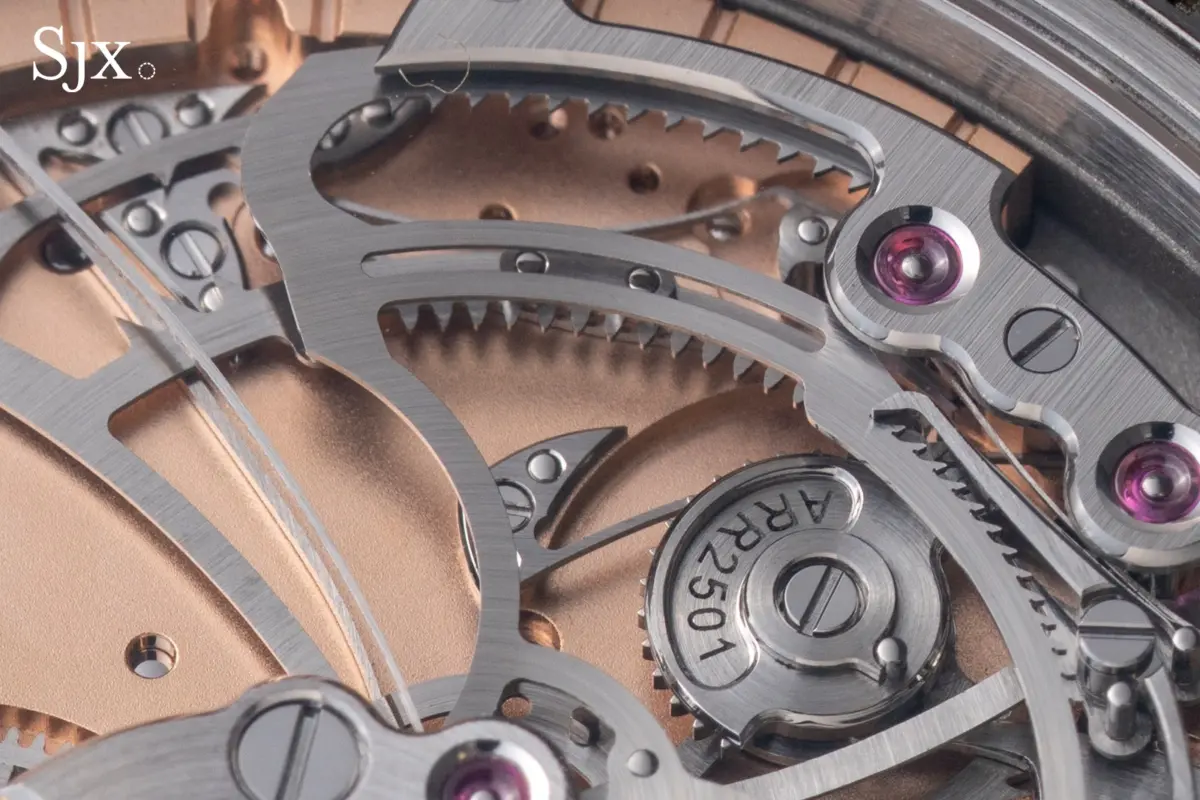
Consequently, the vast majority of modern wristwatches featuring Westminster carillons rely on a single, highly elaborate quarters rack equipped with four distinct groups of teeth—one group designated for each hammer—to imitate the authentic melodies. While many such configurations require an extra-long quarter rack, Armin Strom manages to keep the overall architecture remarkably compact. This space-saving feat is achieved through a stacked hammer arrangement paired with a two-layer rack system, a clever mechanical trick previously utilized by independent master Christophe Claret.

A fascinating tension exists between function and finish within this dense nest of steel levers and springs. Many internal components, including hand-polished bevels adorning the hour rack, the surprise piece jumper, the minutes hook, and the bases of most springs, exhibit exceptional hand-finishing. However, the delicate edges of the minute and quarter racks, along with the thin blades of most springs, intentionally remain un-beveled.
This is not an oversight, but a necessity of watchmaking physics. Bevelling removes material, which directly alters the physical stiffness of components as delicate as springs. Even the stringent guidelines of the Geneva Seal specifically exempt springs measuring 0.18 mm or thinner from bevelling requirements for this very reason. This strategic lack of finishing on specific functional elements highlights the delicate balance between aesthetic ornamentation and mechanical performance.

The Innovation of Demonstration Mode
While the Westminster chimes and coupled oscillators capture immediate attention, the watch’s true distinguishing feature is its novel demonstration mode. Traditionally, demonstrating a minute repeater to an admirer requires setting the time manually to 12:59—the precise minute that triggers the maximum possible number of chimes (twelve hours, three quarters, and fourteen minutes).
Doing this manually is fraught with peril. The user must carefully advance the hands without overshooting; otherwise, the watch will merely emit a pitiful single ding for 1:00. Turning the hands backward can also damage the delicate internal kinematics unless carefully wound backward past the desired point before moving forward again. Most importantly, constantly handling and resetting the hands of an ultra-expensive watch dramatically increases the risk of an accidental drop.

Armin Strom eliminates these anxieties with a simple yet brilliant mechanical solution. By pressing the repeater slide down rather than pushing it straight, the wearer engages a dedicated demonstration mode without needing an extra, unsightly push-piece on the exterior of the case. A tiny indicator dot on the dial near the hand stack subtly shifts from white to red to confirm that the mode is active.
The engineering behind this feature is documented in patent CH722478A1. In normal operation, the minute rack and minute cam work in tandem with the snails to dictate how far the racks fall. For the demonstration mode to function, all three racks must drop their maximum distance to execute the 12:59 chime without physically displacing the hands or the snails attached to them.

Rather than physically shifting the snails, the inventors opted to modify the racks themselves. They introduced an additional lever and beak mechanism positioned between the rack and the snail. In standard operating mode, a small lever mounted to the underside of the hour rack pushes a beak directly into the hour snail, forcing the components to behave as a conventional rack.
When the repeater slide is activated in demonstration mode, a column wheel rotates, shifting an internal lever that repositions the beak slightly away from the snails. When the repeater is subsequently triggered, the rack passes cleanly over the beak, allowing the hour, quarter, and minute racks to fall their absolute maximum distances regardless of the actual time displayed on the dial.

Coupled Oscillators and Resonance
The minute repeater mechanism represents only half of the equation; the "Resonance" in the watch’s title highlights its other defining trait. The calibre ARR25 is a complex two-train movement where both independent gear trains culminate in their own balance assembly. While twin-train watches often feature a second, purely decorative balance that performs no mechanical function, Armin Strom’s architecture employs a true functional linkage.
The two independent balances are connected at the pinning points of their hairsprings via an elastic "resonance clutch spring." Developing this component required a close collaboration with Grégory Musy of the Swiss research institute CSEM—an expert in compliant mechanisms who later joined Rolex’s research and development division—to optimize Claude Greisler’s original design.

The clutch spring itself is a marvel of micro-engineering: mirror-polished and entirely free of bevelling to preserve its precise physical stiffness, it visibly "breathes" in a linear fashion as the two balances beat in harmony. This physical coupling results in more stable timekeeping. If one balance begins to run slightly fast, its opposing counterpart exerts an immediate physical influence to slow it back down, and vice versa.
However, this mechanical stabilization comes at a slight cost to autonomy. Despite housing mainspring reservoirs capable of storing up to 80 hours of energy, the dual-train resonance system limits the overall power reserve to 40 hours.

Armin Strom’s elastic coupling approach differs fundamentally from the historical, inertia-coupled configurations pioneered by independent masters like Antide Janvier, Abraham-Louis Breguet, and François-Paul Journe. Those historical systems operate entirely without a physical mechanical linkage between the two oscillators, relying purely on subtle energy transfers through the mainplate and air. According to F.P. Journe, the independent rates of the oscillators in its resonance watches must remain within five seconds per day of one another for synchronization to successfully occur.
In contrast, Armin Strom’s direct physical linkage via the resonance clutch spring can accommodate a much broader rate variance of up to 250 seconds per day between the two balances. While debates persist among purists regarding whether elastic coupling constitutes true resonance—with some collectors preferring the romantic, unlinked inertia approach—both methods represent distinct solutions to the challenge of coupled oscillators in contemporary watchmaking.

Key Facts and Price
Armin Strom Minute Repeater Resonance 12:59 First Edition
Ref. M26-RMR.5N
Case Diameter: 42 mm
Height: 11.70 mm
Crystal: Sapphire
Material: Titanium
Water Resistance: 50 meters

Movement: Calibre ARR25
Features: Hours, minutes, elastically-coupled oscillators, minute repeating on four gongs with a dedicated "demonstration mode"
Frequency: 25,200 vibrations per hour (3.5 Hz)
Winding: Manual
Power Reserve: 40 hours
Strap: Matte grey alligator strap with a titanium pin buckle

Limited Edition: Yes, strictly limited to 25 pieces
Availability: Available through authorized Armin Strom retailers
Price: CHF 390,000 or US$513,000 before local taxes