





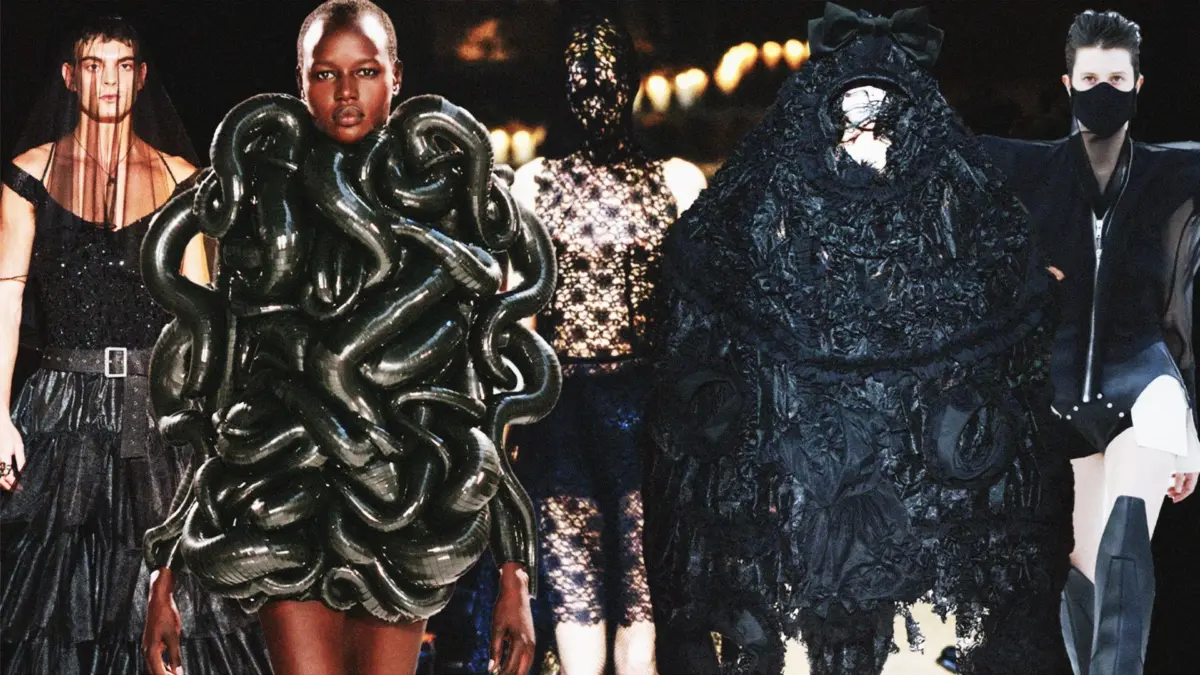
Fashion has long captured a vast spectrum of human emotion—it can be glamorous, elegant, cool, fun, and provocative. But as the autumn leaves fall and Halloween approaches, an unusual yet perennial theme returns to the forefront of cultural consciousness: Can fashion also be scary? The answer, naturally, is a resounding yes. As one of life’s ultimate mysteries, mortality has continuously inspired designers to grapple with ideas of death, grief, and the afterlife.
French haute couturier and fashion designer Charlie Le Mindu reflects on this profound connection, noting that death often strips away pretense to reveal something deeply human. "I have always found it interesting that death often reveals something profoundly human. It can bring people closer to their most authentic selves," Le Mindu says. "The prospect of losing everything changes our understanding of what is important. I sometimes wonder why we need to approach the end of life to begin living with that level of honesty."
Le Mindu is far from alone. Designers across eras and cultures have long utilized the medium of clothing to wrestle with what is paradoxically both life’s only guarantee and one of its greatest unknowns. Fashion has consistently served as a mirror reflecting this universal human experience, giving tangible, visual form to concepts that can otherwise feel entirely incomprehensible. From Ann Demeulemeester’s gothic veils inspired by the romanticized tragedy of L’Inconnue de la Seine to Alexander McQueen’s poignant runway tributes to his late friend and mentor Isabella Blow, creators have continually drawn on the visual language of funerary dress, mourning traditions, and existential grief. As the world counts down to Halloween, a look back at nine defining collections reveals how fashion has continually confronted death—and, in doing so, illuminated what it truly means to be alive.
"It is important to look at death because it is a part of life," Alexander McQueen famously told Nick Knight in a 2009 interview. Few visionaries embraced that dark fascination as fervently as McQueen. His work repeatedly confronted mortality, violence, religion, and the afterlife. This was particularly evident in his landmark eighth runway collection, Dante, which propelled him to international acclaim. Named after the Florentine poet whose Divine Comedy takes readers on an allegorical journey through Hell, Purgatory, and Paradise, the Fall 1996 collection explored the tense intersection of religious dogma, warfare, and historical mourning traditions.

Dedicated to his close friend and muse Isabella Blow, the show unfolded on a striking crucifix-shaped runway inside London’s candlelit Christ Church Spitalfields. A skeleton looked on from the front row while a haunting soundtrack punctuated by gunfire echoed through the venue. McQueen juxtaposed heavy religious imagery with the brutal reality of modern conflict, incorporating photojournalist Don McCullin’s searing images of the Vietnam War directly into garments alongside ecclesiastical tailoring, signature bumster trousers, and thorn-like headpieces. Among the most arresting looks was a lilac silk-faille corset richly embellished with black lace and jet beading, drawing directly from the somber color palette and materials of Victorian mourning dress.
A decade later, McQueen returned to these themes with his Fall 2006 collection, The Widows of Culloden. The presentation translated historical loss into an elegiac runway spectacle that the designer described as "romantic but melancholic and austere at the same time." Conceived as a tribute to the women widowed by the devastating 18th-century Battle of Culloden in the Scottish Highlands, the deeply personal collection incorporated family tartans, dense black lace, feathers, and silhouettes inspired by deep mourning. Its unforgettable finale featured a spectral Kate Moss materializing inside a glass pyramid, conjured through a 19th-century optical illusion known as Pepper’s Ghost. The collection perfectly exemplified curator Andrew Bolton’s observation that McQueen possessed an unmatched gift for "finding poetry and beauty in death," a sensibility that pulsed through his entire creative legacy.
For Charlie Le Mindu, confronting mortality became intensely personal during a period of declining health ahead of his Autumn/Winter 2010 collection, Sex Religion Bullshit Lucifer. "Rather than approaching death as something tragic, I became interested in the strange freedom that comes with accepting its inevitability," recalls the French hairstylist and designer, who has collaborated extensively with brands like Balmain, Mugler, and Vivienne Westwood, and styled cultural figures such as Lady Gaga, Cindy Sherman, and Julia Fox. "I wanted to celebrate it, not because I wished to die, but because I had never felt such an urgency to live." Questioning the religious and moral frameworks that teach humanity to fear the end, Le Mindu embraced Lucifer as a symbol of societal anxieties surrounding desire and disobedience. He expressed these ideas through his signature haute coiffure, constructing towering hair sculptures, jeweled crosses, and elaborate mourning veils. An oversized black lacquered rose fascinator from the collection was later famously worn by Lady Gaga. Reflecting on the period, Le Mindu notes that something which began with the shadow of mortality ultimately revolutionized his perspective on existence, emphasizing that the collection was never about death itself, but about recognizing the extraordinary value of a finite life.
Dutch designer Iris van Herpen also found inspiration in the razor-thin margin between life and destruction for her Fall 2011 haute couture collection, Capriole. Drawing on the visceral sensation of free-falling during a parachute jump, van Herpen explored the tension between fear and liberation. The 19-look presentation featured a breathtaking white 3D-printed skeleton dress, developed in partnership with architect Isaïe Bloch and the Belgian technology firm Materialise. Crafted from laser-sintered polyamide, the bone-like structure wrapped around the body like an external exoskeleton. Van Herpen explained that the piece visualized the interior of the body on the outside, representing the delicate intersection of freedom and imperfection where true beauty resides. Later acquired by the Metropolitan Museum of Art and featured in exhibitions like Manus x Machina and Iris van Herpen: Sculpting the Senses at the Brooklyn Museum, the design transformed a conventional symbol of death into an emblem of modern liberation.
Thom Browne took the colloquial expression "dying for fashion" quite literally for his Fall/Winter 2012 presentation. He staged an elaborate funeral tableau complete with flickering candles and ten wooden coffins, out of which an officiant announced emerged "ten beautiful girls who died for fashion." The models dramatically rose from their caskets, seemingly resurrected by their devotion to clothing, wearing extravagant garments defined by exaggerated hourglass silhouettes, intricate embroidery, and gilded details. By juxtaposing the strict solemnity of Victorian mourning with his signature surreal theatricality, Browne transformed the runway into a theatrical narrative celebrating fashion’s mystical power to bring its devotees back to life.

For Comme des Garçons’s Fall 2015 collection, The Ceremony of Separation, Rei Kawakubo offered an abstract, deeply conceptual interpretation of loss. The designer presented 18 sculptural looks rendered strictly in black, white, and gold—colors traditionally associated with burial rites across various global cultures. Models navigated the runway, approaching, passing, and separating from one another as if enacting a final farewell between the living and the dead. The garments featured voluminous constructions of intricate lace, oversized bows, and densely layered fabrics that entirely enveloped the body. Key pieces included a white dress resembling bundles of tied bedsheets, a tiered gold-lace structure recalling religious vestments, and a stark black ensemble adorned with miniature Victorian-style children’s dresses and bonnets. The show concluded inside a voluminous black tulle cocoon, reinforcing the collection’s profound meditation on human mortality.
Sébastien Meunier, creative director for Ann Demeulemeester’s Spring 2019 collection, drew inspiration from L’Inconnue de la Seine, the enigmatic young woman purportedly pulled from the River Seine in the late 19th century whose serene death mask has captivated generations of artists. Meunier, who keeps a replica of the mask in his apartment, translated his fascination into a hauntingly romantic lineup of diaphanous, nightdress-like gowns, fluid tailoring, and trailing silhouettes. Models walked with their faces partially obscured by sheer veils, draped in billowing black-and-white dresses, gauzy blouses, and long coats finished with an intentionally waterlogged aesthetic. Standout looks included a sheer white dress layered beneath leather straps and chains, pale pink gowns secured with harnesses, and tailored jackets adorned with clusters of flowers, evoking the spectral, tragic beauty of the drowned woman.
Alessandro Michele chose a similarly historic and atmospheric backdrop for Gucci’s Cruise 2019 collection, staging the show after dark in the Alyscamps, an ancient Roman necropolis in Arles, France. Exploring what he described as "the idea of death as fascination," Michele transformed the ancient burial ground into a dramatic "party in a cemetery" illuminated by flickering flames, tolling church bells, and scattered stone sarcophagi. Models walked the grounds styled as mourning widows in sweeping velvet gowns and capes, alongside garments embroidered with skeletal motifs and leggings emblazoned with the Latin phrase MEMENTO MORI—a reminder of mortality. Memorable ensembles included a black gown featuring a skeletal rib cage embroidered meticulously across the torso and a floral cape paired with a cathedral-inspired headdress, seamlessly injecting funerary iconography into Michele’s signature maximalism.
Rick Owens looked to mythology and contemporary anxiety for his Fall/Winter 2020 collection, Phlegethon, named after the river of the Greek Underworld described in Dante’s Inferno as a raging torrent of boiling blood. Presented amidst billowing fog and flashing strobe lights outside Venice’s Lido Casino, the dystopian collection visualized the collective dread of the pandemic and ecological collapse. Models wore towering, thigh-high platform boots resembling heavy waders, functioning as an overt allusion to both the mythical river and Venice’s increasingly threatened, rising waters. Armor-like shoulders, oversized sleeveless jackets, and leather micro-shorts clashed with sheer silk chiffon, fishnet dresses, and sculptural tulle ruffles. Dominated by a dark palette punctuated by flashes of alarm red and bubblegum pink, the collection embraced an apocalyptic ethos. Owens described the imposing, exaggerated shoulders as an intentional "middle finger to doom," framing the presentation as a defiant act of resilience in the face of overwhelming adversity.
Similarly drawing on classical mythology, Jackson Wiederhoeft’s Fall 2023 collection reinterpreted the Greek myth of Orpheus and Eurydice, imagining a subversive afterlife where the heroine actively chooses to remain in the Underworld rather than be rescued. Staged as a grand operatic spectacle, the collection opened with a voluminous white gown crafted from plasticized taffeta, its sheer bodice exposing a tightly laced corset underneath. Shimmering gold-sequined dresses, corseted denim, and coats embroidered with stained-glass-like sequins continually blurred the boundary between Gothic romance and theatrical extravagance, while sheer slip dresses featured hand-embroidered, tattoo-like illustrations referencing the Orpheus myth and broader Catholic iconography, cementing fashion’s enduring, cyclical dialogue with mortality and existence.