

At first glance, the saturated spirals of brilliant blue, verdant green, and deep magenta curling across the walls and floors of the 22MUSE Gallery in Antwerp resemble ancient tree rings, exposed strata of earth, or carved organic specimens found deep within a subterranean cave. Standing before these rich, intricately textured forms, a viewer might easily assume they are looking at heavy, immovable sculptures fashioned from shaped wood, molded clay, or dense stone. However, the foundational material behind these striking, monumental works is surprisingly ordinary and ubiquitous: paper.

For more than four decades, acclaimed Korean-born artist Jae Ko has dedicated her artistic practice to exploring the unexpected sculptural possibilities of paper. By repurposing everyday materials such as discarded office supplies, recycled kraft paper, and standard adding machine paper rolls, Ko builds complex, three-dimensional forms that challenge traditional perceptions of what paper can achieve. Her latest milestone exhibition, titled Striated, is currently on view at 22MUSE Gallery in Antwerp, Belgium, marking a significant moment in her career as her very first solo exhibition in the country. The exhibition brings together a carefully curated selection of works from a deeply formative period in her artistic evolution alongside a brand-new, site-specific installation created exclusively for the gallery space.
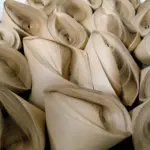
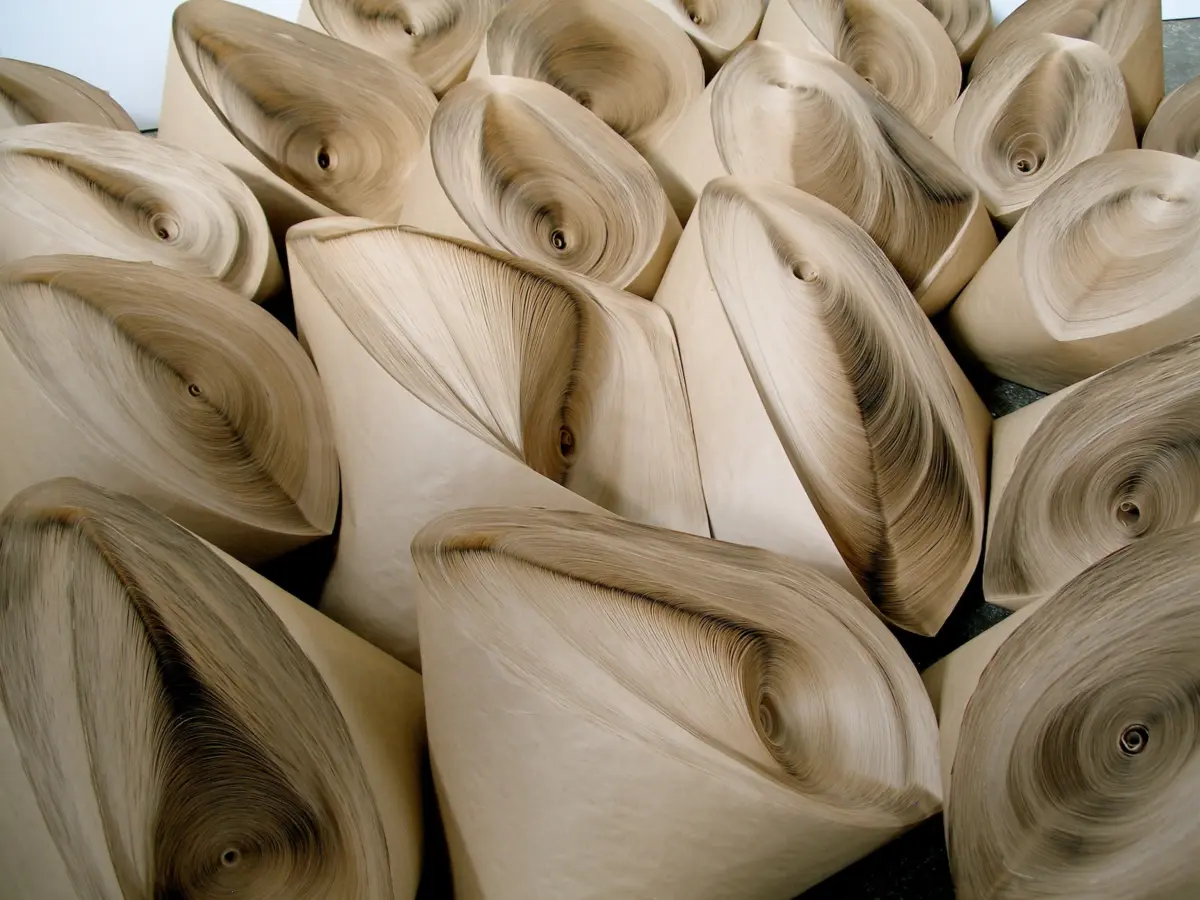
Ko’s meticulous artistic process is a fascinating balance between rigorous method and uninhibited experimentation. The journey of each sculpture begins humbly, with the artist unwinding tightly coiled, industrial rolls of paper. From there, she systematically reshapes the material through a combination of physical actions: rolling, twisting, folding, stacking, and heavy compression. Depending on the conceptual direction of the piece, Ko may treat the paper with traditional Japanese sumi ink—a classic calligraphic medium made from soot that imparts rich, moody tonalities—or incorporate vibrant pigmented inks that introduce striking, saturated shades of blue, red, green, and violet. Furthermore, her intervention does not stop at manipulation and dyeing; she frequently cuts, carves, binds, or even buries the paper, allowing natural elements, time, and environmental conditions to actively participate in shaping the final, weathered form of the sculpture.

The resulting artworks are remarkably diverse in their appearance and spatial presence. Some sculptures curl tightly inward like dense, protective spirals, their countless layered edges creating hypnotic, rhythmic patterns that bear a striking resemblance to the annual growth rings of ancient trees or the sedimentary bands of geological rock formations. Other works stretch outward into elongated ribbons, or fold back upon themselves in fluid gestures, producing organic shapes that appear surprisingly soft and liquid despite their heavy, dense construction. Through the sheer accumulation of countless individual paper layers, Ko achieves a powerful visual weight and presence that completely belies the inherent fragility of her source material.
This inherent tension between delicacy and durability stands at the very heart of Ko’s artistic vision. Through repetitive physical actions and intense mechanical compression, she successfully transforms a material typically associated with transience and office ephemera into a sturdy medium capable of holding substantial physical volume and complex three-dimensional geometries. Every single ridge, groove, and curve functions as a visible testament to the physical labor and time invested in the creation of the work, laying bare the mechanics of its own construction for the viewer to observe.

While Ko’s sculptures rarely attempt to directly represent a specific landscape, plant, or living organism, the natural world has long provided the primary conceptual foundation for her approach. Instead of mimicry, her works explore the powerful, slow-moving forces that continually shape and reshape the natural environment: erosion, organic growth, accumulation, and continuous movement. Her large-scale installations, which are often constructed from densely packed bundles of paper that gradually loosen and expand as they rise upward, evoke rolling hills, powerful ocean tides, or slow-moving glacial formations. Consequently, the undulating surfaces of these installations seem to continually shift, breathe, and flow, even when they are completely stationary.
Ko’s profound relationship with landscape and topography has also evolved significantly over the course of her geographic journey. After growing up in Seoul, South Korea, and pursuing her formal education in Japan, she eventually relocated to the United States, where she ultimately settled on the tranquil and scenic Maryland Eastern Shore. Her mature artistic output deeply reflects this dual background, echoing both the dense, structured urban environments of her early life and the expansive natural surroundings she encountered later. She has frequently drawn conceptual parallels between her layered paper sculptures and the ancient bristlecone pine trees found in the American West, whose gnarled trunks and weathered branches are slowly and dramatically sculpted over centuries by relentless wind and harsh weather.

The title of her current exhibition, Striated, directly points to the fine, parallel lines, grooves, and striations that define the physical texture of much of Ko’s signature work. The exhibition invites visitors to consider how these accumulated layers function simultaneously as a tangible archive of time and a physical record of intense human labor, where every single fold and compressed edge communicates a profound narrative about the process of its own making.
Striated remains on public view at 22MUSE Gallery in Antwerp, Belgium, through November 28, 2026.