






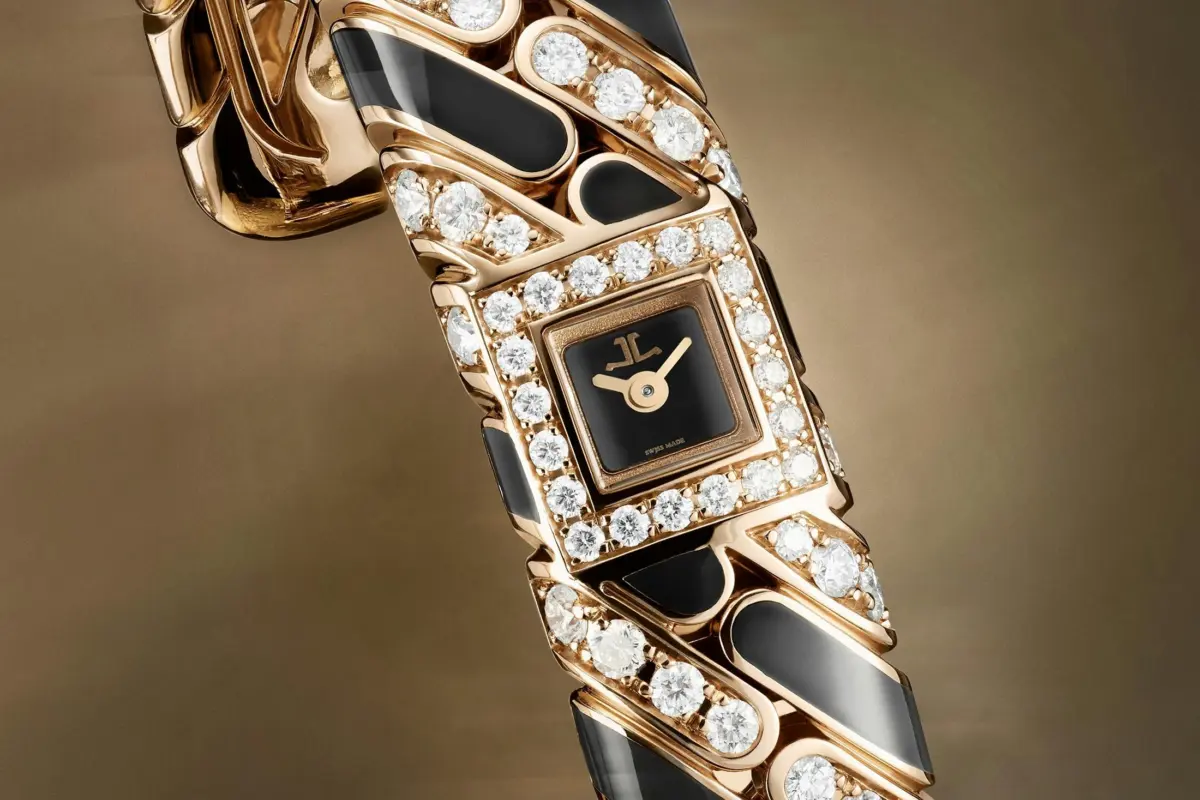
The intersection of haute horlogerie and high jewelry has long been a fertile ground for artistic expression, yet few houses can command this space with the profound technical authority of Jaeger-LeCoultre. The legendary Swiss manufacture has once again pushed the boundaries of what is possible in miniature watchmaking with the introduction of the Jaeger-LeCoultre 101 Chain. At a glance, the timepiece might easily be mistaken for an exquisite, sculptural piece of fine jewelry. However, beating quietly within its shimmering, gold-and-diamond embrace is the world’s smallest mechanical movement—a technical marvel that has remained unrivaled for nearly a century.
A Contemporary Reinterpretation of a Mid-Century Icon
The inspiration for this striking new high-jewelry creation reaches back into the rich historical archives of the Swiss luxury house, drawing directly from a 1955 Duoplan model affectionately nicknamed the "Chain." That historical timepiece earned its moniker from its distinctive, fluidly braided gold-link bracelet. The modern Jaeger-LeCoultre 101 Chain reinterprets that cherished design philosophy through the lens of contemporary sculptural aesthetics, utilizing a bold 18-karat pink-gold bangle that wraps the wrist with effortless elegance.
The architecture of the bangle is a study in sophisticated contrasts and meticulous craftsmanship. It features dynamic diagonal bands that alternate seamlessly between deep, high-gloss black HyCeram—a specialized ceramic material chosen for its lustrous finish and durability—and pristine rows of brilliant-cut diamonds. This alternating pattern offers a thoroughly modern, graphic take on the sinuous chain motif of the 1955 original, marrying the organic warmth of pink gold with the cool precision of modern materials.

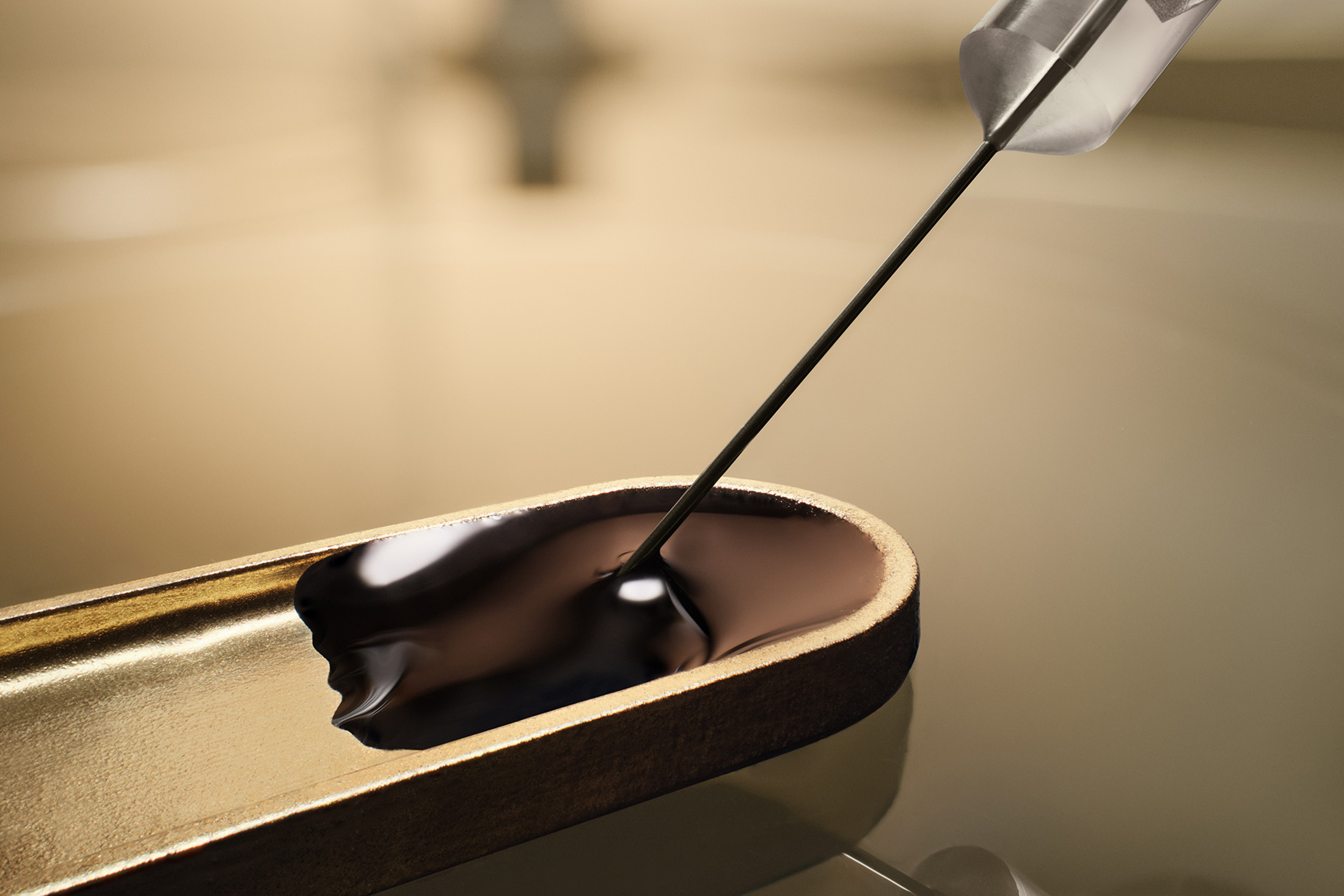
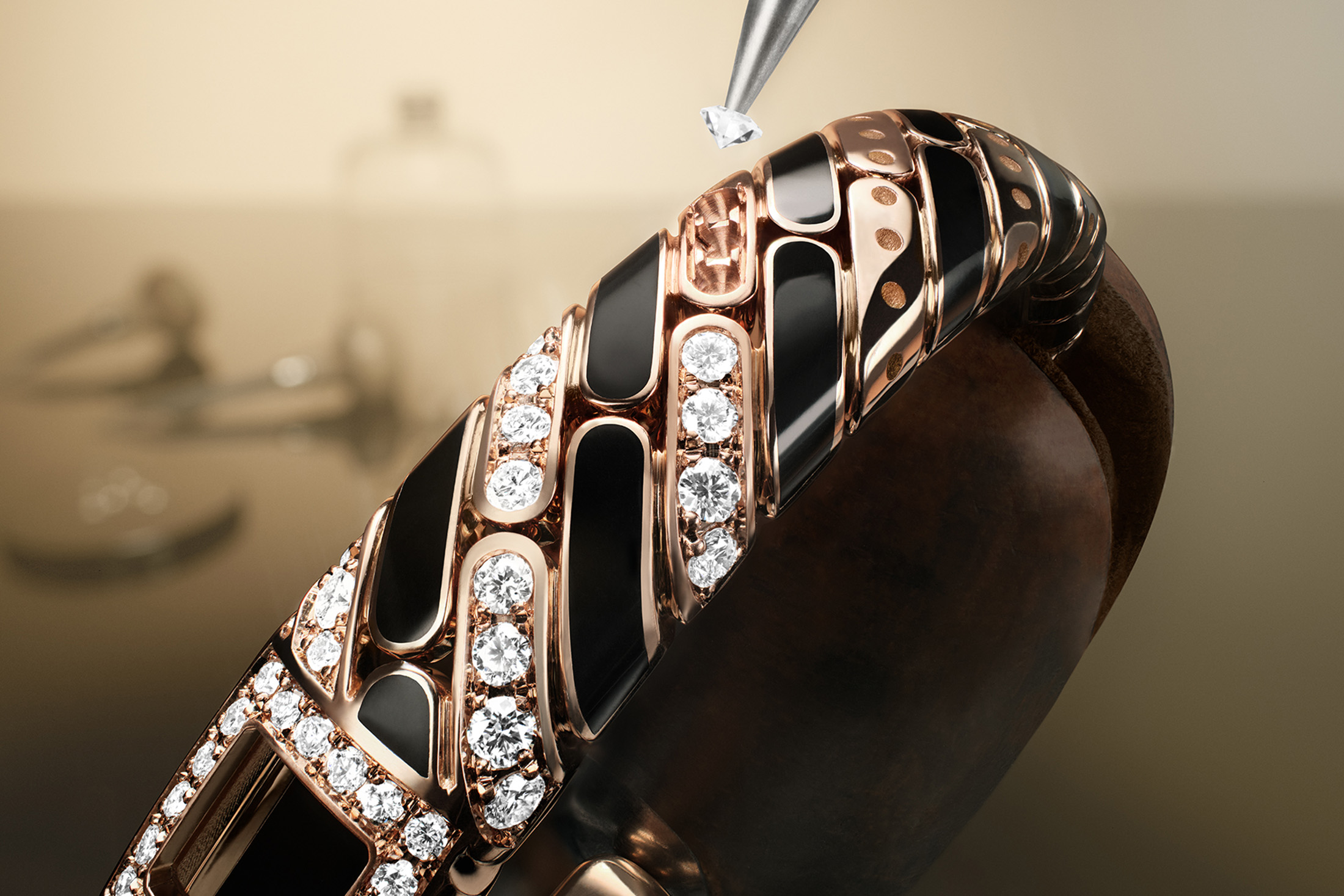
Creating a bangle of this complexity requires an extraordinary level of artisanal skill. Each pink-gold structure is cast in a mold made specifically for an individual watch, ensuring a bespoke fit and finish. Within each bangle, 36 individual cavities are meticulously filled by hand with liquid HyCeram. Once the ceramic has cured and been polished to a mirror-like shine, a master gem-setter steps in to drill and meticulously hand-set the alternating diagonal bands with brilliant-cut diamonds.
The finished bangle gracefully frames a remarkably diminutive watch head. At the center of this miniature stage sits a deep black lacquered dial, adorned simply with a subtle "JL" monogram positioned just above the hour and minute hands. A sparkling diamond bezel frames the dial, bringing the overall diamond weight of the entire piece to an approximate 2.73 carats. The result is a harmonious dialogue between precious stones, high-tech ceramic, and warm pink gold.
The Undisputed King of Miniature Movements: Calibre 101
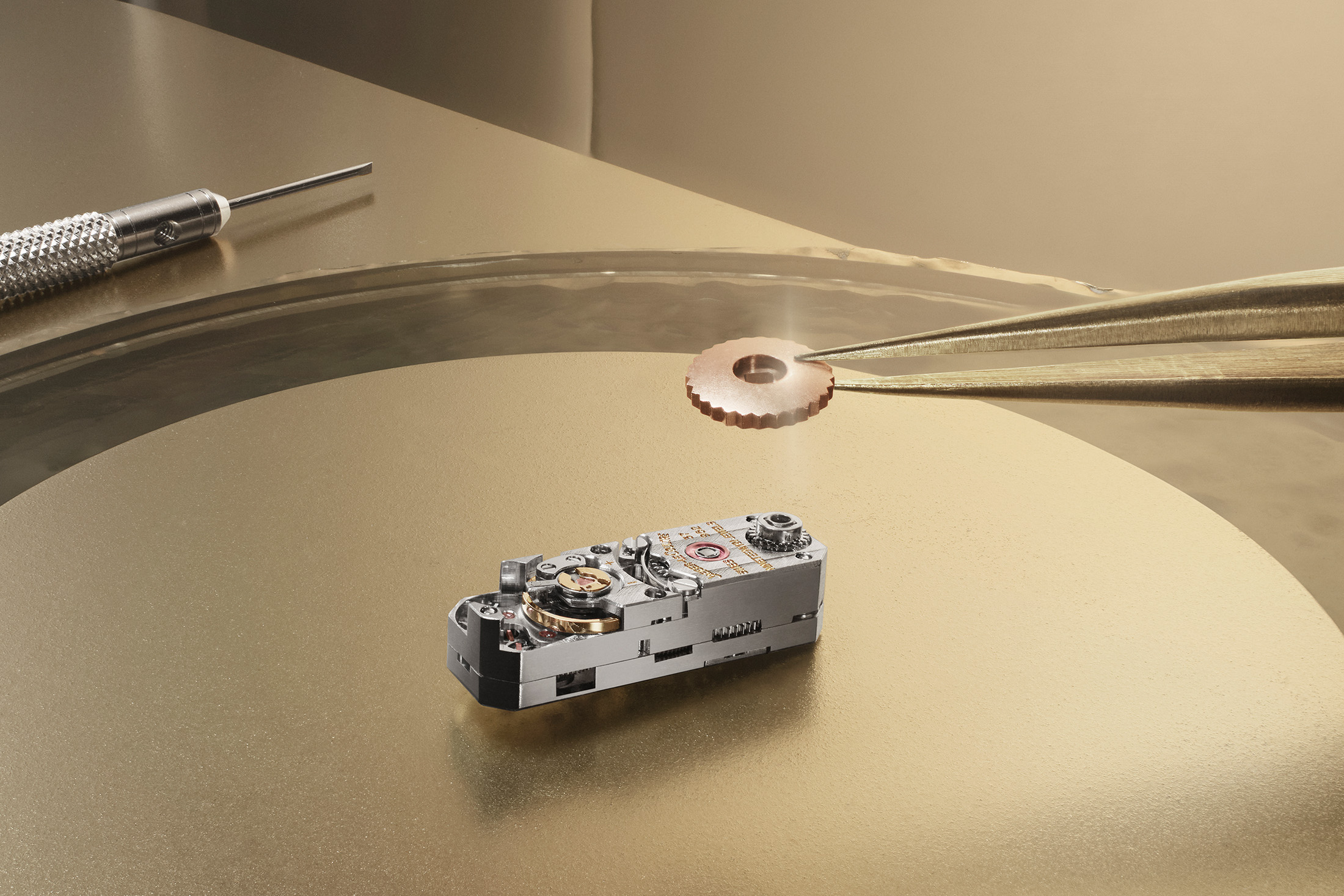
Yet, for all the breathtaking beauty of the jewelry surrounding it, the undisputed star of the show remains hidden inside: the legendary Calibre 101. As the world’s smallest manually wound mechanical movement, it represents a towering achievement in horological engineering that continues to captivate watch enthusiasts and collectors alike.
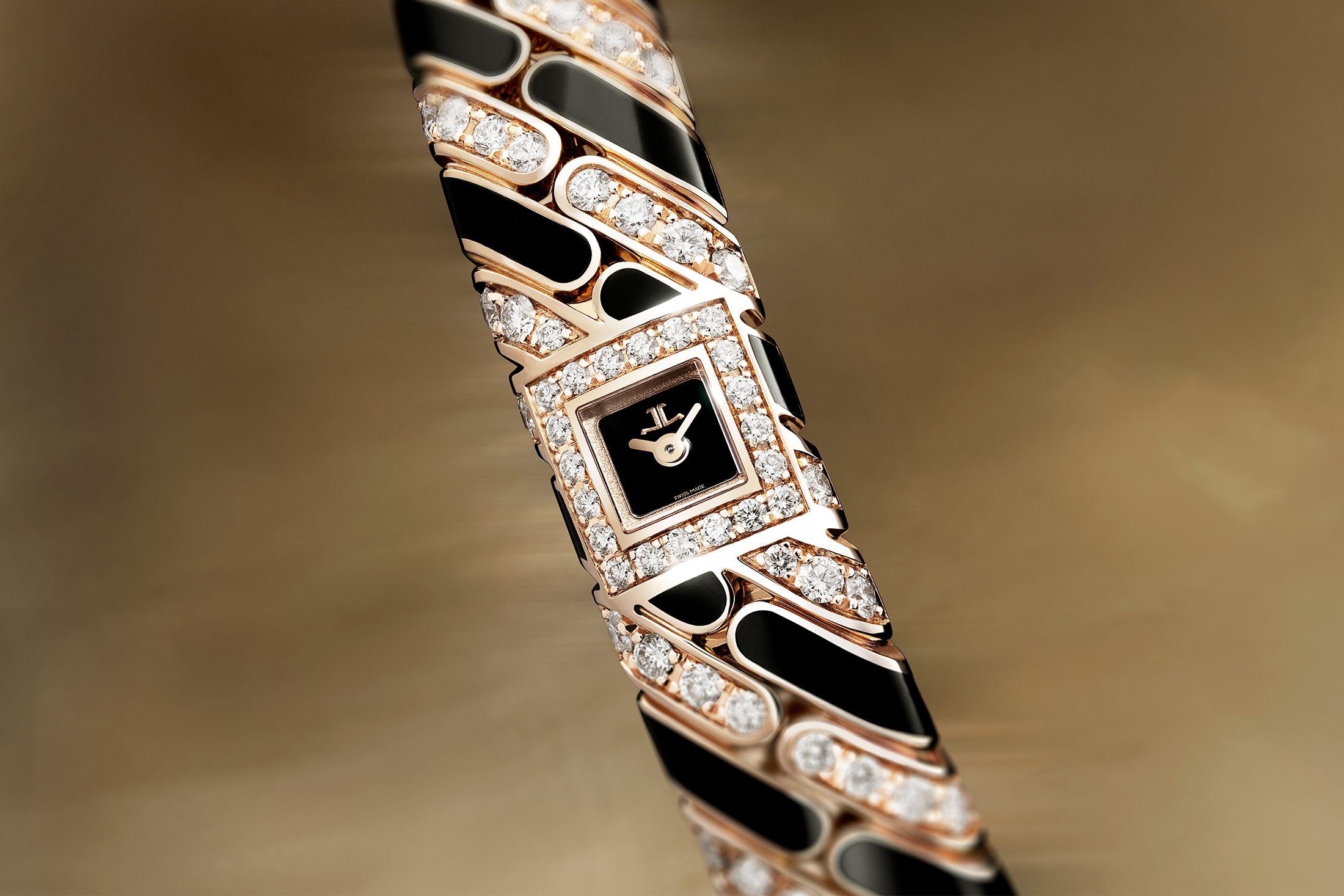
The lineage of this incredible movement stretches back to the historic Duoplan concept, which was invented and patented by Jaeger-LeCoultre in 1925. The core idea behind the Duoplan was to split the movement across two distinct levels, allowing a fully mechanical movement to be built within a radically narrowed footprint without sacrificing reliability or performance. Building upon this revolutionary architecture, JLC introduced the Calibre 101 in 1929.
Remarkably, nearly a century after its inception, the fundamental dimensions and architecture of the Calibre 101 have remained entirely unchanged. The movement measures a microscopic 14 millimeters long, 4.8 millimeters wide, and a mere 3.4 millimeters thick. To put its scale into perspective, the entire mechanism weighs barely a single gram. Composed of 158 tiny, expertly finished parts, it beats at a frequency of 21,600 vibrations per hour (3 Hz), features 19 jewels, and offers a power reserve of 33 hours when fully wound manually.
Because of its extreme miniaturization and the microscopic tolerances required for its assembly, the Calibre 101 cannot be produced on an industrial scale. Today, each individual movement takes around 40 hours of painstaking work to assemble by hand inside Jaeger-LeCoultre’s specialized atelier in the Vallée de Joux. This intensive manual labor severely limits production, with the manufacture completing only a few dozen pieces each year. Consequently, each completed watch is priced individually upon request, reserving these rare masterworks for a select group of discerning collectors.
Shifting Paradigms in Women’s Watchmaking
The launch of the 101 Chain arrives at a fascinating time for the watch industry. Over the past few years, the landscape of women’s watches has undergone a notable evolution, moving away from oversized men’s style adaptations and toward smaller, more jewelry-forward designs. These contemporary pieces increasingly blur the definitive line between a traditional timepiece and a high-end personal accessory.
Iconic pieces, such as Cartier’s sculptural, cuff-style Baignoire, serve as clear reference points in this movement, where sensual, curvy bangles seamlessly integrate time-telling functions. The 101 Chain adopts a parallel philosophy through its expressive pink-gold bangle and meticulously integrated diamond details, ensuring that it functions just as effectively as a luxurious bracelet as it does a precision instrument.
However, a crucial distinction sets Jaeger-LeCoultre’s latest creation apart from many contemporary offerings in the high-jewelry watch segment. While the 101 Chain is undoubtedly adorned with an abundance of fine diamonds, the stones are not the primary engineering focus; rather, they serve as a brilliant frame for an exceptionally tiny mechanical movement.
In an era where many ultra-miniature jewelry watches rely on quartz movements simply to achieve their impossibly slim and dainty proportions, the 101 Chain remains stubbornly, proudly mechanical. It is manually wound and powered by the exact same historic Calibre 101 lineage that Jaeger-LeCoultre has spent generations refining. Its minute dimensions are not merely a stylistic concession to modern fashion trends, but the direct result of a legendary engineering feat that bridges the gap between past and present.
For years, watch commentators and female enthusiasts have voiced a desire for greater representation in the realm of mechanical watchmaking. Too often, women’s timepieces have been relegated to quartz movements, depriving collectors of the tactile, intimate ritual of interacting with a mechanical heart. While the 101 Chain offers strictly hours and minutes without heavily complex grand complications, it represents a vital step forward for connoisseurs who wish to engage in the daily ritual of manually winding their watches while retaining the refined dimensions and delicate aesthetic traditionally associated with high-end women’s jewelry pieces.
This positioning places the Jaeger-LeCoultre 101 Chain in a unique and elite tier alongside such legendary pieces as the Cartier Baignoire, the Bulgari Serpenti, and the Van Cleef & Arpels Sweet Alhambra collections. While those celebrated designs often lean decisively toward the artistic jewelry side of the equation, Jaeger-LeCoultre makes an exceptionally compelling, technically grounded case for the integrity of the watch itself. The dazzling diamonds may be the first element to catch the eye, but the historic mechanical movement ticking quietly beneath the surface provides a profound technical narrative that extends far beyond the fleeting trends of the miniature watch market.
The technical specifications for the Jaeger-LeCoultre 101 Chain outline a case crafted from 18-karat pink gold, measuring 18.6 millimeters by 5.98 millimeters, with a total thickness of 6.7 millimeters. The watch features a striking black lacquered dial and is secured to the wrist by an 18-karat pink-gold braided bangle bracelet, completely set with brilliant-cut diamonds and contrasting black HyCeram inlays.
At its heart lies the manually wound Calibre 101 movement, operating at 21,600 vibrations per hour across 19 jewels, delivering a 33-hour power reserve with hours and minutes functions. The entire composition is embellished with 158 brilliant-cut diamonds totaling approximately 2.78 carats. Reflecting its artisanal exclusivity, the watch is produced in quantities of only a few dozen pieces each year, with pricing available exclusively upon request.