






Last August, looking up from the edge of an ancient river delta on Mars, the Perseverance rover’s electronic eye spied an oblong shadow crossing the distant, glowing Sun. Phobos, the Martian moon named for the Greek god of fear and panic, was transiting the solar disk. Too small to darken the pale, dust-tinged sky, but orbiting close enough to eclipse a significant fraction of the Sun, Phobos passed in less than a minute.
The tiny moon, with its murky origins, is an enigma—one whose makeup and history could tell us much about Mars and the wider solar system. Now, the international Martian Moons eXploration (MMX) mission, which successfully launched on October 20, seeks to explore that mystery with an unprecedented series of landings on the unknown surface of Phobos, culminating in a historic sample return to Earth.
This ambitious endeavor brings unusual challenges, from designing a complex orbit around a microgravity moon that is locked to a much larger planet to figuring out how a spacecraft can land safely on a low-gravity pile of loosely assembled dirt and rock. Engineers also had to solve how a rover might navigate such a terrain, how the main spacecraft might take samples, and how those materials can be successfully returned to Earth.

“I often says that landing on Phobos is like trying to land a balloon,” says Yasuhiro Kawakatsu, project manager of MMX at the Japan Aerospace Exploration Agency (JAXA). “It’s very difficult to drop a balloon to the ground and prevent it from tilting or bouncing.”
Why Phobos Is Such a Strange Moon
Phobos is one of two small Martian moons, the other being Deimos, named after the Greek god of dread and terror. Their cosmic origins remain unknown, though science currently debates two prevailing theories. One hypothesis suggests the moons were once asteroids originating from the belt between Mars and Jupiter before being captured by the smaller planet’s gravity. The opposing theory proposes that Phobos and Deimos formed when a large celestial body slammed into Mars, sending massive amounts of debris into orbit. Some advanced models suggest the pair are simply the last survivors from a once-larger cluster of planetary satellites.
Scientifically speaking, Phobos is classified as a rubble pile—a loosely consolidated aggregate of rock and dust. Far too small to pull itself into a spherical shape under its own mass, it is shaped remarkably like a lumpy potato, roughly 27 kilometers in length, possessing a mere 1/1,800th of Earth’s gravity. On Phobos, a typical adult human would weigh roughly as much as a single tennis ball does on Earth.

More than a decade in the making, MMX launched aboard Japan’s flagship H3 rocket from the Tanegashima spaceport. It is scheduled to arrive at Mars carrying scientific payloads contributed by several space agencies, including NASA, alongside a specialized micro-rover called Idefix, which was developed collaboratively by the French space agency CNES and the German space agency DLR, working alongside JAXA.
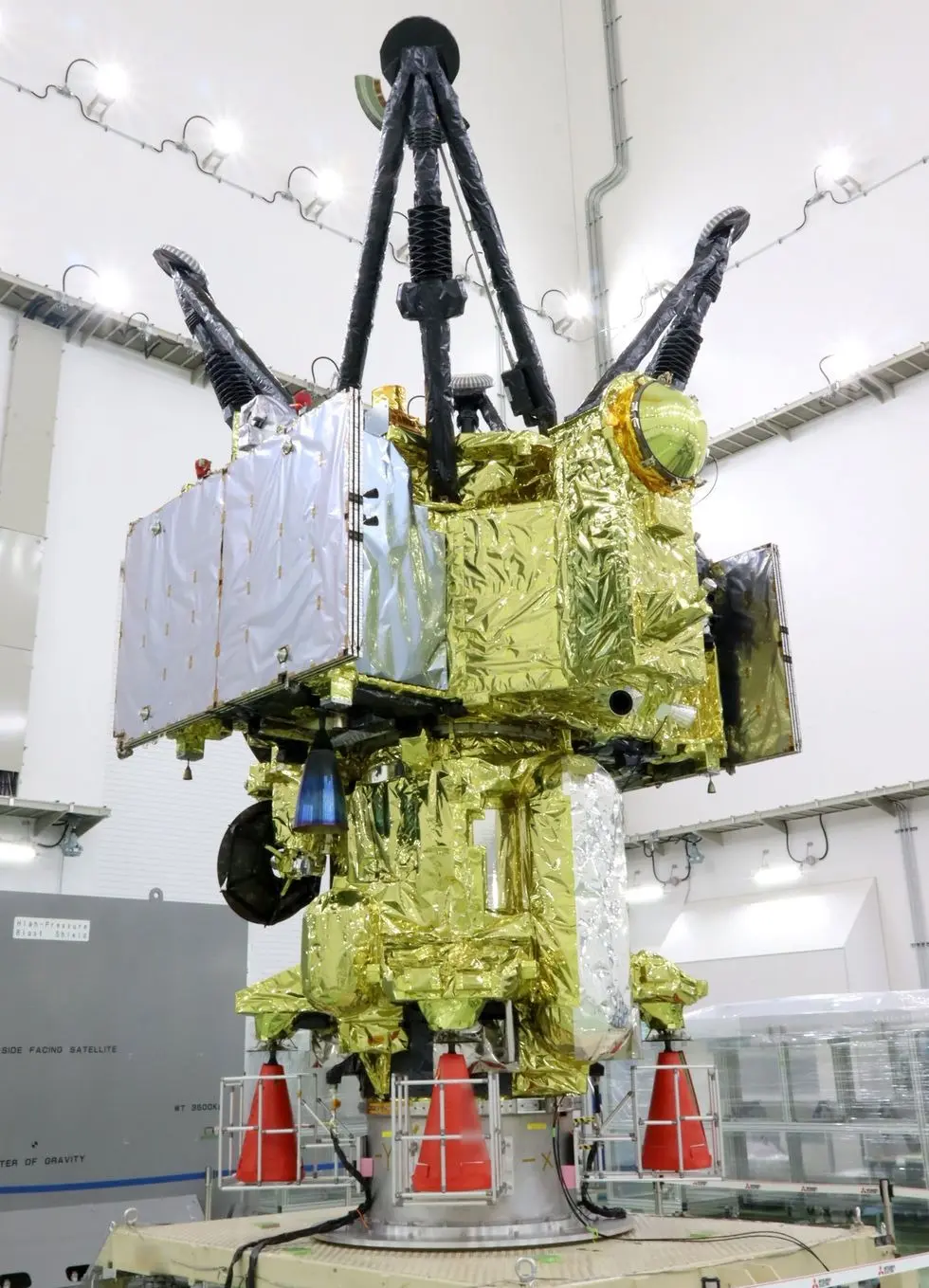
The MMX spacecraft consists of three distinct modules: a propulsion module to power its long journey to Mars and apply the necessary braking burns to enter orbit around the red planet; an exploration module carrying the rover, advanced sampling gear, and a suite of scientific instruments; and a return module, permanently attached to the exploration module, which houses the high-speed reentry capsule destined to bring materials back to Earth. After collecting samples on Phobos, the exploration and return modules will lift off together. The exploration module will then be jettisoned while the return module sets a precise course back home.
If all goes according to plan, MMX will deliver a 10-gram sample to Earth in the second half of 2031. However, the mission faces a formidable series of daunting challenges to reach that endpoint, including navigating complex orbits around Phobos and executing delicate landings while Mars periodically blocks direct communications with Earth.
“It’s the most complex mission I have ever seen,” says Patrick Michel, director of research at CNRS (the French National Center for Scientific Research) and co-principal investigator on the Idefix rover.

How MMX Will Orbit Phobos
Once MMX reached low Earth orbit following its liftoff, its propulsion module’s engine fired to kick off a nearly year-long deep-space cruise toward Mars. Upon arrival, the spacecraft must execute an extended, carefully timed engine burn to slow down sufficiently to be captured by Martian gravity. The propulsion module will then be jettisoned, leaving the exploration and return modules to operate in Mars orbit.
“If something doesn’t go according to plan, MMX will fly by Mars and get catapulted into the solar system,” notes Nicola Baresi, an astrodynamicist who coauthored a research paper examining specially designed orbits for the MMX mission.
From its initial arrival orbit, MMX will transition into a specially engineered quasi-satellite orbit that allows it to keep pace with the tiny moon while dynamically moving around it. Because Phobos is far too small to hold a spacecraft in a conventional orbit, MMX will instead orbit Mars alongside the moon, following a clever egg-shaped path that slingshots the spacecraft alternately ahead of and behind the moon.

“When you’re closer to Mars, you’re accelerating with respect to Phobos, and when you’re farther from Mars, you’re decelerating. So you essentially go back and forth,” Baresi explains.
The best existing images of Phobos, captured previously by spacecraft such as NASA’s Mars Reconnaissance Orbiter and the European Space Agency’s Mars Express, feature resolutions of only a few meters per pixel. That resolution is coarser than the Idefix rover itself, which is roughly the size of a microwave oven. To map the surface in much greater detail, MMX will loop in front of and behind Phobos at distances ranging from 200 kilometers down to less than 20 kilometers from the surface.
During its extensive two-year remote sensing campaign, the exploration module will utilize several high-resolution cameras and a laser altimeter to thoroughly map the terrain and identify candidate landing sites. When Mars periodically passes behind the Sun from Earth’s perspective, causing a roughly two-week communications blackout, MMX will retreat temporarily into a larger, stable parking orbit. Once communications are safely restored, the mission will prepare to send its first robotic visitor down to the surface.
Idefix Rover: The First Penguin

Before the exploration and return modules attempt their own landing, Kawakatsu notes that MMX will send a scout—affectionately referred to in a Japanese idiom as “the first penguin” that bravely leaps into unknown waters. For this mission, that scout is the Idefix rover, named after the loyal canine companion of Obelix from the classic French comic book series Asterix. The exploration module will release the rover during a low-altitude pass ranging between 40 and 100 meters above the surface of Phobos.
It will be a tense moment recalling Japan’s 2005 Hayabusa mission to explore the asteroid Itokawa. During a similarly designed drop, the MINERVA rover was released from an orbiter, but an error deployed it at an altitude of 200 meters instead of the planned 70 meters. The tiny rover missed the asteroid entirely and drifted helplessly into deep space.
Idefix will receive a slight, calculated nudge out of the exploration module toward its negligible-gravity target, freefalling and likely tumbling along the way. It is expected to touch down with a velocity of less than 1 meter per second. Unlike rovers that land on larger celestial bodies using protective airbags or dedicated landing legs, Idefix will land completely exposed, save for strategic padding on its critical solar panels. The barely-there gravity of Phobos should allow the 23-kilogram rover to settle softly, though predicting the exact dynamics of the touchdown remains extraordinarily difficult.
“It will bounce probably several times,” says Stephan Ulamec, Idefix’s co-principal investigator and project manager at DLR. “It will come to rest somehow in some position.”

Once it reaches a standstill, four retracted legs will deploy to right the rover autonomously, regardless of its final orientation. It will then unfold its solar panels to charge its onboard batteries for the exploration tasks ahead.
Once operational, Idefix will roll at a glacial pace, topping out at one millimeter per second. Its metal wheels feature protruding blades designed like paddle wheels to gain traction in the microgravity environment.
“If we were to drive our rover faster, then it would actually be more like we were swimming through instead of driving across the surface,” says Cecily Sunday, a doctoral student involved in testing Idefix’s specialized WheelCams at ISAE-Supaéro in Toulouse, France.
The WheelCams, a pair of downward-facing cameras mounted on the underside of the rover, will observe the wheels and their tracks throughout Idefix’s planned 100-day primary mission. The resulting images will help researchers analyze the size, distribution, and cohesion of grains within the regolith of Phobos. Understanding how the grains stick together will significantly impact how scientists interpret the rover’s mobility. Sunday compares this challenge to building a sandcastle.

“Think of trying to build a sandcastle with dry sand,” she says. “You can’t. Add water, and suddenly you can.”
The science team tested the rover’s nine-bladed wheels across a wide variety of materials, including Phobos regolith simulants provided by JAXA and DLR, lunar simulants, glass beads, quartz sand, and clay pebbles. Despite the microgravity and the rubble-pile nature of the moon, Sunday notes that Earth-based laboratories can approximate the rover’s motion surprisingly well because the reduced gravity also lowers the pressure between the grains beneath its wheels.
Idefix’s direct interactions with its alien environment will provide sub-millimeter resolution data regarding porosity, grain size, surface strength, and material hardness, bridging the gap between orbital observations and laboratory analysis of returned samples.
How MMX Will Land and Collect Samples

Once Idefix has investigated the surface, MMX will face an even greater challenge: landing its much larger exploration module directly onto Phobos. The spacecraft will execute a controlled descent to roughly 10 meters above the surface before dropping the remaining distance in free fall. With so little gravity to pull it downward, even minor sideways momentum could cause the lander to tip or bounce away. A successful, upright landing will mark the beginning of a crucial two-hour window dedicated to surface sampling.
The MMX mission builds heavily upon the operational experience and hardware developed for Japan’s Hayabusa and Hayabusa2 sample-return missions to asteroids Itokawa and Ryugu. However, the new mission features considerably more mechanical complexity. MMX’s exploration module will employ two distinct sampling devices: a robotic coring sampler developed by JAXA and a pneumatic sampler provided by NASA and built by Honeybee Robotics, a subsidiary of Blue Origin.
The coring sampler utilizes a robotic arm and a cylindrical coring tool designed to reach at least 2 centimeters beneath the surface. The arm can maneuver to find an optimal digging location.
“That by itself is a challenge because we’ve never done it,” Michel says. “You never know what can happen at the very sampling site itself, where you might have a boulder and the arm cannot move.”

Probing beneath the top layer is essential because solar radiation, galactic cosmic rays, and micrometeorites have heavily weathered the exposed surface. Subsurface materials should preserve a pristine record of the moon’s ancient origins, with JAXA aiming to collect at least 10 grams of material.
The pneumatic sampler offers a complementary approach. Mounted on one of the lander’s landing legs, it will inject pure, non-reactive nitrogen gas into the surface to kick up and capture loose grains. This dual system provides essential redundancy given the unknown conditions of Phobos.
“If the surface of Phobos proves to be very hard, the coring sampler may struggle to penetrate the ground. The pneumatic sampler would not experience this issue and still be able to gather material,” Kawakatsu notes.
Intriguingly, MMX also carries the possibility of collecting material from Mars itself. Because Phobos has been continually bombarded by Martian ejecta thrown into space by ancient meteor impacts, the mission provides an opportunity to return the first-ever Martian soil samples to Earth. Michel estimates that the collected samples could contain a few hundred grains originating directly from the red planet, which scientists can identify through oxygen isotope analysis.

During the brief surface operations, the robotic arm will deposit the collected samples into an onboard storage unit, from which they will be transferred into a specialized vacuum-sealed capsule within the return module. Following this, the spacecraft will lift off from Phobos.
Once back in stable Martian orbit, the exploration module will resume its remote sensing observations and execute several close flybys of Mars’s smaller moon, Deimos, to study its surface and composition. In November 2030, during an optimal orbital alignment between Mars and Earth, MMX will initiate the homeward phase of its voyage. The return module will separate from the exploration module, using its own propulsion to power the journey back to Earth with the sole objective of delivering the pristine dust of Phobos.
Finally, in 2031, the 60-centimeter-wide sample return capsule will plunge into Earth’s atmosphere at roughly 12 kilometers per second. Assuming it survives the extreme thermal pressures of reentry and touches down safely in Australia, scientists will open the capsule to unlock secrets about the early solar system. JAXA’s Institute of Space and Astronautical Science will curate the samples, sharing portions with international mission partners.
“We have macroscale measurements from the spacecraft, microscale measurements with the rover, and then sample analysis,” Michel says. “So we can relate the three kinds of scales together because we have all of them.”

Insights gleaned from the orbital images, close-up regolith observations, and chemical analysis of the returned samples promise to deepen our understanding of planetary formation.
“MMX is a mission to understand the Mars system and shed light onto how terrestrial planets like the Earth, and maybe Mars, develop a habitable environment,” Kawakatsu concludes. “We strongly suspect that our terrestrial planet region formed dry, and water and organics were scattered inwards from the icy-rich outer solar system.”