



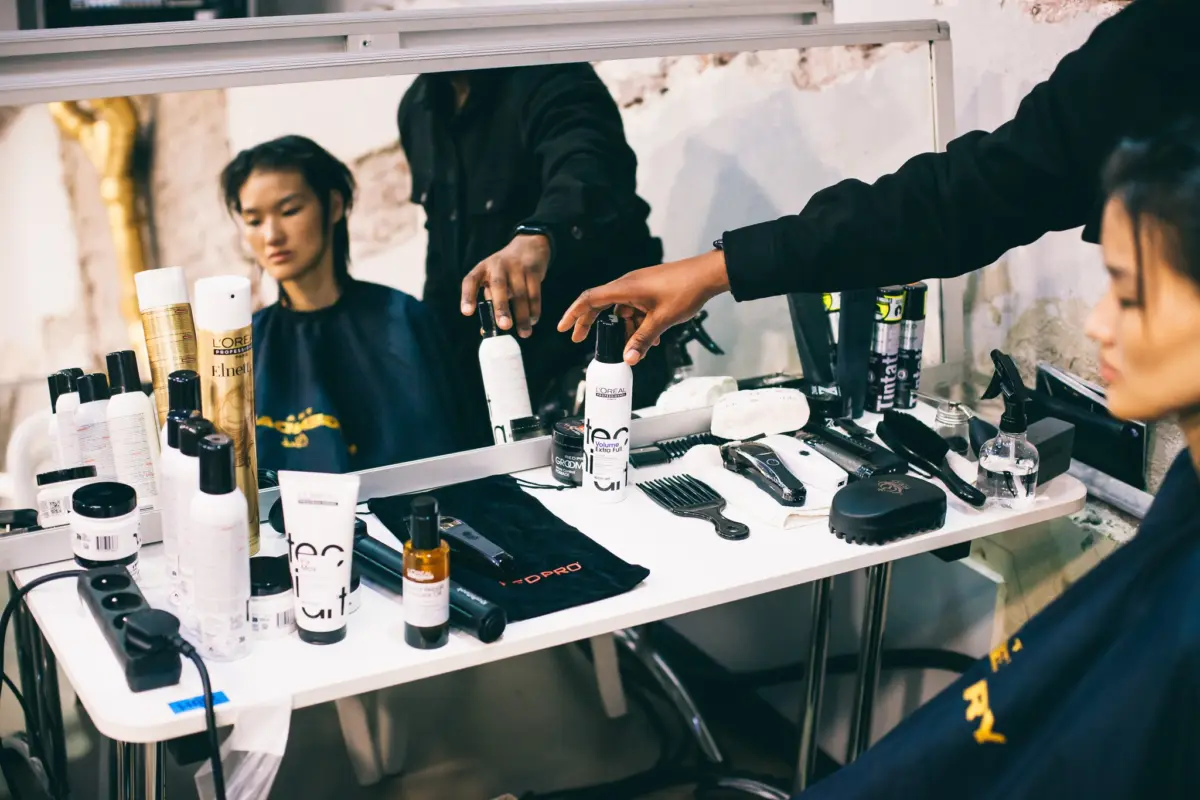
PARIS — L’Oréal Professionnel is elevating its presence on the international fashion calendar, stepping into the role of lead hairstyling partner backstage for four prominent Paris shows during the spring 2027 season.
The move marks a significant evolution in how the heritage beauty brand interacts with the high-fashion world. Rather than following a traditional sponsorship model, L’Oréal Professionnel has chosen to curate its own bespoke environment tailored to the demands of modern media and celebrity culture.
“The brand has had a longstanding partnership with fashion,” said Claire Le Bleis, global brand president of L’Oréal Professionnel. “So this time we wanted to be here for the Paris Fashion Week, but be here our way.”
To execute this vision, the brand engineered a freestanding activation space dubbed Transformation Backstage, situated in Paris’ dynamic 11th arrondissement. The venue serves as an exclusive styling hub where high-profile celebrities and digital influencers receive professional hair treatments and avant-garde styling ahead of the runway shows.
The underlying philosophy of the initiative hinges on elevating hair to the same tier as haute couture and ready-to-wear collections. According to Le Bleis, hair is as foundational to a designer’s vision as the garments themselves. Behind every innovative runway hairstyle lies the intricate technical skill of master professionals and high-performance products designed to withstand the rigorous conditions of the backstage environment.
The bustling activity inside the Transformation Backstage hub is documented and broadcast across social media platforms, providing consumers and professional hairdressers alike with an insider view of fashion week’s most sought-after looks, alongside practical tips, emerging trends, and technical how-tos.
For the spring 2027 season, L’Oréal Professionnel has forged creative alliances with a diverse roster of fashion houses, including Courrèges, Mugler, Weinsanto, and Pressiat.
“It’s important for us to support younger designers and to support the designers that have a point of view and that break the codes of fashion,” Le Bleis said. She noted that while the aesthetic identities of these partnering brands vary widely, they share a common collaborative ethos. Brand-affiliated hairdressers work directly alongside designers to codevelop and cocreate the distinctive hairstyles that ultimately define the runway presentations.
Show backstages remain invaluable to the brand not only for their cultural influence, but also as a rigorous testing ground for product formulation. Le Bleis described the backstage area as a place where products undergo extreme stress testing, subjected to intense heat, repeated styling and restyling, as well as significant physical tension and traction. Among the innovations currently being trialed in these high-pressure environments is the brand’s Flex Pli spray.
The Strategy of Transformation
Transformation sits at the very core of L’Oréal Professionnel’s global strategy under Le Bleis’ leadership. This strategic focus was crystallized during a landmark event titled Transformation Day, held on April 26 at the Palais de Tokyo museum in the French capital.
The event served as a physical embodiment of the brand’s overarching mission. “We are here to invent new formats, new platforms for both our audiences, the hairdressers and women and men around the world,” Le Bleis said in a separate interview. “We are born from transformation. We are born from the invention of the first inoffensive hair dye. Our mission is also to bring desire and professional beauty stimulus around the world.”

Transformation Day brought together an elite group of 100 celebrities, beauty authorities, fashion figures, and hairdresser influencers hailing from 20 different countries, including India, Brazil, China, and the United States. Collectively commanding a digital footprint of more than 150 million followers, these participants were paired with professional hairdressers to execute live hair transformations. The dramatic reveals were broadcast across social media channels, generating more than 127 million views globally.
Describing the scale of the gathering, Le Bleis referred to it as a “giant showcase of tech and creativity,” highlighting the brand’s capacity to leverage its advanced hair care, styling, and hair color technologies.
The momentum continued the following day on April 27, when the brand hosted a livestreamed Tech Talk master class. Designed specifically for industry professionals, the session offered an educational breakdown of how the looks seen at Transformation Day were constructed. The master class drew 24,000 professional viewers tuning in from 65 countries.
Initiatives of this caliber help dismantle traditional boundaries of knowledge-sharing within the industry, Le Bleis noted. These sessions stem from the brand’s ambition to act as a market-maker, inspiring men and women to envision themselves in new styles while breaking away from uniformity. The objective is to demonstrate that diverse, dynamic looks can be achieved through expert, safe, and professional methods.
A Century-Long Legacy and End-to-End Capabilities
L’Oréal Professionnel’s identity has been anchored in transformation since its inception in 1909, when it introduced the world’s first safe hair dye—an innovation that eventually laid the foundation for the entire L’Oréal Group. Today, Le Bleis considers hair color to be the single most transformative cosmetic category available to consumers.
Positioned uniquely within the global beauty market, L’Oréal Professionnel spans every major sector of the hair category. Alongside professional hair color, the brand’s portfolio encompasses targeted hair care, permanent and daily styling solutions, and professional tools.
“We are the only hair brand in the world to carry all of the hair categories,” Le Bleis said, emphasizing the brand’s ability to deliver an end-to-end transformation experience.
This holistic approach increasingly manifests in hybrid product development, merging distinct categories such as hair care with styling, or texture with nourishment. Such innovations are deeply rooted in the brand’s research and innovation (R&I) DNA.
Backed by robust financial performance, L’Oréal Professionnel operates from a position of considerable market strength. Having already crossed the milestone of 1 billion euros in annual sales, the brand’s parent entity, L’Oréal’s Professional Products division, played a pivotal role in driving the group’s overall growth through the second quarter of 2026.
Transformation has established itself as the dominant language of hair, particularly among younger demographics. Le Bleis pointed out that across all beauty sectors, hair transformations command the highest levels of engagement and virality on social media. This modern appetite for change is supported by three primary pillars under Le Bleis’ strategic roadmap: expansion, innovation, and communication.
Global Expansion and the B2B-B2C Evolution
While France and the broader European market remain the historical home base for L’Oréal Professionnel, the brand has successfully transformed into a truly global entity over the past five years. It continues to capture market share across Europe while accelerating growth in critical international regions. Currently, the brand’s top three markets by volume are France, India, and the United States, with India and Brazil serving as primary growth drivers.

“The emerging countries today are around 30 percent of the brand turnover,” Le Bleis noted. “We are still growing in Europe, and we still have a lot of potential needs to fill and recruitment, especially among the Gen Z and men. Professional hair care in Europe is still super big and growing a lot. At the same time, we expanded our footprint in the emerging world and also in China this past year.”
Historically operating as an exclusive business-to-business (B2B) premium hair care brand, L’Oréal Professionnel has successfully balanced its professional salon roots with a robust direct-to-consumer (B2C) presence. Today, the sales split between B2B and B2C channels is relatively even, with both segments exhibiting steady growth and providing the brand with structural resilience.
Over the past four years, L’Oréal Professionnel has nearly doubled its hair care business, securing its position as the second-largest hair care brand within the L’Oréal Group, immediately following Kérastase.
Le Bleis expressed strong confidence in the enduring viability of premium professional hair care, noting that its momentum extends far beyond fleeting trends. Pointing to structural market dynamics in emerging economies, she highlighted significant runway for future expansion.
“When we look, for example, in zones like Latin America or countries like India, the professional-to-mass-market ratio on the hair care business is one to eight, whereas in zones that are more mature, like Europe and the U.S., it’s one to four,” Le Bleis explained. “So we know that we also have a lot of potential of trading and recruitment in these zones, as well, with a lot of young consumers.”
Innovation, Technology, and Supporting the Profession
As a market pioneer, L’Oréal Professionnel relies on advanced technical and technological developments designed to address specific consumer and professional needs. Product development typically begins within a rigorous technical protocol, with every offering codeveloped alongside working hairdressers.
A prominent example of this collaborative approach is Metal Detox, a treatment formulated specifically in response to stylists’ requests for a solution to combat hair breakage resulting from chemical services. The product has since become the brand’s top-selling mask in both Europe and China.
The brand’s innovation pipeline also extends to salon services, highlighted by the recent introduction of French Blending—a professional technique designed to soften harsh regrowth lines and deliver multidimensional color—as well as the summer rollout of the No Bleach French Highlights service.
Beyond physical product formulation, technology and artificial intelligence are increasingly integrated into the brand’s communication and educational infrastructure. During the COVID-19 pandemic, L’Oréal Professionnel launched L’Oréal Access, an educational digital platform that expanded to reach 1.5 million active users during the first half of 2026, marking the brand’s largest-ever educational rollout.
The recurring Tech Talk series further extends this educational mission, offering free, long-form master classes hosted by top stylists and enhanced by AI-powered translation tools to reach a global audience. Additionally, the brand has begun utilizing artificial intelligence to enhance traditional before-and-after visual portfolios shot on real models, creating more immersive digital presentations.
“We consider that we are not just here to serve our clients, we are here to serve the profession,” Le Bleis concluded.