





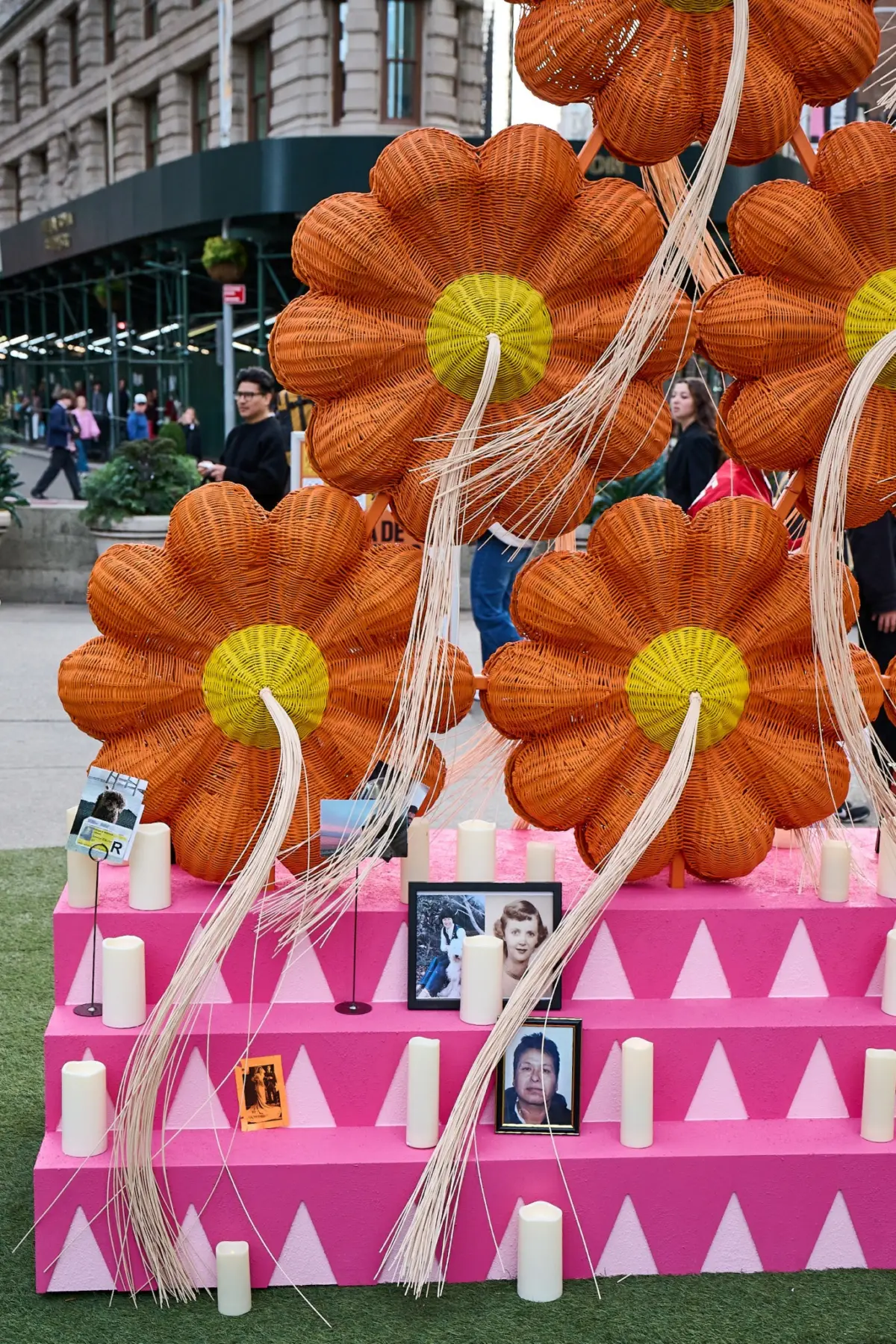
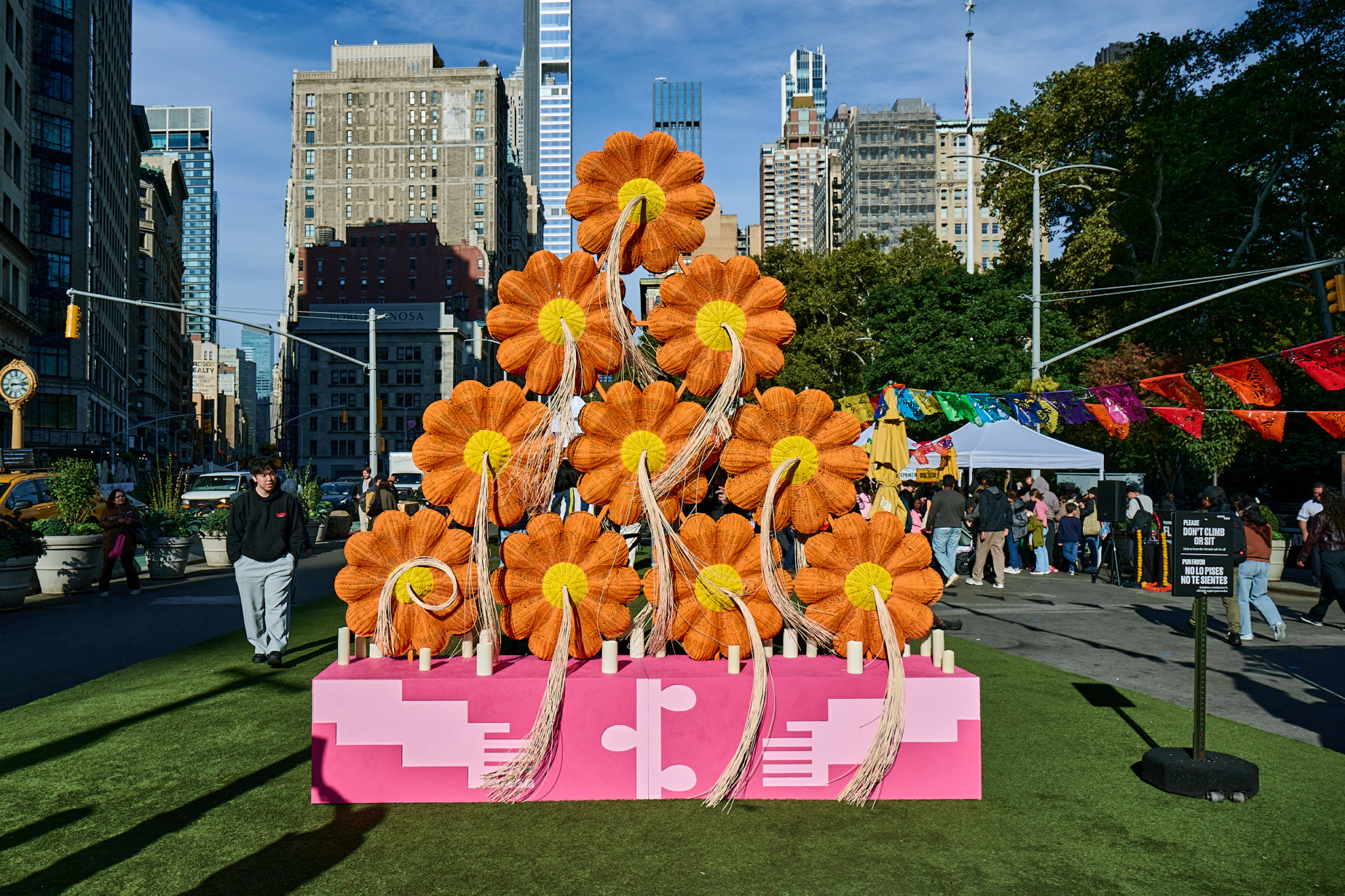
For Día de Muertos, marigolds are far more than mere decorative botanical elements. With their vivid, saturated orange petals and distinctive, pungent scent, these flowers are traditionally believed to guide the spirits of departed loved ones back home, rendering them an indispensable component of the rich Mexican tradition of remembrance. Far from the intimate domestic spaces where these tributes usually reside, this ancient custom has been scaled up and cast in an entirely new light in the heart of Manhattan. In New York City’s bustling Flatiron District, artist and designer Daniel Valero has reimagined the familiar flower into something thoroughly architectural: a monumental, seven-tier altar constructed entirely from handwoven floral forms.
Titled Twenty Petal Flower, the striking public installation was commissioned by the Flatiron NoMad Partnership and brought to life through a close cross-border collaboration between Valero’s Mexico-based design studio, Mestiz, and the Brooklyn-based fabrication organization Powerhouse Arts. Currently on view in the Flatiron North Plaza through November 3, the public artwork boldly reimagines the traditional ofrenda, or altar, transforming it into a communal gathering place where everyday pedestrians and visitors alike can pause, reflect, and leave mementos honoring loved ones who have passed away.
Rather than focusing exclusively on the solemnity of remembrance, Valero intentionally structured the installation to recognize and honor the vast network of people whose daily labor and specialized skills make the cherished holiday possible.
"An altar usually honors someone we love who has passed away," explains Valero, reflecting on the deeper conceptual layers of his public work. "This time, I wanted to honor the many hands behind the cempasúchil, from the people who grow it to those who transform it into an ofrenda."
The installation derives its evocative title from cempohualxochitl, an ancient Nahuatl word translating literally to "20-petal flower," from which the modern Spanish name cempasúchil is ultimately derived. The narrative of the design traces the life cycle and cultural journey of the iconic flower, tracking its path from the agricultural fields of Michoacán, Mexico, all the way to the skilled artisans who weave and shape it into the elaborate floral arrangements that define the seasonal celebrations of Día de Muertos.
For Valero, the primary challenge of the commission lay in translating something inherently delicate, organic, and ephemeral into a permanent, large-scale structural work without sacrificing its deep cultural resonance or its tactile, handmade character.

"I’ve always been fascinated by the idea of flowers becoming architecture," he notes. "With Twenty Petal Flower, we used weaving and scale to transform something delicate and temporary into a monumental structure, creating an architecture of celebration where people can gather, remember, and connect."
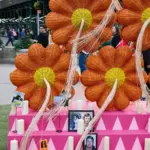
The oversized flowers that populate the monument were handcrafted primarily from wicker, utilizing traditional, time-honored weaving techniques passed down through generations of craftspeople. Their rounded, voluminous organic forms are meticulously arranged across the altar’s seven distinct tiers, yielding a dense, immersive composition of vibrant orange petals that appear warmly illuminated by soft, candle-like lighting integrated into the display.
The intricate work of developing and producing these woven elements took place at Mestiz’s dedicated fiber workshop located in Tequisquiapan, Mexico. However, translating those delicate, intricate forms into a durable structure capable of withstanding the rigorous demands of a busy Manhattan public plaza required a sophisticated engineering partnership. Powerhouse Arts stepped in to work alongside Mestiz, developing a robust supporting framework designed to weather the urban environment without compromising the artistic vision.

This ambitious collaboration required frequent, meticulous exchanges between Mexico and Brooklyn. The fabrication team regularly shared photographs of computer numerical control (CNC)-cut samples, texture tests, and precise paint color matches to ensure that every structural element remained entirely faithful to Valero’s original design intent. One of the most critical engineering decisions involved figuring out how to safely and securely support the heavy cluster of wicker flowers without letting the underlying metal framework visually dominate the composition.
"We wanted the internal structure to support the woven flowers without overpowering them," says Brittni Collins, director of public art at Powerhouse Arts. "So we built a steel frame with a slim profile and color-matched it to the cempasúchil orange so it could hide behind the weavings. The flowers were secured with stainless steel zip ties that hold up to wind and weather."
Furthermore, the installation was thoughtfully engineered with its future lifecycle in mind, Collins explains. Rather than constructing a disposable, single-use temporary structure intended to be discarded after a single holiday season, Powerhouse Arts engineered a modular system. This thoughtful approach ensures the entire installation can be easily disassembled, safely stored, and reinstalled for future celebrations in years to come.

Despite its impressive physical size and commanding presence in the urban landscape, the finished installation is deliberately designed to feel deeply welcoming rather than monumental in a conventional, intimidating sense. Visitors are actively encouraged to step close to the altar, spend unhurried time in its presence, and contribute their own personal tokens and remembrances to the collective display.
"I love the idea of someone walking through Flatiron NoMad and suddenly discovering this joyful, vibrant, handmade monument," Valero says. "Bringing an ofrenda into a public space allows it to become part of the city’s everyday life, a place where people can stop, remember someone they love, and leave an offering."
Cultivating that specific kind of spontaneous, human-centric experience was central to the Flatiron NoMad Partnership’s overarching vision for the seasonal project.

"The scale and openness of Flatiron North Plaza gave us an opportunity to create something immersive and unexpected in the middle of the neighborhood’s everyday rhythm," observes James Mettham, president of the Flatiron NoMad Partnership. "What is so exciting about this project is that it does more than occupy the plaza. It changes how people move through it, invites them to stop and look more closely, and introduces them to the stories and traditions behind the work."
For Valero, bringing a public ofrenda to the heart of New York City also serves as a powerful vehicle for cultural exchange. It creates a space where individuals already familiar with Día de Muertos can honor an important personal and cultural tradition, while simultaneously introducing newcomers to its profound historical and emotional meaning.
"I hope it brings a little piece of home to the Mexican community while inviting everyone in New York to share in the beauty of Día de Muertos," he concludes.

Twenty Petal Flower remains on view to the public in the Flatiron North Plaza in New York City through November 3, 2026.