





In the specialized world of antique jewelry and historical design, terminology often bridges the gap between ancient craftsmanship and modern appreciation. Among the myriad terms used by curators, historians, and appraisers to describe intricate decorative details, "addorsed" stands out as a concept deeply rooted in both heraldry and high-end goldsmithing. Derived from the French word adosse, meaning to lean or rest against something back-to-back, the term describes a specific compositional arrangement where identical or complementary motifs, animals, or letters are positioned back-to-back. While its origins trace back centuries to European coats of arms and stone carvings, the design philosophy found a remarkable second life in the nineteenth century, particularly through the innovations of legendary Italian jewelry houses such as Castellani.
To understand the visual impact of an addorsed motif, one must look to its traditional applications in heraldry and decorative arts. Historically, craftsmen utilized the technique to create a sense of symmetry, balance, and formal dignity. When observers study medieval or Renaissance coats of arms, royal crests, and architectural stone reliefs, they frequently encounter pairs of animals—such as lions, eagles, or lambs—placed symmetrically facing away from one another while sharing a central axis. This back-to-back positioning was not merely an aesthetic choice; it conveyed symbolic strength, vigilance, and structural harmony. Over time, as decorative arts evolved and goldsmiths sought new ways to incorporate classical motifs into wearable art, the principle of addorsed placement naturally migrated from large-scale architecture and heraldic banners down to the intimate scale of fine jewelry.
As jewelry manufacturing shifted during the nineteenth-century revival periods—where artisans eagerly drew inspiration from archaeological finds and Renaissance treasures—the application of addorsed elements expanded beyond pictorial symbols into the realm of maker’s marks and personal signatures. Goldsmiths and jewelry houses recognized that branding their creations required a hallmark that was not only unique and difficult to forge but also visually striking enough to complement the artistic integrity of the piece itself. Consequently, signatures and trademarks frequently utilized a combination of back-to-back letters. By arranging initials in an addorsed configuration, master jewelers transformed simple corporate stamps into elegant monograms that doubled as decorative components of the design.
One of the most celebrated examples of this practice in the historical record can be found in the work of the House of Castellani, the renowned nineteenth-century Roman firm famous for its meticulous revivals of ancient archaeological jewelry techniques. Founded by Fortunato Pio Castellani and later carried forward by his sons Alessandro and Augusto, the firm played a pivotal role in shaping nineteenth-century taste by resurrecting the lost arts of granulation and filigree. Alongside their distinct archaeological revivals, the Castellani family implemented specific maker’s marks to authenticate their output, ensuring that discerning collectors could instantly identify their workshop.
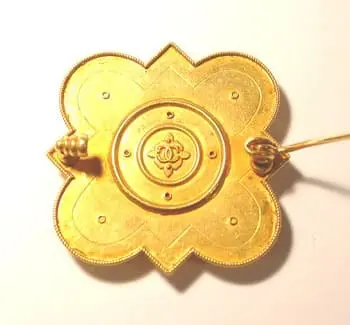
Among these distinguishing marks, the utilization of addorsed letters remains a significant point of study for antique jewelry experts. Most notably, the firm and its associated artisans famously employed back-to-back letter C’s as a signature mark. Around 1880, this distinctive monogram appeared on select pieces, serving as a subtle yet powerful testament to the maker’s identity. In these instances, two stylized letter C characters were placed back-to-back, perfectly mirroring the classical addorsed configuration seen in ancient heraldry. This clever design choice allowed the signature to blend seamlessly with the aesthetic vocabulary of the jewelry, functioning both as a formal hallmark and as an integrated graphic element that honored historical design traditions.
Today, the study of such marks provides crucial context for historians, curators, and fine art appraisers attempting to date and authenticate nineteenth-century creations. Renowned institutions and historic jewelry firms, such as Wartski—the esteemed British antique jewelry firm known for its expertise in Fabergé and Renaissance-revival pieces—frequently document and examine these rare maker’s marks to trace the provenance of museum-quality items. The Castellani mark featuring addorsed C’s, dating to approximately 1880, stands as a prime illustration of how nineteenth-century artisans deliberately bridged the gap between ancient heraldic conventions and modern luxury branding. Through the careful application of the addorsed principle, historic jewelers elevated simple initials into enduring symbols of artistic mastery, ensuring that the legacy of their craft continues to be recognized and celebrated by modern scholars and collectors alike.