





For many technology enthusiasts, a fascination with locks begins early and runs deep. That specific curiosity often traces back to formative literary encounters, such as reading the memoir Surely You’re Joking, Mr. Feynman! as a teenager. In the book, the legendary physicist Richard Feynman recounts his hobby of picking locks and cracking combinations during his day job working on the Manhattan Project at Los Alamos. This enduring appeal has since manifested in locksport pick sets and training locks purchased at hacker conferences over the years, alongside an appreciation for the digital exploits popularized by online security analysts like the LockPickingLawyer.
All of that history naturally leads to a single question: Can a maker build an interesting, unconventional lock from scratch? A classic strategy that lockmakers have long used to challenge would-be intruders is concealing the existence of the lock itself. In the modern era, a common variant of this concept is the magnetic lock, where a user holds or slides a magnet against an innocuous portion of a door or box to trip an internal release catch. The fundamental flaw with this approach, however, is that once an individual guesses the general location of the hidden mechanism, any sufficiently strong magnet will easily pop it open.
To circumvent this vulnerability, the initial thought process might turn toward embedding an RFID reader beneath the surface, accepting the inconvenience of carrying yet another access card. But a much more compelling alternative exists in specialized hardware components like SparkFun’s US $100 magnetic imaging tile. This specialized sensor array allows a creator to build a magnetic lock that opens not with a static magnetic field, but with a programmable, dynamic secret gesture.
The magnetic imaging tile is a small-run SparkFun board based on open-source hardware research originally developed by Peter Jansen. It features an 8-by-8 grid of Hall-effect sensors and communicates via a Serial Peripheral Interface (SPI) with the builder’s choice of microcontroller. These microscopic sensors are capable of detecting both the magnitude and the polarity of a magnetic field. Furthermore, the board can report its comprehensive spatial measurements hundreds or even thousands of times per second, depending on the processing power of the connected microcontroller. This sample rate is more than fast enough to capture the fluid motion of a handheld magnet being swiped across the board’s sensor footprint—serving as the exact secret gesture required for entry.
An additional benefit of relying strictly on magnetic fields rather than radio frequencies involves electromagnetic security. In an environment requiring extreme physical security precautions, the entire lock assembly could be shielded behind copper sheeting. Such an implementation is impossible with a standard RFID reader, because the copper sheet would function as a Faraday cage, entirely blocking the radio signals necessary for RFID authentication, as well as any other electromagnetic fields that an attacker might attempt to detect using an EMF meter to locate the lock’s electronics.

Choosing the Brains of the Box
Selecting the appropriate microcontroller is critical for processing the raw data streams produced by the imaging tile. A Teensy 4.1 serves as an ideal brain for the project, offering an abundance of input and output pins, a rapid 600-megahertz processor, a full megabyte of RAM, and a built-in SD card slot, all housed in a compact form factor with a modest $32 price tag.
Wiring the Teensy to the magnetic-imaging tile is a straightforward process, complicated only by a minor silk-screen error on one side of the board that incorrectly labels the SPI connections—an issue SparkFun has noted for future manufacturing runs.
When it comes to developing the gesture-recognition software, developers face modern questions regarding the integration of AI-assisted coding tools in do-it-yourself hardware projects. Rather than letting an artificial intelligence write the entire application stack from top to bottom, the scope can be strictly confined to auxiliary support libraries. In this project, an AI assistant was used exclusively to write two foundational libraries: one responsible for recording a lock gesture and saving it to the Teensy’s nonvolatile storage, and another tasked with monitoring the tile in real-time to determine whether a newly detected gesture crosses the precise mathematical threshold required to register a successful match.
The top-level application logic can be written entirely by hand to preserve the authentic DIY spirit of the build. This custom code manages operational features such as a physical push button that arms the system into gesture-recording mode after a brief safety delay, an indicator LED that visually signals when the box is actively recording a new master pattern, and the control routines that operate the physical locking mechanism.
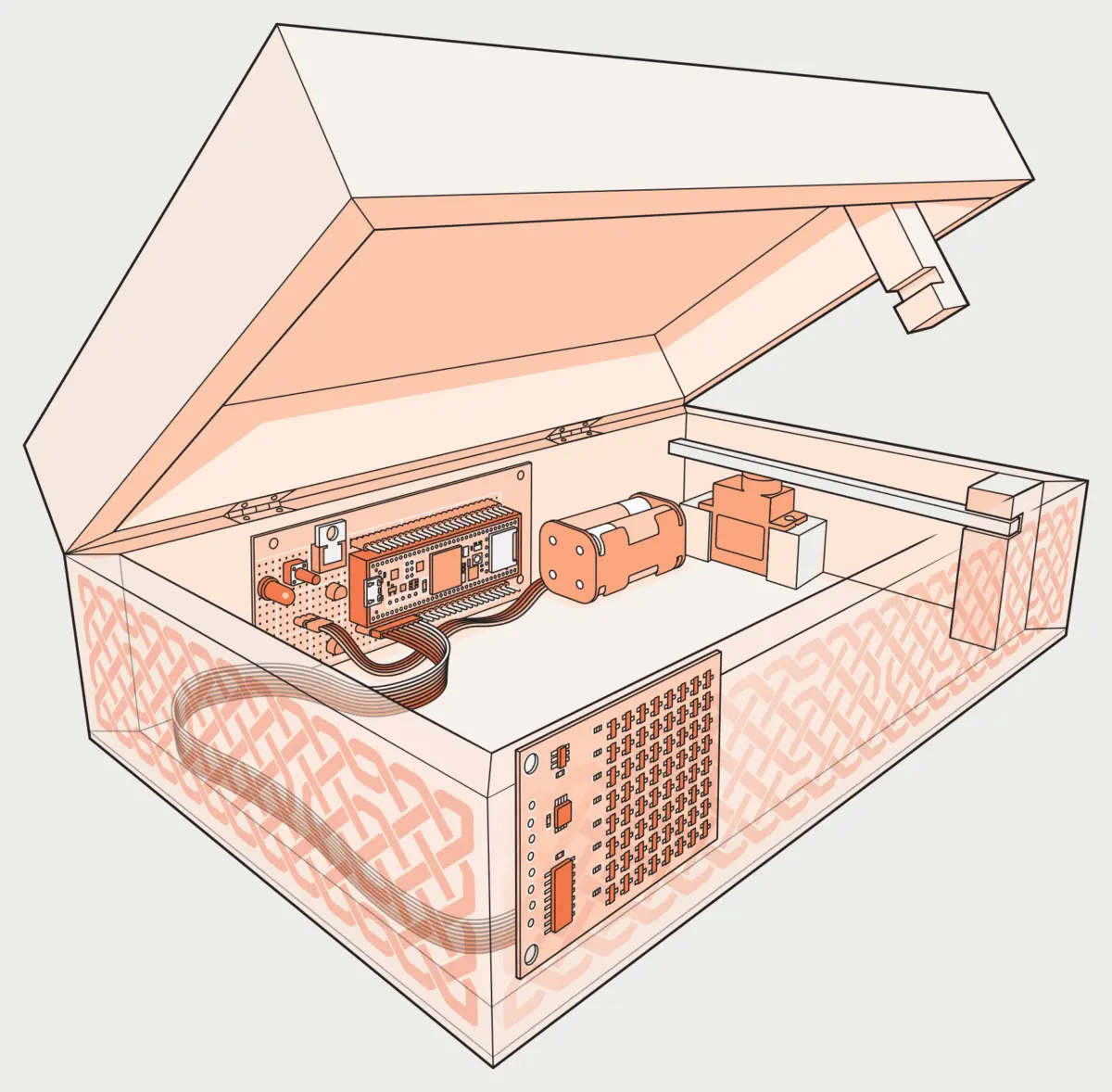
To demonstrate the proof of concept in a real-world scenario, the entire assembly requires a suitable enclosure. Purchasing a simple wooden craft box and removing its factory-installed exterior latch provides a blank slate. Gluing a notched wooden beam inside the lid creates a catch point, while an internal mechanism driven by a servo motor rotates a secondary beam in and out of that notch. While this mechanical setup leans toward the simplistic side, it proves robust enough for a working demonstration. The interior of the wooden box provides ample spatial clearance to mount the magnetic imaging tile flat against an interior wall alongside the Teensy microcontroller and its supporting electronics. These auxiliary components include a portable battery pack, the recording mode button, and a small secondary breakout board featuring two NPN transistors. These transistors step up the Teensy’s native 3.3-volt control signals to the 5-volt level required to reliably drive the servo motor.

Once fully assembled and integrated, a practical challenge immediately emerges: the physical dimensions of the magnetic tile’s active sensing area are quite compact, measuring just three centimeters square. While this small footprint makes it easy to conceal the tile entirely inside the box, it creates an inverse challenge on the exterior, making it difficult to execute the unlock gesture blindly in the exact right spot without missing the sensors. Simply marking the physical outline of the sensor grid on the outside of the box would completely defeat the primary security purpose of having a hidden lock in the first place.
Solving this alignment dilemma involves integrating a camouflaged visual reference grid. By utilizing traditional Celtic knotwork patterns, a designer can run an intricate band of art across the front face of the lockbox. Using an online knotwork generator, the pattern can be projected and traced directly onto the wood. This artistic motif serves as a hidden reference grid, allowing the user to execute a precise, repeatable gesture that consistently falls within the strict physical boundaries of the internal sensor area. To execute the physical gesture smoothly, a magnetic stylus borrowed from a vintage ferrite core-memory kit provides the ideal input tool.
Naturally, any prototype of this nature leaves clear avenues for improvement in future iterations. The most significant vulnerability in the current design is that if the lockbox remains closed when the internal battery completely runs out of charge, the box cannot be opened without causing physical damage to the enclosure. This limitation could be easily addressed in a more refined version by integrating a hidden inductive charging coil to supply emergency power from the outside. Nonetheless, the functional demo lockbox operates reliably, leaving its creator with only one final question: determining what valuable items to store inside.