





An update to the brand’s signature deadbeat seconds model brings forward both visual and mechanical improvements in an exclusive limited release.

For watch enthusiasts who trace the outer orbits of haute horlogerie, Arnold & Son occupies a fascinating position. While it may not command the ubiquitous everyday conversation of certain mass-market Swiss giants, the brand carries a rich heritage story rooted in the historical intersection of Swiss watchmaking and English marine chronometry—a legacy proudly highlighted on its official platforms in homage to the legendary eighteenth-century watchmaker John Arnold. Today, Arnold & Son operates under the umbrella of the Citizen Group, serving as one of the conglomerate’s premier prestige properties alongside Angelus, with both brands guided by Chief Executive Officer Pascal Béchu.

While many consumers might associate the Citizen Group primarily with accessible Japanese manufacturing, its extensive international portfolio extends far beyond those borders. Familiar legacy names and high-end properties like Bulova, Frederique Constant, Alpina, and movement manufacturer La Joux-Perret all fall under the corporate umbrella. Yet, Arnold & Son stands distinctly apart within this family, largely due to its positioning in the market, its unique aesthetic identity, and its dedication to complicated high-horology offerings.

Unveiled just in time for WatchTime NY, Arnold & Son introduced a significant evolution to its well-known DSTB collection: the new DSTB Stop-Seconds limited editions, offered in Cliff Grey and Kingsand variants. Each version is strictly limited to just 18 pieces worldwide. On the surface, casual observers might mistake these novelties for mere aesthetic refreshes, featuring new dial colors and precious metal combinations for the pre-existing Dial-Side True Beat references. However, a closer examination reveals that these new iterations incorporate a major mechanical upgrade—the integration of a hacking functionality for the deadbeat seconds complication. While hacking seconds might appear to be a standard feature in modern watchmaking and perhaps not worthy of major celebration on a typical timepiece, its inclusion in a watch that places the seconds hand as its primary visual and mechanical protagonist is a profoundly welcome sight for chronometry purists.

The deadbeat seconds—frequently referred to as true-seconds—complication serves as the undisputed focal point of the entire architectural design. This is achieved by isolating the specialized mechanism from the rest of the movement train and placing it directly on the dial side of the watch. Consequently, an array of polished bridges, intricate gears, and the distinct release mechanism are left on full display. This layout translates the continuous, sweeping motion of the underlying mechanical caliber into distinct, punctuated pulses that drive an oversized seconds hand forward in discrete, one-second jumps. The composition of the dial is intentionally asymmetrical, with the deadbeat seconds mechanism occupying the expansive upper quadrant between the nine and twelve o’clock positions, complemented by an oversized railroad seconds track printed directly on the dial in a striking shade of blue.

One striking, if somewhat literal, design element is the lever of the deadbeat seconds mechanism, which is artfully shaped to mirror the anchor emblem of the Arnold & Son logo—itself a direct nod to the marine chronometers historically crafted by John Arnold. Although flawlessly executed in blued steel, the anchor form leans slightly toward the graphical, perhaps feeling a touch literal for a dial that is otherwise defined by its classical elegance and mechanical sophistication. Nevertheless, the overarching structure of the dial-side complication is breathtakingly finished, projecting a grand, theatrical presence. The fact that the ticking, jumping seconds hand commands the absolute center of attention defines the entire character of the watch.

Positioned near the five o’clock mark is the offset subdial dedicated to displaying the traditional hours and minutes. Crafted from white opal, this subdial introduces a delightfully subtle layer of texture and visual refinement to the overall architecture. The subdial sits slightly elevated above the main dial surface, yet it creates an engaging play with dimensionality because its center is subtly concave, sloping inward and sinking back down closer to the baseline level of the main dial canvas. This gentle downward slope is particularly noticeable along the edge of the subdial, where the printed Roman numerals subtly curve as they approach the perimeter. Previous iterations of the DSTB utilized a flat presentation for this white opal subdial, making the new concave design a sophisticated step forward. For purists who appreciate the heritage of chronometry, the only minor wish for this subdial might be the inclusion of discrete minute markings, though the current minimalist execution preserves its clean aesthetic.

The base metallic dials beneath these complications are rendered in a tactile, grained texture and colored using advanced PVD coatings. The 18-karat red gold model is paired with a sophisticated light grey treatment, while the platinum edition utilizes a pale gold base that offers a warm, striking contrast to the heavy, cool luster of the precious metal case. Under direct sunlight, these textured surfaces exhibit a subtle, lively sparkle, yet legibility remains completely unaffected, ensuring that form and function coexist harmoniously.

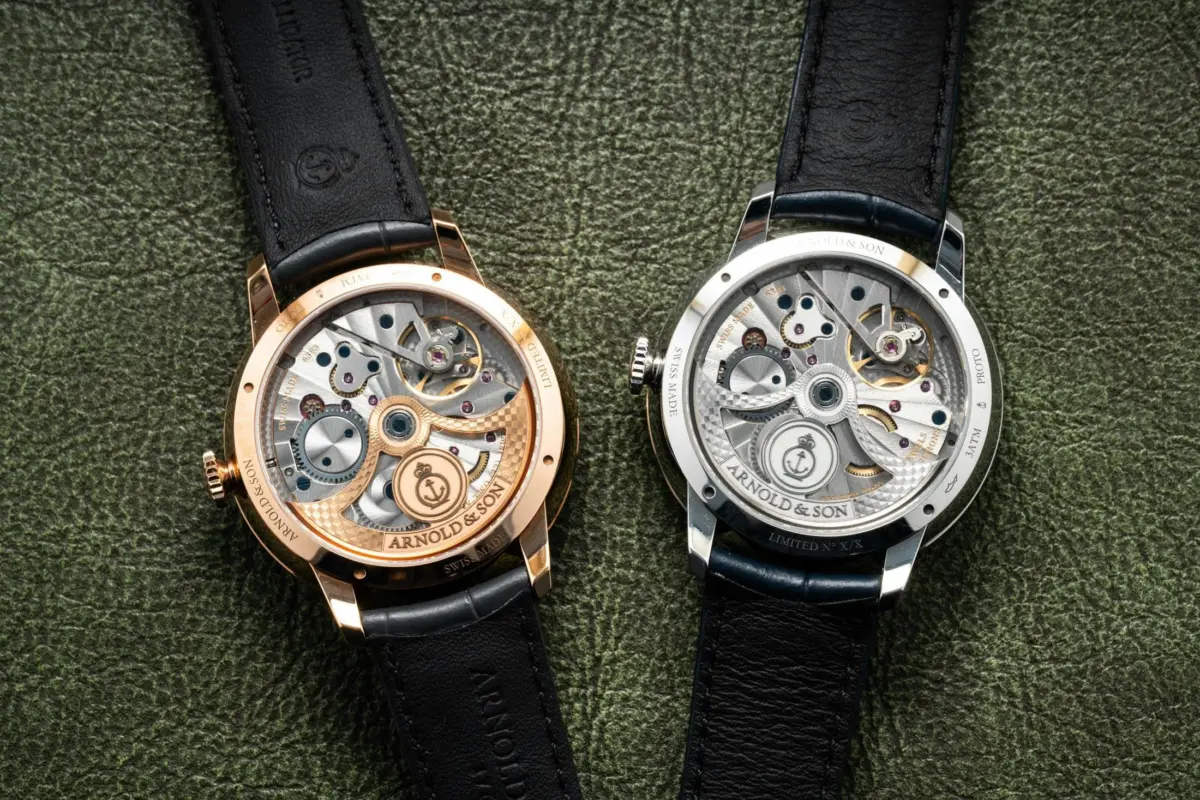
Powering both models is the in-house automatic A&S6303 caliber. In addition to housing the signature deadbeat seconds mechanism and the newly added hacking seconds feature, the movement delivers a reliable power reserve of 55 hours. The mechanical finishing is executed in a classic and attractive manner, featuring radial Côtes de Genève on the bridges, complemented by meticulous anglage (beveled edges), thermally blued screws, and a sophisticated variety of directional brushing techniques. The oscillating weight is equally compelling, featuring an intricate guilloché pattern and the brand’s anchor logo. All of this complex horological machinery is housed within a substantial 42mm case available in either 5N red gold or platinum, measuring 12.95mm in thickness and offering a water resistance rating of 30 meters.

On the wrist, the DSTB Stop-Seconds maintains a commanding presence, wearing with the same substantial scale that characterized its predecessors. Given the complex, feature-rich dial layout of the DSTB, this larger footprint feels entirely intentional rather than accidental. The visual proportions—driven by an expansive dial layout paired with exceptionally thin bezels—tend to make the watch wear somewhat larger than its numerical diameter suggests. This design choice aligns seamlessly with the broader aesthetic philosophy of Arnold & Son, as the brand’s most complicated and mechanical creations are traditionally housed in generously proportioned cases designed to showcase their intricate inner workings.

While watch collectors frequently advocate for more compact case sizes, and one might harbor hopes for a future downsized interpretation given the movement’s compact 36.2mm diameter, the generous sizing of the DSTB Stop-Seconds feels entirely justified. The watch is purposefully engineered to act as a dramatic, unobstructed stage for a mesmerizing jumping seconds complication, and it performs this role with absolute confidence.

Ultimately, these two new DSTB Stop-Seconds models represent a thoroughly cohesive and compelling evolution for this specific product line. The red gold edition is priced at $58,700, while the platinum counterpart commands $72,500. These figures represent a relatively modest markup—just over a thousand dollars—over the outgoing versions in their respective case metals, despite incorporating two major enhancements in the form of the stop-seconds mechanism and the concave stone subdial. For the discerning collector searching for a highly finished, mechanically fascinating, and visually distinct interpretation of a high-end deadbeat seconds timepiece, these new limited editions offer a proposition that is more compelling than ever before.