



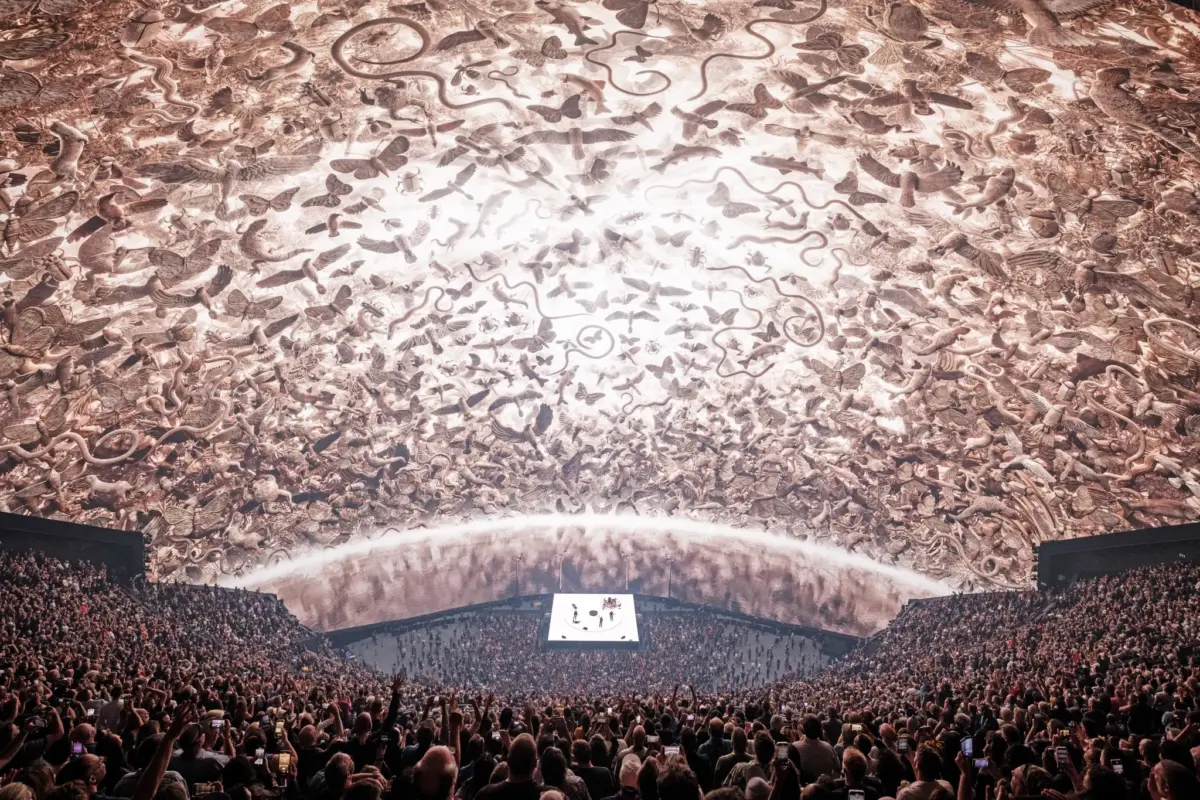
Books usually stay still until someone picks them up and brings them to life by reading. Yet, in the imagination and architectural mastery of artist and stage designer Es Devlin, books keep moving—turning, rotating, and reflecting—as demonstrated by her expansive new exhibition, Es Devlin: Other Worlds, which opened recently at London’s Design Museum.
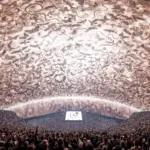
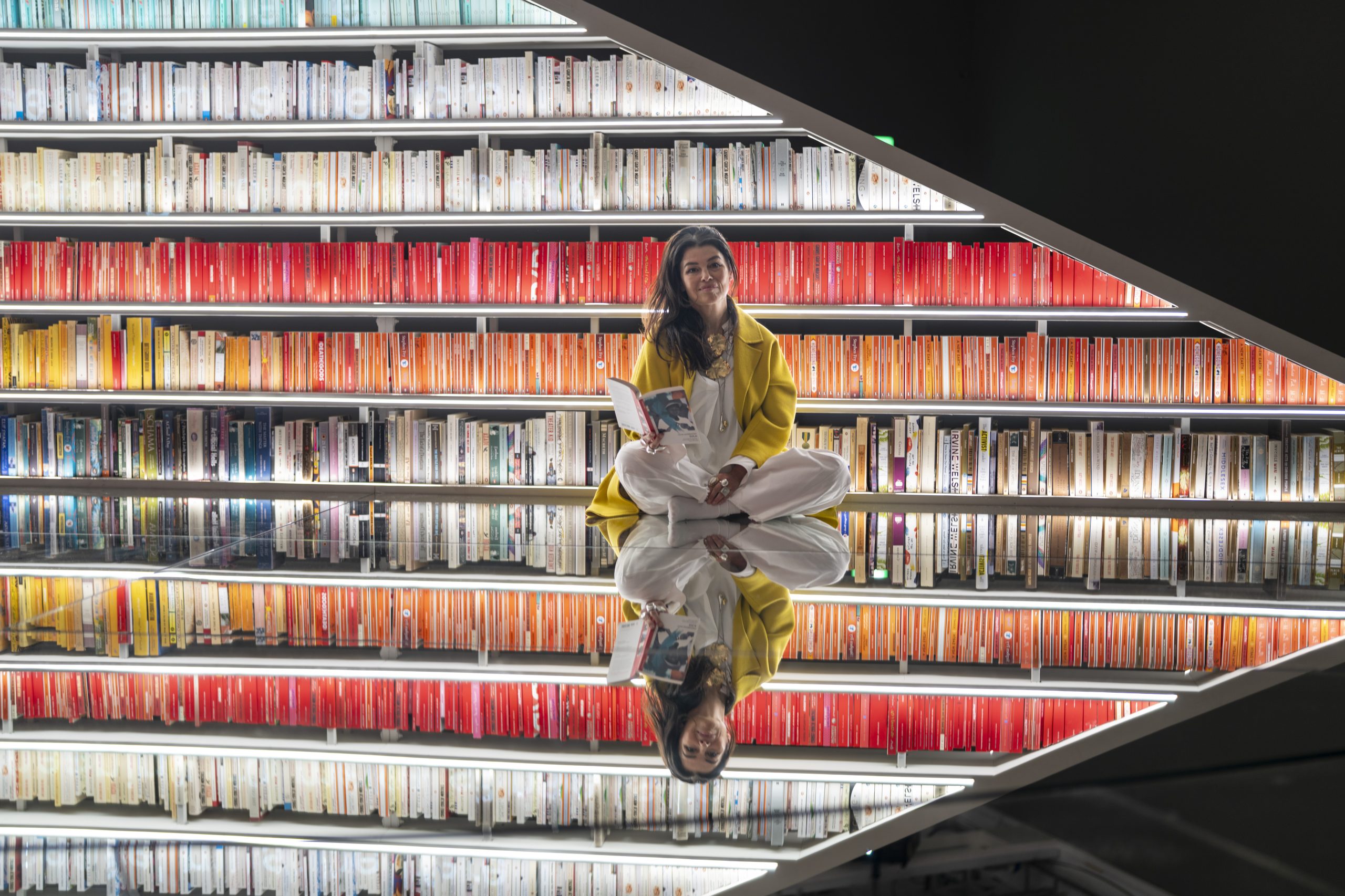
For those familiar with Devlin’s recent immersive installations, the moving library format will feel like a breathtaking homecoming. Audiences have previously encountered these rotating bookcases of varying shapes turning around them or in front of them: Library of Light at the Pinacoteca di Brera during Milan Design Week, Library of Us on Faena Beach for Miami Art Week, and Library of the Four Winds at Castle Howard. Now, for her first major European retrospective, Devlin unveils Infinite Library, a towering giant triangle holding 2,000 books that continuously rotates and mirrors itself within a vast circular space.
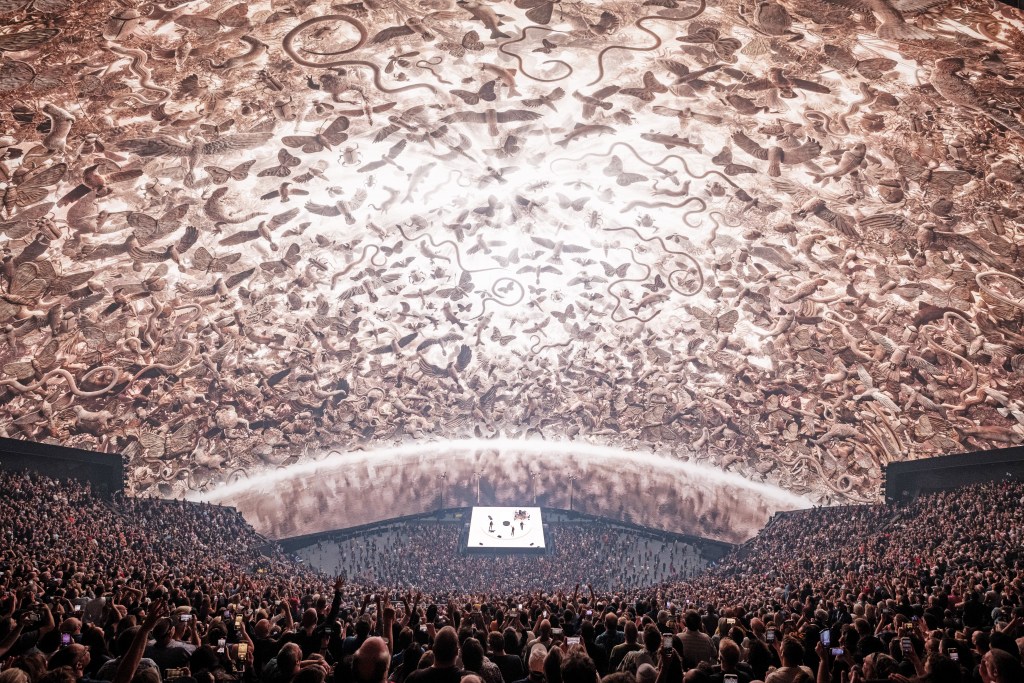
Attempting to label Devlin with a single title is an impossible task. Operating fluidly as a stage designer for theaters and massive stadiums, an artist, a painter, and a sculptor, her career defies traditional categorization. She has collaborated with a constellation of music icons including Kanye West, Lady Gaga, Billie Eilish, U2, Beyoncé, and Mika. Her visionary stagecraft has graced the Metropolitan Opera in New York, the National Theatre in London, and the historic Bregenzer Festspiele in Austria. Furthermore, she has engineered ambitious installations for the Victoria and Albert Museum (V&A) and Tate Modern, anchored the inaugural visual spectacle at The Sphere in Las Vegas, designed show sets for Louis Vuitton, and stood as the subject of the critically acclaimed survey An Atlas of Es Devlin at the Cooper Hewitt, Smithsonian Design Museum in New York. Most recently, she lent her unique perspective as the artistic director of Homo Faber, the celebrated craft biennial held on the island of San Giorgio Maggiore in Venice.
Reflecting on Devlin’s multi-faceted identity during a press preview, Tim Marlow, director of the Design Museum, remarked, “Es is such a multi-hyphenate. There’s so many things that Es does and is, but ultimately she’s Es Devlin.”
When considering whether her multidisciplinary output needs a rigid category, Devlin offers a pragmatic perspective rooted in the shifting landscape of modern creative work. Discussing her experience working with artisanal objects in Venice, she noted that traditional distinctions between genres are becoming increasingly obsolete in the face of rapid technological shifts. As human creators contend with the rise of collective artificial intelligence, Devlin believes the cultural emphasis will shift away from technical specialisms toward the fundamental presence of the human hand and embodied consciousness.
Having spent decades shaping productions in theater, dance, and live music, Devlin has increasingly channeled her focus toward museum art installations over the past ten years. Explaining this evolution, she noted that she has created 37 such installations within the last decade alone. While museums and galleries now form the core of her practice, she deliberately brings the terms of engagement learned in performance environments into the gallery space. For Devlin, the arrival sequence is critical: she takes care of the initial moments, orchestrating how visitors gather and offering them the intimate experience of sharing space as a small audience.
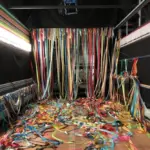
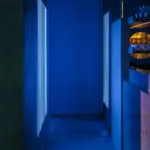
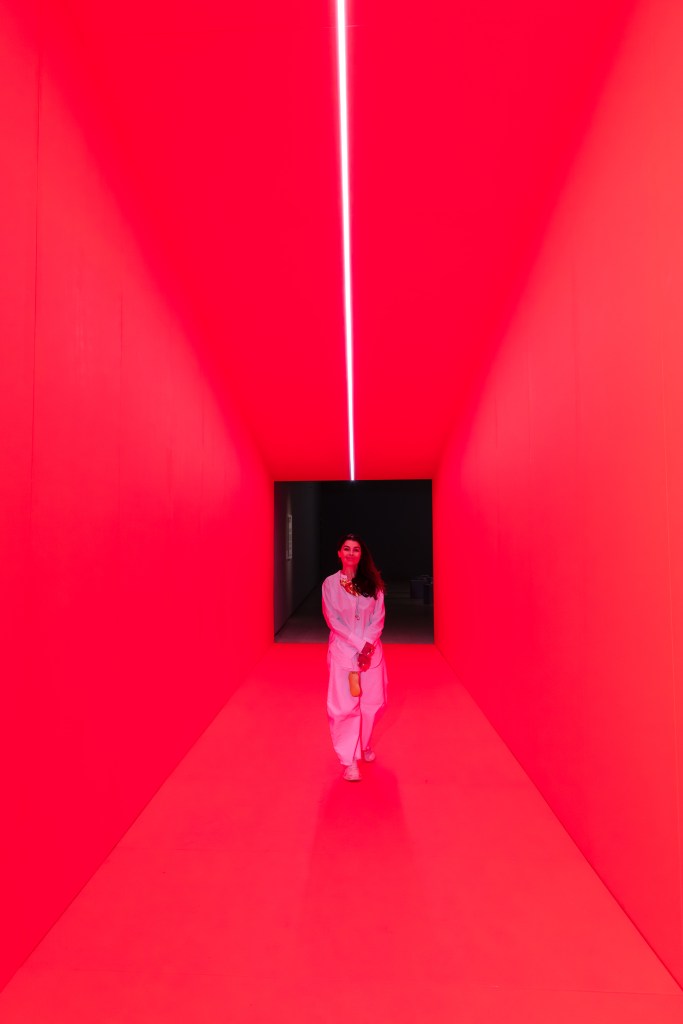
This theatrical sensibility is immediately palpable at the Design Museum in London. Visitors first gather in groups of fifty within a dramatic red room before stepping directly into an almost exact, meticulously detailed reproduction of Devlin’s personal studio. After a few minutes to roam and photograph the environment, a sequence of sound, lighting effects, and a moving video chronicling the artist’s life unfolds, building toward a carefully orchestrated scenographic twist. From there, the exhibition transitions into a more traditional museum layout, allowing visitors to explore the extensive archive at their own pace. Devlin emphasizes that those opening minutes establish a temporary community and set the crucial lens through which the rest of the retrospective is experienced.
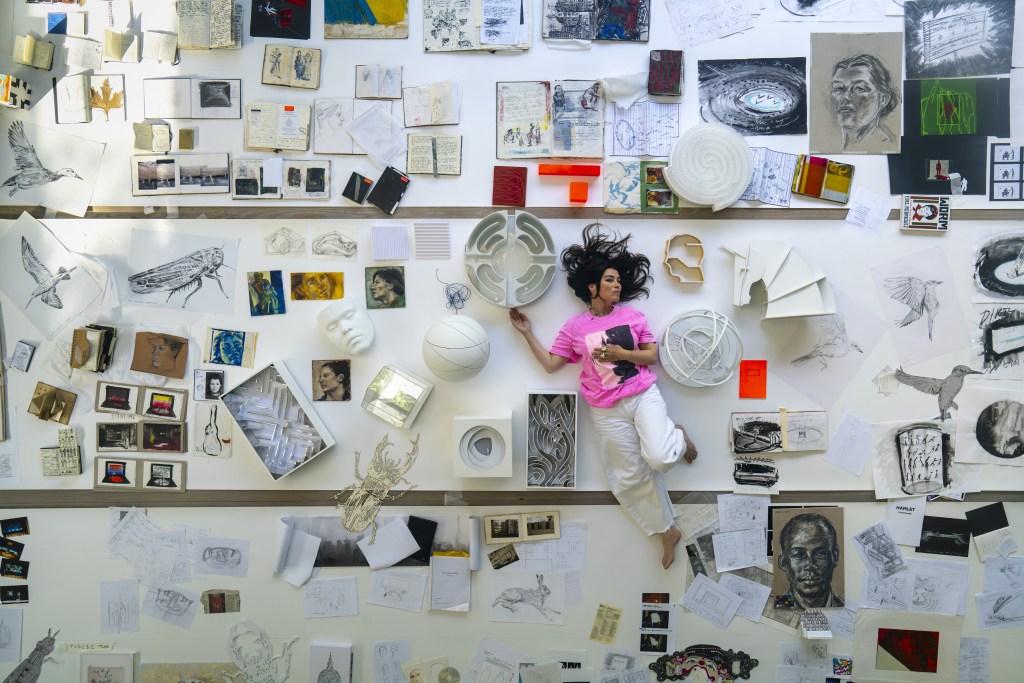
At the heart of the retrospective lies a staggering display of drawings, sketches, and physical models spanning hundreds of distinct projects. Curator Johanna Agerman Ross, working alongside Danielle Thom and Margherita Dosi Delfini, spent days sorting through thousands of archival artifacts, ultimately selecting 5,000 items and organizing them in close collaboration with Devlin’s studio staff.
Remarkably, this expansive archive survived almost by chance. Devlin recounts that when she was twenty-eight years old, following the end of a long-term relationship, she left her home with a single suitcase. Roughly three years later, her former partner—with whom she remained on good terms—noted that he was selling the house and had discovered eight bin bags in the attic. Those bags contained the foundational material of her early creative years. Though she was not consciously archiving at the time, once she returned to the contents, she immediately recognized their enduring value.
The studio team has played an instrumental role in bringing the retrospective to life, a collaborative dynamic that Devlin is quick to highlight. Operating as a tight-knit team of designers, her studio members handle technical drawings, construct recent models, and meticulously file documentation. Because of this disciplined internal process, the studio has managed to preserve a continuous, unbroken archive stretching all the way back to 1996.
Devlin’s global footprint remains as active as ever, with multiple concurrent projects offering a window into her ongoing creative trajectory. Among them is a recent work created for the V&A East Storehouse, a project that led her to adopt a term originally coined by avant-garde artist Natalia Goncharova: "the everythingists." Goncharova used the term to describe a practice that seamlessly spanned stage design, performance, fashion, portraiture, and painting, rejecting the modern impulse to limit creative expression to narrow specialisms.
Embracing this renaissance approach, Devlin balances multiple modes of inquiry simultaneously. Even as she focuses heavily on museum installations and smaller-scale works—including an upcoming exhibition at Soho House—she continues to maintain her footprint in live performance, recently collaborating with Hussein Chalayan on the staging for Olivia Rodrigo’s tour and designing productions for the opera house.
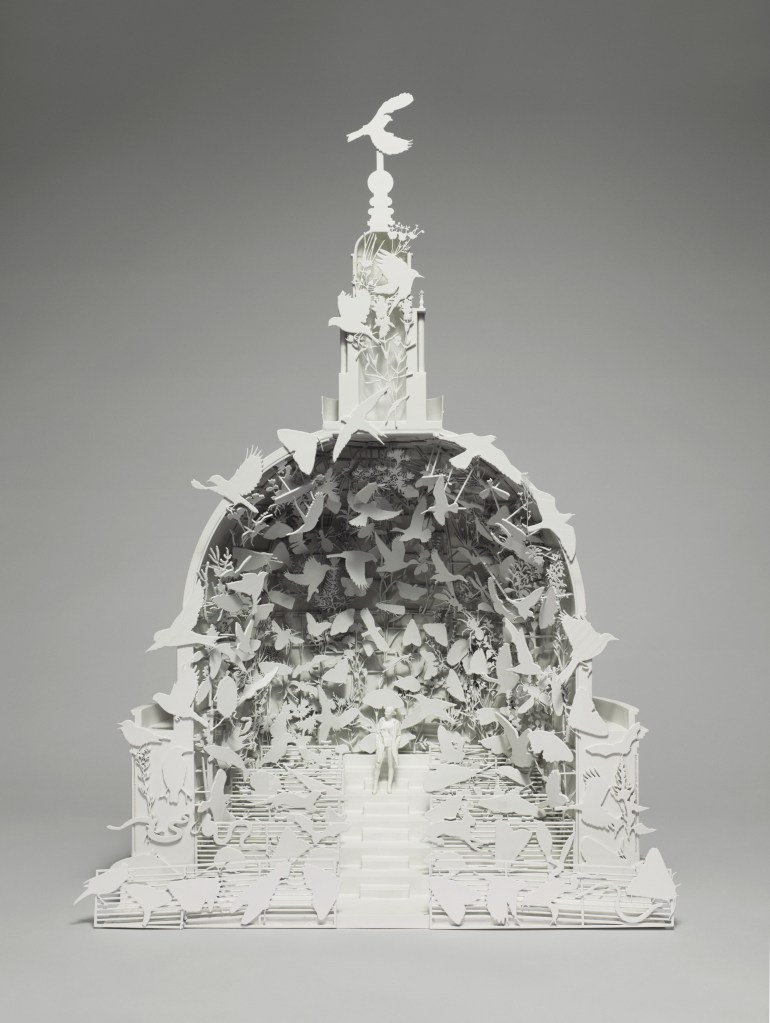
The journey through Es Devlin: Other Worlds ultimately culminates in a final room dominated by the giant rotating library. Comprising 2,000 books provided entirely by Penguin Random House UK, the volumes are arranged to form a striking, luminous rainbow. Here, visitors are invited to sit and read from a curated selection of titles that fundamentally shaped Devlin’s intellectual ethos and artistic vision. Among the volumes are James Gleick’s Chaos, David Abram’s The Spell of the Sensuous, Toni Morrison’s Beloved, and Margaret Atwood’s Oryx and Crake. For Devlin, these books served as the original portals through which she entered imaginative realms—the very same "other worlds" that she now constructs for audiences worldwide.
Es Devlin: Other Worlds runs from October 2, 2026, through April 4, 2027, at the Design Museum in London.