




The intersection of craft, technology, and historical art is rarely the first thing that comes to mind when encountering Volker Hermes’s meticulously reworked classical portraits. Yet, this dynamic friction between centuries-old oil paintings and twenty-first-century digital image editing forms the beating heart of the artist’s practice. Currently on view in New York City at 44DeVore, Hermes’s exhibition, titled “Hidden Portraits,” invites viewers to reconsider the familiar faces of European art history through a distinctly contemporary lens.
For Hermes, the technical foundation of his work is both its defining feature and its most provocative element. Unlike traditional fine artists who might attempt to copy or restore historical masterpieces, Hermes utilizes a digital manipulation technique to alter archival pigment prints sourced from online imagery.
“I think the biggest, also kind of controversial, discussion about my work is the technique. I’m not painting, and people think that this is ruining something,” Hermes reflects.

This tension between reverence and subversion has roots in the artist’s unique background. Before pursuing painting at the prestigious Kunstakademie Düsseldorf, Hermes studied philosophy—a discipline that clearly informs the conceptual scaffolding of his current visual interventions. Around 2007, he began developing the digital photo-collage techniques that would come to define his archival pigment prints.
Rather than viewing his digital alterations as a desecration of canonical art, Hermes sees them as an act of homage and resuscitation. “My work is really like a bow to this historical art, and that is exactly the reason why I’m not transforming them into mediocre paintings,” he explains.
His output remains steadfastly contemporary, avoiding the trap of historical mimicry. “I didn’t want to repaint them because I think it’s not a solution to paint like Rembrandt in 1625,” Hermes notes. “Nostalgia doesn’t have a future; there is no energy in nostalgia. Mixing things up and making them come alive again… I think this is the best that can happen to historical artworks.”

Deconstructing the Gaze and the Realities of the Elite
When contemporary audiences encounter historical portraits, the human face is almost invariably the focal point, drawing immediate attention at the expense of sartorial and environmental context. Hermes deliberately disrupts this habit, forcing viewers to slow down and absorb the multifaceted messaging embedded within the imagery.
“I’m choosing portraits [that deal with] the topic that I want to talk about at the moment,” the artist says.
His subjects run the gamut of European portraiture, but they share a common thread: they serve as windows into power dynamics, societal strictures, and historical inequality. “I want to point out, for example, that [formal portraits] are relics of an elite; this is the top one percent of a society. And the restrictions for women or for people who were thinking different were so hard.”

Hermes is fully aware that his disruptive interventions can occasionally trigger discomfort or debate among purists. However, intellectual and optical wrestling is precisely the point. Enchanting surfaces in historical art frequently conceal darker, more restrictive realities.
As an example, Hermes points to his frequent use of pearls. “Quite often I extend pearl necklaces, and I wrap them around the necks of the women because I love pearls, and they are a timeless sign for wealth and beauty. But women had no rights. When I wrap pearls around them, I want to point that out. I want to tell people, ‘Wait, this was different at that time.’ The thought that follows very secretly—and I hope that people get it—is be happy that we are different.”
This critical perspective extends beyond historical critique into a broader commentary on modern visual culture. In an era dominated by endless scrolling, digital saturation, and rampant visual overload—a phenomenon famously diagnosed by cultural theorist Jean Baudrillard in The Ecstasy of Communication as a “pornography of information and communication, a pornography of circuits and networks”—Hermes’s work offers a masterclass in visual literacy.

“We can’t hinder AI coming into our lives,” Hermes observes, “but we can look closely and we can judge and we can say, ‘This is made up; this is not reality.’”
The Playfulness of Form and the Strict Rules of the Canvas
Despite the serious sociopolitical undertones of his conceptual framework, Hermes’s work brims with a palpable sense of joy, wit, and playfulness—qualities best exemplified by his signature use of ribbons.
“They are my favorite tool,” he admits. “These are two-dimensional works: You see the people from the front, but they have a back. The dresses that they are wearing are three-dimensional, and there is a body. If you wrap or let a ribbon float around this person, the viewer gets the feeling that there is really somebody sitting there.”

These ribbons often extend beyond the boundaries of the digital canvas, creating a sense of boundless space. “Sometimes I lead the ribbons out of the painting because the paintings don’t really stop at the border of the canvas. They are really worlds. When the viewer is following the ribbons… You get a rhythm, you get life, you get movement.”
Crucially, Hermes operates under a strict self-imposed rule: any structural transformation he applies to a portrait must exclusively utilize elements already present within the original composition. As detailed in the exhibition catalog, nothing is foreign-imported into the pictorial space. “Nothing is added to the paintings,” he emphasizes.
The physical presentation at 44DeVore mirrors this seamless blending of historical epochs and textures. Gallerist Loie DeVore has transformed the gallery space into a warm, salon-style environment. Working in collaboration with textile expert Cora Ginsburg, the gallery has arranged Hermes’s contemporary archival prints amidst authentic Old Master paintings, historical laces, rich jacquards, and period accessories.

“To show them all together is wonderful, and it’s charming,” Hermes says of the installation. “Art is the company of our lives and gives us so much joy and beauty and invention.”
Selected Works in the Exhibition
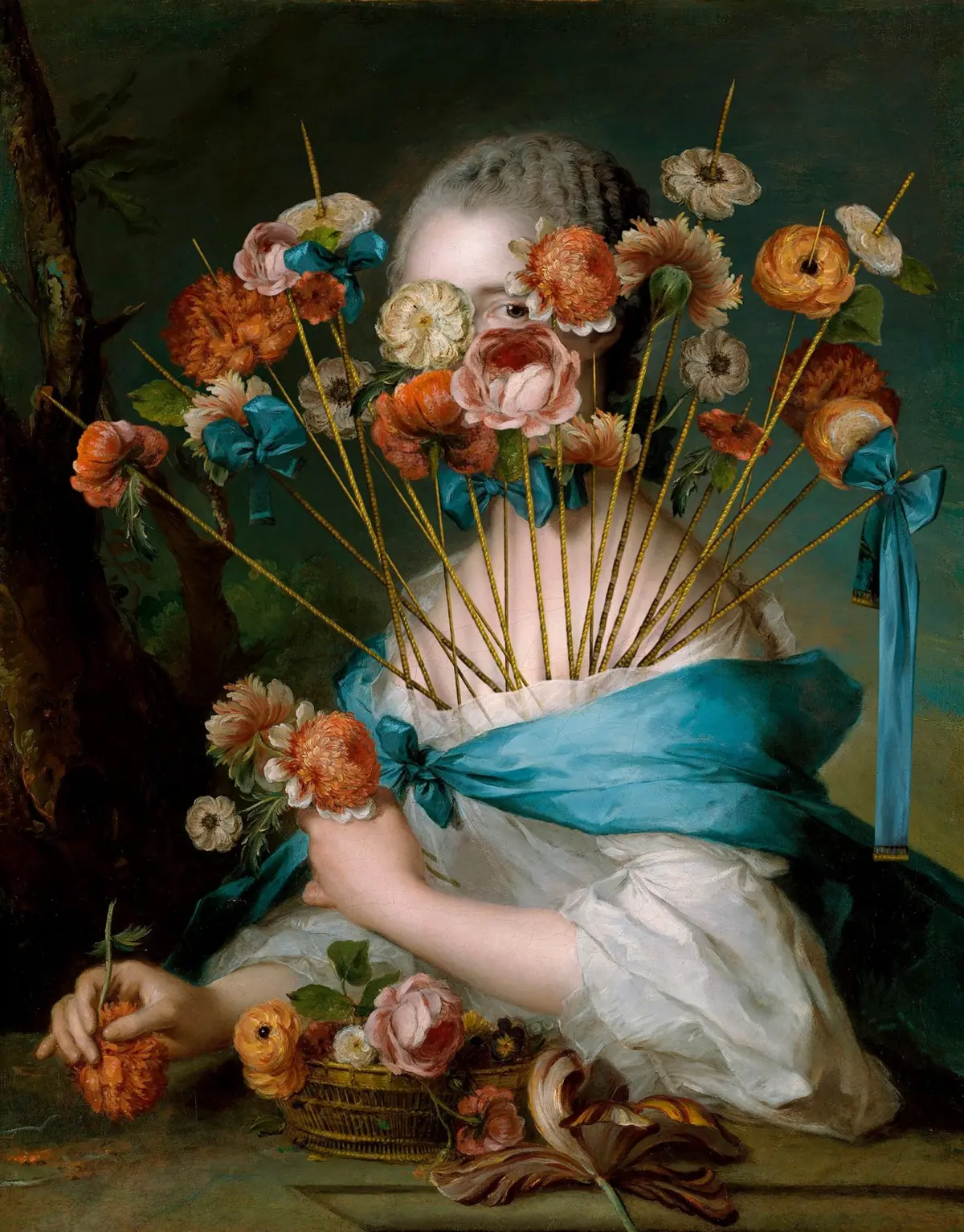
Hidden Nattier VII
The history of female portraiture is nearly impossible to imagine without flowers. Rich in symbolic meaning, floral motifs have long carried a range of associations projected onto women: beauty, grace, freshness, naturalness, and youth—qualities to which women have historically been reduced.
In Hidden Nattier VII, based on Jean-Marc Nattier’s 1753 Portrait of a Woman housed at The Metropolitan Museum of Art, Hermes transforms the young female subject into a literal bouquet. Flowers emerge from her open neckline, yet they are unnervingly impaled on sharp stakes fashioned from her own basket.

This subtle introduction of aggression serves as a reminder that treating physical beauty as the sum total of a woman’s identity is an outdated notion, even if remnants of it persist today. Peering out from behind the botanical arrangement is a single eye. She watches those who watch her, shifting from a passive object of the male gaze to a sovereign observer holding her audience accountable.
Hidden David
In earlier centuries, securing a portrait by a renowned artist was a primary vehicle for securing immortality in the historical record. Madame Récamier certainly understood this when she commissioned Jacques-Louis David to paint her in 1800, a monumental canvas now residing in the Louvre. Fortune added longevity that even the sitter could not have predicted: the daybed upon which she reclines eventually gave its name to furniture design—the récamier—a piece optimized for elegant, decorative posing during an era infatuated with antiquity-inspired white dresses.
In Hidden David, Hermes seeks to draw the eye away from the individual sitter and toward the institutionalized position and status she represents. He transforms her flowing white dress into an oversized hood enveloping her form. Meanwhile, elements of the surrounding interior—the legs of the daybed, decorative cushions, and fragments of a candelabra—are transmuted into elaborate, heavy necklaces adorning her body.

These constructed jewels borrow their striking shapes from the visual iconography of another legendary historical woman: Cleopatra, an enduring figure frequently subjected to theatrical, highly staged artistic portrayals. Through this visual bridge, Hermes’s collage transforms into a deeper meditation on female influence, aesthetic objectification, and the capricious nature of historical memory.
Hidden Hals X
Frans Hals’s original 1634 Portrait of a Man in the Mauritshuis is a remarkably compact painting, functioning more as a tronie—a Dutch golden age character study—than a formal, high-status portrait. Yet despite its modest physical dimensions, the explosive, free-flowing brushwork of Hals generates an astonishing tactile richness.
In Hidden Hals X, Hermes approaches the artwork as an inventory of textures. Cataloging the fabrics available within the original painting—the magnificent lace of the collar, the shimmering black of the garment, and the delicate, weightless cuffs—Hermes isolates each component, transforming them into cascading ribbons that drape dramatically over an enormous hat. The focal point of the image thus shifts away from the individual sitter’s specific psychology and squarely toward the refined craftsmanship of his attire, which functioned in its time as an undeniable marker of pride, wealth, and societal standing.

Hidden Reynolds II
When examining historical portraits of women, confronting society’s obsession with beauty is inescapable. While men have rarely been judged primarily on their physical appearance, beauty has frequently served as the defining—and occasionally singular—criterion by which women were evaluated.
In this striking intervention based on Sir Joshua Reynolds’s 1787 Portrait of Lady Selina Skipwith from The Frick Collection, Hermes was struck by a pervasive sense of physical and emotional restraint. Beyond the sitter’s fashionably pale complexion, which echoes the delicate white tones of her dress, the portrait projects an atmosphere of constrained performance. The subject appears less as a living human being and more as an actress placed upon a theatrical stage, expected to embody the rigid beauty ideals and elitist social conventions of late eighteenth-century society.
To visually articulate this claustrophobic performance, Hermes extends the ribbons of her flamboyant hat, morphing them into the folds of a stage curtain. The fabric partially conceals and constrains her face, yet it simultaneously carves out a protective psychological space—an artistic sanctuary shielding her from being entirely reduced to a cold system of societal expectations.

“Volker Hermes: Hidden Portraits” is on view through October 29, 2026, at 44DeVore, located at 44 East 65th Street in New York, NY.