






By Christopher Stevens, TV Critic
Published: 23:13 BST, 21 October 2026 | Updated: 23:14 BST, 21 October 2026
Apple TV’s hit espionage drama Slow Horses brought its latest season to a thrilling and chaotic close, reminding viewers why it remains one of the sharpest television adaptations on air. In the gripping finale, unit chief Jackson Lamb invoked a phrase guaranteed to send a thrill of recognition through the blood of every classic spy tale aficionado: Moscow Rules.
It is a concept rich with literary and historical resonance. George Smiley, the mild-mannered, brilliant hero of John le Carré’s legendary ‘Circus’ novels, invoked Moscow Rules repeatedly throughout his covert exploits. Developed originally by the Central Intelligence Agency, these directives served as the core principles of genuine espionage tradecraft—the intricate and vital tricks that Cold War agents practiced religiously to avoid breaking cover in hostile territory. Top of the list were foundational commandments such as ‘Assume nothing’ and ‘Never go against your gut.’
Unluckily for Jackson Lamb, brilliantly brought to life by Gary Oldman, none of his ‘joes’—the hapless failures, administrative outcasts, and professional klutzes relegated to his drab Slough House command—would recognize a genuine gut feeling if it arrived accompanied by two Alka-Seltzer and a generous spoonful of bicarb.
Yet, the enduring brilliance and fun of Slow Horses lies in its clever duality. The series gleefully pretends to be an anti-spy story, chronicling the bureaucratic misfits and washed-up operatives of the intelligence service, while simultaneously satisfying all our deepest cravings for a traditional, high-stakes espionage adventure. This climactic episode truly delivered everything an audience could ask for: a delicious double-cross, menacing Russian thugs, a svelte and dangerous supervillainess, and a bloody, frantic shootout at a desolate coastal safe house.
At the same time, the production masterfully subverted all the tired clichés of the genre. Every traditional James Bond fan will undoubtedly enjoy the subtle, brilliant reference to Thunderball during the finale’s coastal sequences. Shirley, played with characteristic grit by Aimee-Ffion Edwards—arguably the grumpiest and least outright incompetent of Lamb’s bruised protégés—discovered a fully loaded harpoon gun resting improbably at the bottom of a rowing boat washed up on a Suffolk beach. The narrative wisely left the viewer pondering the absurd logistics of its placement—what was it doing there? The show answers its own internal logic with a shrug: don’t ask, it doesn’t matter.
True to form, Shirley didn’t even get the satisfaction of firing the weapon. That unexpected honor instead fell to Reece, played by Lenny Rush, an actor standing just under 3ft 3in and serving as arguably the worst Sean Connery lookalike in the history of cinema, adding a layer of absurdist British humor to the high-tension proceedings.
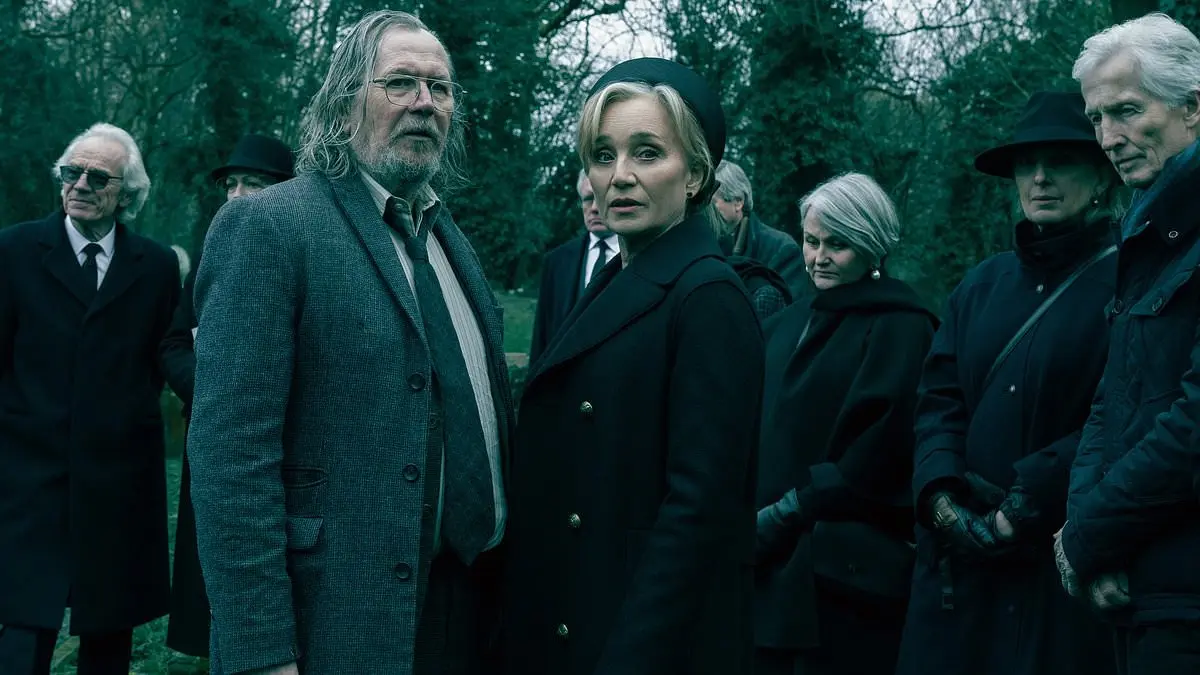
The contrast between the polished sheen of traditional spy franchises and the grimy, underfunded reality of Slough House was further highlighted by the presence of Kristin Scott Thomas. Playing the formidable head of MI5, Diana Taverner, Scott Thomas wouldn’t look remotely out of place stepping into the shoes of M for a big-budget 007 motion picture. However, in the world of Slow Horses, she was forced to hold her nose, almost literally, as she slid uncomfortably into the passenger seat of Jackson Lamb’s vehicle. The car is definitively not a sleek Aston Martin. Underneath decades of rust and neglected maintenance, sharp-eyed viewers might suspect it is a battered 1990s Honda, perfectly encapsulating the unglamorous underbelly of modern British intelligence work.
Inside that humble vehicle, the geopolitical chess pieces were moved with ruthless efficiency. Taverner had been caught double-dealing with the Russian elements, playing a dangerous game of institutional survival. ‘I’d think twice before admitting to treason,’ Lamb advised her with his signature cynical drawl, before landing the ultimate bureaucratic blow: ‘That’s your pension f****d right there.’ Beneath all the layers of professional cynicism, personal untidiness, and caustic wit, Lamb remains fundamentally driven by the heart of an old-fashioned civil servant who understands the immutable rules of the agency.
Every series of Slow Horses follows a finely tuned and reliable dramatic pattern. Lamb continually despairs of his utterly useless agents, who constantly strive for his reluctant approval yet inevitably manage to foul everything up at the worst possible moment. Inevitably, Lamb is obliged, against all of his better instincts and personal preferences, to drag himself out of his chair and save their skins—or at least the skins of the ones who haven’t ended up dead along the way. This season, notably, the body count has been unusually high, raising the emotional stakes for everyone involved.
Despite the profound grottiness of the Slough House headquarters, the fluorescent-lit corridors filled with discarded takeaway containers, and Lamb’s stomach-turning personal habits, the show is frequently elevated by moments of striking, beautiful filmic artistry. In one memorable sequence during the finale, a sweeping aerial shot revealed a collection of tiny blue dots converging steadily on a stark green background, resembling a piece of liquid modern art. They resolved dramatically into a team of heavily armed guards securing an isolated airstrip, demonstrating the production’s commitment to visual storytelling.
A few minor logistical television magic tricks did not go entirely unnoticed, however. Eagle-eyed viewers might be somewhat puzzled by the geography and architecture of the coastal safe house. The windows in the building were thoroughly blown out and shattered during a ferocious gunfight, yet miraculously seemed entirely intact and repaired by the time late MI5 reinforcements finally arrived at the scene. Evidently, local double-glazing salesmen operating in the rural expanses of Suffolk must work at astonishing, unprecedented speeds to accommodate the chaotic schedules of Britain’s secret service.