





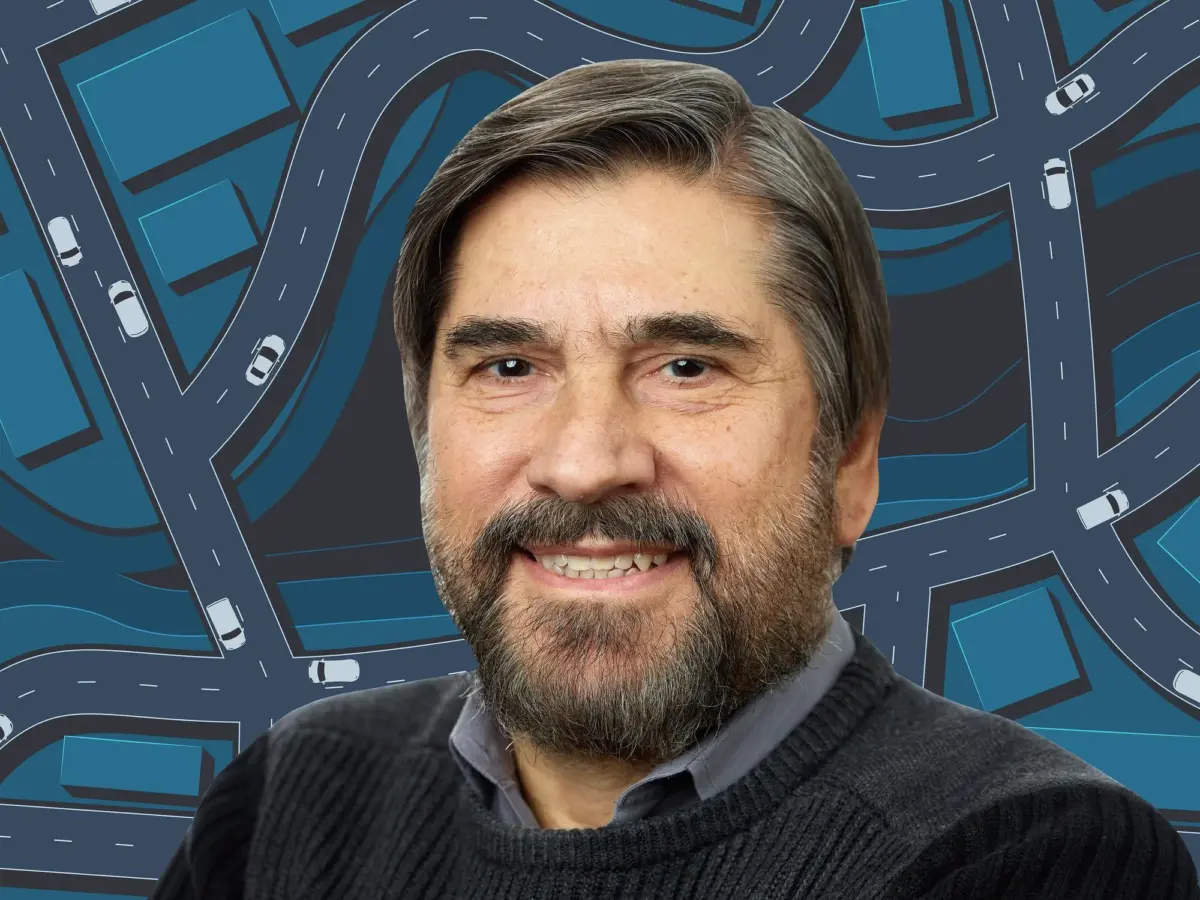
For more than four decades, Christos Cassandras has dedicated his career to studying how computers and machines make decisions. Lately, his work has focused on a frustrating problem that nearly every driver knows intimately: sitting impatiently at a red light with no cross traffic in sight, wondering why it takes so long for the signal to finally turn green.
Cassandras, an IEEE Life Fellow and professor at Boston University, previously headed the institution’s systems engineering division, a graduate program he helped create. His decades of dedication to the intricacies of automation have earned him high recognition. He is the recipient of this year’s IEEE Intelligent Transportation Systems Society Outstanding Research Award for his pioneering work on autonomous vehicles and the control systems that govern them—work that could one day render traditional traffic lights entirely obsolete.
That ambitious vision—proving through rigorous mathematical models and intelligent algorithms that self-driving cars will behave safely before they are ever let loose on public streets—has become the foundation of Cassandras’s career and the reason his name consistently surfaces in high-level conversations about the future of transportation.
In the 1990s, he theorized that a machine such as a modern automobile could be understood simultaneously as two distinct entities: a physical object strictly obeying the laws of physics and a computer processing vast amounts of information to make real-time decisions. This conceptual breakthrough led to what engineers now call cyber-physical systems. Decades later, that foundational framework remains the standard way engineers describe a car’s complex mechanical and digital behavior.
"Ultimately, the key word is safety," Cassandras emphasizes. "You would not buy a self-driving car unless the manufacturer could guarantee that it’s safe for you."
Growing Up in Greece During a Dictatorship
Born in Athens, Cassandras was a teenager during Greece’s military dictatorship, a turbulent period he says left lasting emotional scars on him and many of his peers, but also taught him valuable lessons in resilience. His father worked as a partner in an insulation manufacturing company, while his mother managed the household.
As a young man, Cassandras was naturally drawn toward engineering by a tight-knit group of school friends who spent their free time reading philosophy, history, and science. They were particularly captivated by the 1969 Apollo 11 moon landing and the profound questions it raised about the advanced technology required to make such a feat possible.
That momentous year also marked the first time a piece of data was successfully transmitted from one computer to another—an early, crucial step toward the creation of the modern Internet. Several inspiring teachers during his youth further stoked his insatiable curiosity about technology and mathematics.
His academic potential eventually earned him a prestigious scholarship to study in the United States. He enrolled at Yale University, initially pursuing studies in physics and philosophy before ultimately shifting his focus to engineering. He earned his bachelor’s degree in engineering and applied science in 1977, at a time when Yale did not yet offer separate, specialized degrees in distinct fields like electrical or mechanical engineering.
Following his undergraduate studies, Cassandras moved on to Stanford University, where he completed a master’s degree in electrical engineering in 1978. During his time at Stanford, he developed a deep intellectual interest in game theory, the mathematical study of mathematical modeling and strategic decision-making.
A mentor eventually pointed him toward Harvard University, which was home to a leading game theory researcher at the time. His new mentor, Professor Yu-Chi “Larry” Ho—now an IEEE Life Fellow—advised him to abandon game theory, which Ho considered a scientific dead end at that juncture. Instead, Ho suggested exploring a much newer, less-explored area of research: emerging dynamic systems in modern technology whose behavior could be understood and managed through the occurrence of discrete events.
Cassandras heeded the advice. He earned a second master’s degree from Harvard the following year and completed his Ph.D. in applied mathematics there in 1982. To this day, Cassandras and Ho remain close friends and professional colleagues.
Fiat Assembly Line Births a New Kind of Engineering
If you ask people within intelligent transportation systems circles why Cassandras’s name carries such significant weight, the answer points directly to a theoretical paradigm shift he helped pioneer beginning in the 1980s. Cassandras recognized that human-made systems—ranging from computers and factory machines to modern vehicles—operate on an entirely different kind of logic than the natural world.
The physical world runs on time-driven physics, governed by the exact same mathematical principles Isaac Newton laid out centuries ago. But the machines built by humans, Cassandras realized, are far better understood as event-driven entities. They largely sit entirely still and dormant until a specific trigger occurs, such as a user clicking a button or a manufactured part arriving at a designated spot on a factory conveyor belt.
That vital insight did not emerge from a standard textbook; it took concrete shape during Cassandras’s early graduate studies when he was handed a complex, real-world industrial problem. He was tasked with figuring out how to optimize and manage the buffers—the temporary holding areas for car parts—on a bustling assembly line for the Italian automaker Fiat.
Solving that practical, high-stakes puzzle helped him visualize how event-driven thinking could effectively describe an entire class of systems that classical, physics-based mathematics simply could not handle well. This new approach blossomed into what became widely known as discrete event systems.
By the early 1990s, that initial insight matured into a formal academic and engineering framework known as hybrid systems theory, which evolved into modern cyber-physical systems theory. The core premise is that a machine can be fully understood both as a physical object subject to the laws of motion and as a digital computer bound by event-driven dynamics.
Building "Event-Driven" Systems
After completing his doctoral studies, Cassandras wanted to test his theoretical knowledge outside the traditional confines of academia. He spent roughly a year and a half working as a systems engineer at Information and Technology for Production, a small manufacturing-automation startup based in the Boston area. That hands-on experience convinced him that the professional "real world" was not fundamentally detached from academic inquiry, leading him to return to full-time research while continuing to consult for the company for approximately a decade. Maintaining a close bridge to industry has remained a hallmark of his career ever since.
In 1984, he joined the University of Massachusetts Amherst as a faculty member in the electrical and computer engineering department. Building directly on the insights born out of his earlier Fiat assembly line project, he helped spearhead foundational research into event-driven systems.
This represented a major conceptual departure from traditional mathematics used exclusively to describe the natural world, focusing instead on engineered systems structured around discrete events. This transition, heavily propelled by the rapid proliferation of computers, formed the backbone of Cassandras’s academic research agenda for the next three decades.
In 1997, after years of enduring a grueling weekly commute between Amherst and Boston to manage his ongoing consulting commitments, he accepted a position at Boston University as a tenured full professor in what was then its manufacturing engineering department. As the technological landscape evolved rapidly in the early 2000s alongside the explosion of the Internet and advanced sensor networks, Cassandras played an instrumental role in establishing the university’s systems engineering division. In 2008, he assumed the role of the research program’s very first director, a demanding leadership position he held until stepping down just recently.
In his recent research, Cassandras has turned his academic focus toward mathematically proving vehicle safety prior to any physical road testing. He has developed sophisticated models built squarely around measurable, real-time quantities: a vehicle’s exact position, its current speed, and its precise distance relative to surrounding vehicles. This allows connected and automated vehicles to cooperate seamlessly during tricky, high-risk driving maneuvers, such as navigating a congested highway lane change amid heavy traffic.
He has subsequently extended this methodological approach to a much larger, more transformative idea: completely eliminating traffic lights. One of his most striking and heavily discussed projects involves a chronically congested intersection located just a short distance from his office in Boston, where Commonwealth Avenue intersects with the Boston University Bridge.
Utilizing advanced computer simulations, Cassandras and his dedicated research team modeled precisely what would happen if all physical traffic lights were completely removed, allowing cars to coordinate their movements with one another through vehicle-to-infrastructure and vehicle-to-vehicle communication. The results, he notes, demonstrated remarkable improvements not only in how smoothly traffic would flow through the bottleneck, but also in overall safety and energy efficiency.
Cassandras readily acknowledges that widespread public and infrastructural adoption of such a system is still a long way off. For now, only a minuscule fraction of the vehicles currently navigating public roads possess the advanced communication hardware required for such sophisticated cooperation. However, he is actively testing similar multi-agent coordination systems using fleets of small, ground-based robots inside his Boston University laboratory, working diligently to bring the concept closer to reality and to demonstrate how cooperating autonomous vehicles can drastically improve traffic flow even when they represent only a small minority of the cars on the road.
He also notes that his personal perspective has evolved significantly over recent years. He has shifted away from viewing human drivers merely as unpredictable obstacles to smooth automation toward a philosophy emphasizing the design of technology that genuinely serves and accommodates people.
Through collaborative smart city projects with the City of Boston, he learned firsthand that not every citizen has equal access to or can easily afford cutting-edge technological advancements—a sobering lesson that profoundly reshaped how he approaches his engineering research.
"It’s not just about technology," Cassandras says. "It’s really about technology and people."
A Legacy Passed On Through His Students
Cassandras’s profound influence on the field of intelligent transportation has been significantly amplified through the achievements of his former students. Several of the doctoral candidates he mentored have gone on to develop critical safety algorithms at major companies such as Aptiv and Zoox, both of which develop core technology for autonomous and connected vehicle fleets. Furthermore, Cassandras co-authored a comprehensive book titled Safe Autonomy with Control Barrier Functions: Theory and Applications alongside one of his former students, laying out the rigorous mathematical foundations of autonomous vehicle safety with direct applications to intelligent transportation networks.
His longstanding relationship with the IEEE began when he joined as a student member during his graduate school days, initially drawn in by the practical incentive of discounted student registration fees for academic conferences.
That early, pragmatic decision blossomed into a lifelong professional community with which he has remained actively engaged for more than forty years. He has served as president of the IEEE Control Systems Society, which remains his primary professional home within the organization, has contributed extensively to its conference publications committee, and remains actively involved with IEEE Publishing Ethics.
Looking back on more than four decades of academic and research contributions, Cassandras maintains that the ultimate goal has never been about pursuing technology merely for its own sake.
"After all," he says, "we’re doing all this to make society better and facilitate the comfortable lives of all of humanity."