




While nations such as the United Kingdom and the United States had already established regular television programming years earlier—with the BBC launching its pioneering service as early as 1936—the Netherlands arrived notably later to the television era. This delayed entry was largely driven by a combination of societal caution and national priorities. In the immediate aftermath of the Second World War, the Dutch government, cultural institutions, and society at large were intensely focused on national reconstruction and recovery. Furthermore, widespread moral and cultural concerns regarding television’s potential corrupting influence on traditional social structures and family life meant that authorities approached the new medium with considerable hesitation and strict regulatory oversight.
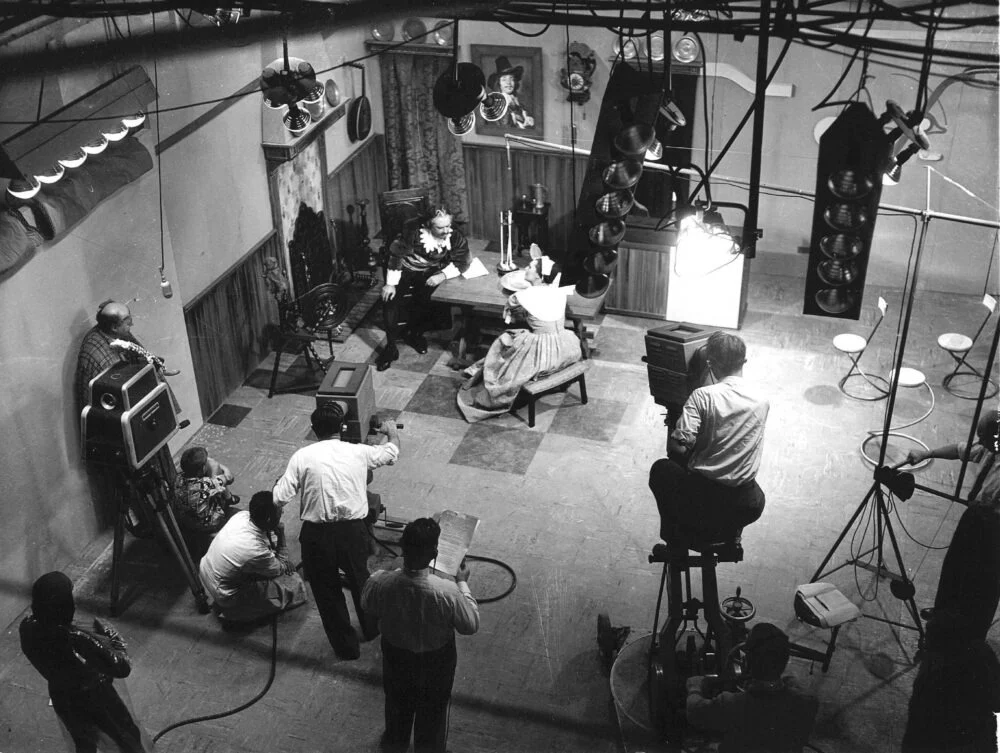
Despite these hesitations, the experimental broadcast from Bussum marked the official birth of Dutch television. Among the select few audience members watching the 90-minute theatrical production was the Dutch Royal Family, who tuned in from the Soestdijk Palace. At the time of this inaugural broadcast, the technological footprint across the country was remarkably small. There were only an estimated 500 television sets in the entire Netherlands. By contrast, radio remained the undisputed king of domestic mass media, with roughly 250,000 wireless devices installed in homes nationwide.
The primary barrier to widespread television adoption was prohibitive cost. A single television set at the dawn of the medium cost 785 guilders. To put that financial figure into perspective, it amounted to roughly one-third of the average annual salary of a working-class or middle-class citizen at the time. This exorbitant price tag immediately categorized the television set as an extreme luxury good, placing it completely out of reach for the vast majority of the Dutch population.
Media historian Huub Wijfjes, reflecting on the milestone in an interview with the public broadcaster NOS, noted that the earliest television programming did not attempt to invent a new visual grammar or unique format. Instead, early broadcasts simply mirrored the established conventions of radio. Producers transferred existing audio formats directly to the screen, relying heavily on talking heads, static camera setups, and theatrical recordings.
"TV took a dominant position and reached its peak in the 60s, 70s, and 80s. The medium displaced radio," Wijfjes told the NOS, describing how television rapidly evolved from an expensive novelty watched by an elite few into the central hearth of modern Dutch domestic life.
As manufacturing scaled up, prices gradually decreased, and disposable incomes rose during the post-war economic boom, public appetite for the new medium surged. The growth trajectory during the 1950s was swift. By 1956, just five years after the initial broadcast of De Toverspiegel, the number of television sets in the country had multiplied exponentially, reaching 75,000 registered devices. This rapid expansion laid the groundwork for the pillarized broadcasting system that would come to define Dutch media culture throughout the latter half of the twentieth century.
For contemporary viewers and history enthusiasts interested in experiencing what those pioneering days of broadcasting looked like, the Netherlands Institute for Sound and Vision has made archival material accessible. Visitors can view selections of the earliest Dutch television broadcasts directly on the institution’s digital heritage platform, offering a fascinating window into the modest beginnings of an industry that would fundamentally transform Dutch society, culture, and daily life over the next seventy-five years.