




Memory is rarely as simple as looking backward. Across history, art, and literature, the act of remembering is frequently treated as a passive archival process—a mental retrieval of dates, faces, and places long left behind. Yet, in the hands of contemporary multidisciplinary artist Wangari Mathenge, memory transforms into something much more active, physical, and urgent. For Mathenge, memory is a deliberate process of gathering, reconstructing, and critically reconsidering what history has left behind in the wake of colonial disruption and national transformation.
This central premise drives Re-membering, the artist’s compelling first solo exhibition with the prominent gallery Lévy Gorvy Dayan in New York City. On view through October 24, 2026, the landmark exhibition introduces five striking new paintings alongside the artist’s very first publicly exhibited sculptures. Together, these works expand upon an expansive and deeply personal series that Mathenge originally began in 2024, pushing her artistic vocabulary into new physical and spatial dimensions while maintaining her signature explorations of identity, diaspora, and collective heritage.
The intellectual framework and title of the project draw profound inspiration from Ngũgĩ wa Thiong’o’s influential 2009 book, Something Torn and New: An African Renaissance. To build the foundation of this body of work, Mathenge immersed herself in rigorous research, studying Kenyan colonial literature and examining cultural objects spanning the crucial historical period from 1900 to 1963. The latter year marks Kenya’s hard-won independence from the United Kingdom, a watershed moment that permanently altered the nation’s political and social landscape. Through her research, Mathenge began a profound inquiry into how history—and her own complex cultural identity—had been constructed, fractured, and passed down through generations.

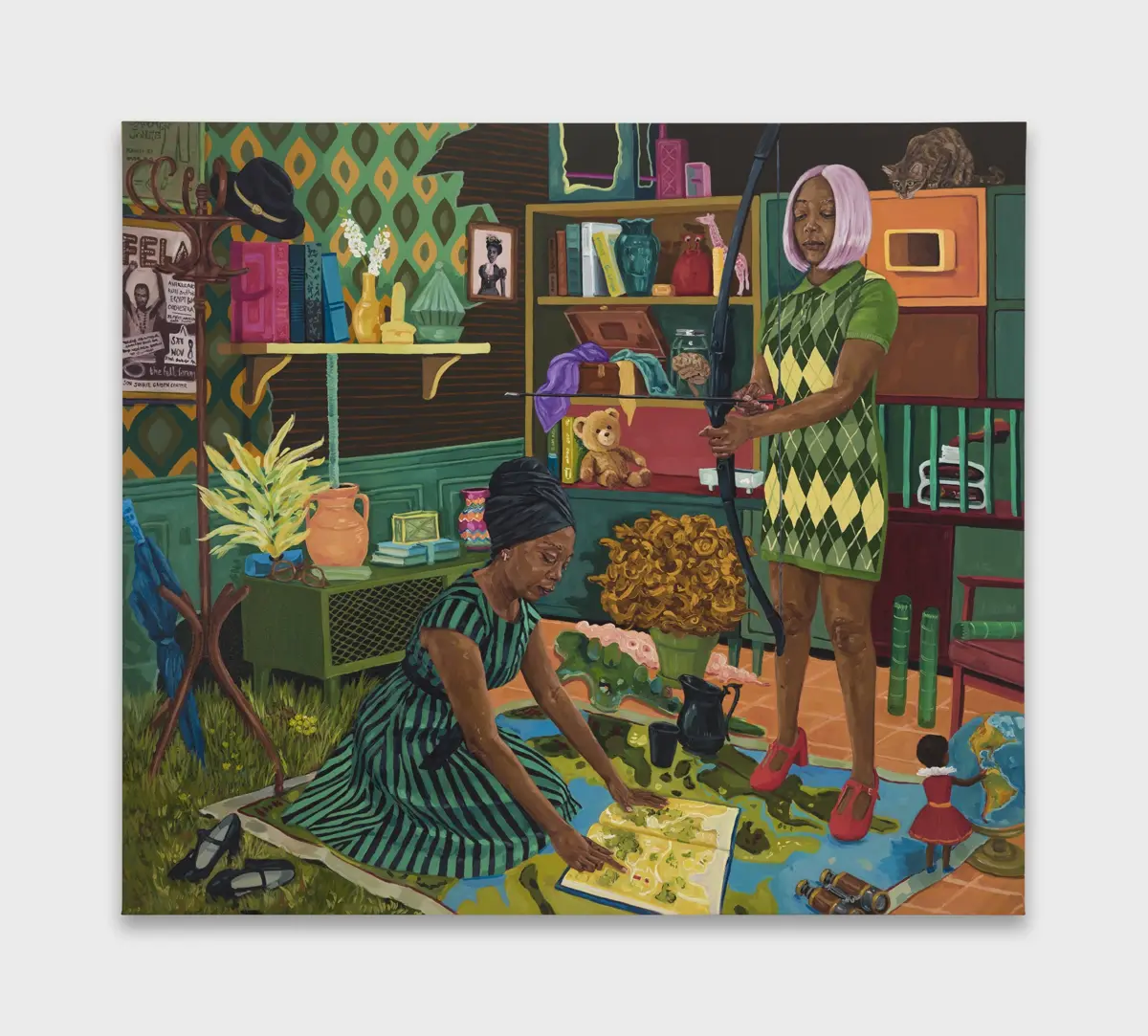
In her latest paintings, Mathenge shifts this rigorous historical investigation from quiet contemplation toward dynamic action. The canvases feature women who serve as direct avatars for the artist herself, occupying richly layered domestic interiors meticulously set during the pivotal decade of the 1960s. These domestic spaces are far from ordinary living rooms; they are dense, psychological landscapes packed with vintage-style furniture, patterned wallpaper, books, toys, and an eclectic assortment of objects that function as personal and cultural markers. Works like Re-membering XIII (May the Wind Be Always at Your Back) and Re-membering XII (The Wednesday Women’s Club) place their figures within these vibrant, textured environments, inviting viewers to consider the quiet, often overlooked domestic spaces where history is internalized, negotiated, and lived daily.
As Mathenge explains, the concept behind the exhibition goes far beyond simple nostalgia or retrospection. “Re-membering signifies not merely the act of recall, but the active gathering and reassembly of what has been fragmented: cultural memory, inherited forms, histories, and ways of seeing,” she notes.

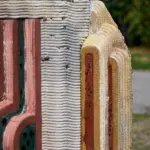
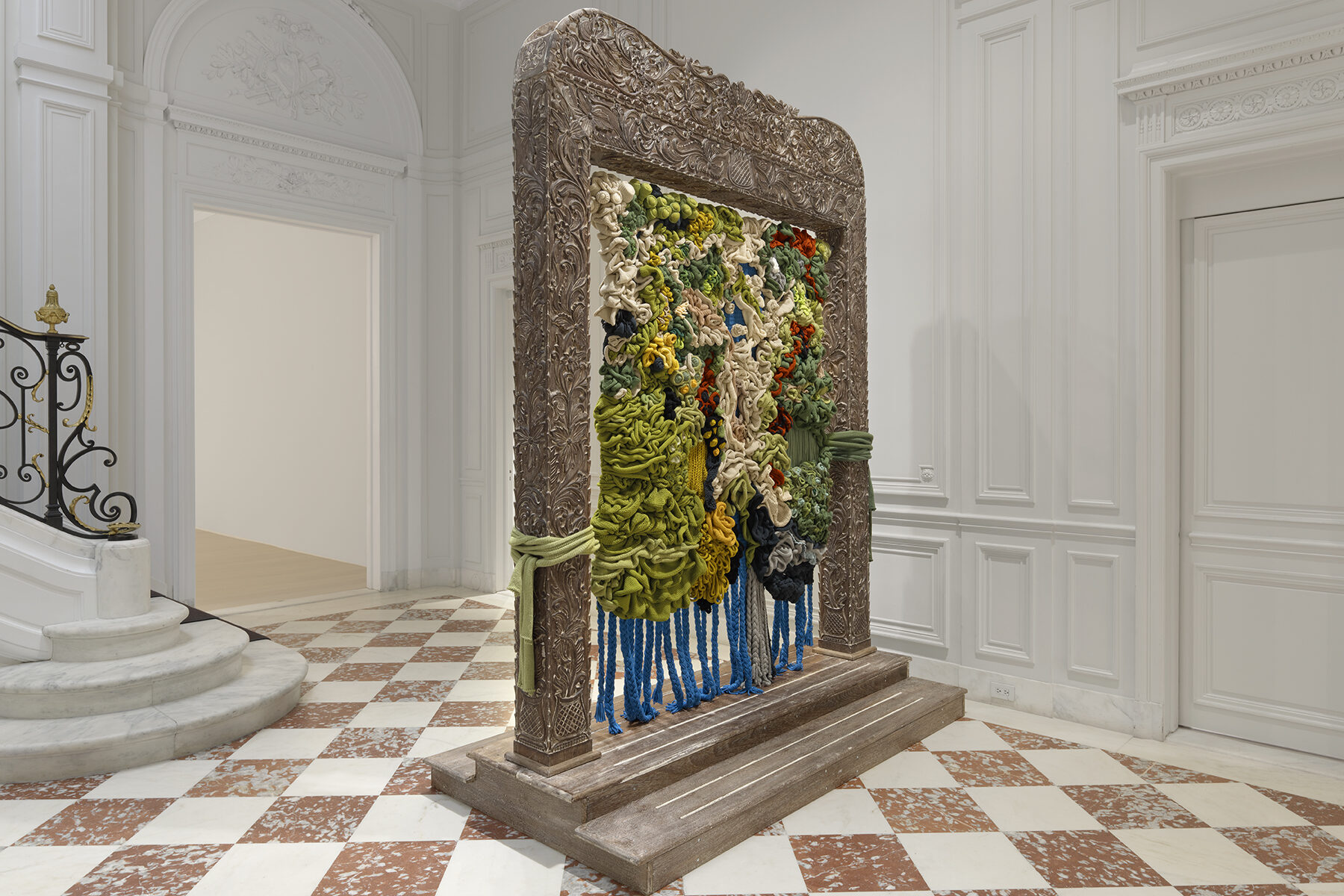
This profound act of reconstruction dramatically breaks free from the flat plane of the canvas, spilling out into the gallery space through two ambitious new sculptural works that mark a major evolution in Mathenge’s career. In Re-membering VIII (Before Us, After Us, Ever Changing), the artist bridges architectural heritage and textile art by pairing a hand-carved wooden doorframe—meticulously crafted by traditional artisans in Malindi, Kenya—with a densely embellished macramé textile created with the collaborative help of Mathenge’s own family and community. The intricately carved doorframe draws clear inspiration from the legendary architectural traditions of Lamu Old Town, while the sprawling, tactile macramé evokes an imagined, continually shifting landscape that refuses to remain static.
Mathenge continues her exploration of materiality and shared labor in Re-membering IX (The Shape of Inheritance), where she turns her keen eye toward the profound significance of clothing and textiles. Displayed prominently on a standard dress form, a voluminous, intricately knitted sculpture reinterprets historical Gikuyu dress while simultaneously incorporating unmistakable colonial sartorial references, such as the dramatic Victorian bustle and train. Much like her previous sculptural experiment, community members played an integral role in the knitting process. By involving others in the creation of the work, Mathenge turns the collaborative process itself into a vital commentary on how cultural forms and traditions can be genuinely inherited, reinterpreted, and carried forward without remaining frozen in time.

Across both her vibrant paintings and her tactile, community-built sculptures, Mathenge consistently treats history less as a rigid monument to be reproduced faithfully and more as a malleable material to work with, question, and transform. In her artistic universe, human bodies function as living landscapes, domestic spaces become active sites of historical reconstruction, and inherited cultural forms are thoughtfully taken apart and assembled anew. Consequently, Re-membering becomes an exhibition as deeply concerned with what can be resiliently carried forward into the future as it is with what has been irrevocably lost to the past.
Wangari Mathenge’s Re-membering is on view through October 24, 2026, at Lévy Gorvy Dayan, located at 19 E. 64th St. in New York City.