





This article is part of a series of stories about hunting, fishing, and foraging experiences across North America. Joseph Ogilvy is the author of Tin Can Coast, published in July 2026.
It is low tide, not long after dawn, and a group of would-be foragers is about to disturb the tide pools of a small Sonoma cove in a hunt for sea urchin. Gathered at The Sea Ranch, a couple of hours north of San Francisco on the rugged and windswept edge of the California coast, the participants stand where fog-pressed hills tumble steeply into the Pacific. The tide pools of Pebble Beach are heavily blanketed in shaggy mats and bundles of kelp. The spots not covered in seaweed reveal themselves as a carnival of alien creatures: sea stars, anemones, crabs, abalone, forming a muddled parade of luminous colors and implausible body shapes.
Nathan Maxwell Cann, a foraging guide with Flora & Fungi Adventures, stands among the rocks. Spectacled, moustachioed, and clad in a well-worn chore jacket and waterproof boots, Cann talks the group through the principles and practice of sea urchin gathering. He tosses out explanations of what the group is looking for with the easy, self-deprecating banter of a former bartender. For a long time, he worked in restaurants in Northern California, but a few years ago he caught the tidal foraging bug and became a self-professed “kelp guy” with a sideline in urchins.
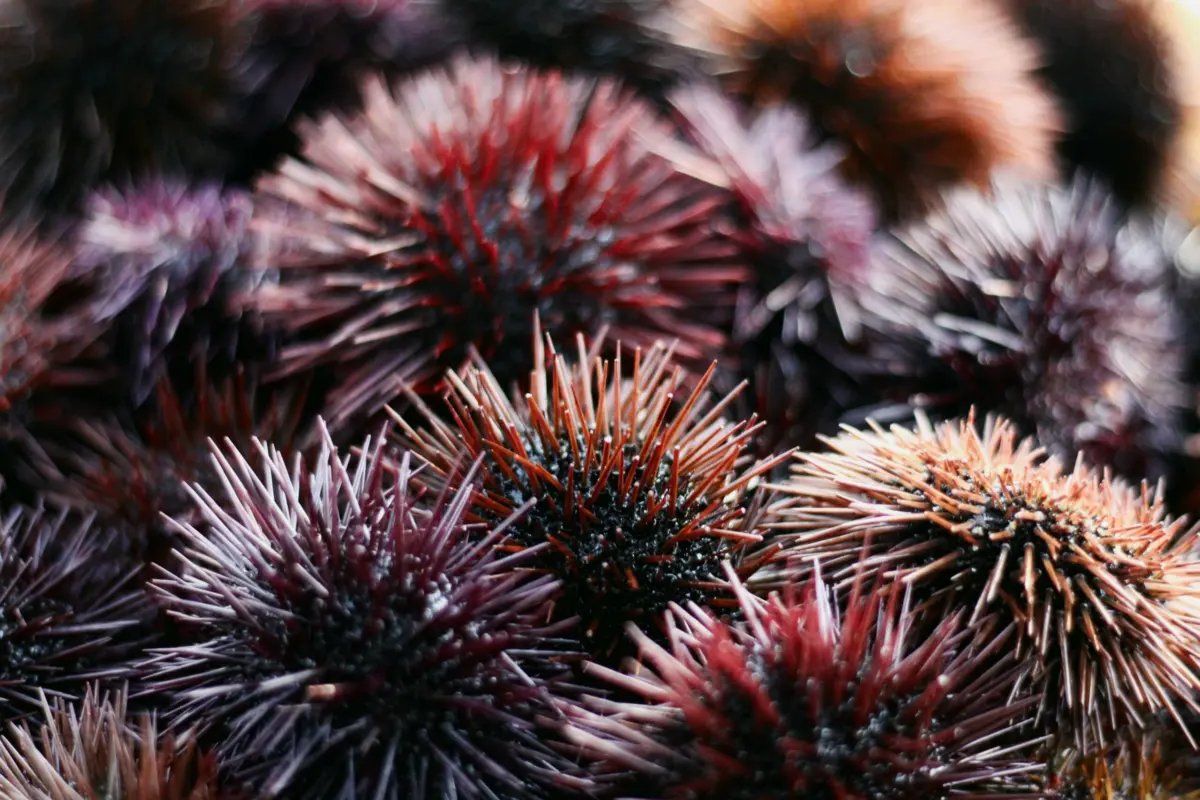
Cann shows the group their prey. Out of the water, sea urchins look remarkably like curled-up hedgehogs, which is the linguistic root of their name in Spanish, Italian, and English, tracing back to an era when the word urchin was commonly used for the hedgehog itself. Their purple spikes project outward from a roughly hemispherical shell, known scientifically as a test. Most specimens found in these pools range somewhere between the size of a golf ball and a fist. Their most prominent and malevolent-looking feature is a mouth armed with five overlapping teeth designed for grinding and shearing kelp.

In the water, their flare of dark spines resembles starbursts against the rock. At first, an observer only notices the largest individuals, but the longer one stares into the pools, the more urchins emerge from the shadows, resolving into potential pickings far exceeding what could ever be harvested by hand.
There are massive numbers of purple sea urchins in this specific cove, and even larger numbers are found throughout the entirety of California’s coast. Whole swathes of the seafloor where vibrant kelp forests once stood are now home to thousands upon thousands of these prickly echinoderms, creating what marine scientists call urchin barrens. Similar barrens have been documented in Alaska, Tasmania, New Zealand, South Africa, and beyond. Through a combination of ecological disruptions, sea urchins have transitioned into one of the few seafood species that exist in startling abundance—or rather, overabundance.
The concept of urchins as a pest was not immediately intuitive to everyone. When author Joseph Ogilvy first encountered them while working as a commis chef in a London restaurant, they were treated as luxurious delicacies reserved for gourmands who had graduated beyond oysters. Preparing them required a great deal of time and physical discomfort, much of it borne by kitchen staff tasked with cleaning the catch. The restaurant served the roe raw in the shell or tossed with spaghettini, while kitchen workers spent their shifts pulling sharp shards of urchin spines out from underneath their fingernails.
In the high-end restaurant business, urchins remained precious commodities. It was only years later, while researching and writing a book about the history of California and its ocean, that Ogilvy witnessed the other side of their nature. The historical narrative followed the delicate balance between human activity and marine life, detailing how fishing and the sea shaped the state, and how California’s history shaped them in return. For most of that history, the urchin played a minor character compared to majestic sea otters or massive schools of sardines. In recent years, however, the unassuming urchin has moved directly to center stage. While it is scientifically inaccurate to ascribe villainy to a brainless shellfish, within the complex drama of the intertidal zone, the label feels entirely appropriate.

To put it bluntly, California’s sea urchins are out of control. They are blindly mowing down kelp forests, leaving barren rockscapes in their wake. Those kelp forests historically functioned as marvels of marine diversity, providing vital shelter for a vast array of ocean creatures ranging from jeweled top sea snails to barrel-bodied harbor seals. The core of the problem lies in the urchins’ insatiable appetite for seaweed. Left unchecked, they graze through the tough stipes of the kelp until the plants detach and float away into the deep ocean, destroying the foundation of the ecosystem.
For the vast majority of California’s history, natural predators kept urchin populations heavily suppressed. Few marine animals can bypass the formidable wall of spines and hard shell, but sea stars and sea otters historically made a significant difference. Sea stars feed by everting their stomachs to envelop urchins, dissolving the edible tissues in digestive juices before ejecting the empty shells. Sea otters rely on brute force, using rocks to bash and bite their way through the defenses.
The environmental crisis in Sonoma and the coastline north of it stems partly from the fact that it has been more than 150 years since a wild otter smashed open an urchin in these waters. In the early 19th century, California’s sea otters were hunted nearly to the point of extinction, driven by the unparalleled softness and commercial value of their pelts, which drew fur trappers all the way from Russia down the Pacific coast. Two centuries later, the modern range of sea otters remains restricted to a couple hundred miles of the Central California coast.
For a time, sea stars stepped in to help control the surging urchin population. In recent years, however, those populations have been devastated by an uncontrollable plague worsened by warming ocean waters, an affliction known scientifically as sea star wasting disease. Afflicted stars grow lethargic and limp, developing visible lesions across their bodies as their arms disintegrate and fall off. This massive population collapse effectively removed the last major check on the urchin population, allowing them to graze and multiply at will.

From an ecological perspective, the primary job of a small group of morning foragers is to temporarily step into the ecological role of the sea otters. Once the principles of urchin harvesting are internalized, the participants ditch their shoes and clamber around the rocky intertidal zone. The group shakes off early morning sleepiness while scattering over the rocks, bending over to peer closely into the tide pools. Gathering urchins evokes a psychological state similar to mushroom picking, birdwatching, or an Easter egg hunt. Participants quickly enter a focused flow state punctuated by small jolts of childish joy upon spotting their quarry.
Compared to other forms of foraging, gathering urchins is remarkably straightforward. None of the participants, mostly ocean-curious thirty-something Californians visiting from the Bay Area and beyond, have prior experience with urchin foraging, yet their coolers and bags quickly begin to brim. Their motivations are split evenly: half are most excited by the prospect of eating the catch, while the other half are driven by the immersive experience of hunting in the wild.
Once an observer’s eye adjusts to the specific color and shape, the urchins appear to be everywhere. Extracting them from their rocky niches requires little more than a gentle clasp and a wiggle using a pair of tongs. The true skill in urchin foraging lies in maintaining balance; the kelp-slicked rocks are exceptionally slippery underfoot, ocean waves constantly tug at human ankles, and the bizarre, bustling life of the tide pools makes distraction easy.
As net bags begin to bulge with spines, participants find themselves deeply absorbed in what author John Steinbeck famously described as the "hurrying, fighting, feeding, breeding animals of the tide pools." The scuttling of a hermit crab fleeing from a shadow, the respiration holes of an algae-camouflaged abalone peeking from a crevice, and the waft and flicker of an anemone’s tentacles command full attention. The shared experience offers a socially acceptable excuse to engage in aimless exploration—a rarity in modern society. As guide Nathan Maxwell Cann notes, urchin gathering is ultimately "a reason for being out in the tide pools," using a simple task to encourage deeper observation.

Beyond the ecological symbolism, the urchins offer a striking culinary reward. Back on dry ground, participants use stout kitchen shears to crunch a rough circle out of the top of each urchin, scooping out and discarding the briny viscera, rinsing the interior in a bucket of seawater, and using a clean mussel shell to scoop out the five golden tongues of roe arranged in a distinct star shape.
The roe is exceptionally rich and buttery, starting off savory and briny before mellowing into a sweet, complex finish. It is a bracing flavor profile for early morning, tasting intensely of the surrounding marine environment. Cann explains that the deep umami savor comes directly from the kelp the urchins consume. At The Sea Ranch Lodge, located just down the coast from the expedition site, head chef Ryan Seal utilizes local sea urchins to create an inventive urchin zabaglione as the base for a carbonara, introducing hesitant diners to the delicacy while highlighting authentic local flavors.
Even after opening numerous specimens and consuming the meat on the shore, the group’s net bags remain overflowing. Yet, this localized harvesting has barely made a numerical dent in the cove’s vast urchin population. As substitute otters, a handful of human foragers fall significantly short; a single wild sea otter can consume dozens of urchins in a single day.
While uni foraging workshops are becoming increasingly popular across Northern California alongside independent beachcombing, the urchins continue to dominate the coastline. From a macro-environmental perspective, human foraging efforts amount to little more than a drop in the bucket, a reality that guides like Cann openly acknowledge. Restoring the depleted kelp forests will ultimately require much more forceful, large-scale intervention. The Giant Kelp Restoration Project in Monterey utilizes an enormous submarine vacuum system to suck urchins from barren areas. In Northern California, scuba divers systematically crush them with hammers. Entrepreneurs along the West Coast have launched commercial ranching operations, gathering underweight urchins from barrens and fattening them up on sustainably harvested kelp before marketing them to restaurants. Other regional ventures, such as Mendocino-based Marblis, are even compacting discarded urchin shells into a composite material marketed as a sustainable substitute for marble countertops.

A morning workshop involving tongs and kitchen shears stands in stark contrast as a largely symbolic gesture. By mid-morning, the participants head home carrying fond memories and enough seafood for a few meals, while the remaining urchins continue grazing through the kelp forests of The Sea Ranch.
Before parting ways, Cann and Ogilvy reflect in the parking lot on the true purpose of such foraging expeditions given their minimal impact on overall kelp preservation. The experience functions primarily as a form of education and consciousness-raising. There is no substitute for feeling kelp between one’s toes or swallowing urchin roe minutes after harvest to make the stakes of ocean conservation feel immediate and personal. Such activities cultivate curiosity and shared stewardship, with participants leaving the parking lot eager to share their newfound knowledge and meals with others.
John Steinbeck once advised his readers to look "from the tide pool to the stars and back to the tide pool again." That sentiment captures the essence of tidal foraging. Focusing on a single small creature opens an observer up to its myriad connections within a broader ecosystem, offering a visceral reminder of humanity’s relationship with the natural world.