






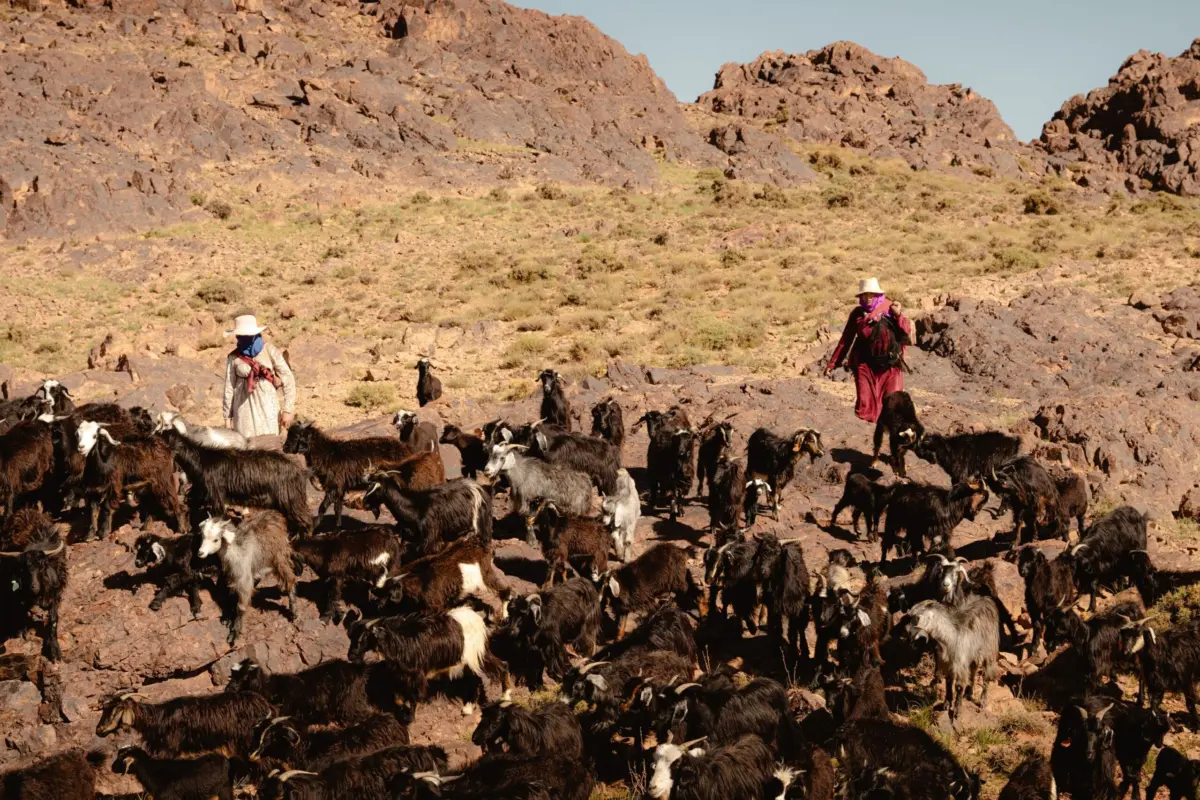
A persistent chorus of shrill bleats and guttural baas echoes across the canyons and basalt towers of Jebel Saghro, breaking the silence of the rugged southeast Moroccan landscape. Against the glare of the midday sun, high on a rocky peak, the vibrant red djellaba of Telhou Belâwane stands out. Telhou is the matriarch of the Berber family at the center of an ancient migration, and her position confirms that the livestock is near. Scanning the crags, steep scree, and stony folds of the volcanic mountains, the onyx coats of the goats are, to an untrained eye, frustratingly indistinguishable from the surrounding terrain. Yet for the families who have walked these paths for centuries, every shadow and silhouette tells a story.

Jebel Saghro serves as the ancestral homeland of Telhou’s people, the Aït Atta, a historically powerful Berber—or Amazigh, meaning "free people"—tribe in southeast Morocco. The region unfurls dramatically from the jagged High Atlas Mountains to the unforgiving edge of the Sahara. Twice each year, it provides the backdrop for one of the oldest continuing migrations in Africa. For millennia, the Aït Atta and other Berber families have moved their herds upwards of 180 miles, navigating the vertical drop between the high summer grazing grounds of the High Atlas and the winter pastures of Jebel Saghro. This seasonal pastoral journey, known as transhumance, defines a semi-nomadic way of life that is now rapidly disappearing under the pressures of modern environmental and social changes.
It is late September, and Telhou, alongside her husband, Hmad, and daughter, Saâdia, is already 10 days into their grueling trek when a support team from the luxury travel operator Black Tomato joins them. Hiking alongside a nomadic family and their herd forms one of five immersive experiences comprising "The Keepers," a collection of global itineraries designed by Black Tomato. Each trip in the series is built around custodians of ancient knowledge whose traditional practices continue to be passed down through generations, ranging from a 28th-generation Daoist master in Chengdu, China, to a mariscador on Chiloé Island in Chile who has spent a lifetime reading the unpredictable rhythms of the ocean’s tides.

As a pioneer of off-the-grid luxury travel, Black Tomato has developed an acute instinct for discerning what high-end travelers will crave next. With the launch of The Keepers, Black Tomato co-founder Tom Marchant predicts that in a contemporary world where nearly any fact can be looked up or generated by artificial intelligence in seconds, authentic human knowledge and direct connection represent the ultimate luxuries. More than ever, modern travelers want to step into the role of students rather than remaining passive spectators.
Before the arrival of outside support, the Belâwane family’s caravan consisted of 200 goats, two working dogs to help manage the herd, two chickens for fresh eggs, and three donkeys carrying tea kettles, water jugs, blankets, food, and essential camp supplies. To accommodate the incoming travelers, Black Tomato integrated five mules and a dozen additional personnel into the fold. This expanded team included two drivers, four logistics workers responsible for pitching a canvas glamping tent complete with a bed and a flush toilet, a chef, and five mule handlers whose animals carried all the extra provisions, luggage, and comforts required for the stay.

Several members of this support crew are cousins of the Belâwane family. Many, including head mule handler Zaïd Oukhazaid, have reluctantly abandoned their traditional nomadic ways for permanent village life due to a combination of socioeconomic pressures and climate change. On the day of arrival, Zaïd and another mule handler meet travelers roadside in Tagdilt, a village perched at the edge of the Dadès Valley. Both men wear coarse, sheep’s wool djellabas over modern trekking pants and plaid shirts, with turban-like scarves known as shesh piled high on their heads. Zaïd flashes a wide smile that exposes the gap left by four missing front teeth. Despite his diminutive stature, he possesses an outsized personality and a deep, unyielding pride in his Aït Atta heritage.
Extending a sinewy arm after a firm double handshake, Zaïd pulls visitors into a hearty bear hug, exclaiming "welcome, welcome"—one of the few English phrases he has mastered through years of working with international visitors. With rudimentary skills in Arabic, French, and Berber among travelers, a local translator named Noureddine, or Nouri, Bachar steps in to facilitate conversations. Over the following days, however, it becomes apparent just how much can be effectively communicated through simple phrases like "thank you very much" and "very very good," accompanied by shared laughter and smiles.

With rain looming on the horizon, the family started earlier than usual with the herd and planned to rendezvous at the evening camp. Nouri explains that the nomads dictate the daily rhythm of the expedition. Once the pack mules are loaded, Zaïd beckons the group forward into the Martian landscape ahead. The expanse immediately clarifies why Saghro translates to the "Land of Thirst" in the Berber tongue, revealing an endless horizon of flat-topped mesas, dry riverbeds, and weathered umber cliffs. Sensing any lingering traveler uncertainty, Zaïd offers a reassuring perspective, remarking that while he would be entirely lost if dropped into a city, he could find his way effortlessly anywhere within these mountains.
The initial two-hour hike serves as a modest warm-up for the rigorous days ahead, which regularly involve trekking for five hours or more. The group reaches the Tircht pass, sitting at an elevation of 6,100 feet, just as the support crew finishes establishing the encampment. Each Aït Atta family holds traditional rights to specific migration routes and designated campsites, known as azib, where they have constructed stone shelters to protect their herds overnight. Zaïd fetches water from a local well and tends a fire to heat a kettle for traditional Moroccan tea. When he reaches for a massive chunk of sugar to drop into the pot, a quick joke about preserving dental health prompts a booming belly laugh, resulting in an unsweetened pour.

As night falls, the family and the support team gather inside a traditional goat-hair tent for formal introductions and a communal candlelight meal. The atmosphere evokes a family reunion, with the men exchanging news and gossip while Telhou and her 17-year-old daughter, Saâdia, sit quietly nearby. Traditionally, the male head of the household leads the caravan and pitches camp each evening, while the wife and children bear the arduous physical responsibility of driving the goats forward alongside their domestic chores. The arrival of external support grants the women a brief respite from cooking duties. The camp chef ladles out bowls of harira, a thick, savory tomato soup spiced with beans, herbs, and aromatics. Following Zaïd’s lead, lifting the bowl directly to take a long slurp earns an approving nod and the label, "the nomad way."
The traditional nomadic lifestyle, however, has grown increasingly precarious. Rising global temperatures and severe, prolonged droughts have drastically shrunk available pastures. Furthermore, since 2019, Moroccan law has mandated that children between the ages of six and 16 attend school, drastically reducing the availability of young hands to tend the livestock. Four of Telhou’s six children are currently enrolled in school, one daughter is married, and Saâdia’s future marriage will soon draw her away as well. Once younger generations experience modern conveniences such as electricity and running water, returning to the profound hardships of living entirely off the land becomes exceedingly difficult. Hmad shares through Nouri that only six families within his sub-tribe, the Ait Slilou, made the arduous trek to Jebel Saghro this year, a stark decline from the 80 families that historically made the journey. This narrative mirrors shifts occurring globally, from the sheep herders of the Swiss Alps to ranching families in the American West, where ways of life tied inextricably to family and land are slowly fading.

Each morning begins well before sunrise, roused by the braying of donkeys acting as the camp alarm. While coffee is served alongside baghrir—spongy, crepe-like pancakes topped with amlou, a Moroccan almond butter spread—the crew swiftly packs up camp, leaving behind no trace other than the stone walls of the goat pen. By 7:30 a.m., Nouri and the travelers set off alongside the family. Hmad guides the pack donkeys along dusty trails lined with almond and date trees, while Telhou and Saâdia manage the much rougher task of navigating the herd off-trail. Saâdia routinely scrambles up nearly vertical cliffs of loose scree wearing a shimmery, gold-striped dress and plastic loafers, moving with the same effortless agility as the mountain goats.
A single day’s trek can cover 7.5 miles, climbing up and over mountain passes like Tizi n’ Tircht at 8,200 feet, which offers sweeping vistas looking back toward the High Atlas and down toward remote valley campsites. Aside from a single passing nomadic family traveling with a caravan of camels, the route remains entirely isolated. Arriving at camp by early afternoon, travelers are greeted by a lunch of kefta and fresh Moroccan salads before shedding hiking boots to rest aching feet. Meanwhile, the women continue moving at the deliberate rhythm of the herd, grazing the animals hourly before finally descending into camp late in the afternoon.

As the days progress, deeper bonds form within the camp. Evening meals often feature traditional dishes prepared from a freshly slaughtered goat shared in a communal setting, where dinner conversation frequently spans everything from local daily life to historic national developments, such as political appointments. The daily routine fosters an intimate familiarity with the landscape and the animals, down to recognizing individual goats by their distinct horns or markings.
Ultimately, the journey offers a rare window into a resilient culture maintaining an ancient balance with a demanding environment. While modern stresses of finding water, securing firewood, and protecting livestock from predators remain ever-present realities for the Aït Atta, the shared miles and communal meals forge lasting connections. As the migration concludes at the family’s winter settlement, expressions of gratitude highlight a mutual respect between the traditional herders and those who walked alongside them, offering a fleeting glimpse into a heritage fighting to endure.