



Thirty years into a distinctive and uncompromising career, Aitor Throup says he is finally ready to be a commercially successful fashion designer. Given this monumental revelation, “Ultra Veil,” a major new exhibition of his work opening this week at Ambika P3—a former concrete testing facility that now serves as an experimental exhibition space at the University of Westminster in London—can be read as a definitive statement of intent. For a creative force long celebrated as an industry secret, this moment marks a profound turning point.

To understand the significance of this exhibition, one must first ask: Who is Aitor Throup, and why should the broader fashion world care? He is an Argentinian-British designer who commands a fiercely loyal, cult-like status within the streetwear and avant-garde communities. Throup was famously scouted by C.P. Company on the very day he graduated from the prestigious Royal College of Art in 1996. His unforgettable graduation collection, titled “When Football Hooligans Become Hindu Gods,” instantly established his reputation as a visionary disruptor.
That groundbreaking collection served as a deeply personal exploration of his own experiences with racism as an immigrant in England, juxtaposed with his simultaneous attraction to and repulsion for the aggressive dandy style of the country’s sports agitators and subcultural youth. At C.P. Company, Throup would later go on to design iconic garments and kits that would be famously peacocked at football stadiums across Europe, cementing his influence on contemporary technical apparel.

Over the subsequent decades, Throup’s career has been defined by a series of high-concept projects and unexpected collaborations. Recent endeavors have included a creative hookup with Umbro—with whom he famously created the conceptual uniforms for the British national team in 2009—as well as partnerships with Maharishi and Stone Island. Looking ahead to 2027, Throup is slated to launch a major collaboration with Fred Perry, a brand that is generously supporting the “Ultra Veil” exhibition alongside the Westminster Menswear Archive, a renowned academic treasure trove housing more than 2,000 historic and contemporary garments available for rigorous study.
Despite his deep influence on generations of designers, Throup is frequently described as an “insider’s designer,” operating largely behind the scenes rather than chasing mainstream commercial visibility. Fellow designers hold him in absolute reverence. Renowned designer Rick Owens has praised his unique approach, noting, “Aitor is an architect and world builder who thinks outside the box, which is something I am always on the lookout for. I’m a construction geek who appreciates another construction geek.”

It is entirely true that Throup operates on the intellectual and experimental fringes of the fashion industry, far away from traditional seasonal cycles and forward-facing marketing strategies. He did not grow up harboring conventional ambitions of becoming a mainstream clothing designer. Instead, he discovered that design offered a powerful bridge to other worlds, transporting him far beyond day-to-day reality. Since childhood, Throup’s primary vehicle for self-expression has been drawing; through clothing, he realized he could bring the dynamic figures and narratives of his illustrations to life in three-dimensional space.
Reflecting on his early fascination with technical apparel during a recent interview, Throup recalled his introduction to legendary outerwear: “When I saw the first goggle jacket, it wasn’t about the person in the jacket. It was the fact that I could become that character. It was an extension. I could finally become Batman in many ways.”

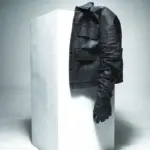
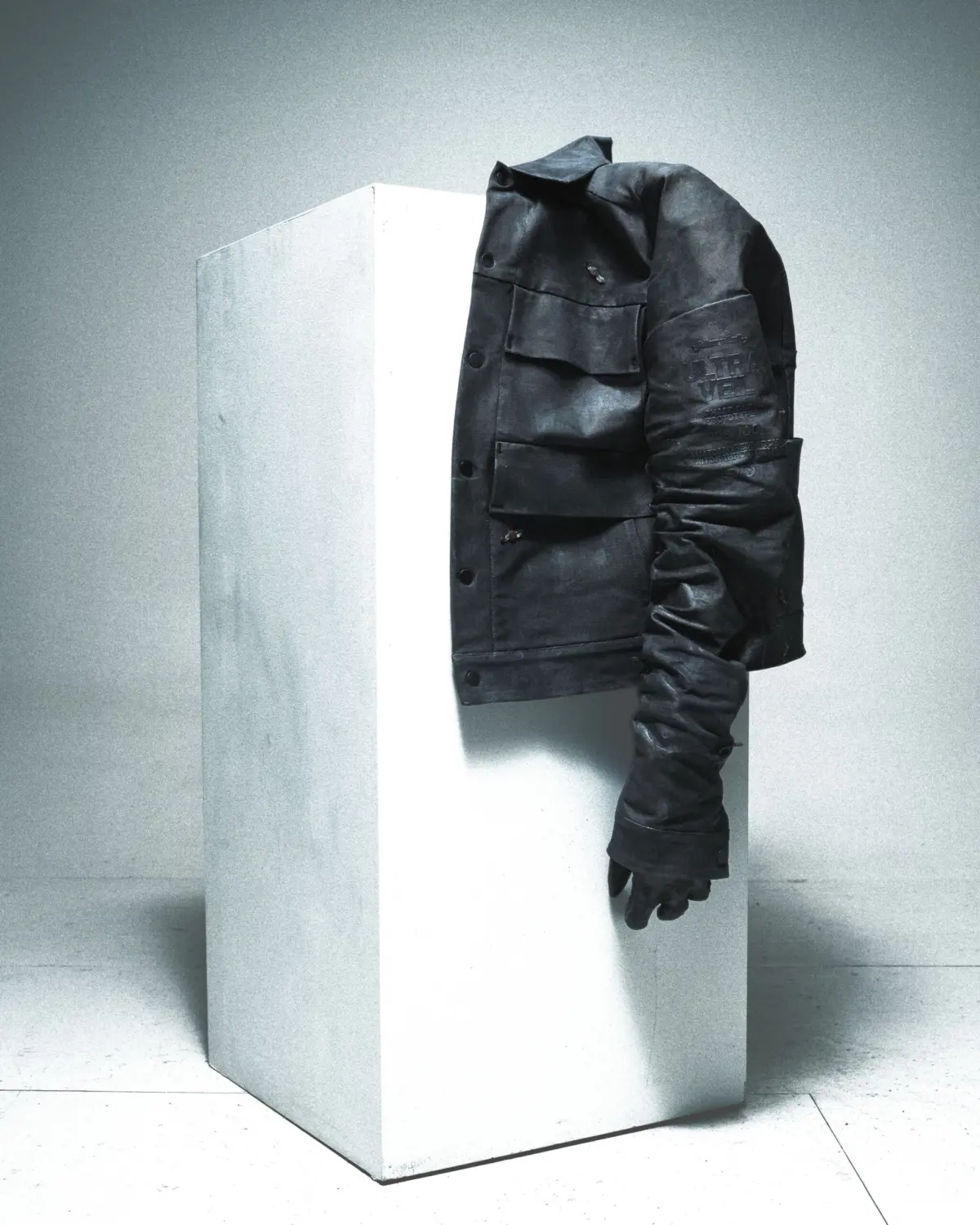
There is a distinct uniform, utilitarian, and near-military aesthetic running through many of the experimental designs featured in “Ultra Veil.” This atmospheric weightiness is entirely intentional, which makes the choice of materials all the more dramatic. The garments are constructed primarily from women’s lingerie mesh, creating an intentional tension between structural rigidity and delicate fragility. Throup explained that he “vandalized” his own pristine designs by painting directly in three dimensions—working straight onto the human body—with a specialized liquid glitter rubber finish that took him weeks of trial and error to formulate.
When asked to highlight key elements of his distinct design language, Throup points to several signature features: masks and veils seamlessly integrated into hoods and hats, giving the objects an expressive “face”; fully integrated gloves; and trousers engineered with transforming foot covers. Through this meticulous tailoring, his trousers achieve the immediate, lifelike appearance of actual legs even when removed from the body.

What Throup shares with many other visionary artists is a restless desire to achieve harmony between opposing forces. However, in his case, this ambition extends far beyond superficial aesthetics into a left-brain and right-brain synthesis that unites raw intuition with a rigorous, academic study of human anatomy. In Throup’s immersive world, ethereal lightness is consistently balanced by a darker, more haunting energy—a mood heightened by the inclusion of roughly 100 meticulously crafted skull sculptures. The conceptual framework of the exhibition treats approximately 70 prototype garments not merely as clothing, but as standalone artworks intended to be acquired by collectors and institutions alike.
“For the last 20 years, essentially what I’ve been trying to figure out is, How does one breathe life into an inanimate object?” Throup reflected. He firmly rejects the conventional commercial notion that a garment is only truly completed when worn by a human body. Instead, he maintains that a garment can be perfected as an autonomous object, and that all thoughtfully crafted objects possess an inherent soul, or anima. “I would say that everything I create is anthropomorphic in the deepest sense,” he added. “My work aims to capture the essence of humanity objectified into inanimate objects. Be it garments, sculptures, drawings—the aim is to capture the essence of life and, in particular, human life.”

For nearly three decades, Throup has sustained his uncompromising artistic practice primarily through high-level creative consultancies across the worlds of music, fashion, and industrial design. This pragmatic arrangement allowed commercial pressures to take a distant backseat to his deeply intellectual and theoretical pursuits. Rather than viewing fashion through a purely consumerist lens, Throup proposes a philosophy of fashion as a form of public service.
“I instinctively felt I had something important and I felt a sense of service, like my work had a purpose,” he reflected on his career trajectory. “I know this sounds big, but [I thought] my work would be in service to humanity in some way.”

If one were to assign a natural element to Throup, it would undoubtedly be air, despite the profound physical and philosophical weightiness of his creations. His monumental installations, much like his intricate anatomical drawings, capture rare moments of suspended animation. That temporary, floating state of existence is an in-between realm where Throup’s creative process thrives.
“The etymology of the word ‘inspiration’ is pivotal in the point I’m trying to make,” he explained. “‘Inspire’ means in spirit; your breath, being your spirit, comes into your body. So when we are inspired, we are in our spirit. When we’ve expired, we’re out of our spirit. So to create something that’s inspiring and to be inspired is foundational.”

With his rigorous theoretical homework now complete and the exciting prospect of his own upcoming main line, Aitor Ultra, visible on the horizon, Throup finally appears ready to bring his visionary ideas down to earth. While the fashion world waits for that next major milestone to unfold, audiences and critics alike find themselves caught in a suspended state of anticipation.
“Ultra Veil” will be open to the public from October 30 to November 8 at Ambika P3 in London.