






There were a number of surprising and sometimes divisive releases from Patek Philippe this year, but when you look at them as a whole, you can attempt to read the tea leaves to see the future of the Maison. We start with the most technical.
We are on the eve of one of Patek Philippe’s biggest events every few years: the presentation of the brand’s Watch Art Grand Exhibition in Milan, running from October 2nd to the 18th. Ahead of previews for the exhibition, there is another story that has been waiting in the wings and in progress for some time now—a hands-on look at two of the most surprising and potentially divisive releases from Patek this year: the Cubitus perpetual calendar and the Celestial ref. 6105G.

While all eyes were naturally drawn to celebrations surrounding the Nautilus’s 50th anniversary, Patek Philippe engineered a fascinating Watches & Wonders from the perspective of bold releases and brand strategy. Truthfully, the brand could have done just about anything with the Nautilus, and those fortunate enough to secure an allocation would have been entirely content. The Celestial alone introduced a wristwatch complication previously created by only four other brands in horological history. But looking closely at recent novelties reveals a broader trajectory.
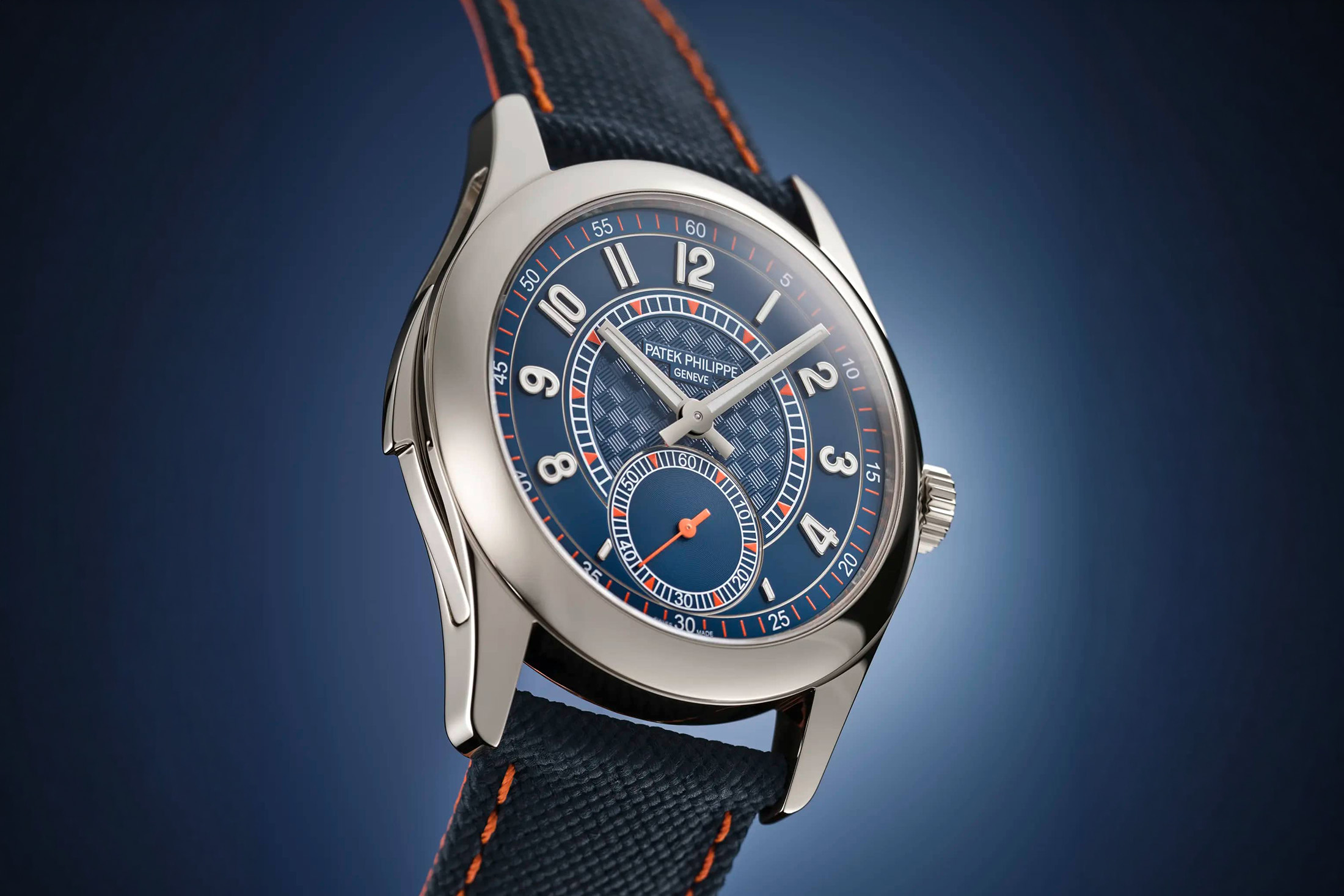
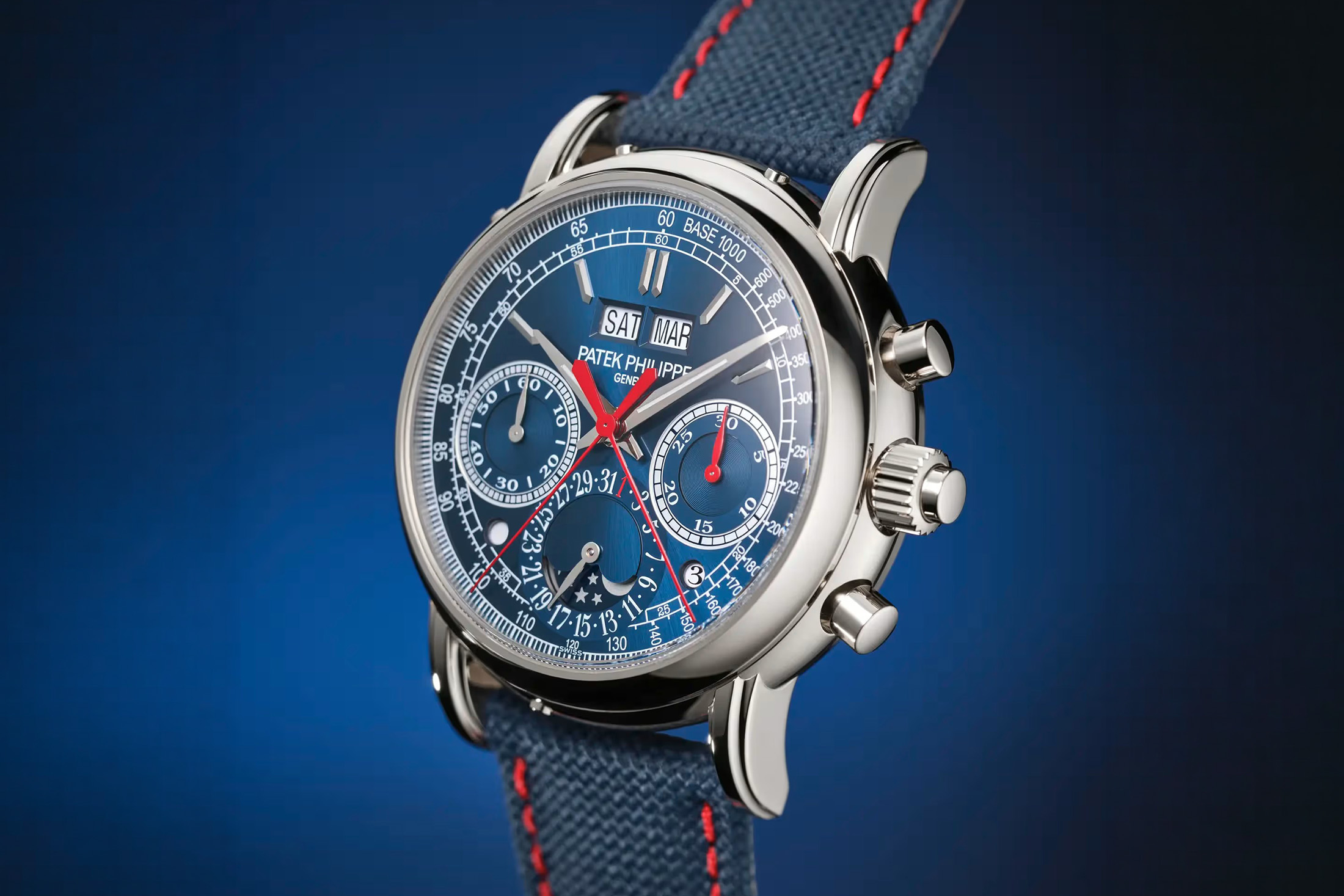
While the ref. 7047G was not seen in person by everyone, it raised eyebrows for its unusual blue tire tread-style dial layout—reminiscent of the ref. 6007G—alongside remarkably strong orange accents, luminous hands, and dial markers placed on a minute repeater retailing north of $570,000. It was perhaps so aesthetically surprising that it distracted observers from the fact that Patek was honoring its past with a Calatrava-cased minute repeater echoing unique historical pieces like the ref. 3652 and ref. 541. The same goes for the new white gold ref. 5204, featuring a blue soleil dial and red accents. Equipped now with a tachymeter scale, it immediately evokes several legendary ref. 5004 models and the first- and second-series ref. 2499s.

It is the introduction of vibrant colors, paired with a distinct blend of contemporary choices and vintage references, that suggests these releases were not merely designed to please traditional collectors who understand those historical callbacks. Instead, they appear aimed at finding ways to reach younger potential buyers and bring them into the fold so they might come to appreciate that rich heritage. Reading the tea leaves here does not involve sitting around with Patek’s President Thierry Stern kicking brand strategy back and forth, but based on hands-on experience with the new watches, clear thoughts emerge regarding what Patek is attempting to achieve and why. While the Cubitus remains temporarily waiting in the wings, attention turns directly to the stars.
The Patek Philippe Celestial Ref. 6105G – The Dial Side
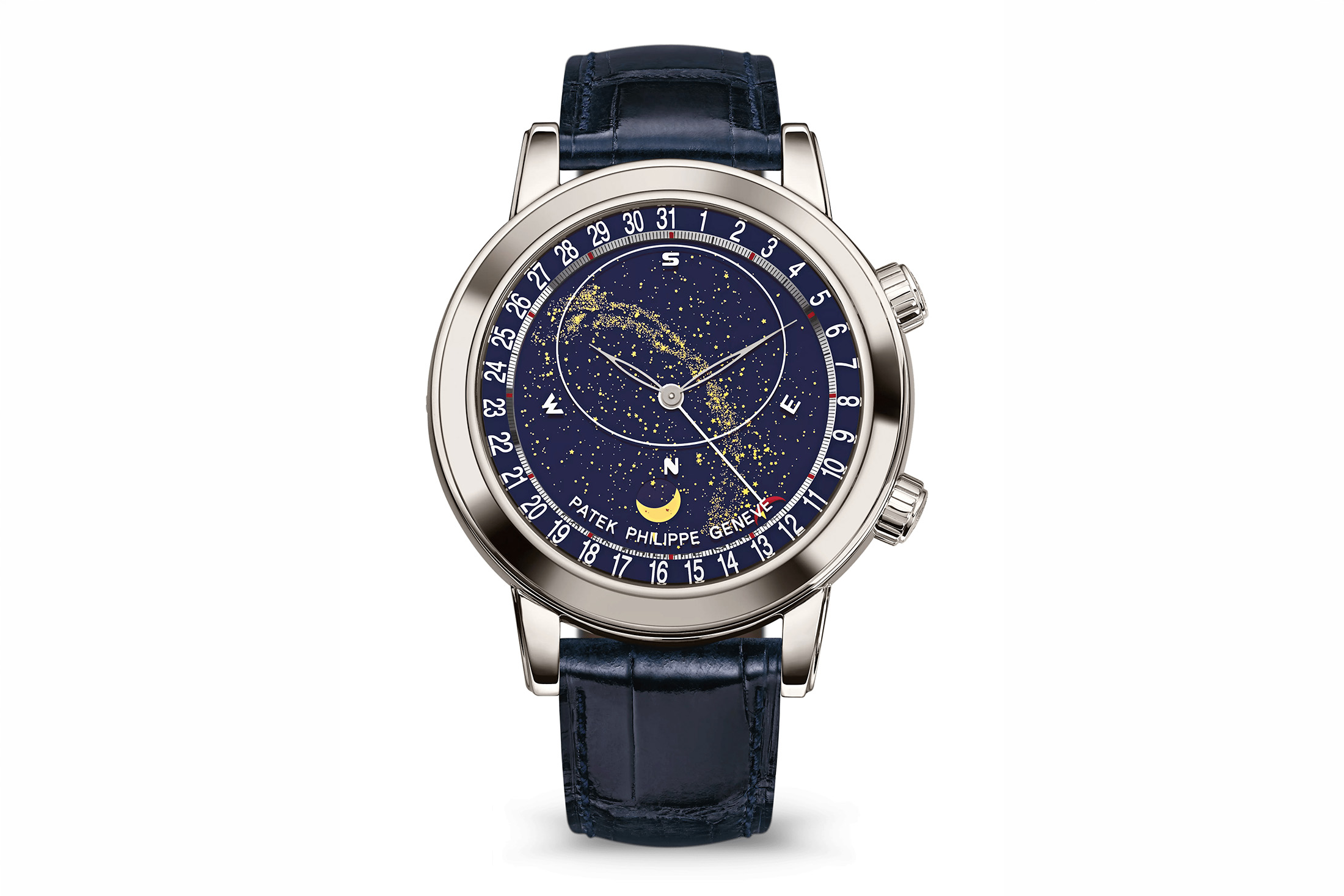
In the rush to cover the anniversary Nautilus release, the Celestial ref. 6105G fell slightly to the bottom of priorities during a late-night writing session at a Genevan press hotel during Watches & Wonders. Still, its presence lingered. The watch resembles a flying saucer and functions as a literal night sky, serving as a spiritual successor to the discontinued ref. 6102 and the current ref. 6104, yet featuring a rubber strap. Specifically, this is not an Aquanaut-style rubber strap, but rather a lugless, integrated bracelet version. Beyond its surprising visual identity, it incorporates a sunrise and sunset display—a complication executed only in rare instances within historic Patek pocket watches, never before in a wristwatch from the brand, and achieved by only a handful of wristwatches ever made.
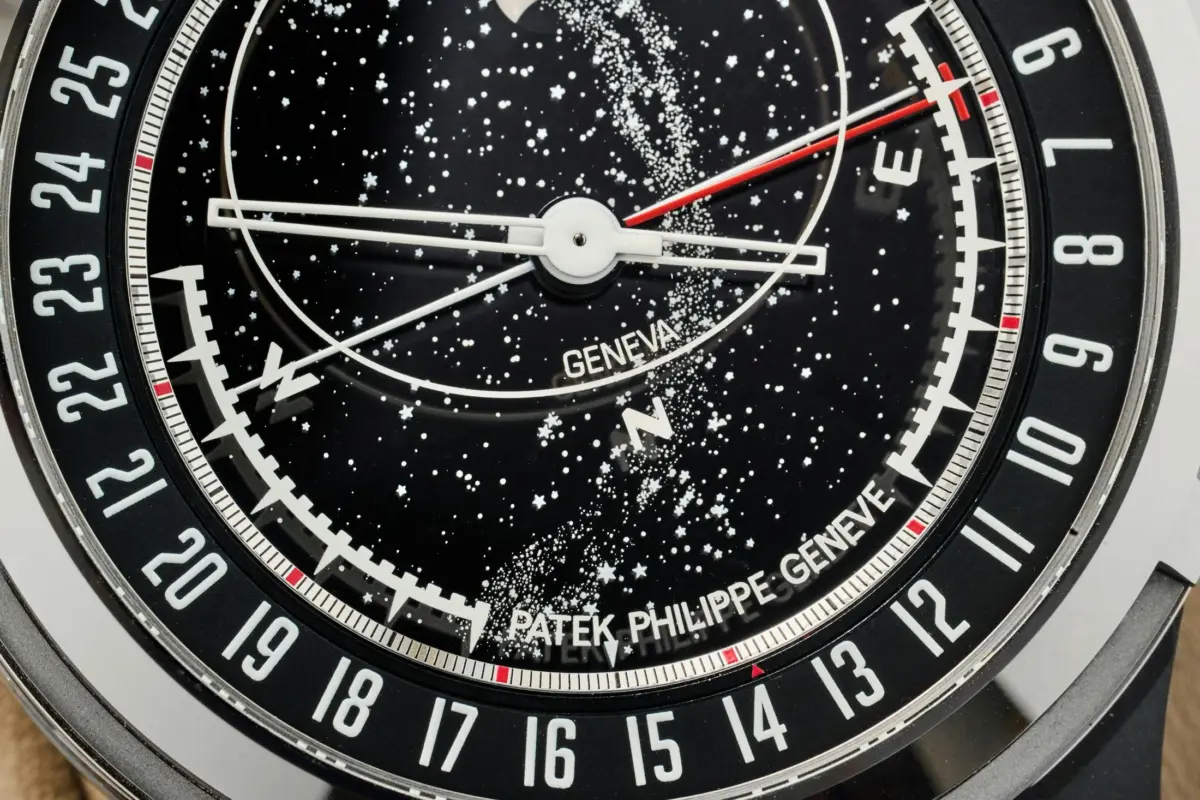
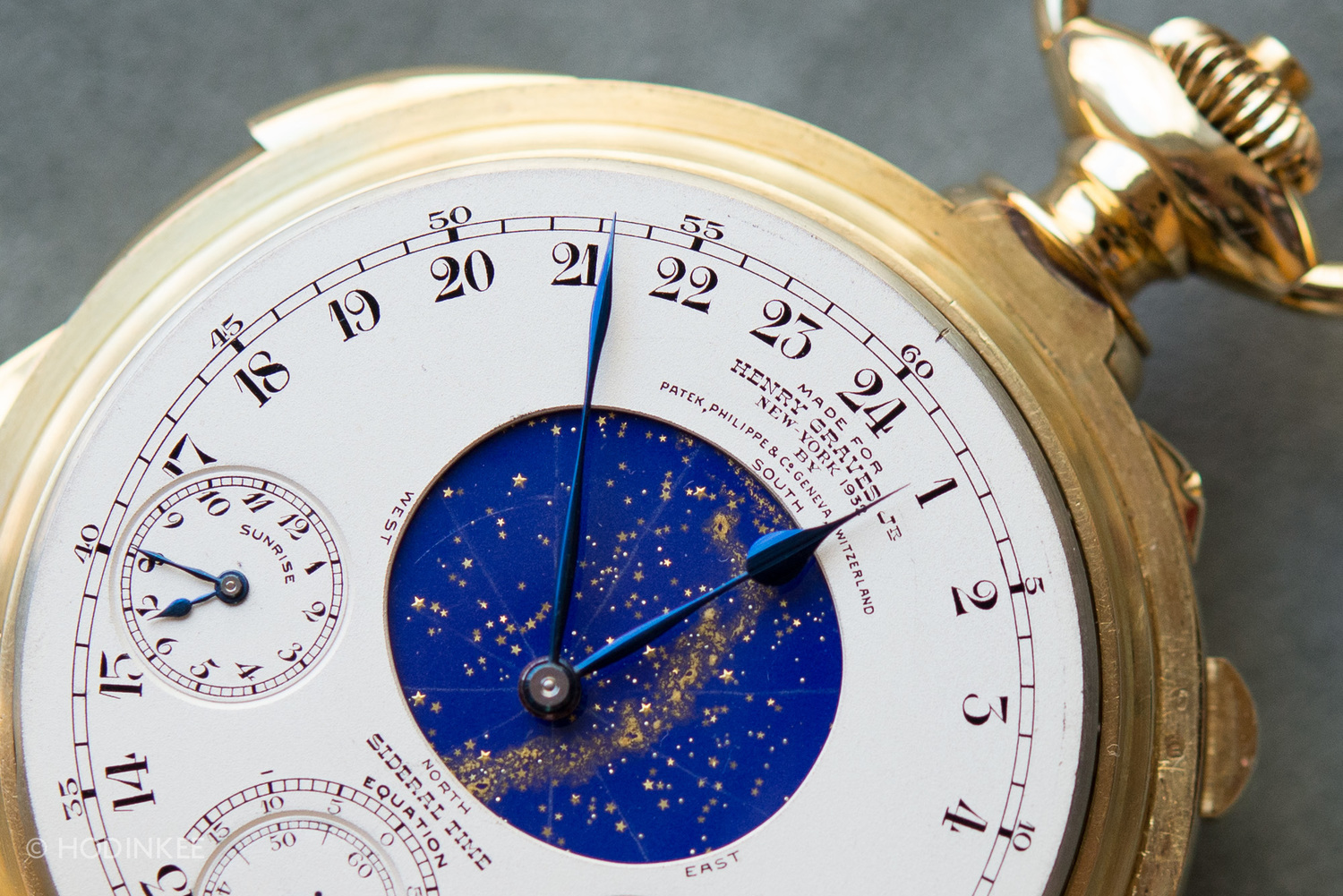
In fact, its lineage traces directly to the 1933 Henry Graves Supercomplication (the first Patek watch featuring sunrise and sunset indications), the Caliber 89, and the Star Caliber 2000 models. This grounds the watch firmly in historic high watchmaking heritage, even if its modern aesthetic masks that pedigree at first glance. Compared to current Celestial offerings, the dial architecture is quite similar, featuring a clear sapphire crystal and white transfer-printed stars over a dark, smoked sapphire background layer that depicts a view of the night sky in the Northern Hemisphere. This view is specifically calibrated for Geneva and all cities sharing the same latitude. For collectors living in regions matching that parallel—such as Milan, Portland, Oregon, New York, or parts of Ontario—the watch offers direct astronomical relevance.
There is a tremendous amount happening across the dial, yet it remains surprisingly accessible after a brief explanation. Larger, skeletonized hands indicate the hours and minutes, while two long, slender hands reach out toward the sunrise and sunset track positioned at the edge of the celestial disc. At the top, transfer-printed beneath the protective crystal, a circle highlighting the celestial vault sits on another sapphire disc that remains stationary while the sky beneath it rotates in synchronization with sidereal time. Unlike historical pocket watches that obscure portions of the sky, this design displays everything for maximum visual impact. The dark sky itself serves as the moonphase disc, rotating with lunar time, while a final T-shaped red hand points to the peripheral date scale.
The peripheral date accomplishes more than just tracking days. Looking closely at the spiked scale for the sunrise and sunset complication reveals how the respective times are read. By avoiding the placement of the 1st of the month at the top, the sunrise and sunset indications now align directly with correct hour markers where the dates act as a 24-hour scale—matching the 4th through the 10th to 4:00 through 10:00, and the 16th through the 22nd to 16:00 through 22:00. That display is also symmetrical across the horizontal axis of the watch. A small red triangle circles the dial to indicate the annual index, which requires consulting Patek’s documentation for initial setup.
On a properly set model, the time might read 3:49 on the 6th of the month, with sunrise occurring at approximately 5:50 AM and sunset at 9:23 PM as shown on the dial. The annual index triangle sits near the 6 o’clock red indication, showing sunrise and sunset data for June 6, matching the displayed times.
Patek’s instructions for setting the watch are thorough and intricate. The crown at 2 o’clock sets the annual index, moon phase, and sky chart, while the lower crown controls standard timekeeping. Correctors positioned on the 9 o’clock flank handle winter and summer daylight saving transitions and adjust the date for the five short months of the year.
Despite its complexity, the watch feels exceptionally three-dimensional and dynamic compared to the ref. 6102 and 6104. While the sapphire crystal construction is similar—meaning tilting the watch at various angles creates natural depth and reflections—the unusual white gold case architecture, particularly the bezel design, amplifies that optical depth. Measuring 12.39mm in thickness, it houses a tremendous amount of mechanical ingenuity beneath the surface.
The Caliber 240 C LU CL LCSO – A Technical Deep Dive
Normally, a technical discussion would feature a photograph of the movement to examine its finishing and construction. However, that is not possible with the ref. 6105G. The automatic movement is concealed behind an unusually constructed solid caseback featuring a webbing-like structure reminiscent of acoustic resonance designs meant to keep resonating watch structures off the wrist. In the case of the 6105G, this design serves to remove heavy white gold from the large case to reduce overall weight while echoing the sporty aesthetic found along the case flanks.
Drawing from Patek’s technical documentation and product videos, the scale of the achievement becomes clear. The watch features a 47mm case, its caliber required more than five years of development, and it carries six pending patents. One of those patents, filed in 2019 and granted in 2022, reached commercial production seven years after initial filing.

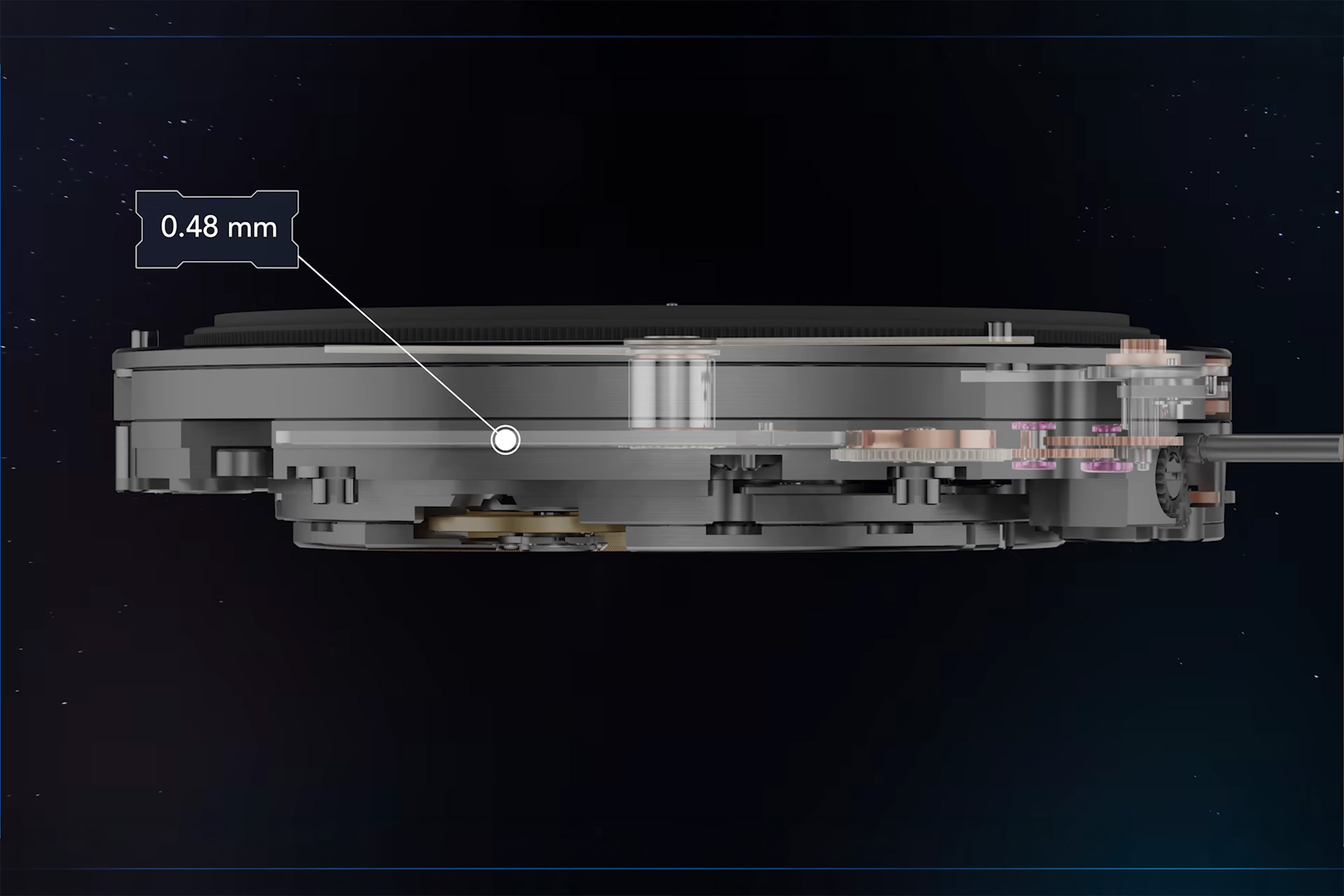
The movement measures a reasonable 7.93mm in thickness, incorporating 121 additional components for the new complication while requiring only 1.12mm of vertical space. The base movement itself is relatively compact, and watches like the ref. 6104 measure 44mm. The overall size increase stems primarily from the lateral space required for the complex sunrise and sunset mechanism. Utilizing a compliant mechanism that stays under tension, the internal components flex and deform reliably to translate power into astronomical calculations.
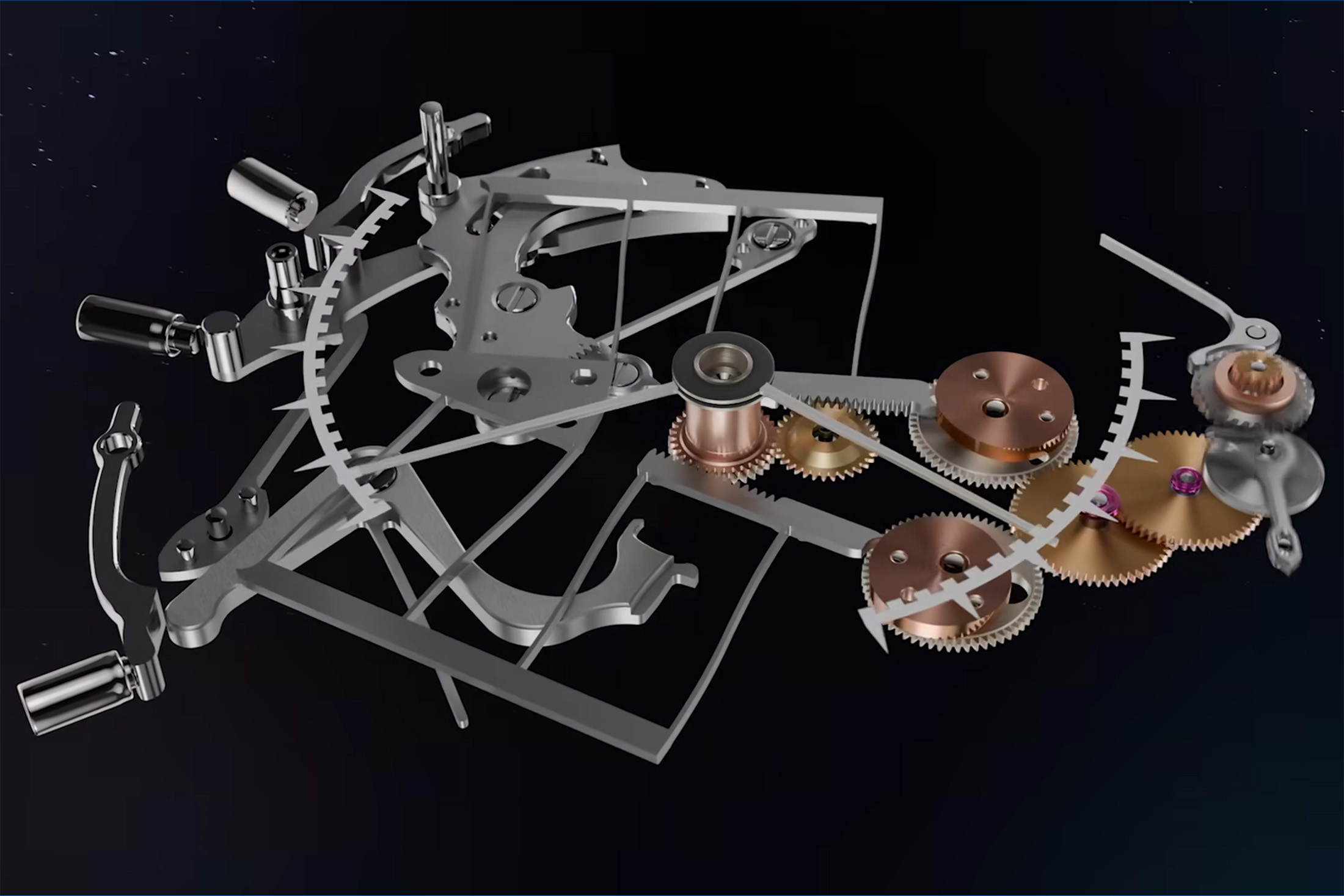
Nearly every traditional execution of this complication relies on a cam-and-lever system. Here, power is transmitted from the gear train to the sunrise and sunset mechanism through a patented eccentric finger piece that slowly drives the annual index. Simultaneously, a step-down system translates power to two gears capped by program cams. The top cam governs sunrise while the bottom cam governs sunset, with both featuring 365.25 steps representing days in the solar cycle.

The novel aspect of this architecture lies in its flexible spring and compliant component system. Designed to move slowly over the course of the year, the blade spring features two sets of four parallel spring arms. Each set connects to an anchor point and a movable arm linked to a geared feeler. This compliant spring system requires significant lateral workspace, which explains the wider case dimensions while keeping overall thickness tightly controlled.
The system operates under constant tension, forcing feeler tips into constant contact with the program cams. As the gear train rotates the cams, the feelers move forward and backward across the yearly cycle. The sunset feeler rides along a gear attached directly to the center post tube driving the sunset hand, while the sunrise feeler utilizes an intermediary gear to accommodate a vertical offset drop-down.
Despite the high component count, the system remains remarkably streamlined. Built as a module atop the existing Caliber 240 LU CL C, the movement features Patek Philippe Seal standards, a Gyromax balance, and a Spiromax balance spring. Simplicity in execution ensures long-term reliability while avoiding unnecessary mechanical theater.
Wearability and Modern Strategy
Horology is ultimately about the physical wearing experience. Measuring 47mm by 12.39mm, the ref. 6105G represents the closest modern equivalent to a historical disco volante chronograph, though without traditional lugs.
It stands as one of the most wearable oversized watches in recent memory, aided by a lightened, sandblasted white gold case that leaves internal volume for the sunrise and sunset module. Paired with a rubber strap utilizing an Aquanaut-style deployant clasp, the lugless profile wears similarly to standard chronographs on a 7.25-inch wrist due to the immediate downward drop from the case edge to the strap.
One consideration for daily ownership is the 48-hour power reserve. Based on the original 240 microrotor caliber introduced in 1977, with the base 240 LU CL emerging in 2002, the movement lineage emphasizes reliability and adaptability, though owners of complicated displays may require a watch winder to maintain precise settings.

For traditional collectors, the form factor represents a major departure from classic dress watch conventions. Yet that appears to be the precise objective. The visual identity shares a bold, futuristic presence with avant-garde sports watches like the Richard Mille RM032, targeting a new generation of collectors who appreciate extreme horological engineering paired with commanding wrist presence.
The question of what this watch signals for Patek Philippe points toward a broader market transition. Patek is rapidly adapting to a younger, bolder clientele whose collecting journey does not always begin with a strict adherence to mid-century heritage, yet who seek the ultimate pinnacle of traditional finishing without the overt flash of competitor sports models.

For years, senior industry observers noted that Patek Philippe’s greatest competition was its own historic catalog. While vintage references like the ref. 3970 and ref. 3940 remain legendary, Patek cannot compete directly with its secondary market legacy. By pushing boundaries in design, scale, and mechanical complication, the brand continues to chart a new path forward—proving that even a conservative institution can reinvent classic watchmaking for a modern era.