




Autumn in London brings a distinct shift in the city’s artistic rhythm, drawing galleries and curators toward exhibitions that invite introspection as the days shorten and the weather turns. Among the season’s most compelling presentations is “Bound,” an evocative group exhibition hosted by Secteur Privé within the intimate confines of a Grade II-listed Georgian townhouse located at 35 Portland Place in Marylebone.
Bringing together the distinct artistic practices of Sonia Navarro, Soojin Choi, and Maliha Abidi—alongside the architectural presence of Mark Brazier-Jones’s permanent metalwork—the exhibition centers on a fundamental human question: how do separate entities, whether threads, bodies, or lives, become bound together? Across wool, clay, and paint, the participating artists investigate the physics and emotion of connection. Thread gathers into heavy cloth, an arm curves defensively or lovingly around a shoulder, and a dark braid stretches from one woman to the next until a group coalesces into a single, unified figure.
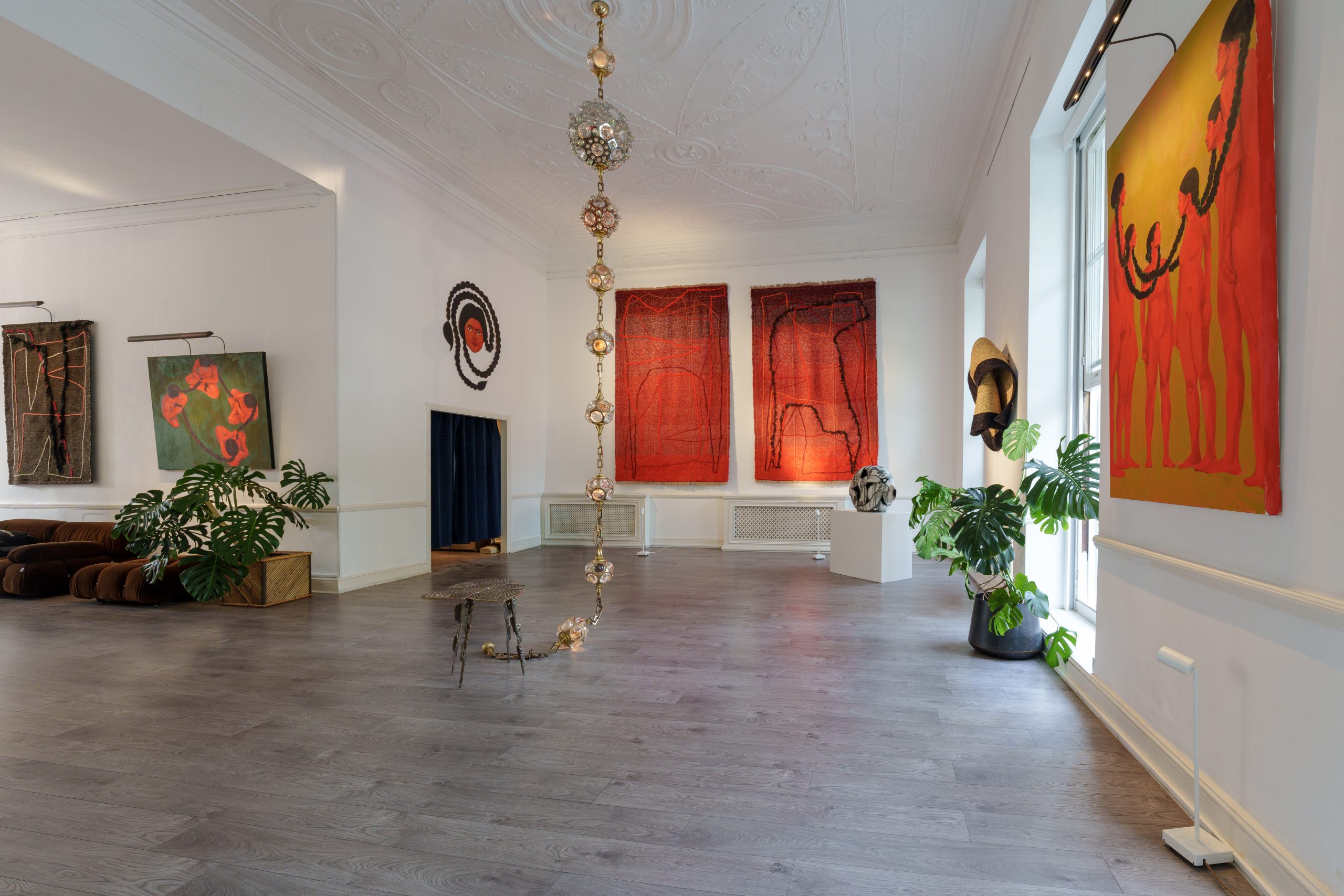
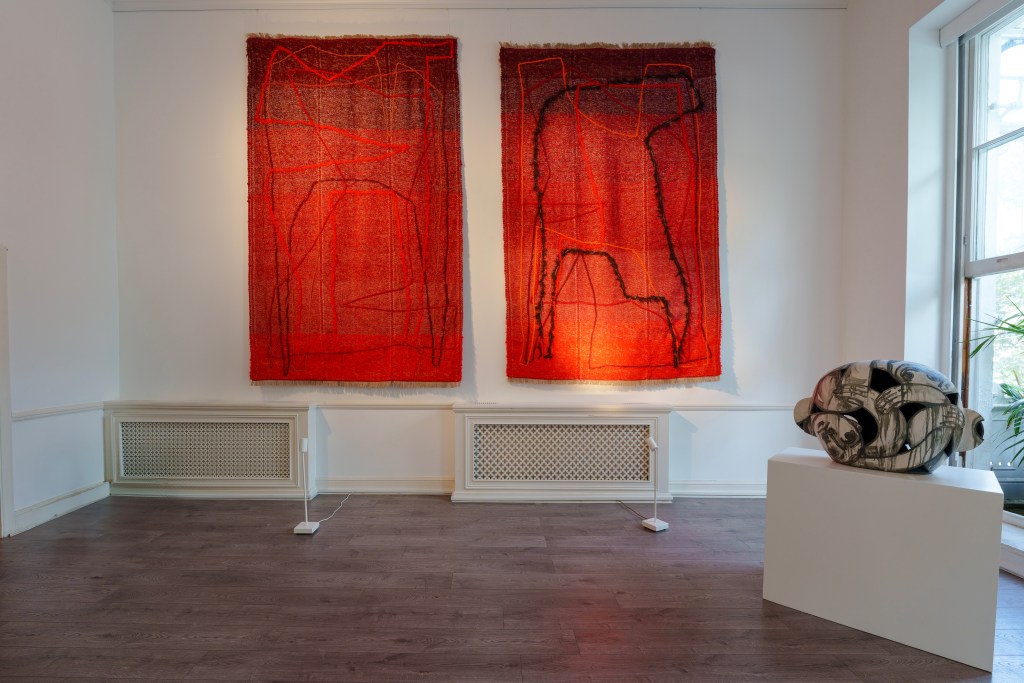
The domestic scale of the gallery’s single exhibition room amplifies these conceptual explorations. Monumental textiles rest against the historic walls like integrated layers of architecture, while ceramic figures occupy the floor space, sharing the immediate environment with the viewer. Overhead, Mark Brazier-Jones’s intricate chandeliers—crafted from interlocking metal links that have long inhabited the historic townhouse—suspend a chain of their own, carrying the overarching theme of interconnectedness into the vertical air of the room.
Sonia Navarro: Drawing with Thread
Sonia Navarro’s contributions command the physical space through sheer scale, demanding that viewers first observe them from a distance before drawing close to examine their intricate surfaces. In Piel y memoria I y II (Skin and Memory 1 and 2), two monumental wall hangings measuring three meters by two meters, the woven ground undergoes a subtle chromatic transformation. A pale, dusky violet at the upper edge bleeds down into a deep, saturated red, evoking the flush of human skin or the dying light of a hot summer evening.
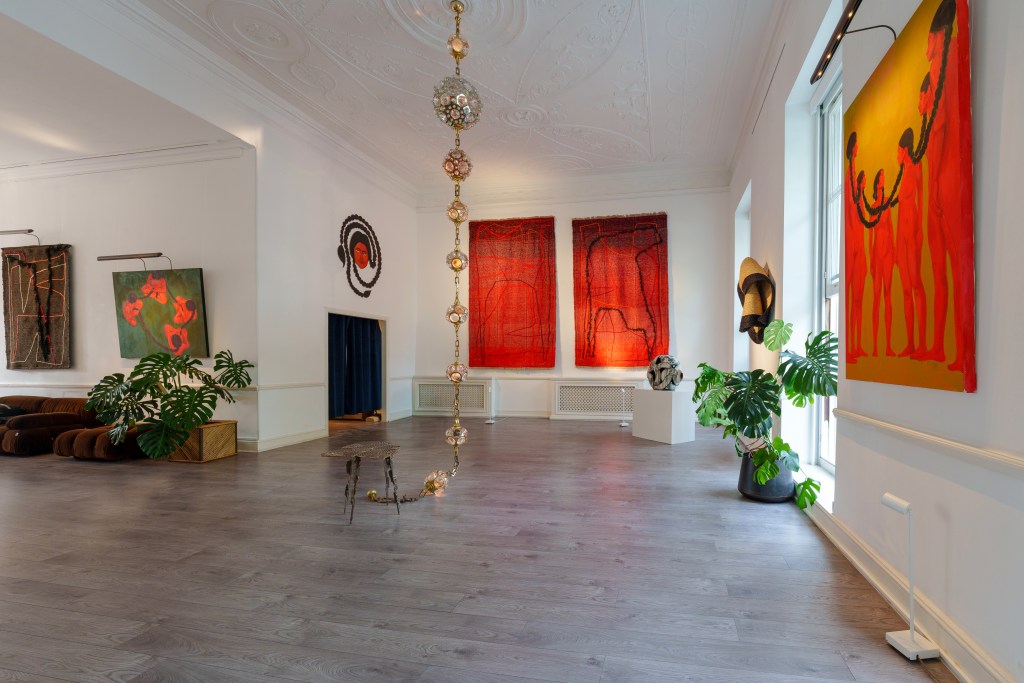
Across this expansive backdrop, loose cotton stitching traces wandering outlines in shades of orange, scarlet, and black. These linear configurations hint at domestic architecture—doorframes, chairs, room dividers, and the skeletal blueprints of a home—yet they deliberately resist resolving into a definitive diagram. In one hanging, a dark, furred line evokes the quiet tension of a held breath. Operating as a pair of mirrored memories, the two works feature recurring shapes that shift and rearrange, capturing the way a familiar domestic space is recalled differently over time by an evolving recollection.
In Resguardarse del Sol en Granada 1 (Finding shelter from the sun in Granada), Navarro shifts her color palette toward the hues of burnt earth. The coarsely woven rust-brown field provides a foundation for a cage-like structure of black and white lines, accompanied by a shaggy blue thread that tracks along one margin like an exposed vein. It stands as the exhibition’s most direct meditation on shelter: a rustic, elemental outline of a room rendered with the raw simplicity of a child’s drawing of home.
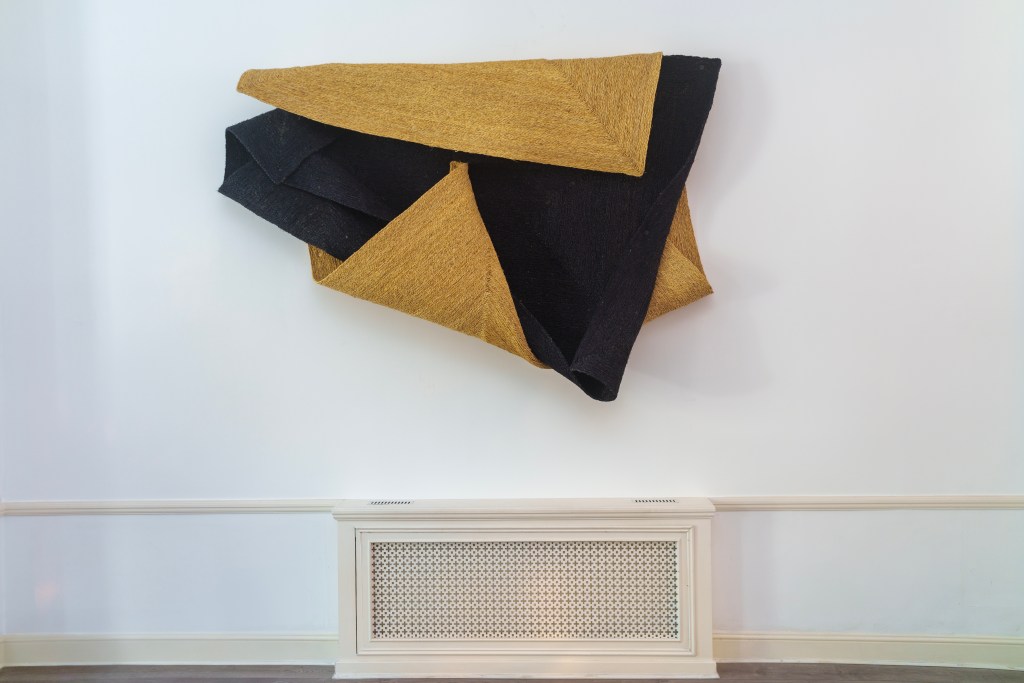
Navarro further expands her material vocabulary in Spartaria (Sparta), shifting away from the flat wall plane into three-dimensional sculpture. Utilizing braided and sewn esparto grass—an unpretentious fiber rooted in the traditions of Spanish rural labor—the work drapes over a dark mass like a protective sheet thrown across furniture. Striking a balance between pale gold stiffness and soft pliability, the piece functions as a rope transformed into a cloak. By engaging with these crafts, which she learned from her grandmothers, Navarro treats humble materials with the reverence of a monument while maintaining the casual familiarity of household laundry. An additional sculpture in red esparto grass remains in progress, anticipated to join the ongoing installation group.
Soojin Choi: The Weight of an Embrace
While Navarro’s textiles focus on architectural structures and spatial memory, Soojin Choi’s sculptural works turn inward to examine the human bodies that inhabit those spaces. Comprising three stoneware sculptures, Choi’s portfolio is densely packed with limbs, torsos, and facial features that appear to organically sprout from one another. The surfaces are treated with slip and underglaze applied with the unrestrained freedom of a painter, deliberately leaving visible drips to record the physical intervention of the artist’s hand alongside the pull of gravity.
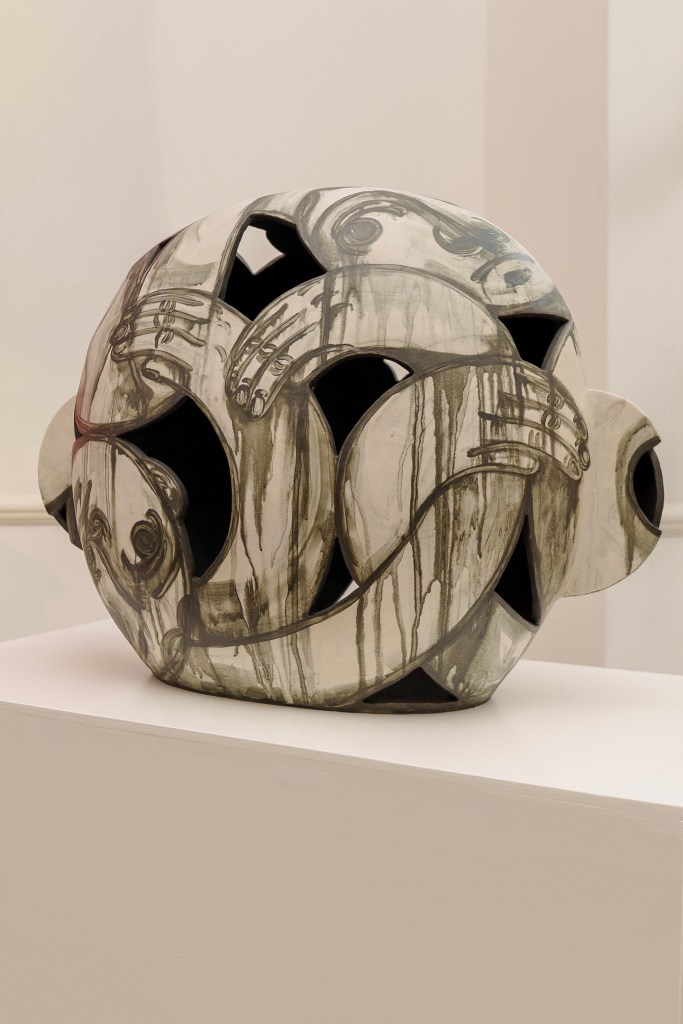
Rekindling serves as the most compact of the trio—a rounded, helmet-like form whose contrasting black-and-white surface teems with curled figures, hands, and watchful eyes. It presents the impression of an entire family compressed into a single vessel, with deliberate openings cut through the ceramic skin to reveal the darkness resting between the intertwined bodies.
By contrast, As It Was (2023) offers a warmer, deeply intimate configuration. Mounted directly on the wall, this sculpture forms a knot of figures rendered in fired oranges and moody blue-grey shadows, depicting one head tucked securely beneath another’s arm. The piece functions as a visual study in human dependence, blurring the boundaries where mutual support ends and emotional burden begins.
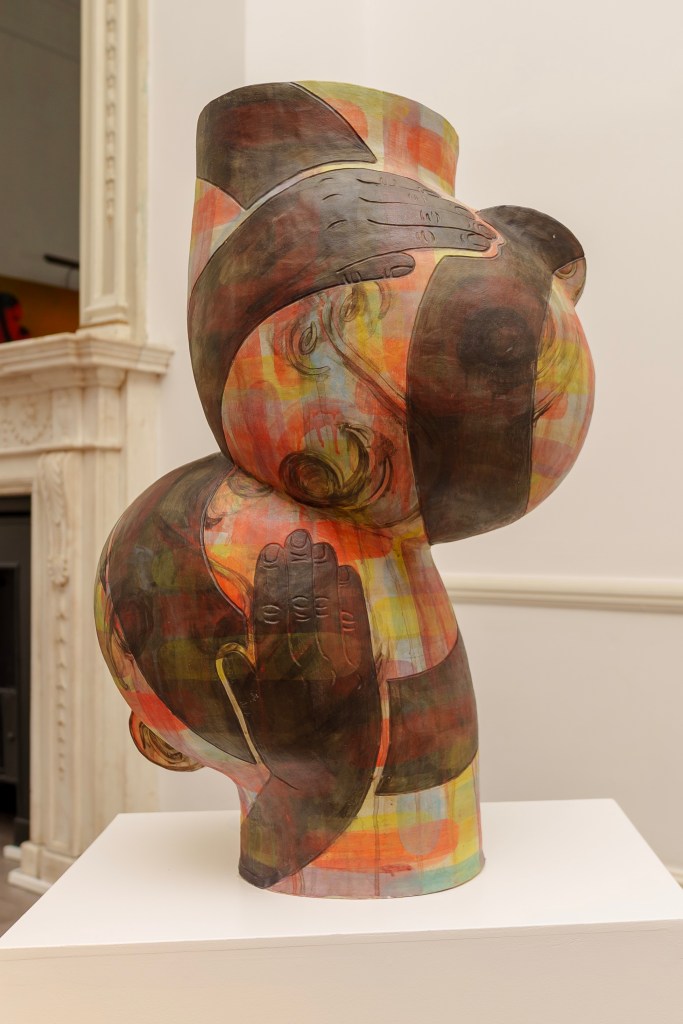
Standing as the tallest of Choi’s works, You Never Knew presents a vertical column of tangled figures rendered in smoky black over subtle underlayers of orange, yellow, and blue. Its upward stack of embraces imparts a totem-like quality, anchored emotionally by meticulously sculpted hands that grip and cradle. As these figures hold fast to one another, the exhibition leaves the viewer to ponder a lingering ambiguity: are they rescuing each other from isolation, or are they mutually entrapping one another in an unbreakable bond?
Maliha Abidi: Braids as Lifelines
Maliha Abidi introduces vibrant color narratives and immersive installations to the Marylebone townhouse, utilizing the recurring motif of the braid as a central thematic device. Rendered as a long, dark rope, the braid loops, connects, and encircles the figures within her paintings and sculptural constructions.
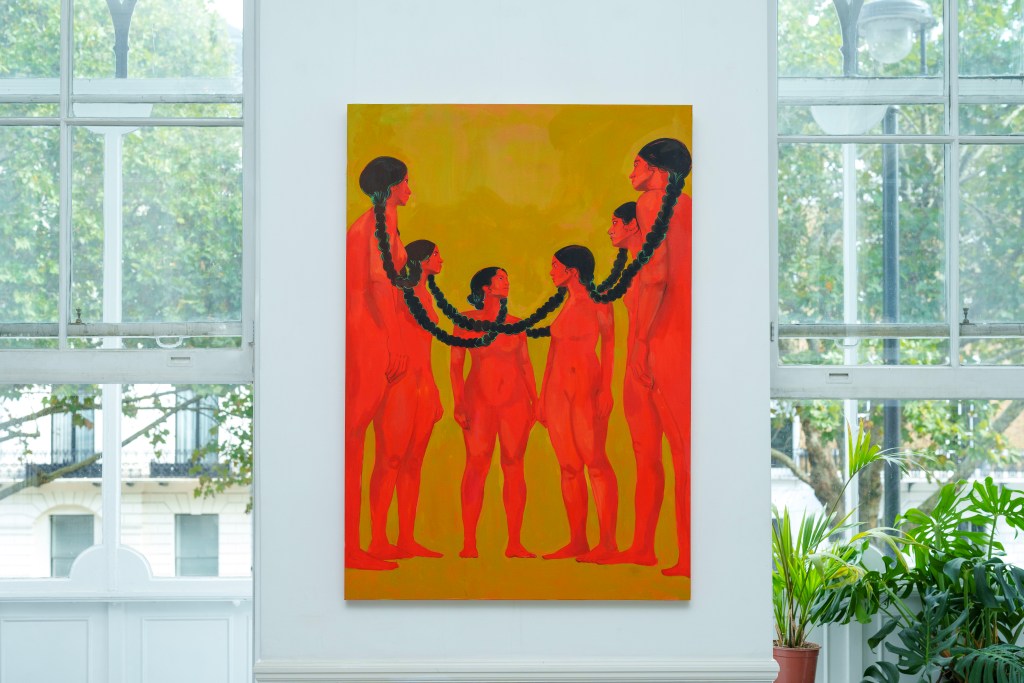
In With Us, six barefoot women stand against a warm mustard-gold background, their bodies illuminated in a striking vermilion. Their hair is braided to impossible lengths, extending beyond their physical forms in sweeping, low-hanging arcs from one figure to the next until the entire assembly is united by a single dark garland edged with teal accents. While some women engage with each other’s gazes, others look outward past the picture plane, and the outermost figures gently curve the garland into a shallow bowl that appears to cradle the viewer as well.
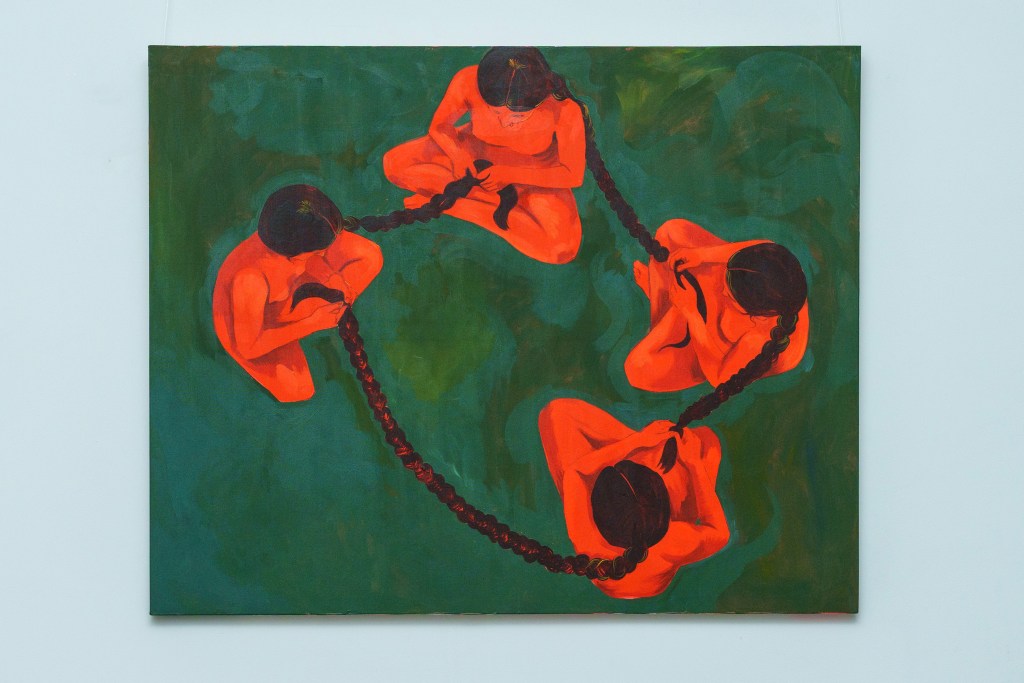
Ties offers an elevated perspective, looking down upon four women seated cross-legged on a deep forest-green field, each wholly absorbed in the domestic ritual of tending to her neighbor’s hair. Their extended plaits sprawl across the canvas surface, merging into a loose, circular loop that revolves around an empty green center, much like water circulating around a stationary stone. By framing an everyday grooming practice as a formal diagram of kinship, Abidi draws direct inspiration from the childhood afternoons spent with her aunts and grandmother, marking the emotional genesis of the series.
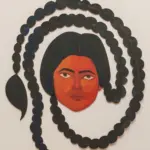
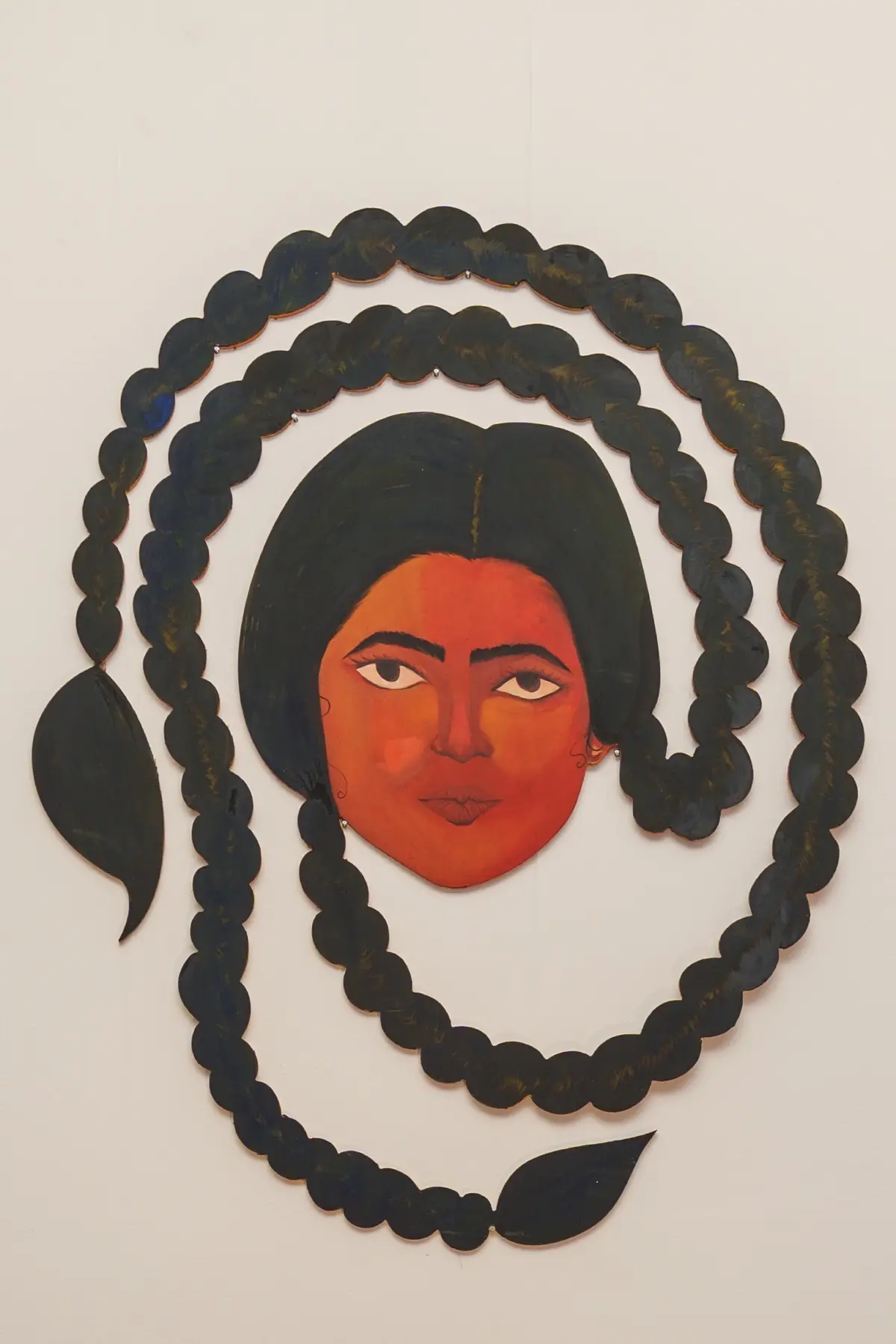
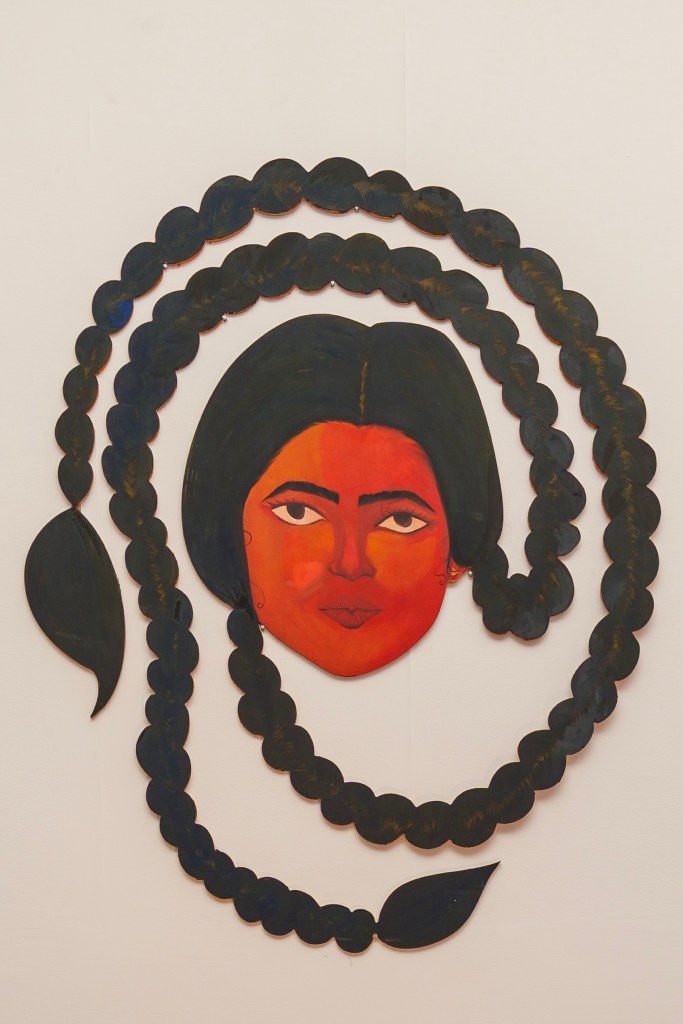
The exhibition also features Untitled, a cutout mixed-media work combining plywood and oil paint. At its center, a calm orange face is framed by two enormous black braids that spiral outward in concentric rings. Each plait features a scalloped edge terminating in a leaf-shaped tip, while the painted figure’s direct gaze meets the viewer from the heart of the spiral, functioning simultaneously as a mandala, a portrait, and a length of woven rope.
Another tender composition, Untitled Log, portrays two red-skinned women facing one another with clasped hands. Their dynamic braids swing outward and loop together as they maintain their balance atop a wooden box against a pale pink backdrop patterned with soft clouds, capturing sisterhood as an act of shared equilibrium rooted in mutual trust.
The most ambitious spatial intervention by Abidi is Island, an interactive installation incorporating both sound and scent elements. Encased in a tall, hexagonal red structure, the piece features a standing female figure on each exterior panel, linked continuously by a braid that wraps around the entire architectural surface. The interior, accessed through curtains of hair and woven braids, invites the viewer to step physically inside the artwork. By integrating auditory and olfactory dimensions, the installation transcends visual representation, allowing the audience to physically inhabit the concept of connection rather than merely observe it.
Common Threads
When viewed collectively, the disparate bodies of work by Navarro, Choi, and Abidi explore the theme of connection through three distinct lenses. Navarro locates human linkage within manual labor and the domestic memory preserved in stitched textiles; Choi examines the physical and emotional weight two people bear when sustaining one another; and Abidi honors the generational rituals of care passed down among women until the braid itself transforms into a visual family tree.
Despite utilizing vastly divergent materials—ranging from esparto grass and stoneware to oil paint and cotton thread—each artist positions the tie itself as the primary subject of inquiry. Visitors standing within the single-room gallery space at 35 Portland Place could trace an uninterrupted line of connection moving fluidly from a stitched wall hanging to a ceramic embrace, and onward to a painted plait of hair, departing with the lingering sensation of having traversed the length of a single, continuous bond.
"Bound" at Secteur Privé officially closed on November 4. Further information regarding future viewings and gallery appointments can be accessed through the official Secteur Privé website.